10 Pro Strategies

How to Win a Trading Competition

Proven strategies and tactics from successful tournament traders who consistently finish in the top 3. Learn risk management, position sizing, timing, and the common mistakes that eliminate most competitors.

Join Free Tournament

Trading competitions are not the same as regular trading. In a tournament, you're not just trying to be profitable — you're trying tooutperform hundreds of other traderswithin a fixed time window. This changes the optimal approach significantly.After analyzing results from over 50,000 tournament participants at ForTraders, we've identified the strategies and patterns that separate winners from the rest. Here are the 10 most impactful strategies for winning trading competitions.

1. Master Risk Management Before Anything Else

The #1 reason traders get eliminated from competitions ishitting the 10% maximum drawdown limit. It doesn't matter how good your entries are if one bad trade wipes you out of the tournament.Winning traders typically risk1-3% of their account per trade. This means on a $100,000 tournament account, your maximum loss per trade should be $1,000-$3,000. This gives you room for 3-5 losing trades before you're in danger of elimination.

2. Focus on 2-3 Instruments You Know Well

With 50+ instruments available in ForTraders tournaments, it's tempting to jump between markets chasing opportunities.Resist this urge.Top tournament finishers consistently trade a small number of instruments they understand deeply. Knowing how EUR/USD reacts to NFP data, how Gold moves during risk-off events, or how BTC/USD behaves on weekends gives you an edge that spreads across many markets can't match.

  • For forex tournaments: Focus on 2-3 major pairs (EUR/USD, GBP/USD, USD/JPY are the most liquid)
  • For crypto tournaments: BTC/USD and ETH/USD should be your core, with one altcoin for opportunistic trades
  • For monthly multi-asset: Pick your strongest asset class and add one instrument from another class for diversification

3. Trade During Peak Volatility Sessions

Not all hours are created equal. The best trading opportunities cluster around specific market sessions and overlaps:

  • London/New York overlap (13:00-17:00 UTC) the highest-volume period for forex. This is when major moves happen in EUR/USD, GBP/USD, and Gold.
  • London open (08:00-10:00 UTC) European session start often triggers breakouts of Asian range setups.
  • Major economic releases NFP, CPI, central bank decisions create the volatility needed for tournament-winning moves.
  • For crypto: Volatility is more evenly distributed, but US market hours (14:00-21:00 UTC) tend to see the most volume.

In a 24-hour tournament like Wednesday Clash,timing is everything. Concentrate your trades during the London/New York overlap rather than trying to trade all 24 hours.

4. Use Favorable Risk-Reward Ratios (Minimum 1:2)

In tournament trading, aminimum 1:2 risk-reward ratioshould be your baseline. This means for every $1 you risk, you target at least $2 in profit. With this ratio, you can win just 40% of your trades and still be profitable.Many tournament winners actually use1:3 or higherratios. Fewer trades, but bigger winners. In a competition where you need to outperform others, one trade with a 1:5 risk-reward that hits is worth more than five trades with 1:1 ratios.

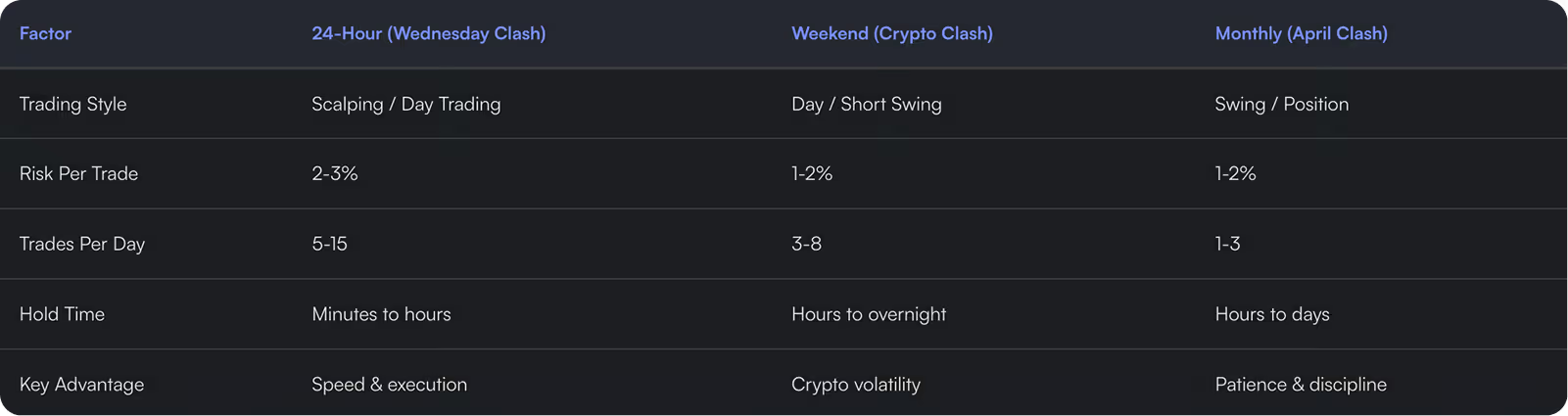
5. Adapt Your Strategy to Tournament Duration

6. Don't Chase the Leaderboard

One of the biggest mistakes in trading competitions ischecking the leaderboard too oftenand adjusting your strategy based on others' performance. This leads to:

  • Increasing position sizes to "catch up" which increases drawdown risk
  • Taking trades outside your strategy because you feel pressured
  • Abandoning a working plan because someone else is ahead

The best approach:Trade your plan as if you're the only person in the competition. Check the leaderboard once per day at most. In monthly tournaments, many top-3 finishers don't take the lead until the final week.

7. Manage Your Trading Psychology

Competition pressure amplifies every psychological trap in trading. Revenge trading after a loss, overconfidence after a win, fear of missing out on a big move — these emotions are magnified when you know others are watching the leaderboard.Practical tips for managing tournament psychology:

  • Set daily loss limits: if you lose 3% in a day, stop trading. Come back tomorrow with a clear head.
  • Take breaks between trades: a 15-minute break after each trade prevents impulsive follow-up trades.
  • Journal your trades: write down your reasoning before entering. This forces discipline.
  • Remember it's virtual capital: the risk-free nature of tournaments should reduce anxiety, not increase it.

8. Use the Economic Calendar

Major economic events create the volatility that tournament winners exploit. Before each trading session, check which events are scheduled:

  • High-impact events (NFP, CPI, central bank rate decisions): these move markets 50-200 pips in forex and 3-10% in crypto. Position yourself before or trade the reaction.
  • Medium-impact events (PMI, retail sales, employment): useful for intraday moves, especially in 24-hour tournaments.
  • Avoid trading during low-liquidity periods: Asian session for forex (unless trading JPY pairs) or early Monday/late Friday for any instrument.

9. Protect Your Drawdown Like Your Life Depends On It

In a trading competition,survival is the prerequisite for winning. You cannot win if you're eliminated. The 10% drawdown limit is not just a rule — it's your lifeline.Create a personal drawdown schedule:

  • 0-3% drawdown: Trade normally with your regular position sizing.
  • 3-5% drawdown: Reduce position size by 50%. Be more selective with setups.
  • 5-7% drawdown: Reduce to minimum position sizes. Only take A+ setups.
  • 7%+ drawdown: Consider pausing for 24 hours. You have very little room left before elimination.

This adaptive approach keeps you in the tournament when others get eliminated. In monthly competitions, many winners only start their serious run in week 2 or 3 — after the aggressive traders have blown out.

10. Start With Weekly Tournaments to Build Experience

If you're new to trading competitions, start with theWednesday Clash(24 hours) orWeekend Crypto Clash(72 hours) before jumping into monthly tournaments. Shorter tournaments give you:

  • Faster feedback loops: you see results in 24-72 hours instead of waiting a month
  • More practice opportunities: 4 weekly tournaments per month vs. 1 monthly
  • Lower psychological pressure: if one doesn't go well, the next one is just days away
  • Strategy testing ground: try different approaches each week to find what works for you

Once you're consistently finishing in the top 20% of weekly tournaments, you're ready to compete in the Monthly Clash with confidence.

Summary: The Tournament Winner's Mindset

Winning a trading competition isn't about luck or one heroic trade. It's aboutconsistent, disciplined executionof a sound strategy while others around you make emotional mistakes. The traders who survive the longest and compound small gains are the ones who end up on top.The best part? ForTraders tournaments are completely free, so you can practice these strategies risk-free every single week until you're ready to claim your prize.

Put These Strategies to the Test

Join a ForTraders trading tournament today and start applying these competition strategies with zero risk.

Welcome, US visitor!