

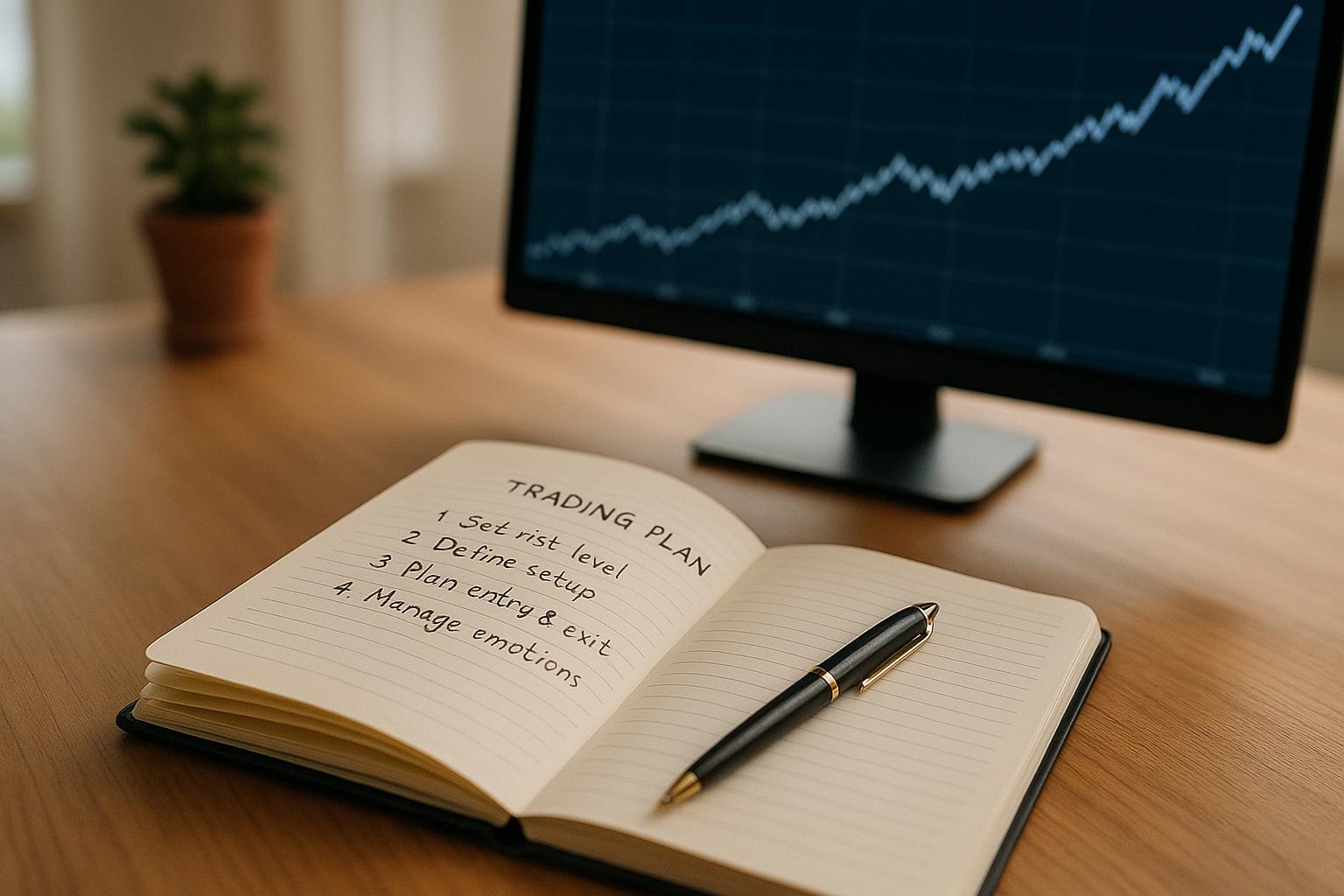
Funded trading challenges are a way to trade with virtual capital while earning real profits. But many traders fail because they lack preparation, discipline, or risk management. Here’s what you need to know to succeed:
- Have a Clear Plan: Define your trading strategy, including entry/exit rules, stop-loss levels, and daily trade limits.
- Manage Risk Wisely: Limit risk to 0.5%-1% per trade and track drawdowns to avoid disqualification.
- Control Emotions: Avoid revenge trading, overconfidence, and fear-driven decisions.
- Practice in Simulated Conditions: Test your strategy thoroughly in a demo account before the challenge.
- Set Realistic Goals: Break profit targets into smaller, achievable milestones.
- Track Performance: Use metrics like win rate and risk-to-reward ratio to refine your strategy.
Success requires consistency, discipline, and following your plan. Focus on quality trades, protect your capital, and adapt to market conditions to improve your chances.
14 Top Tips to Pass a Funded Trader Challenge and Stop Being in the 90% Who Fail
Common Mistakes That Lead to Failure
Failure often comes from avoidable missteps - diving into challenges unprepared or letting emotions cloud judgment. Spotting these issues early can make all the difference in achieving success. Here's a breakdown of some common pitfalls and how they can derail your efforts.
Trading Without a Clear Plan
Jumping into trading without a solid plan is a recipe for inconsistency. A trading plan is your roadmap, detailing everything from the markets you'll focus on to your entry and exit strategies, risk levels, and more.
Without a plan, decision-making becomes erratic. One day you might hold onto a losing trade, hoping it turns around, while the next day you might exit a profitable trade too soon out of fear. This randomness makes it nearly impossible to replicate success or pinpoint what’s working and what isn’t.
This lack of structure is especially problematic in funded challenges. Traders often leave positions open, hoping for a reversal, or close winning trades prematurely, driven by fear. Without a repeatable process, every trade feels like a gamble, and the odds are rarely in your favor.
To avoid this, your trading plan should answer specific questions like:
- What time of day will you trade?
- Which instruments (e.g., currency pairs, stocks, futures) will you focus on?
- What signals will trigger your entries and exits?
- Where will you set your stop-loss and profit targets?
- How many trades will you take per day?
Writing this all down removes guesswork and helps you stay focused, even when the market gets noisy. A detailed plan not only keeps you on track but also sets the stage for disciplined risk management.
Poor Risk Management
Risk management mistakes are one of the top reasons traders fail challenges. Many focus so much on profit targets that they overlook drawdown limits, which can disqualify them instantly. Just one oversized trade without a proper stop-loss can wipe out weeks of progress.
Some traders make the mistake of risking 5% or even 10% of their account on a single trade, hoping for quick profits. But this approach is risky - two consecutive losses at 10% risk would leave you down 20%, dangerously close to the maximum drawdown limits in most challenges.
Position sizing is another common issue. Many traders base their lot sizes solely on their account balance, ignoring how far their stop-loss is from their entry. This leads to inconsistent risk. For example, a tight stop-loss might risk only 1% of your account, while a wider stop on the next trade could risk 8%, even with the same position size. To maintain consistent risk, you need to calculate position size based on both your account balance and the stop-loss distance.
Ignoring daily and total drawdown limits is another costly mistake. For instance, a trader might be up $2,000 but lose $1,500 in a single day, violating the daily loss limit and failing the challenge. Others may slowly chip away at their account with small losses, eventually hitting the maximum drawdown threshold. Once you reach these limits, the challenge ends - there’s no second chance.
The pressure to hit profit targets often leads traders to abandon sound risk management. They might double their position size after a losing streak to recover losses faster or remove stop-losses to avoid being stopped out. Some even hold trades through major news events without adjusting their risk. These decisions prioritize short-term gains over long-term survival, but in funded challenges, survival must come first.
Emotional and Impulsive Decisions
Trading psychology often separates those who succeed from those who fail. The time limits and entry fees of funded challenges add emotional pressure, making every loss feel like a step further from your goal. This pressure often leads to emotional and impulsive decisions.
One of the biggest pitfalls is revenge trading. After a loss, the urge to recover quickly can be overwhelming. You might take the next setup you see, even if it doesn’t meet your criteria, or increase your position size to make back the loss faster. At this point, you’re not following your plan - you’re trading on emotion, which usually leads to even bigger losses.
Overconfidence is another issue. A few winning trades in a row can make you feel unstoppable, tempting you to take riskier trades or hold positions longer than planned. But when the market inevitably turns, this overconfidence can quickly spiral into a cycle of revenge trading.
Fear and greed also play major roles. Fear can cause you to exit winning trades too early, missing out on potential profits, or avoid taking valid setups because you’re worried about losing. Greed, on the other hand, might push you to move your stop-loss further away to avoid being stopped out, turning a small loss into a large one. It can also lead you to hold positions past your profit target, only to watch the market reverse and turn a win into a loss.
The time constraints of funded challenges amplify these emotions. With only 30 to 60 days to hit your profit target, desperation can set in as the days tick by. Traders may start forcing trades, taking low-probability setups, or trading during news events they’d normally avoid. This kind of desperation rarely ends well.
Managing these emotions requires self-awareness and a set of predefined rules. Before you start trading, decide how you’ll handle losing streaks - will you reduce your position size, take a break, or review your trades? Set a daily loss limit and commit to stopping for the day if you hit it, no matter how much time is left. Treat emotional control as seriously as you treat technical analysis, because staying disciplined is just as important as understanding the markets. Recognizing these emotional patterns can help you maintain the focus and discipline needed to succeed.
How to Prepare for Funded Challenges
Entering a funded challenge without proper preparation is a recipe for failure. It's not just about knowing the markets - you need a solid strategy, realistic goals, and practice that mimics the exact conditions of the challenge. With strict profit targets and drawdown limits, preparation can make all the difference in turning potential pitfalls into strengths.
Create and Test Your Trading Strategy
Your trading strategy needs to be more than just an idea you picked up from a video or tried out for a few days. It should be detailed, tested, and backed by data. Write down every aspect of your approach: your entry criteria (specific indicators, price patterns, or conditions), your exit rules (both for gains and losses), the markets and timeframes you'll focus on, and your active trading hours. This forces you to think through your plan and removes guesswork.
Once your strategy is outlined, test it rigorously in a demo account. Aim for at least 50 to 100 trades to see how it holds up under different market conditions. Keep a trading journal to track each trade - note the setup, entry and exit points, results, and the market’s behavior (e.g., trending, ranging, or volatile). This helps you understand how your strategy performs in varying environments.
Pay close attention to your win rate and risk-to-reward ratio. For example, a 40% win rate can still be profitable if your average winning trade is double the size of your average losing trade. On the other hand, a 60% win rate won’t save you if your losses are too large. Calculate your strategy’s expectancy - how much you can expect to make per trade on average - to ensure it’s viable.
Testing also reveals your strategy’s strengths and weaknesses. A breakout strategy might thrive in trending markets but struggle in sideways conditions, while range-trading might perform well in calm markets but falter during high-volatility news events. Knowing these limitations will help you decide when to trade aggressively and when to step back.
Skipping this testing phase is a mistake. The time spent validating your strategy in a demo account is an investment that can save you from costly failures during the challenge. If your strategy doesn’t work in a demo environment, it won’t magically succeed under the pressure of real stakes.
Practice in Simulated Trading Environments
After fine-tuning your strategy, practice it in a demo account that mirrors the challenge’s conditions. Even experienced traders benefit from this step. Set your demo parameters to match the challenge - such as a 5% maximum drawdown and a 9% profit target - and trade as if real money is on the line.
This practice isn’t just about testing your strategy; it’s about building the discipline to hit profit targets while staying within risk limits. Many traders can do one or the other but struggle to achieve both simultaneously. Use this time to refine your ability to balance profitability and risk management.
Track how long it takes you to reach profit targets in your demo account. If you’re consistently hitting a 9% target within 15 to 20 trading days, you’re on track to succeed in a 30-day challenge. If it takes you longer, you may need to adjust your strategy or reconsider the challenge parameters.
Simulated trading also helps you identify emotional triggers that could derail your performance. Do you feel tempted to deviate from your plan after consecutive losses? Or when you’re running out of time to meet your target? Recognizing these patterns allows you to create strategies to manage them before they become costly mistakes.
Treat your demo account seriously. Don’t take trades you wouldn’t take with real money, and stick to your stop-loss and risk management rules. The habits you develop during practice will carry over to the challenge, so make sure they’re good ones.
Set Realistic Profit Goals
Breaking your overall target into smaller, manageable goals can make the challenge feel less overwhelming. For instance, if you need to achieve a 9% profit on a $25,000 account (or $2,250), focus on daily or weekly milestones. With 30 days to hit your target, that’s an average of $75 per day. If you trade four days a week, aim for about $563 per week. These smaller goals are easier to focus on and help you maintain steady progress.
Your profit goals should align with your strategy’s proven performance. If your testing shows an average of $50 per day, don’t aim for $150 just because you’re in a challenge. Unrealistic goals can lead to overtrading and unnecessary risks, which are counterproductive.
Some traders prefer to front-load their progress, aiming to hit 60% to 70% of their target early in the challenge. This can reduce pressure later on, but only if you’re sticking to your plan and not forcing trades. Build in rest days to review your trades, update your journal, and assess your progress. Taking time to reflect can prevent burnout and keep your decision-making sharp.
Adapt your goals to market conditions. During volatile periods or major news events, it might be wise to lower your daily targets and focus on preserving capital. Conversely, during favorable market conditions, you might naturally exceed your goals without taking extra risks. Flexibility within your framework ensures you stay aligned with reality.
Consistency is key. A trader who steadily earns $60 to $80 per day for 20 trading days will pass the challenge. In contrast, a trader who swings wildly between big wins and losses is more likely to hit a drawdown limit. Steady, reliable progress is the ultimate goal - not chasing excitement or high-risk rewards.
Risk Management Techniques for Funded Challenges
Managing risk effectively is the cornerstone of successfully navigating funded challenges. With strict drawdown limits - often capped at 5% - one significant loss can disqualify you. The key to success lies in protecting your capital above all else. Every decision you make should focus on keeping your account intact rather than chasing profits.
Calculate Position Size and Risk Per Trade
To stay in the game, limit your risk to 0.5%–1% of your account per trade. For example, on a $25,000 account, this means risking $125 to $250 per trade. It might feel overly cautious, but this approach ensures you can withstand losing trades without jeopardizing your challenge.
Before entering a trade, calculate your position size. Start by determining your risk amount (e.g., $250 for 1% of a $25,000 account). Then, factor in your stop-loss distance. For instance, if your stop-loss is 20 pips, you would trade 1.25 lots:
Position Size = Risk Amount ÷ (Stop-Loss Distance × Value Per Pip)
This method keeps your risk consistent, regardless of where you set your stop-loss. Adjust your risk percentage based on market conditions. For example, during high-volatility events like major economic announcements, consider reducing your risk to 0.5% or even stepping aside temporarily. And if you’re on a losing streak, resist the temptation to increase your risk in an attempt to recover losses - that’s a fast track to blowing your account.
With a 5% drawdown limit on a $25,000 account, you have $1,250 of leeway before being disqualified. Risking 1% per trade gives you only five consecutive losses before hitting that threshold. Many traders prefer risking 0.5% per trade, which allows for ten losses and provides more breathing room during rough patches. Smaller risks per trade mean you can endure losing streaks without derailing your progress.
Once you’ve determined your trade size, reinforce discipline by setting stop-loss and take-profit orders immediately.
Set Stop-Loss and Take-Profit Orders
Every trade you place should include a stop-loss order - no exceptions. A stop-loss defines your exit point if the trade moves against you and is your most critical tool for safeguarding your account. Without it, you’re gambling, not trading. Set your stop-loss based on technical levels, like support or resistance, rather than arbitrary distances. For example, if you’re buying at a support level, place your stop just below that support. If you’re trading a breakout, position it below the breakout level where the setup would be invalidated.
Avoid the temptation to move your stop-loss further away from your entry to "give the trade more room." This common mistake often turns manageable losses into catastrophic ones. Stick to your original analysis - adjusting your stop-loss means abandoning your plan and relying on hope, which has no place in trading.
Take-profit orders are equally essential. They lock in gains without requiring you to monitor the market constantly. Set your take-profit level based on a risk-to-reward ratio. A 1:2 ratio is a good starting point - if you’re risking $125, aim for at least $250 in profit. Many experienced traders aim for 1:3 or higher, allowing them to remain profitable even with a win rate below 50%.
Align your take-profit with logical technical levels, such as resistance areas, previous highs, or Fibonacci extensions. Avoid arbitrary targets based on how much money you want to make - the market doesn’t cater to personal profit goals. Instead, focus on where price action is likely to stall or reverse.
Some traders opt to scale out of positions, locking in partial profits at multiple levels. For instance, you might close 50% of your position at a 1:2 ratio, move your stop-loss to breakeven, and let the rest run to a 1:4 target. This strategy can maximize gains but requires more active management. Beginners may find a simpler approach - using a single stop-loss and take-profit order - more manageable and just as effective.
Always use limit orders for take-profits to ensure your desired price level is honored, especially in fast-moving markets. Similarly, rely on stop-loss orders (not stop-limit orders) to guarantee execution, even with slippage. In a funded challenge, being stopped out with minor slippage is far better than not being stopped out at all.
Beyond setting orders, managing drawdowns is crucial for staying in the challenge.
Track and Control Drawdowns
Monitoring drawdowns is vital because exceeding the maximum - typically 5% - results in immediate disqualification. Drawdowns are calculated from either your starting balance or your highest balance, depending on the challenge rules. For a $25,000 account, this means you can’t lose more than $1,250. If your account grows to $26,000, your maximum drawdown adjusts to $1,300 (5% of $26,000).
Track your drawdowns daily using platform metrics or a simple spreadsheet. Keeping a close eye on your balance ensures you know exactly how much room you have left. When your drawdown reaches 2%–3%, take it as a warning sign. Something isn’t working - whether it’s the market conditions, your strategy, or your execution. At this stage, consider scaling back your risk to 0.25% per trade or taking a short break to reassess. Review your trades to identify mistakes. Are you entering too early? Holding onto losing trades? Trading during unfavorable conditions? Use this analysis to make necessary adjustments.
If your drawdown hits 4%, stop trading immediately. You’re too close to the limit, and one or two bad trades could end your challenge. Step away for a few days, clear your mind, and evaluate what went wrong. Many traders who push through at this stage end up hitting the 5% limit quickly. The pressure of near-disqualification often leads to emotional decisions and further losses.
Managing drawdowns isn’t just about numbers - it’s also psychological. Watching your account decline can create stress and cloud your judgment. That’s why having predetermined rules for drawdown levels is essential. Decide ahead of time: "At 3% drawdown, I reduce risk. At 4%, I stop trading and reassess." These rules protect you from making impulsive decisions when emotions are running high.
How to Stay Disciplined Under Pressure
Risk management might safeguard your capital, but it’s discipline that keeps you on the path to long-term success. When emotions run high - whether from strict rules, drawdown limits, or time constraints - your ability to stick to a plan can make or break you. Successful traders aren’t necessarily more skilled; they’re just better at keeping their impulses in check when the pressure mounts. Discipline is about following your plan, even when every instinct tells you to do otherwise.
Follow Your Trading Plan
A solid trading plan is your anchor in the storm. It removes emotions from the equation, giving you clear, actionable steps to follow. But during a funded challenge, the temptation to bend the rules grows. Maybe you spot a setup that’s “almost” right or skip a valid trade because you’re still reeling from earlier losses. These small deviations might seem harmless, but they often lead to bigger problems.
Your plan should be precise, leaving no room for interpretation. For example, it might state: “Enter long positions only when the price breaks above the 20-period moving average on the 1-hour chart, confirmed by RSI above 50, during the New York session.” This clarity eliminates guesswork. At 2:00 PM, you’re not debating; you’re simply checking if the conditions align with your criteria.
The hardest time to stick to your plan? After losses. Imagine you’ve just taken two losing trades and are down $400 on a $25,000 account. A setup appears, but it’s not quite right - maybe the RSI reads 48 instead of 50. You rationalize: “It’s close enough, and I need to recover.” This is where discipline falters. One small deviation can snowball into more, leading to bigger losses. Treat your plan as a non-negotiable contract. If a setup doesn’t meet every requirement, you don’t take it - end of story.
To reinforce discipline, use a visible checklist before each trade. Questions like “Does this match my timeframe?” and “Are my indicators aligned?” create a pause, giving your rational mind a chance to override impulsive decisions. Some traders even set consequences for breaking their plan, like stopping trading for the rest of the day after a rule violation. These self-imposed penalties make you think twice before acting on emotion.
Handle Losing Streaks
Losing streaks happen to everyone, no matter how solid their strategy is. The difference between those who succeed and those who don’t often lies in how they handle consecutive losses. Panic can lead to revenge trading, oversized positions, and abandoned risk rules - all of which can quickly wipe out your account.
If you’ve had three losses in a row, stop trading. Your mindset is likely compromised. Step away from the screen for a few hours, or better yet, until the next trading day. Use this time to review your trades objectively. Were they valid based on your plan? Did you execute them correctly? If the answer is yes, then the losses are just part of the game. If not, figure out what went wrong and commit to fixing it.
Think of losses as tuition rather than failure. Each one teaches you something - whether it’s about market conditions, your strategy’s limits, or your own behavior. Keep a trading journal to document not just what happened, but how you felt before, during, and after each trade. Patterns will emerge. You might notice, for example, that you trade impulsively when you’re tired in the afternoon or hold onto losing trades too long on Fridays.
During a losing streak, resist the urge to overhaul your strategy. Many traders jump ship after a few losses, trying something completely new. This constant switching guarantees failure because no method gets enough time to prove itself. Trust your plan if it has been tested and works under normal conditions. The only exception? If market dynamics shift dramatically - like a drop in volatility that makes breakouts less effective.
Some traders reduce their risk during losing streaks, cutting their position size from 1% to 0.5% or even 0.25%. This gives them more breathing room while waiting for their strategy to bounce back.
Accept the possibility of not passing every challenge. Ironically, this mindset can improve your odds by reducing the desperation that leads to poor decisions. Treat each challenge as a learning opportunity, and you’ll find it easier to stay disciplined and make sound choices.
Prioritize Quality Trades Over Quantity
Funded challenges reward profitability, not the number of trades you take. Yet many traders fall into the trap of overtrading, thinking more trades mean more chances to hit their targets. In reality, every trade carries risk, and the more you trade, the higher the chances of breaking rules or hitting drawdown limits. Focusing on quality over quantity is key.
Define what a high-probability setup looks like for your strategy. For instance, if you trade support and resistance, a high-probability setup might be a bounce off a major weekly support level with clear price rejection and confirmation across multiple timeframes. A low-probability setup, on the other hand, could be a bounce off a minor 15-minute support with no broader context. Only take the high-probability trades.
Set a daily trade limit - three to five trades per day is often enough for most strategies. Once you hit your limit, close your platform and walk away. This forces you to be selective. Knowing you only have a limited number of trades, you’ll wait for the best opportunities instead of wasting them on marginal setups.
Boredom can be dangerous. Long stretches without valid setups create anxiety, leading you to force trades that don’t meet your criteria. Combat this by planning activities for these slow periods. Whether it’s taking a walk, reading, or exercising, stepping away from the screen can help you avoid impulsive decisions.
Track your performance separately for high-probability and low-probability setups. You’ll likely find that your best trades have much better outcomes. For example, if your high-probability trades win 60% of the time with a 1:3 risk-to-reward ratio, while marginal trades win only 40% with a 1:1.5 ratio, the numbers speak for themselves. Patience pays off.
Remember, passing a funded challenge doesn’t mean hitting profit targets quickly. Most challenges give you 30 to 60 days. If your goal is to make $2,000 on a $25,000 account in 30 days, that’s about $67 per day - achievable with just one solid trade every day or two. There’s no need to trade constantly. Focus on taking one or two excellent trades per week, and you’ll reach your target with less stress and risk.
The best traders spend most of their time waiting. They analyze, prepare, and act decisively when the right conditions arise. Your job isn’t to trade as much as possible - it’s to identify and execute the highest-probability setups while ignoring everything else.
Track Performance and Adjust to Market Changes
Once you've nailed down risk management and discipline, the next step is to measure your performance and adapt to shifting market conditions. While discipline keeps you steady, data shows you if you're on the right path. Tracking your trades helps pinpoint the reasons behind profits and losses. Without this, you risk repeating mistakes or missing chances to improve. Successful traders treat their performance data like a GPS - using it to fine-tune strategies and adjust to market changes. Building on a foundation of discipline and risk control, tracking performance ensures smarter, well-timed decisions.
Use Trading Metrics to Improve Your Strategy
To refine your trading approach, focus on key metrics like your win rate, average win/loss, and risk-to-reward ratio. For example, a 60% win rate doesn't mean much if your losses are larger than your wins. The risk-to-reward ratio is crucial - it tells you how much you're risking compared to your potential gain. A 1:2 ratio means risking $100 to make $200. Combined with your win rate, this metric determines your overall profitability. For instance, a 40% win rate can still yield profits with a 1:3 risk-to-reward ratio, while a 60% win rate might lose money with a 1:1 ratio.
Beyond these basics, dive into metrics specific to your trading style. If you're trading breakouts, track how often they succeed versus how often they fake out. Trend traders should measure how often they capture most of a move versus getting stopped out early. For day traders, analyzing performance by time of day can be revealing - you might notice stronger results during the first two hours of the New York session while losing ground in the quieter afternoon hours.
Don't overlook drawdown metrics either, especially if you're working within specific limits. Keep a detailed trading journal that goes beyond just numbers. Record market conditions for each trade: Was volatility high or low? Were you trading with the trend or against it? Were there major news events? Over time, you'll start to see patterns. For example, you might discover your strategy thrives in trending markets with moderate volatility but struggles in choppy, low-volume conditions.
Review your metrics weekly rather than daily. Day-to-day fluctuations can be misleading, but a week provides enough data to spot real trends. During these reviews, ask targeted questions: Which setups performed best? Were certain timeframes more effective? Did you stick to your plan, or were there deviations?
Use these insights to make precise adjustments. For instance, if data shows you win 70% of trades when you wait for confirmation across multiple timeframes but only 45% when you don't, the solution is clear - always wait for confirmation. If your trades during the London session consistently outperform those during the Asian session, consider focusing your efforts during London hours.
Some traders use spreadsheet dashboards to track performance in real-time. You can set up formulas to calculate win rates, average risk-to-reward ratios, and profit factors (total wins divided by total losses). Visual tools like equity curves, drawdown charts, and monthly performance graphs make it easier to spot trends at a glance.
Analyzing losing trades is just as important. Categorize them: stopped out too early, misread the market, broke trading rules, or valid loss from a solid setup. If 60% of your losses stem from breaking rules, the issue lies with your discipline, not your strategy. If most losses occur when entering trades prematurely without confirmation, you've identified a behavior to correct.
Adjust Your Strategy for Different Market Conditions
Once you understand your metrics, align your strategy with the current market environment. Markets are always changing, and what works in one scenario might fail in another. A strategy that thrives in high volatility can falter in calm conditions. Similarly, a trending strategy can perform well during directional moves but struggle during sideways consolidation. Recognizing these shifts and adapting is critical, especially during a funded challenge where prolonged losses can jeopardize your progress.
Volatility is a key factor to monitor. High volatility brings larger price swings, offering greater profit potential but also requiring wider stop-losses. Low volatility means tighter ranges and smaller moves. For example, if you're trading breakouts and volatility drops, breakouts may lose their reliability - prices might breach levels but lack the momentum to continue. In such cases, switching to range-bound strategies like trading bounces off support and resistance might be more effective.
To measure volatility, use tools like the Average True Range (ATR) indicator. If the ATR drops 30% below its recent average, volatility is low; a 50% spike signals heightened volatility. Adjust your position sizes accordingly - smaller positions during high volatility help protect against being stopped out by random price swings, while slightly larger positions can work in low-volatility conditions where moves are more predictable.
Market trends versus ranges also call for different approaches. In a strong trend, you’ll want to trade in the trend’s direction, letting winners run and cutting losses quickly. In a range-bound market, fading extremes - selling near resistance and buying near support - tends to be more effective. One common mistake is forcing a preferred strategy regardless of market conditions.
To identify the current market regime, look at higher timeframes. On daily or weekly charts, are you seeing clear higher highs and higher lows (uptrend), or lower highs and lower lows (downtrend)? If prices are bouncing between the same levels repeatedly, it's a range. Once you’ve identified the regime, adjust your strategy accordingly. If you're a trend trader and the market is ranging, reduce your trading frequency or step back until conditions improve.
Economic events and news can also disrupt market behavior. During major announcements like Federal Reserve rate decisions or Non-Farm Payrolls reports, volatility spikes, and price action becomes erratic. Many traders avoid trading 30 minutes before and after such events. If you're close to reaching a profit target during a funded challenge, it's wiser to avoid unnecessary risks during these volatile periods.
Seasonal patterns are worth considering too. Markets often slow down during the summer months (July and August) and around major holidays when institutional traders are less active. Lower volume can lead to unpredictable price action. If you're starting a funded challenge during these times, adjust your expectations and strategies accordingly - perhaps by being more selective with trades or extending your timeframe for hitting profit targets.
When your strategy stops working, don’t panic or overhaul everything. Make small, incremental adjustments. For instance, if your breakout strategy struggles in low volatility, try waiting for stronger confirmation before entering, like requiring a price close above the breakout level rather than just touching it. If your trend-following strategy gets whipsawed, consider widening your stop-losses or shifting to a higher timeframe where trends are clearer.
Document every adjustment you make and why. If you tweak your entry criteria due to low volatility, note the date and the ATR reading at the time. This creates a record you can review later to see if the change improved your results. Without documentation, you're just guessing.
While your core trading approach - whether it's breakouts, trend-following, or mean reversion - should remain consistent, the specific parameters, timeframes, and risk levels can adapt to current conditions. Think of it like driving: your destination stays the same, but you adjust your speed and route based on traffic and weather.
Some traders even develop separate strategies for trending and ranging markets. While this requires extra effort to test and master both, it ensures you stay active and profitable regardless of market conditions. Just make sure each strategy has clear rules, and avoid switching between them impulsively.
During a funded challenge, err on the side of caution when market conditions shift. If you're unsure whether your strategy aligns with the current environment, reduce your position size or trade less frequently until you gain clarity. Missing a few opportunities is far better than forcing trades in unfavorable conditions and risking your account. Let your metrics guide you - distinguishing between temporary variance and genuine market shifts is key to long-term success.
Conclusion
Achieving success in a funded trading challenge isn’t about luck or taking wild risks - it’s about treating trading as a business. This means focusing on careful preparation, managing risk consistently, executing with discipline, and adjusting your strategies thoughtfully. Each piece of the puzzle plays a vital role: a well-thought-out trading plan provides direction, proper position sizing safeguards your capital, and tracking your performance helps you learn and grow.
One of the biggest reasons traders fail these challenges is skipping the preparation and discipline outlined here. But if you approach the process with clear rules, realistic expectations, and a commitment to sticking to your strategy - no matter the short-term results - you’ll greatly improve your chances of success.
These challenges are built for traders who value consistency and risk control over quick wins. By focusing on precise execution and sticking to your plan, the profits will come naturally. For instance, risking only 1% per trade, honoring your stop-losses, and sticking to high-probability setups can keep you on the right track.
Journaling for funded traders and tracking performance metrics are essential tools for improvement. They uncover patterns you might otherwise overlook, such as which setups yield the best results, when you perform at your peak, and which mistakes you tend to repeat. Use this information to gradually refine your approach. Small, evidence-based adjustments are far more effective than overhauling your strategy out of frustration.
Markets are unpredictable, so prepare for volatility, reversals, and losing streaks. The key is recognizing when conditions shift and adapting accordingly. That might mean widening your stop-losses during volatile periods, trading less during choppy markets, or stepping back entirely when your edge is no longer effective.
At the heart of passing a funded challenge is consistency. From the very first trade, focus on protecting your capital rather than chasing profits. Quality always outweighs quantity. With solid preparation, disciplined execution, and a flexible mindset, you’ll give yourself the best shot at success.
FAQs
What are the essential elements of a winning trading plan for funded challenges?
A well-thought-out trading plan is essential for tackling funded challenges successfully. It should feature a clear strategy detailing your entry and exit points, along with specific risk management rules to safeguard your capital. On top of that, establish realistic goals for profitability and growth to keep your efforts focused.
Consistency is key, so make it a habit to track your trades and review the outcomes. Leverage tools to monitor your progress and ensure your plan evolves with shifting market conditions. Lastly, discipline and emotional control are non-negotiable - these will help you stay steady under pressure and stick to your plan.
How can I stay calm and avoid emotional decisions during a funded trading challenge?
Managing your emotions plays a huge role in acing a funded trading challenge. To keep a cool head and steer clear of rash decisions, stick to a well-thought-out trading plan and base your actions on logic instead of emotional impulses.
Give yourself regular breaks to prevent burnout, and try mindfulness practices like deep breathing to stay sharp when the pressure is on. It's important to accept that both losses and wins are part of the trading journey - stay balanced and avoid letting either throw you off track. With consistency and discipline, you'll be better equipped to tackle challenges head-on.
How can I adjust my trading strategy to handle different market conditions during a funded challenge?
To fine-tune your trading strategy for different market conditions during a funded challenge, it’s all about aligning your methods with the challenge’s specific objectives and risk guidelines. Start by assessing the current market environment - whether it’s trending, ranging, or highly volatile - and adjust your tactics to match. For instance, in a volatile market, you might opt for tighter stop-loss orders to manage risk, while in a strong trend, a trend-following strategy could yield better results.
Equally important is regularly evaluating your performance and tweaking your approach based on what’s working. Leverage tools to track your trades, analyze key metrics like your win rate and risk-reward ratio, and stay disciplined by following your established rules. The combination of adaptability and consistent self-assessment will help you navigate shifting market conditions with confidence.
Related Blog Posts
Start Trading with For Traders
Join our platform to test your trading skills, trade virtual capital, and earn real profits. Access educational resources, advanced tools, and a supportive community to enhance your trading journey.
Start your Trading Challenge