How to Choose the Right Trading Strategy for Your Lifestyle
Match your trading style to your schedule, personality, and risk tolerance—scalping, day, swing, position, or news trading—and test with demos first.
Trading success isn’t just about profits - it’s about matching your strategy to your lifestyle, personality, and risk comfort. Whether you’re a full-time worker, student, or busy professional, the right approach depends on:
- Time: How much you can dedicate daily or weekly to trading.
- Risk Tolerance: Your ability (financial and emotional) to handle potential losses.
- Personality: Whether you prefer fast-paced decisions or a slower, analytical approach.
Here’s a quick breakdown of trading styles:
- Scalping: Fast, short trades requiring constant focus.
- Day Trading: Intraday trades with no overnight positions.
- Swing Trading: Multi-day trades, ideal for limited daily monitoring.
- Position Trading: Long-term trades held for months or years.
- News Trading: Short-term trades reacting to major events.
Aligning your strategy with your schedule and risk tolerance ensures consistency and reduces stress. Before committing real money, test your approach using top trading platforms with demo accounts or simulated environments to refine your skills and build confidence.
What TRADING STYLE is best for YOU? Different Trading Styles EXPLAINED!
Understanding Your Lifestyle and Trading Preferences
Before diving into a trading strategy, it’s crucial to take a step back and evaluate three key factors: how much time you realistically have, your tolerance for risk, and your natural personality traits. These elements play a huge role in determining whether a strategy will seamlessly fit into your life or feel like a constant uphill battle.
Assessing Your Available Time
Start by taking a hard look at your schedule. Map out your daily and weekly commitments - work hours, family responsibilities, and any other non-negotiables. The time you can consistently dedicate to trading will dictate which strategies are even realistic for you.
For example, if you work full-time and can only carve out 1-2 hours a day, you’ll likely need to focus on higher time frame charts, such as daily or 4-hour charts. Pair this with weekend prep work to keep your trading process efficient. On the other hand, if your schedule allows for several hours during U.S. market hours (9:30 AM to 4:00 PM ET for stocks, or during major forex sessions), you might explore lower time frames like 1-minute or 5-minute charts. Just remember, these shorter time frames require intense focus and quick decision-making.
Once you’ve figured out your time availability, the next step is to evaluate your comfort with risk - both financially and emotionally.
Determining Your Risk Tolerance
Your risk tolerance isn’t just about how fearless you feel when trading; it’s a mix of your emotional comfort with losses and your actual financial ability to absorb them. Nevenka Vrdoljak from Merrill and Bank of America Private Bank explains:
"People tend to focus only on their comfort level with risk. But your ability to take risks based on your financial situation is just as important."
Ask yourself: Would a $1,000 loss feel manageable, or would it disrupt your life? Your answer offers insight into your financial capacity and emotional resilience. Scott Hurt, CFP® at Covenant Wealth Advisors, adds:
"Risk tolerance is not just about how much risk you can handle emotionally. It's also about how much risk you need to take to achieve your financial goals. The key is finding the right balance between risk and potential reward that allows you to sleep at night while still working towards your objectives."
A great way to test your risk tolerance is by using demo trading accounts. Track how you react to both winning and losing streaks. Do you stay calm and stick to your plan, or do losses keep you up at night? This self-reflection will help you identify strategies that align with your financial situation and emotional bandwidth - whether it’s lower-risk swing trading or more fast-paced, high-risk scalping.
Finally, think about how your personality aligns with different trading styles.
Matching Your Personality to Trading Styles
Your temperament plays a bigger role in trading than you might expect. Derek Barnett, a professional day trader and coach, advises:
"Consider your emotional capacity and your available time frame. From there, you will be able to narrow down a strategy that best works with your personality and availability."
If you’re someone who thrives on fast-paced decisions and enjoys the adrenaline of quick trades, scalping might be your style - as long as you can handle the pressure. On the other hand, if you prefer a more methodical approach and are comfortable waiting days for trades to play out, swing trading might be a better fit. Position trading, which involves holding trades for months, requires a patient mindset and a focus on long-term trends. This style tends to work best for those who are naturally cautious and able to tune out the daily noise of the markets.
To really zero in on what works for you, keep a detailed trading journal. Don’t just record your results - track how different strategies make you feel. Are you energized or drained? Confident or anxious? These patterns will reveal which trading styles align with both your personality and the time you have available.
Core Trading Styles Explained
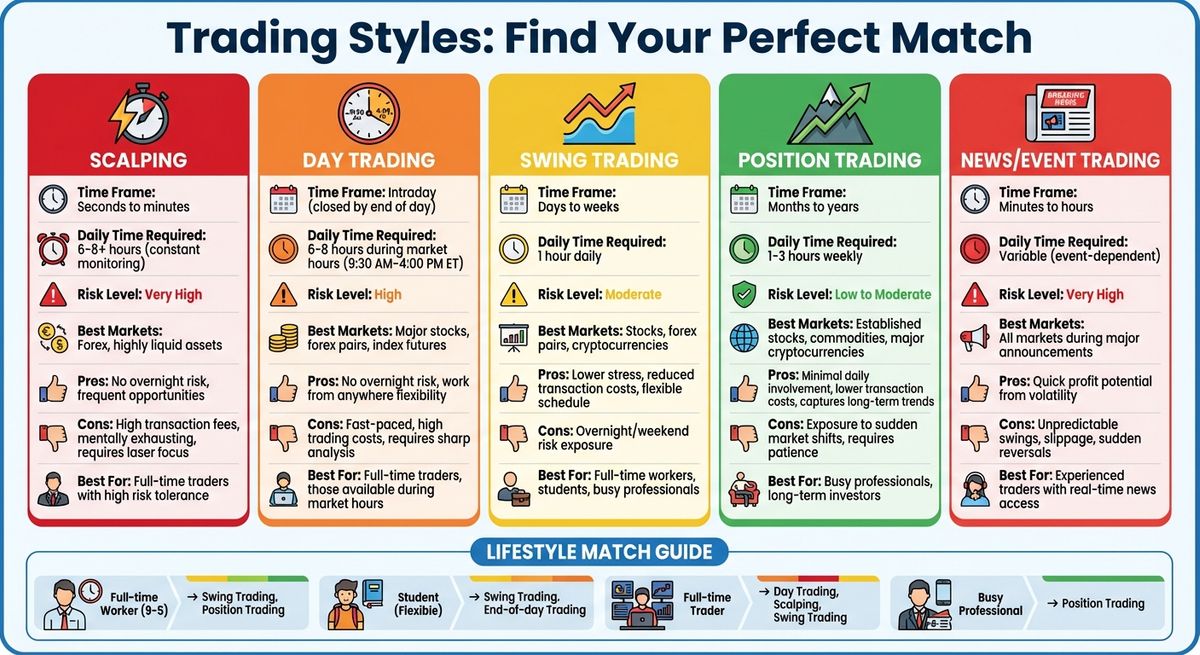
Choosing a trading style that fits your lifestyle is crucial. Each style operates on different time frames, requires varying levels of commitment, and demands a unique mindset. Below is a breakdown of key trading styles to help you align your approach with your schedule and preferences.
Scalping
Scalping is all about speed. Trades are opened and closed within seconds or minutes, aiming to profit from small price changes multiple times a day. This style works best in highly liquid markets like forex, where trades can be executed quickly with minimal slippage. While scalping offers frequent opportunities for small gains, high transaction fees can eat into profits. The upside? No overnight risk, as all positions are closed before the trading session ends. However, the constant need for screen time and split-second decision-making can be mentally exhausting. Success here requires laser focus and unwavering discipline.
Day Trading
Day trading involves buying and selling within the same trading day, avoiding the risk of holding positions overnight. Traders typically focus on the most active market hours, such as 9:30 AM–4:00 PM ET in the U.S., to capitalize on intraday price swings. This style suits volatile assets like major stocks, forex pairs, and index futures. While day trading can be lucrative and offers the flexibility to work from anywhere, it’s not for the faint-hearted. The fast-paced nature of this approach, combined with high trading costs, demands sharp trend analysis and solid risk management skills.
Swing Trading
If you’re looking for a more relaxed pace, swing trading might be your style. Positions are held for days or even weeks, allowing traders to capture short- to medium-term price movements without the need for constant monitoring. This approach typically requires about an hour a day to review positions and stay updated on market trends, making it ideal for those balancing trading with a full-time job or other responsibilities. Swing traders often rely on a mix of a mix of technical analysis tools and fundamental analysis to time their trades. While this strategy reduces daily stress and keeps transaction costs lower than scalping or day trading, it does expose traders to overnight and weekend risks. A clear plan and strict risk controls are essential to succeed.
Position Trading
For those who prefer a long-term, low-maintenance approach, position trading is the way to go. This style focuses on holding assets for months or even years, targeting large market trends rather than short-term fluctuations. Position traders use fundamental analysis to identify long-term opportunities and technical analysis for timing their trades. With minimal daily involvement - just 1-3 hours a week - this strategy is perfect for busy professionals. The potential for significant gains from long-term trends and lower transaction costs are major perks, though you’ll need to be prepared for sudden market shifts and the possibility of missing out on short-term opportunities.
News and Event-Driven Trading
This style thrives on market volatility triggered by major news or events, such as economic reports, earnings announcements, or geopolitical developments. Trades are usually short-lived, lasting minutes to a few hours, as they aim to capture the immediate market reaction. While news and event-driven trading can yield quick profits, it’s also high-risk. Unpredictable price swings, slippage, and sudden reversals are common challenges. To succeed, traders need real-time news access, strict stop-loss strategies, and the mental resilience to handle rapid market changes.
Ready to trade funded capital?
Choose your path — Instant Accounts, One-Step or Two-Step Challenges — from just $23, with up to $300,000 in funded capital.
Choose your challengeMatching Strategies to Your Lifestyle and Risk Profile
To create a successful trading approach, it's essential to align your strategy with both your daily routine and your comfort with risk. Your lifestyle largely dictates the type of trading you can realistically manage. For instance, if you work full-time, swing or position trading might be a better fit since they require less daily oversight. On the other hand, if you have the flexibility to trade full-time, you can explore more demanding strategies like day trading or scalping.
Position trading is ideal for those looking to capture long-term trends without needing to monitor the market daily. Meanwhile, scalping and day trading demand constant attention and are better suited for those who can dedicate most of their day to trading.
Aligning Risk Tolerance with Strategy Volatility
After identifying your lifestyle profile, the next step is to assess how much risk you’re comfortable taking on. Risk tolerance is about balancing your emotional ability to handle market swings with your financial capacity to absorb potential losses. For example, high-volatility strategies like scalping or day trading require quick decisions and a higher tolerance for risk, making them suitable for those with a more aggressive mindset. If frequent losses feel overwhelming, slower-paced strategies like swing or position trading might be a better match.
Keep in mind that your risk tolerance isn’t fixed - it can change as you gain experience or as your financial situation evolves. It’s a good idea to revisit your strategy every month or quarter to ensure it still aligns with your goals. Testing strategies with a demo account is an excellent way to gauge how you handle different trading styles emotionally before committing real money. Keeping a trading journal can also help you understand your reactions to market fluctuations and refine your approach.
Choosing Instruments and Understanding Leverage
With your strategy and risk profile in place, the next step is to choose trading instruments and decide how much leverage to use. Certain instruments naturally align with specific strategies. For example:
- Forex is ideal for scalpers due to its high liquidity and minimal slippage.
- Major stocks and index futures are great for day traders, especially during U.S. market hours (9:30 AM–4:00 PM ET).
- Swing traders often prefer stocks, Forex pairs, and cryptocurrencies that show clear medium-term trends.
- Position traders typically focus on well-established stocks, commodities, and major cryptocurrencies with strong fundamentals.
Leverage, while powerful, can be a double-edged sword. For instance, using 10× leverage means that a 1% price drop results in a 10% loss on your account. Traders with a high risk tolerance might use significant leverage in fast-moving markets like Forex, but this requires strict discipline and precise stop-loss orders. On the other hand, conservative traders - especially those with smaller accounts - should stick to minimal or no leverage to limit their exposure.
Your lifestyle also plays a role in how you use leverage. If you’re swing trading while juggling a day job, lower leverage can shield you from unexpected market moves when you’re not actively monitoring trades. For day traders and scalpers, who often rely on higher leverage, constant vigilance and tight risk management are non-negotiable. Remember, leverage increases both potential gains and losses, so use it sparingly and responsibly.
Testing and Refining Your Strategy with For Traders
Before putting your hard-earned money on the line, it’s essential to test your trading strategy thoroughly. For Traders offers simulated prop trading challenges that let you practice with virtual capital ranging from $6,000 to $100,000.
Simulated Prop Trading Challenges: A Realistic Testing Ground
These challenges are designed with specific rules for risk and profit, such as a 9% profit target and a 5% maximum drawdown. This setup encourages a balanced approach, blending ambition with discipline.
For beginners, the $6,000 account (priced at $46) provides a low-pressure, risk-free environment to test strategies. More seasoned traders can opt for higher-stakes challenges, like the $50,000 or $100,000 accounts, to simulate trading on a larger scale. These challenges come with access to robust trading platforms like DXTrade, TradeLocker, and cTrader, offering real-time data across multiple asset classes.
To make the experience as close to real trading as possible, these simulations factor in spreads, commissions, and slippage. This ensures you’re testing your strategy under authentic market conditions. Consider these challenges as a stepping stone to refine and perfect your trading approach.
Sharpening Your Strategy Through Rigorous Testing
Once you’ve chosen a challenge, it’s time to put your strategy through its paces. Start by backtesting your approach against 20 years of historical data, spanning 727 assets. This helps identify patterns and potential pitfalls. Next, move to forward testing with virtual capital to uncover real-world issues like emotional decision-making or unforeseen time constraints.
Leverage advanced analytical tools and custom indicators to pinpoint weaknesses in your strategy and make necessary adjustments. This iterative process is key to building a strategy that can withstand the complexities of live trading.
Crafting a Practical and Detailed Trading Plan
When your testing yields consistent results, it’s time to formalize your approach with a comprehensive trading plan. Your plan should outline clear goals - like targeting $500 in monthly profits - alongside risk management rules, such as limiting risk to 2% per trade. Establish a systematic routine to guide your daily trading activities.
The For Traders framework supports this planning phase with features like bi-weekly payouts and flexible profit targets. Use the simulated environment to test every part of your workflow, from researching trades to reviewing performance. Keep a detailed trading journal to document what works, what doesn’t, and how different market conditions impact your results. This ongoing analysis will help you refine your strategy and improve over time.
Conclusion
Choosing the right trading strategy comes down to understanding your lifestyle, time availability, risk tolerance, and personality. For instance, if you're drawn to day trading, which demands constant attention, it might not be practical if you can only dedicate a few hours a week. On the other hand, position trading might not suit someone who feels uneasy holding positions through short-term market swings.
The secret lies in finding alignment. When your strategy matches your circumstances, it becomes easier to stay consistent, manage risks effectively, and avoid emotional decisions. Knowing and respecting your risk tolerance allows you to craft an approach that you can stick to, even when markets get volatile. This helps curb impulsive actions that often lead to losses.
Before putting real money on the line, test your strategy in a risk-free environment. Tools like For Traders' simulation challenges let you see if your approach works with your lifestyle and if you can execute it consistently across different market conditions.
Once you've tested and refined your strategy, stay open to adjustments as your skills, finances, and the market evolve. Regularly review your performance, maintain a detailed trading journal, and tweak your plan as needed. It's wise to master one trading style first before exploring others, and always focus on discipline rather than chasing quick gains.
FAQs
How can I figure out my risk tolerance for trading?
Determining your risk tolerance begins with taking a close look at your financial situation. Ask yourself: How much can you afford to lose without jeopardizing your essential needs? Beyond the numbers, consider your emotional response to potential losses. Do market fluctuations make you uneasy, or are you relatively calm during ups and downs? Your investment goals and timeline also play a big role. If your timeline is short, you might need to be more cautious. On the other hand, a longer horizon could give you room to take on more risk.
A practical way to gauge your comfort level is by starting small. Use demo accounts to practice trading without putting your money on the line. When you're ready to trade live, begin with modest amounts. Pay attention to your emotions during both gains and losses - this can give you insight into your true risk appetite. The key is to ensure your risk tolerance aligns with your financial capacity and emotional resilience.
What trading strategy works best for someone with a busy schedule?
If your schedule is packed, you might want to explore a trading strategy that doesn’t demand constant attention. Swing trading could be a solid choice. This approach involves holding positions for several days or even weeks, giving you the flexibility to analyze the market during your downtime without needing to monitor it all day.
Alternatively, you could focus on the most active periods of the trading day - typically the first and last 30 minutes. These high-volatility windows often present opportunities to make quick, efficient trades. To save even more time, consider using automated tools like stop-loss or limit orders to manage your trades with minimal direct involvement. The key is finding a strategy that matches your schedule and risk tolerance while emphasizing quality over quantity.
What’s the best way to test a trading strategy without risking real money?
Testing a trading strategy effectively means turning to paper trading or demo accounts. These tools let you practice trading in real-time market conditions without risking your hard-earned money.
With features like transaction costs, slippage, and realistic order execution, paper trading accounts offer a practical way to see how your strategy might hold up in actual market scenarios. It's an excellent way to fine-tune your approach and gain confidence before diving into live trading.
Ready to trade funded capital?
Choose your path — Instant Accounts, One-Step or Two-Step Challenges — from just $23, with up to $300,000 in funded capital.
Choose your challengeTrade up to $300,000
Choose challenge