


Passing a 2-phase evaluation challenge is tough but rewarding. Proprietary trading firms use these tests to assess your ability to trade profitably while managing risk. Success grants access to significant trading capital, but only 5–15% of traders pass, with fewer than 10% succeeding on their first attempt.
Here’s what you need to know:
- Phase 1: Hit an 8–10% profit target while staying within strict drawdown limits (e.g., 5% daily, 10% total). Avoid overleveraging, emotional trading, and overtrading.
- Phase 2: Focus on consistency with a lower target (4–6%) and stricter rules, like completing a minimum number of trades.
- Keys to Success: Stick to a prop-firm-approved trading plan, limit risk to 1–2% per trade, and use tools like trading journals and performance trackers to refine your strategy.
Risk management and discipline are non-negotiable. Treat every simulated dollar as if it’s real, and focus on steady, controlled performance to improve your odds of earning a funded account.
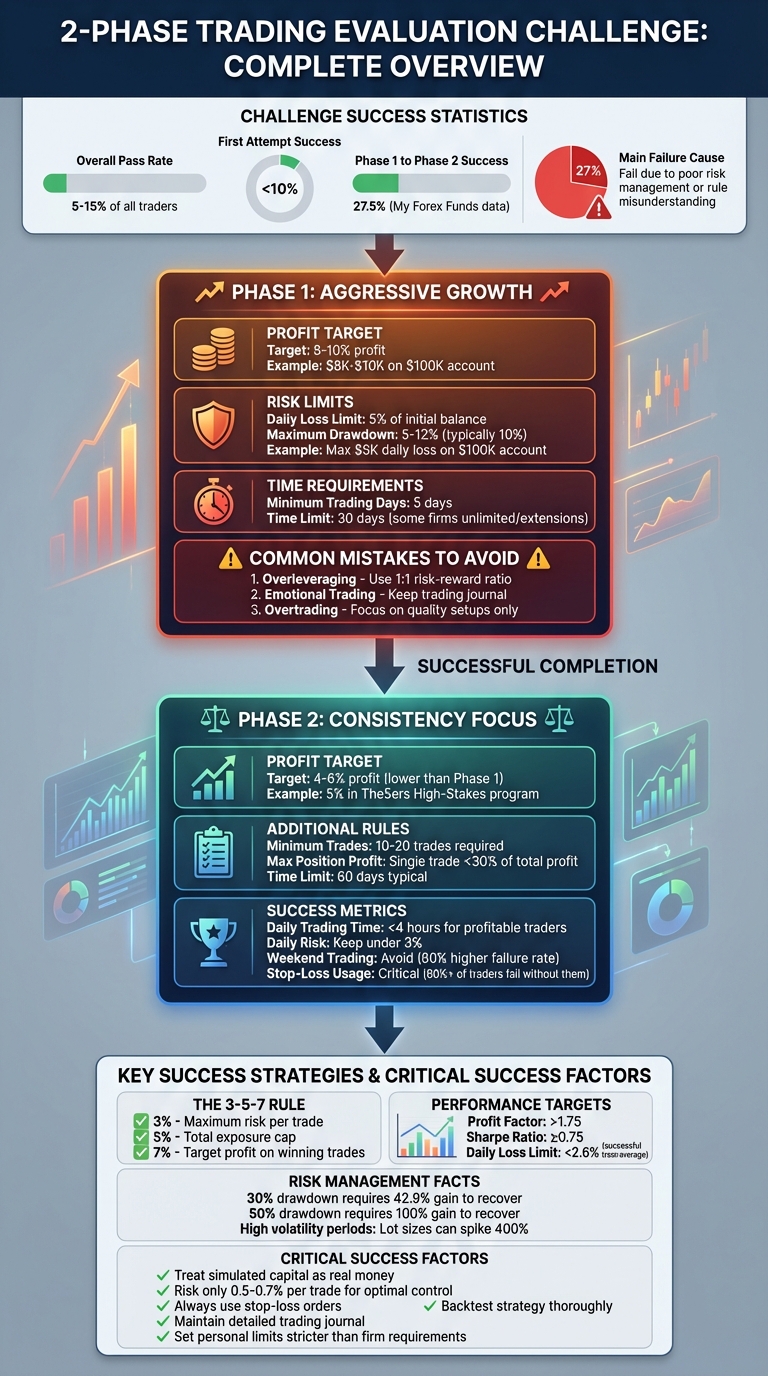
2-Phase Trading Evaluation Challenge Requirements and Success Rates
Phase 1: Meeting the Profit and Drawdown Requirements
Phase 1 Profit Targets and Risk Limits
In Phase 1, traders must hit a profit target of 8–10% based on their starting balance. For example, if you’re trading a $100K account, you’ll need to generate $8K–$10K in profits to move forward. While this range is typical, specific targets may vary by firm. For instance, BrightFunded and Optimal Traders generally set their targets around 8%.
On the risk side, daily loss limits are capped at 5% of the initial balance. For a $100K account, that means you can’t lose more than $5K in a single day. Additionally, most firms enforce a total drawdown limit between 5% and 12%, with 10% being a common benchmark. BrightFunded sticks to a 10% maximum drawdown, while My Forex Funds has allowed up to 12%, according to data from late 2021.
Many firms also require a minimum of five trading days to complete Phase 1, though some, like Optimal Traders, have removed this rule entirely. Time limits for completion vary, too. Some firms allow unlimited trading days, while others, such as My Forex Funds, provide a 30-calendar-day window with the option to extend by 14 days. These guidelines are standard across most proprietary trading evaluations.
Understanding and adhering to these requirements is essential to successfully progress to Phase 2.
Common Phase 1 Mistakes to Avoid
Navigating Phase 1 successfully requires disciplined risk management. Here are three common mistakes traders should steer clear of:
1. Overleveraging
One of the quickest ways to hit loss limits is by risking too much capital on a single trade. Overleveraging can wipe out gains in minutes. To improve your chances, aim for a balanced 1:1 risk–reward ratio, which can significantly enhance profitability over time.
2. Emotional Trading
Trading based on emotions rather than strategy often leads to poor decisions. Even if you win more than half your trades, unmanaged losses can still outweigh your gains. This often happens when traders adjust stop-loss levels to avoid taking a loss or close winning trades too early out of fear. To combat this, take regular breaks from the charts and maintain a trading journal to manage emotions and identify triggers.
3. Overtrading
The pressure to meet profit targets can tempt traders to chase every market movement or force trades when no high-probability setups are present. This often leads to unnecessary losses. Instead, focus on quality over quantity - stick to high-probability setups and limit the number of trades you take.
How to PASS a Prop Firm Challenge in 2025 – The Key to Success!
Phase 2: Proving Consistency and Rule Adherence
Phase 2 shifts the focus away from aggressive profit targets and toward demonstrating steady, reliable performance. For example, in The5ers High-Stakes program, the profit target drops from 8% in Phase 1 to 5% in Phase 2. This adjustment emphasizes disciplined, repeatable trading strategies over one-off wins.
To ensure that traders aren't advancing purely by luck, firms introduce specific rules. Trade The Pool, for instance, uses a Max Position Profit Ratio, which ensures that no single trade can account for more than 30% of the total required profit. Additionally, many firms require traders to complete a minimum of 10–20 trades before concluding Phase 2. These measures are designed to filter out speculative trading and highlight those with consistent, strategic approaches. The underlying message is clear: long-term success comes from discipline and controlled risk management.
Maintaining Consistent Performance in Phase 2
Achieving steady results in Phase 2 depends on maintaining consistent position sizes and trading regularly. Limiting your risk to 1–2% of your account per trade can protect against a string of losses and help keep your equity curve stable. Evaluators look for disciplined execution across multiple trades.
Take Cade, a trader with Trade The Pool, as an example. In his first evaluation, he aggressively pursued a 6% profit target, violating his daily loss limit and ultimately failing. On his second attempt, Cade adopted a consistent trading approach, focusing on a single market setup. This change allowed him to hit his target over five steady trading days.
Statistics further highlight the challenges of this phase. At My Forex Funds, only 27.5% of traders who pass Phase 1 succeed in Phase 2. Many failures stem from impatience, even with generous 60-day time limits. Data also shows that successful traders typically spend less than four hours per day in the market and keep daily risk under 3%. This reinforces that patience and precise risk management are rewarded far more than extended market exposure.
These strategies to pass a prop firm challenge naturally lead to the next critical element: refined risk controls for lasting profitability.
Managing Risk While Staying Profitable
In Phase 2, protecting your capital becomes the top priority. A good practice is to set personal daily loss limits that are stricter than the firm's guidelines. For instance, if the firm allows a 5% daily loss, consider capping your own at 3%. Focus on high-probability setups that yield steady, incremental gains.
Avoid holding positions over weekends, as market gaps and volatility increase the likelihood of failure by 60%. Shockingly, over 60% of traders fail to use stop-loss orders. Always implement protective stop-losses for every trade.
Risk management also means adapting to market conditions. During periods of high volatility, adjust your trade size to stay within your risk parameters. At My Forex Funds, even top payout traders lost their accounts within three weeks due to taking on excessive risk. This serves as a stark reminder: consistency and capital preservation are far more valuable than chasing rapid, spectacular gains.
Practical Strategies for Passing Both Phases
To succeed, you need three key ingredients: a solid trading plan, strong risk management, and emotional discipline. With pass rates sitting between just 5% and 15%, most traders fail - not because their strategies don’t work, but because they struggle to manage risk or keep emotions in check. The most successful traders approach every simulated dollar as if it were their own, sticking to a structured game plan from the very beginning.
Crafting a Clear Trading Plan
Start by defining your trading rules: entry and exit points, risk limits, and the triggers you’ll use - whether technical signals like resistance breakouts or fundamental catalysts such as earnings reports. Also, schedule your trading hours. Interestingly, data shows that traders who profit spend less than four hours per day actively trading. More screen time doesn’t always mean better results.
Before you put real money on the line, backtest and forward-test your strategy. Studies reveal that over 90% of traders fail without disciplined risk management and emotional control. Your plan should outline which assets you’ll trade, your maximum leverage, and any restrictions specific to your firm, such as avoiding news trading or prohibited strategies.
Once your plan is set, focus on quantifying risk with precise position sizing.
Position Sizing and Risk Management
Stick to strict risk limits using the 3-5-7 rule: risk 3% per trade, cap your total exposure at 5%, and aim for a 7% profit on winning trades. For example, on a $10,000 account, you’d limit risk to $300 per trade. To calculate position size, divide your maximum risk by the stop-loss distance. If your stop-loss is 10 points and each point equals $1, you’d trade 30 contracts.
These measures align with the drawdown and daily loss limits that prop firms enforce. Traders who make it to their fourth payout cycle typically keep daily risk below 3%. Always set your stop-loss and take-profit levels before entering a trade - this removes emotional decision-making when the market moves unexpectedly.
Be especially cautious during high-impact news events when market volatility can surge, sometimes spiking lot sizes by up to 400%. These periods can be particularly risky.
Building Discipline and Emotional Control
Even the best trading plan won’t work without psychological discipline. Set a personal daily loss limit that’s stricter than the firm’s allowance. For instance, if the firm permits a 5% daily loss, you might cap yourself at 3%. Data shows that consistently profitable traders rarely lose more than 2.6% in a single day.
Keep a detailed trading journal to track your decisions, emotions, and results. Review it weekly to spot patterns like overtrading, ignoring stop-losses during drawdowns, or making impulsive trades. A routine of pre-trade planning and post-trade analysis is critical for building the discipline needed to succeed long-term.
"Passing is not luck; it is the direct result of comprehensive preparation, unwavering patience, and consistent discipline. Diligence secures success."
– The5ers
Prop firms design their evaluations to test your mental resilience under pressure. They want traders who are steady, patient, and methodical - not those chasing quick wins. Treat the simulated capital as if it were your own money, because the habits you develop during the evaluation phase will follow you into your funded account.
Tools and Resources for Evaluation Success
Succeeding in a two-phase evaluation isn’t just about having a solid strategy - it’s about combining that strategy with the right tools and practical experience. Data-driven tools can turn uncertainty into clarity, helping you stay on track with profit goals, drawdown limits, and consistent trading. These tools act as a bridge, connecting your preparation to measurable results.
Tracking Your Performance Metrics
Performance tracking is a cornerstone of effective trading. Tools like TradeZella (4.8 rating) and Edgewonk make this process easier by automatically importing your trades and calculating important metrics such as win rate, profit factor, and maximum drawdown. With automation, you save time and reduce the chances of manual errors.
To improve your chances, aim for a profit factor above 1.75 and a Sharpe Ratio of at least 0.75. Keep a close eye on drawdowns - remember, a 30% drawdown requires a 42.9% gain to recover, and a 50% loss demands a full 100% rebound. Additionally, data shows many day traders achieve their best results during market open.
While tracking metrics is essential, building your skills through practice is just as important.
Learning Resources and Practice Platforms
Demo accounts are an excellent way to test your skills without risking real money. Platforms like For Traders offer simulated trading challenges that let you practice with virtual funds. You can also customize trading rules to mimic real evaluation conditions and access educational resources like video tutorials and e-books. These platforms often include advanced tools, such as AI-driven risk management systems, and provide support through active communities like Discord.
Backtesting is another critical step in refining your strategy. For instance, forward tests conducted in May 2025 demonstrated that AI-enhanced strategies could improve simulated gains. While AI tools continue to evolve, the fundamentals remain unchanged: thoroughly test your approach before trading live.
When setting up a demo account, configure it to match real evaluation parameters - this means mirroring profit targets, drawdown limits, and timeframes. Rigorous backtesting helps build the discipline and consistency needed for high-pressure evaluations. This is especially important since about 27% of prop firm challenge failures stem from poor risk management or misunderstanding the rules.
Conclusion
Successfully passing a 2-phase evaluation boils down to understanding the rules, managing risk effectively, and maintaining discipline. The statistics speak for themselves - only about 5% to 10% of traders manage to pass prop firm challenges. What sets these traders apart isn’t luck or reckless strategies; it’s their focus on consistency and capital preservation.
Your trading plan serves as your roadmap. Before you even begin, make sure you’re clear on your profit targets, drawdown limits, and any prohibited strategies. Stick to risking only 0.5% to 0.7% of your capital per trade to keep drawdowns under control. Always use stop-loss orders, maintain a detailed trading journal, and thoroughly backtest your strategy. These aren’t optional extras - they’re the foundation of your success.
"Prop firms don't care about your best day. They care about your worst." - Andrew Rul Trading
This quote highlights the critical importance of risk management. Both phases of the evaluation require a mindset where survival takes precedence over speed. Rushing to hit profit targets often leads to unnecessary mistakes or even lost accounts. In contrast, a steady, methodical approach increases your chances of success.
Take advantage of the tools at your disposal - performance trackers, demo accounts, and backtesting platforms. These resources allow you to refine your strategy without putting real money at risk. Practice until your approach feels second nature. When the time comes to attempt the evaluation, treat it as if you’re trading with real capital, not gambling on a quick win.
The combination of disciplined execution and proper use of these tools is what paves the way for long-term success. By mastering these fundamentals, you’ll significantly improve your chances of earning a funded account.
FAQs
What are the best strategies to pass both phases of a 2-phase trading evaluation?
To successfully navigate both phases of a 2-phase trading evaluation, you'll need a mix of discipline, strategy, and consistency. Here's how you can approach it:
- Stick to strict risk management: Set clear limits on daily losses and adhere to your risk parameters to safeguard your account balance.
- Have a solid trading plan: Outline your goals, preferred trade setups, and specific rules for entering and exiting trades.
- Trade during high-activity periods: Focus on market hours when trading activity is at its peak, as these times often present the best opportunities.
- Review your performance daily: Analyze your trades to spot patterns, learn from mistakes, and refine your strategy.
- Keep your emotions in check: Stay composed, avoid impulsive decisions like revenge trading, and remain faithful to your plan.
By blending these practices, you'll put yourself in a stronger position to meet the evaluation requirements and move closer to your trading goals.
How can I stay in control of my emotions while trading during the evaluation?
Managing emotions during the evaluation process is crucial for maintaining consistency and discipline. Begin by crafting a well-thought-out trading plan that clearly defines your strategies, risk limits, and daily targets. Once it's in place, commit to following it, even when you're tempted to stray.
In moments of stress or impulsiveness, try mindfulness techniques like deep breathing or briefly stepping away from your trading setup. Keep in mind that the evaluation isn’t just about making a profit - it’s also about adhering to the rules. Prioritize rational decision-making over chasing quick gains, and always keep your long-term goals in focus.
What mistakes should I avoid to succeed in Phase 1 of the evaluation challenge?
To navigate Phase 1 successfully, it's crucial to steer clear of these pitfalls:
- Overtrading: Taking too many trades can quickly lead to unnecessary losses. Instead, stick to your trading plan and prioritize quality over quantity. Fewer, well-thought-out trades are often more effective than chasing every opportunity.
- Ignoring Risk Management: Exceeding your maximum daily loss or risking too much on a single trade can result in instant disqualification. Always calculate position sizes carefully and use stop-loss orders to protect your account.
- Chasing Losses: Trying to recover losses in a hurry often leads to emotional decisions and poor outcomes. Stay disciplined, focus on your strategy, and aim for long-term consistency rather than quick fixes.
By staying calm, disciplined, and focused on your strategy, you’ll set yourself up for a much smoother path through Phase 1.
Related Blog Posts
Start Trading with For Traders
Join our platform to test your trading skills, trade virtual capital, and earn real profits. Access educational resources, advanced tools, and a supportive community to enhance your trading journey.
Start your Trading Challenge