


The funded account verification phase is your chance to prove consistent trading skills after passing the initial evaluation. Success requires meeting profit targets (typically 5% within 30–60 days), managing daily drawdown limits, and following strict trading rules. This phase emphasizes discipline, steady returns, and risk management over aggressive strategies.
Here’s how to prepare:
- Understand the Goals: Focus on consistency, risk control, and achieving targets without exceeding drawdown limits.
- Build a Trading Plan: Define clear entry/exit rules, maintain a risk-reward ratio (e.g., 1:2 or 1:3), and stick to a daily routine.
- Manage Risk: Limit risk to 1–2% per trade, set daily loss caps, and use stop-loss orders effectively.
- Track Performance: Use a trading journal and analytics tools to monitor progress and refine strategies.
- Control Emotions: Avoid impulsive decisions by pausing after losses and practicing mindfulness.
- Stay Disciplined: Follow your plan, avoid overtrading, and focus on long-term growth.
This phase is more than a test; it’s about building habits for a lasting trading career.
How Anyone Can Pass The Verification Stage - FUNDED FTMO

Building a Trading Plan for Verification
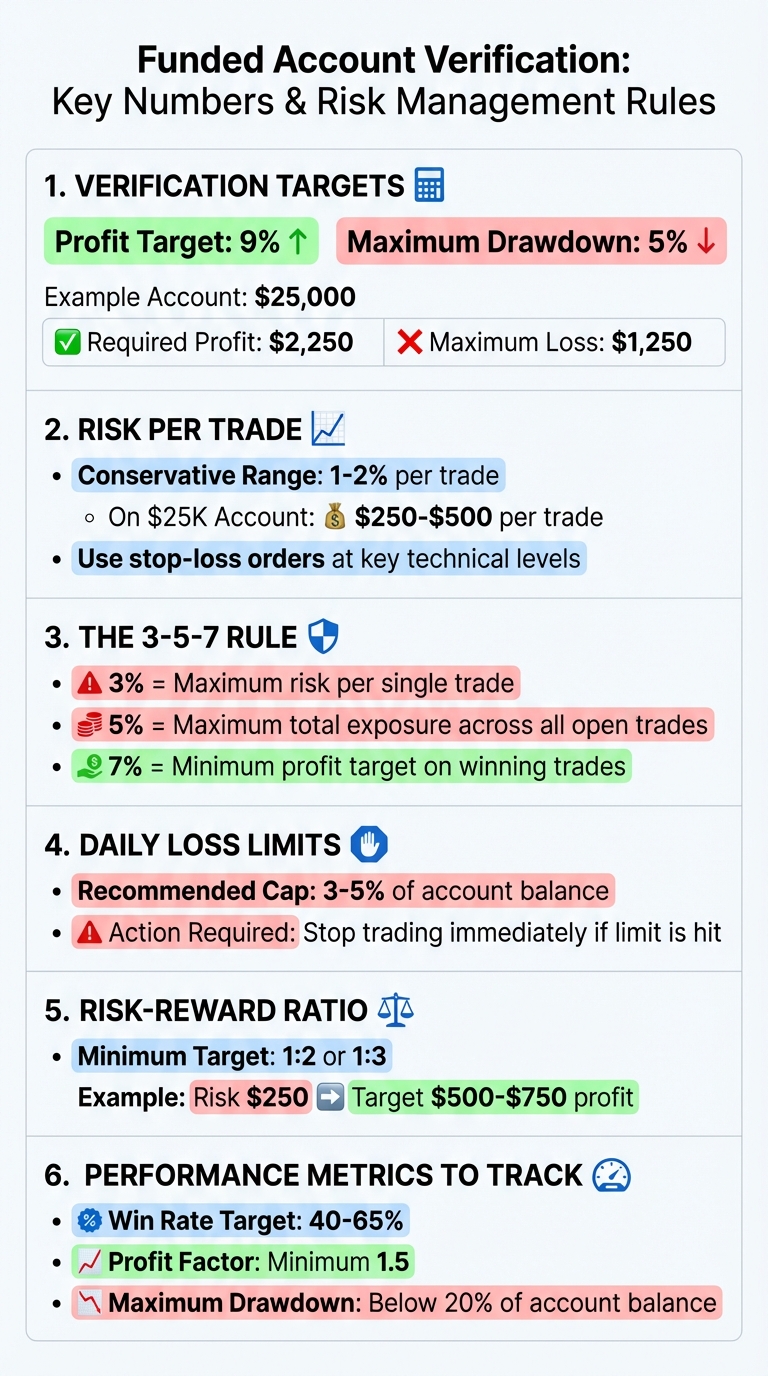
Funded Account Verification Requirements and Risk Management Guidelines
Core Elements of a Trading Plan
A solid trading plan should be straightforward, consistent, and regularly reviewed. Start by clearly defining your market, preferred timeframes, and the instruments you’ll trade - whether it’s forex, indices, or commodities. Your entry and exit rules should be specific and based on measurable criteria, such as technical indicators, chart patterns, or price action signals. Aim for a risk-reward ratio of at least 1:2 or 1:3 to maintain a favorable balance between potential gains and losses. Establishing a regular trading schedule is also essential for maintaining discipline.
To stay organized, use a pre-trade checklist to confirm your technical setup, risk parameters, and mental readiness before entering any position. Document your plan thoroughly, noting areas that might need fine-tuning. Cheat sheets summarizing key trade criteria and common mistakes can be a helpful quick reference. Once your plan is in place, adapt it to meet the specific requirements of your verification process.
Matching Your Plan to Verification Requirements
To align your plan with the firm’s verification guidelines, reverse-engineer your goals based on the profit target and drawdown limits. For instance, during the Traders' verification phase, you’ll need to achieve a 9% profit target while keeping drawdowns under 5%. On a $25,000 account, this translates to generating $2,250 in profits without exceeding $1,250 in losses.
A prudent approach is to risk 1–2% per trade, which equals $250–$500 on a $25,000 account. Always use stop-loss orders placed at key technical levels to manage risk effectively. Some traders follow the 3-5-7 rule: risk up to 3% per trade, cap total exposure to 5% across all open trades, and aim for at least a 7% profit on winning trades. Setting daily loss limits - typically around 3–5% - can protect your account from significant drawdowns and signal when it’s time to pause and reassess your strategy.
Define your profit targets using clear benchmarks like resistance levels, Fibonacci extensions, or your pre-established risk-reward ratio. Additionally, include rules for scaling into or out of positions and consider time-based exits for trades that fail to meet expectations within a set period.
Tools and Templates for Planning
Once your strategies and parameters are outlined, document and organize them using practical tools. Planning tables and calculators can help you track your progress toward the 9% profit target. A simple spreadsheet is an excellent way to monitor daily profit and loss, cumulative returns, and how close you are to drawdown limits. Use a checklist to review your trading rules before backtesting your strategy.
It’s also helpful to develop a well-defined trading hypothesis that guides your decisions and provides a structured approach to predicting price movements. Regularly analyze your performance data to refine your plan - documenting what works and addressing recurring issues as they arise. This ongoing review process ensures your strategy remains effective and aligned with your trading objectives.
Risk Management and Trade Execution
Setting Risk Limits
When it comes to managing risk, a conservative approach is essential. Limit your risk to 1–2% per trade. For example, if you have a $25,000 account, this means risking around $250–$500 per trade. This strategy helps you stay well within the firm's drawdown restrictions, protecting your account from significant losses.
It's also crucial to set a daily loss limit, typically around 3–5% of your account balance. If you hit this limit, stop trading immediately - this prevents emotional decisions that could lead to even bigger losses or disqualification. With these limits in place, you can focus on executing trades with discipline and precision.
Managing Trades with Discipline
Discipline starts with proper planning. Place a stop-loss order as soon as you enter a trade, basing it on key technical levels rather than random values. Similarly, set take-profit targets that align with a risk-reward ratio of at least 1:2 or 1:3. For instance, if you’re risking $250, aim for a profit of $500–$750.
Consistency matters more than chasing quick wins. Stick to your plan and avoid impulsive decisions. If you reach your daily loss limit, log off immediately to sidestep the temptation of "revenge trading". The goal is to preserve capital, prioritizing long-term success over short-term gains.
Using Risk Management Tools
Modern trading platforms offer powerful tools to help you stick to your risk management plan. Many prop trading platforms now include AI-driven risk engines that monitor your account in real time. These systems enforce trading rules during the verification phase, tracking everything from drawdown limits to position sizes and exposure caps. If you approach your risk thresholds, you’ll receive alerts via email, dashboard notifications, or messaging apps like Telegram and Slack.
Platforms such as DXTrade, TradeLocker, and cTrader provide real-time dashboards to monitor your performance. They can even enforce risk limits by automatically closing positions or temporarily pausing your account if rules are breached. These tools are invaluable for maintaining disciplined trade execution and ensuring your trading activity stays within the guidelines.
Tracking Performance with Journals and Analytics
Accurate performance tracking is a key part of meeting verification targets and sharpening your trading strategy. By keeping detailed records and analyzing essential metrics, you can pinpoint strengths, address weaknesses, and maintain discipline throughout the verification phase.
Keeping a Trading Journal
A trading journal is more than just a log of your trades - it’s a tool that helps you understand the reasons behind your wins and losses. For each trade, jot down the details: entry and exit points, position size, stop-loss, take-profit levels, the strategy you used, and the market conditions at the time. Don’t forget to capture your emotional state during the trade, as this can reveal how psychology impacts your decisions. Including chart screenshots to highlight key price levels can also be incredibly helpful.
As the Earn2Trade Blog aptly puts it:
"What you can't measure, you can't improve."
– Earn2Trade Blog
By regularly reviewing your journal, you’ll start to notice recurring patterns - both good and bad. These insights can guide you in making adjustments to improve your performance.
Performance Metrics to Track
To stay on track with verification requirements, focus on metrics that matter. For instance, aim for a win rate between 40% and 65%. Even with a win rate of 50%, you can still be profitable if you maintain a strong risk-reward ratio of 2:1 or higher. A profit factor of at least 1.5 is another solid benchmark, as it reflects effective risk management.
Keep an eye on your maximum drawdown, ensuring it stays below 20% of your account balance. This is especially important since most verification programs enforce strict drawdown limits. Another key metric is trade expectancy, which measures the average outcome of your trades and helps confirm whether your strategy is viable. Regularly check your account balance and adjust position sizes as needed to avoid hitting critical thresholds.
Once you’ve established your key metrics, consider using automated tools to simplify your analysis.
Combining Tools for Performance Analysis
Spreadsheets are a good starting point for tracking metrics, but dedicated performance analytics software can take your analysis to the next level. Tools like TradesViz and Edgewonk can generate visual reports and provide deeper insights into your trading habits.
Additionally, many trading platforms, such as DXTrade, TradeLocker, and cTrader, come equipped with built-in analytics dashboards. These dashboards offer real-time performance stats, helping you stay informed as you trade. By combining these digital tools with your manual journal entries, you’ll gain a well-rounded understanding of your performance. Make it a habit to review this data weekly to ensure consistency - a critical factor for long-term success.
These practices not only enhance your tracking efforts but also strengthen your prop-firm-approved trading plan, ensuring disciplined execution during the verification process.
Mental and Physical Preparation
Achieving success in trading often depends more on mastering your mindset and emotions than on technical skills alone. During the verification phase, many traders stumble because fear, greed, or impatience take over, leading to emotional decisions. The pressure to hit targets while staying within drawdown limits can push even experienced traders into impulsive actions that derail their progress.
Controlling Emotions During Verification
Keeping your emotions in check is critical when trading. Instead of obsessing over individual wins or losses, focus on sticking to your trading plan. Before entering a trade, pause and double-check that it matches your criteria - this helps avoid overtrading. Research shows that traders who react strongly to wins or losses often perform worse overall.
There are practical ways to maintain emotional control. Start each trading day with an affirmation like, "I trade based on my plan, not my emotions," to reinforce discipline. Visualization can also be a powerful tool - imagine yourself calmly following your strategy, even after a loss. Studies suggest that visualization can boost performance significantly; for example, athletes using this technique have seen improvements of up to 45%.
Pay attention to physical signs of stress, such as a racing heart or tense shoulders. When these appear, take a five-minute break to practice deep breathing or meditation. After a major win or loss, consider a 30-minute cooling-off period before placing your next trade. This pause helps prevent impulsive decisions driven by emotion.
Setting daily and weekly loss limits can act as a safety net. For instance, if you reach a 2% daily loss, stop trading for the day, no matter how confident you feel about your next setup. In one case study, a trader who combined daily mindfulness exercises with a strict 1% daily loss limit found it easier to stay consistent and achieve success.
Managing your emotions effectively is the foundation for a productive trading day.
Creating Daily Trading Routines
A well-structured daily routine can help you stay calm and focused, even during volatile market conditions. Begin your day with a 30-minute pre-market session to review your watchlist, check economic calendars, and set price alerts. During trading hours, limit your screen time to 4–6 hours and take a 10-minute break every two hours to stay mentally sharp. After the session, spend another 30 minutes reviewing your trades in a journal to identify what worked and what needs improvement.
Using a compliance checklist for your trading plan is another helpful strategy. Before each trade, ensure that your position sizes, stop-loss orders, and exit strategies align with your rules. If you deviate from your plan, log it in your journal to spot patterns and address them before they become bad habits.
Lifestyle Factors That Affect Trading Performance
Just as risk management protects your capital, maintaining healthy lifestyle habits safeguards your mental clarity during the verification phase. Aim for at least seven hours of sleep each night and include 20–30 minutes of exercise in your daily routine to enhance decision-making and reduce stress.
Steer clear of prolonged exposure to negative news or social media during volatile market periods, as this can amplify anxiety and cloud your judgment. Instead, consider joining a supportive trading community where you can share experiences, ask questions, and gain fresh perspectives. Traders with access to mentorship or peer support often find it easier to maintain emotional balance.
Finally, practice daily gratitude by reflecting on lessons learned from losses or progress made by following your plan. This simple habit shifts your focus from worrying about outcomes to appreciating your growth, which is essential for staying grounded during the verification process.
Conclusion: Preparing for Verification Success
Navigating the funded account verification phase isn’t just about showing off your trading skills - it’s about mastering discipline and committing to continuous growth. To start strong, focus on understanding the evaluation rules inside and out, like drawdown limits and profit targets. Pair this knowledge with a solid risk management plan that keeps you grounded and prepared for any scenario.
The verification phase is more than a test - it's the first step in your funded trading journey. As MyFundedFutures wisely puts it, "Remember that passing the evaluation is just the beginning. Maintaining disciplined trading practices remains essential for long-term success with your funded account". Building habits like journaling your trades, analyzing your performance, and refining your strategies will turn this phase into a stepping stone for your long-term growth as a trader.
Setbacks are inevitable, but they’re also opportunities to learn and improve. Trade The Pool highlights the importance of using losses or missed targets as feedback to refine your approach. When things don’t go as planned, take a moment to evaluate what went wrong, adjust your strategy, and move forward with a clearer perspective.
Ultimately, the goal isn’t just to pass a prop firm challenge - it’s to lay the groundwork for a lasting trading career. MyFundedFutures emphasizes, "Remember that the goal isn't just to pass prop firm challenges but to develop sustainable trading habits that will serve you throughout your trading career". The discipline, emotional control, and structured approach you cultivate during this phase will shape your success as a funded trader for years to come.
FAQs
What should I include in my trading plan to succeed in the verification phase?
To navigate the verification phase successfully, your trading plan needs to cover a few critical components:
- Profit targets: Aim for clear, achievable goals - typically in the range of 8% to 15%. These give you a benchmark to measure success.
- Risk management: Establish firm boundaries, like a daily loss limit of 2% to 5% and a maximum drawdown between 8% and 12%. These safeguards help protect your account.
- Position sizing: Keep things consistent by risking only 1% to 2% of your account on any single trade.
- Entry and exit criteria: Define these ahead of time based on your strategy, incorporating both technical indicators and fundamental analysis.
- Discipline: Stick to your plan without wavering. This demonstrates both professionalism and emotional control.
By focusing on these areas and sticking to a structured approach, you'll boost your chances of meeting the firm's expectations and passing the verification phase.
How can I stay in control of my emotions during the funded account verification phase?
Staying composed during the funded account verification phase is crucial for success. Stick closely to your trading plan, and make sure you’ve clearly defined your entry and exit points ahead of time. This helps minimize impulsive decisions and keeps your strategy grounded. Regularly revisit your risk management rules to ensure you're only taking well-thought-out risks.
Taking short breaks during trading sessions can work wonders for clearing your mind and regaining focus. Techniques like deep breathing or mindfulness can also help you stay steady when the pressure builds. Another helpful practice? Keeping a trading journal. Use it to log emotional triggers - like fear or overconfidence - and review it to spot patterns that could be impacting your performance.
Above all, prioritize consistency and discipline in every trade. Long-term success comes from sticking to your plan, not letting short-term outcomes sway your emotions.
What tools can I use to track my trading performance and meet verification requirements?
To keep a close eye on your trading performance and meet verification requirements, tools like trading journals, performance trackers, and market analysis tools can be incredibly useful. These resources not only help you monitor your trades but also assist in spotting patterns and ensuring you're hitting critical metrics like profit goals and risk thresholds.
Take trading journals, for example - they let you record every trade, review your decision-making, and pinpoint areas that need work. Performance trackers, on the other hand, offer a clear view of your overall progress by breaking down stats like win rates, average returns, and drawdowns. And with market analysis tools, you can stay up-to-date on trends and potential opportunities, giving you the confidence to approach each trading session fully prepared.
Related Blog Posts
Start Trading with For Traders
Join our platform to test your trading skills, trade virtual capital, and earn real profits. Access educational resources, advanced tools, and a supportive community to enhance your trading journey.
Start your Trading Challenge