


Trading funded accounts is more about mental discipline than strategy. Around 80% of traders fail, not due to poor strategies but because of psychological challenges. Strict rules, loss limits, and performance pressure create what many describe as "invisible pressure." Key takeaways:
- Loss aversion: Traders fear losses more than they value gains, leading to impulsive decisions.
- Stress impact: High stress impairs decision-making, triggering revenge trading or hesitation.
- Emotional control: Winning trades can lead to overconfidence, while losses may cause panic or frustration.
- Risk management: Conservative position sizing and strict stop-loss orders help maintain discipline.
- Mindset shift: Moving from "challenge" to "funded" mentality is essential for long-term success.
To succeed, focus on process-based goals, like following your trading plan, rather than obsessing over profits. Tools like pre-trade checklists, trading journals, and smaller position sizes can help you stay disciplined and consistent. Remember, even professional traders lose often but succeed by managing risk like a professional and staying emotionally neutral.
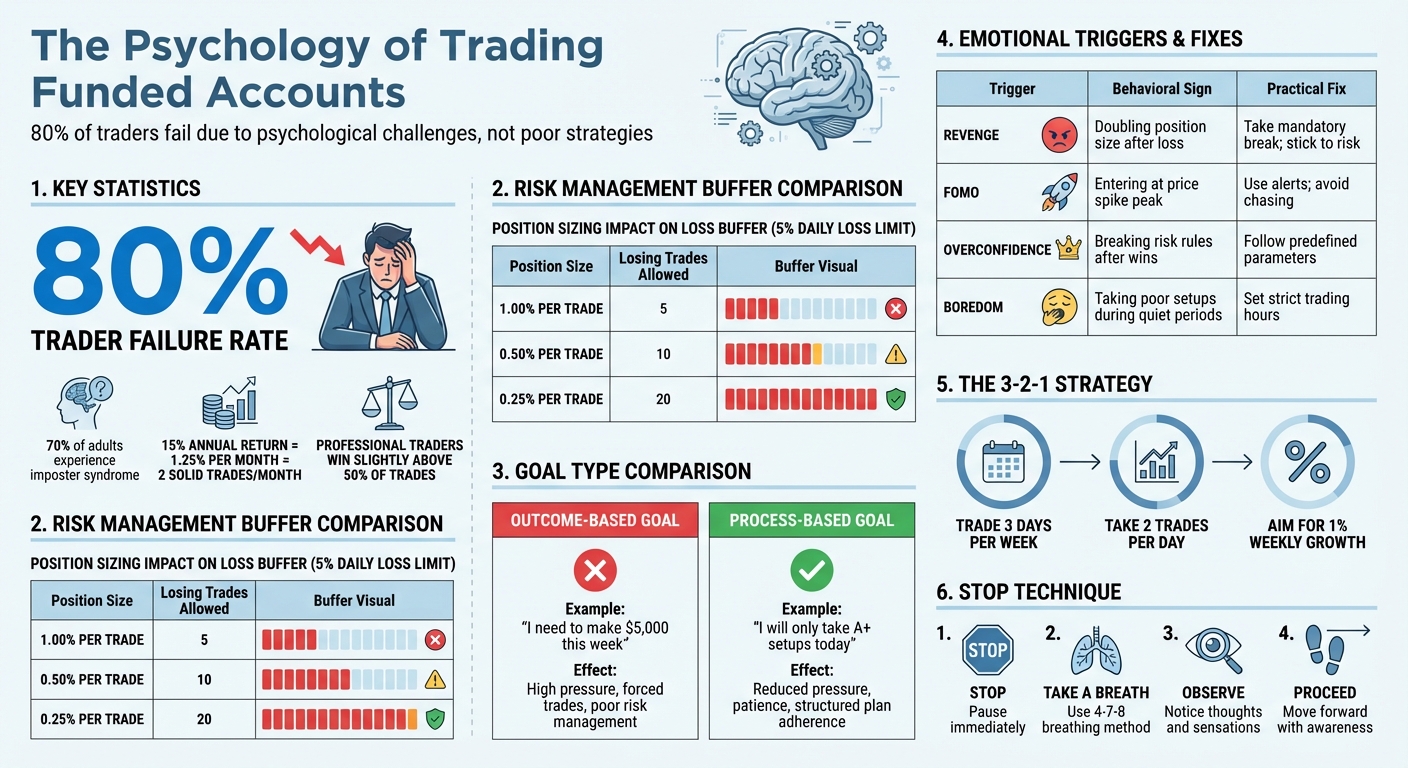
Trading Psychology: Risk Management Strategies and Emotional Triggers Guide
Managing Performance Pressure and Stress
How Stress Affects Your Trading Decisions
When you're nearing a drawdown limit or chasing a profit target, your brain can shift into survival mode. High emotional stress reduces blood flow to the prefrontal cortex - the part of your brain responsible for planning, reasoning, and making complex decisions. This can lead to what psychologists call "dysexecutive syndrome", where even simple plans feel overwhelming, and distractions take over.
In these moments, your "fight-or-flight" response kicks in, overriding rational thought. You might find yourself revenge trading - taking bigger risks to recover losses - or freezing up, avoiding valid trade setups out of fear of losing again. Both reactions highlight how stress can hijack your ability to think clearly.
Recognizing the effects of stress is the first step toward maintaining discipline and sticking to a plan.
Creating and Following a Trading Plan
A written trading plan is your lifeline when emotions start to cloud your judgment. Take, for example, FTMO trader Yasin. In October 2020, despite being sick for two weeks, he passed his challenge by following strict rules: risking only 0.25% per trade and limiting himself to 4–5 trades per day. This disciplined approach allowed him to keep a high reward-to-risk ratio without letting individual losses derail his progress.
Your trading plan should spell out precise entry and exit criteria to keep emotions in check during market fluctuations. Trader Carlos uses a similar method with his funded account: he risks 1% per trade, allows a maximum of two open positions at any time, and limits himself to three trades per day. This structured approach helps him avoid the temptation to overtrade, especially during drawdowns.
Before placing a trade, run through a pre-trade checklist: Does this setup align with your rules? Is your risk limited to 1% or less? Are you basing your decisions on analysis rather than emotions? This simple habit helps you stay focused on the process instead of succumbing to panic.
Breaking Down Goals Into Smaller Targets
Aiming for a 15% annual return may feel daunting, but when broken down, it translates to about 1.25% per month - achievable with just two solid trades a month. Breaking big goals into smaller, manageable milestones not only simplifies the math but also eases the psychological burden.
Consider the story of trader Diego. He failed his prop firm evaluation five times because he was "rushing the process" and overtrading. His breakthrough came when he shifted his mindset, treating trading like a "boring machine" and focusing on the random distribution of trades instead of obsessing over individual outcomes. Instead of setting high-pressure goals like "I need to make $5,000 this week", he switched to process-oriented goals such as "I will only take A+ setups today."
| Goal Type | Example | Psychological Effect |
|---|---|---|
| Outcome-Based | "I need to make $5,000 this week." | Creates high pressure, leading to forced trades and poor risk management. |
| Process-Based | "I will only take A+ setups today." | Reduces pressure, encouraging patience and adherence to a structured plan. |
This shift in focus removes the stress of unpredictable market outcomes. Instead, it places your attention on what you can control: discipline, risk management, and sticking to your plan.
Next, we’ll explore strategies to tackle the fear of loss.
Dealing With Fear of Loss
Why Fear of Loss Is Stronger in Funded Accounts
Losing money in your own trading account hurts, but in a funded account, the stakes are much higher. The fear of loss becomes more intense because of the strict rules tied to funded accounts. These accounts come with rigid risk parameters - breaking them can mean losing the account entirely.
Funded accounts push traders to prioritize capital preservation. Every trade feels like it could jeopardize the entire opportunity. This shift from a "challenge mindset" to a "funded mindset" creates immense pressure.
"Where you want to be is always in control, never wishing, always trading, and always, first and foremost, protecting your butt." - Paul Tudor Jones, Hedge Fund Manager
Losing streaks in such accounts don’t just drain your balance - they can shake your confidence as a trader. This often leads to second-guessing, cutting profits too early, or stubbornly holding onto losing trades. If you find yourself obsessively checking trades or feeling physical stress during market swings, it’s a sign your position size might be too large for your comfort level.
The solution? Adjust your risk setup to manage these heightened fears effectively.
Using Position Sizing and Risk Management Rules
One of the best ways to combat fear-based trading is by using a lot size calculator for conservative position sizing. For example, risking 1% of your account per trade under a 5% daily loss limit gives you a buffer of five consecutive losses. Lowering that to 0.5% per trade doubles the buffer to 10 losses, and at 0.25%, you’d have room for 20 losing trades.
| Risk Level | % Per Trade | Number of Losses Allowed Under a 5% Limit |
|---|---|---|
| Standard | 1.00% | 5 losing trades |
| Safer | 0.50% | 10 losing trades |
| Ultra-Conservative | 0.25% | 20 losing trades |
In addition to smaller position sizes, adopting a drawdown scaling approach can provide extra protection. For instance, if your account drops by -2%, you could cut your position sizes by 50% and limit yourself to one trade per day. If the drawdown deepens to between -4% and -6%, reduce your risk even further to just 0.1% per trade and take a mandatory three-day break to reassess your approach. Setting a personal daily loss cap - like stopping at a 1.5% loss even when the firm’s limit is 5% - can help prevent disastrous trading days. These strategies not only safeguard your capital but also help you stay calm and focused.
Alongside position sizing, automated tools like stop-loss orders can further ease trading anxiety.
How Stop-Loss Orders Reduce Anxiety
Stop-loss orders are a simple yet powerful tool for managing both risk and stress. By placing a stop-loss as soon as you open a trade, you remove the emotional burden of deciding when to exit if the market moves against you. Without one, it’s easy to fall into the trap of "hoping" for a turnaround, which can turn small losses into major setbacks.
Amateur traders often widen their stop-losses to avoid taking a hit, but seasoned professionals stick to their predefined limits. As Ed Seykota famously put it:
"The elements of good trading are: cutting losses, cutting losses, and cutting losses. If you can follow these three rules, you may have a chance." - Ed Seykota
Using hard stop-loss orders ensures you operate within your risk parameters on every trade. Knowing the maximum amount you could lose before entering a trade can significantly reduce anxiety. Once you’ve accepted the worst-case scenario, it’s easier to regain focus and approach the market with confidence the next day.
Controlling Emotional Reactions to Market Swings
Recognizing Your Emotional Trading Patterns
Winning trades can give you a surge of overconfidence, while losing trades can leave you frustrated and desperate to recover quickly. Both reactions can spell trouble in a funded account, where staying disciplined matters far more than chasing short-term results.
To break this cycle, start by tracking your emotions alongside your trade data. Keep a trading journal where you log your entry and exit points, as well as your emotional state during each trade. Were you feeling confident? Anxious? Still reeling from a previous loss? This process helps you uncover patterns, like impulsively entering trades after losses or loosening your risk rules after a winning streak.
Be mindful of the "revenge cycle": taking a loss personally, rushing into the next trade without a plan, and increasing your position size out of frustration - only to dig an even deeper hole. Pay attention to physical signs of stress, like a racing heartbeat or sweaty palms, as these can signal emotional escalation. At the end of each trading session, rate your discipline on a scale of 1 to 10. This small habit can go a long way in building awareness and control.
Recognizing these emotional patterns is the first step toward managing them effectively.
Techniques for Emotional Control
Once you’ve identified your emotional triggers, you can use practical strategies to keep your mindset steady. One powerful method is the STOP technique: Stop (pause immediately), Take a breath, Observe (notice your thoughts and physical sensations), and Proceed with awareness. This simple practice helps you pause before acting on emotions.
Breathing exercises are another effective tool. The 4-7-8 method - inhale for 4 counts, hold for 7, and exhale for 8 - can calm your nervous system and lower cortisol levels. To prevent emotional trading, try a three-strike rule: after three consecutive losses, step away from trading for 24 hours.
Between trades, take a 30-second pause to check in with your emotions without judgment. This brief reset helps you approach the next opportunity with a clear head. Another helpful tactic is setting a daily trade quota - limit yourself to 3–5 high-quality setups per day. This forces you to be selective and avoids the temptation of overtrading out of boredom.
As psychologist and trading expert Brett Steenbarger puts it:
"If we can change our self-talk, we can change the ways we respond emotionally to our profits and losses."
Focusing on Process Instead of Profit
Managing emotions is just one piece of the puzzle. To truly improve your trading discipline, you need to shift your focus from profits to execution. Don’t tie your self-worth to wins or losses - it’s a draining mindset that doesn’t work long-term.
Instead, focus on process-oriented goals. For example, commit to following your trading plan perfectly for 10 consecutive days, rather than obsessing over hitting a specific profit target. You can control how well you stick to your rules, but you can’t control how the market behaves. When under stress, your brain struggles with complex goals, but it can rely on well-established routines. That’s why using a pre-trade checklist to confirm every setup is so effective.
Look at losses as part of the cost of doing business, not as personal failures. Many professional traders only win slightly more than half their trades, so losses are inevitable. For those managing funded accounts, consider adopting the 3-2-1 strategy: trade three days a week, take two trades per day, and aim for 1% weekly growth. This structured approach reduces emotional pressure and helps you focus on consistency.
| Emotional Trigger | Behavioral Sign | Practical Fix |
|---|---|---|
| Revenge | Doubling position size after a loss | Take a mandatory break; stick to a structured risk plan |
| FOMO | Entering at the peak of a price spike | Use alerts for high-probability setups; avoid chasing |
| Overconfidence | Breaking risk rules after a winning streak | Follow predefined risk parameters no matter what |
| Boredom | Taking poor setups during quiet periods | Set strict trading hours and step away when done |
Overcoming Self-Doubt and Building Confidence
What Is Imposter Syndrome in Trading
Did you know that around 70% of adults experience imposter syndrome? If you're a trader, this might sound familiar: you feel like a fraud who just got lucky during your evaluation. You’re convinced that when the market inevitably turns against you, everyone will see you for what you "really are." This mindset can be dangerous. It might make you hesitate, second-guess your setups, exit winning trades too early, or freeze at critical moments.
Things get even harder when you tie your self-worth to your profit and loss statement. A losing trade can feel like undeniable proof that you don’t belong, instead of just being part of the process. Some traders react by overtrading or taking revenge trades in an attempt to "prove" themselves. This behavior often leads to breaking drawdown rules and, ultimately, losing funding entirely. Fear takes over, clouding your logic.
To break free from this cycle, getting an outside perspective is essential. Mentors and trading communities can offer the support and insight you need to move forward.
Connecting With Mentors and Trading Communities
Isolation often makes self-doubt worse. When you're stuck in your own head, it’s easy to believe that everyone else is succeeding while you’re struggling. But connecting with mentors or joining trading communities can help you see the bigger picture. Losing streaks and moments of self-doubt aren’t unique to you - they’re a normal part of a trader’s journey.
A mentor or peer group can help you spot patterns in your behavior that you might miss. For example, they might notice hesitation after losses or overconfidence after wins and guide you toward a more balanced approach. Trading communities also help cut through the noise of social media. Instead of comparing yourself to others’ carefully curated highlight reels, you’ll get honest feedback from people who are facing similar challenges.
Improving Skills Through Education and Practice
While external support is crucial, building your own skills through consistent practice is just as important. Confidence doesn’t come from hoping things will go better next time - it comes from preparation and learning. Try implementing a structured 7-day plan: spend the first two days observing, trade with minimal risk (0.1%–0.25%) on days 3–4, and then gradually increase your exposure on days 5–7.
Books like The Disciplined Trader or Trading in the Zone can help shift your focus from obsessing over outcomes to refining your process. Use tools like pre-trade checklists to make sure every setup aligns with your criteria, and keep a psychology journal to track both your emotions and trade data. As Ray Dalio, founder of Bridgewater Associates, wisely said:
"Pain + Reflection = Progress".
Every mistake you make is an opportunity to learn - if you’re willing to reflect on it honestly. By committing to these practices, you’ll not only sharpen your skills but also develop the discipline and mindset needed to handle the challenges of managing a funded account.
Dr. Deanna Cole: Trading Psychology Tips to Keep Your Funded Account
Conclusion
Trading a funded account isn’t just about technical skills - it’s about mastering your mindset. A striking 80% of funded accounts fail, not because traders lack knowledge, but because they struggle with discipline, emotional control, and sticking to a long-term strategy. The real difference between amateurs and professionals lies in their approach: while amateurs chase quick wins, professionals prioritize risk management, preserving capital, and playing the long game.
Psychological hurdles are part of the journey. Performance pressure, fear of losses, emotional highs and lows, and self-doubt are all common challenges. But with self-awareness and consistent practice, they can be managed. Tools like keeping a psychology journal to identify emotional triggers before they lead to impulsive decisions, or using techniques like pre-trade checklists and the "three-strike rule", can help enforce rational, disciplined choices.
Even the best traders don’t win every time. Many professionals maintain win rates just slightly above 50%. What sets them apart is their perspective: they see losses as the cost of doing business, not as personal failures. As George Soros famously said:
"It's not whether you're right or wrong that matters - it's how much money you make when you're right and how much you lose when you're wrong".
Adopting this mindset encourages a disciplined, process-driven approach. Instead of obsessing over profit targets, focus on process-based goals, like following your trading plan with complete discipline for 10 straight days. This shift in focus strengthens your foundation, helping you manage stress and fear while building long-term consistency. Understanding what makes a great funded trader and moving from a "challenge mentality" to a "funded mentality" is what allows traders to thrive over time.
Ultimately, trading success comes down to staying emotionally neutral, protecting your capital, and reflecting on your experiences. As Ray Dalio wisely put it, "Pain + Reflection = Progress". Every mistake is a chance to learn and grow.
FAQs
How can traders manage the psychological challenges of trading funded accounts?
To manage the psychological pressures of trading a funded account, it's crucial to focus on the process rather than the outcomes. Instead of chasing quick profits, set goals that emphasize consistency, like sticking to your trading plan over a specific timeframe. This mindset shifts your attention to what you can control - your actions - rather than the unpredictable nature of the markets, which can significantly lower stress.
Another essential aspect is maintaining emotional detachment. Think of each trade as just one piece of a broader professional strategy. Prioritize capital preservation by keeping risks small and calculated - say, between 0.25% and 0.5% of your account per trade. Establishing a structured routine can also help. This might include using a pre-market checklist, adhering to strict position-sizing rules, and maintaining a post-trade journal. These habits build discipline and reduce the likelihood of emotional decisions, like revenge trading or chasing trades out of FOMO.
Mental training techniques can further help you stay grounded. Practices like mindfulness exercises or keeping an emotional journal can be effective tools to manage anxiety. Preparing for worst-case scenarios by visualizing them and planning your responses can also diminish the fear of losses. Finally, regularly reviewing your performance metrics keeps your confidence tied to data, helping you stay resilient and focused in the face of challenges.
How can traders manage stress and stay disciplined while trading funded accounts?
Managing stress and staying disciplined are essential for success when trading funded accounts. One way to achieve this is by concentrating on process-based goals rather than fixating on outcomes. For example, commit to following your trading plan with discipline over the next 10 trading days. This approach eases performance pressure and keeps your focus on what you can actually control. Building a consistent routine - like trading at specific times, conducting thorough market reviews before and after each session, and maintaining a detailed trade journal - can further strengthen your discipline while helping to avoid impulsive decisions.
Another critical element is risk management, which plays a major role in reducing stress. Always set a clear stop-loss level before entering a trade, and limit your risk per trade to a small percentage of your account - say, 0.25% to 0.5%. This way, even during a losing streak, your losses remain manageable. To prevent overtrading, establish a daily trade limit and prioritize high-quality setups over chasing quick profits.
Incorporating emotional-regulation techniques can also help you stay calm during intense moments. Practices like deep breathing, taking short physical breaks, or engaging in mindfulness exercises can help you reset and regain focus. Instead of viewing stress as a threat, treat it as a reminder to refocus on your strategy. By combining clear goals, strict risk controls, a disciplined routine, and mindfulness techniques, you can navigate the challenges of trading funded accounts while safeguarding your long-term success.
Why is it important to focus on process-oriented goals in trading?
Focusing on process-oriented goals allows traders to remain disciplined and consistent by concentrating on actions they can control, rather than unpredictable outcomes like profits or losses. This mindset creates a solid base for long-term success by promoting smarter decision-making and minimizing the emotional toll of short-term fluctuations.
When traders emphasize processes - like sticking to a trading plan, managing risk carefully, and routinely evaluating their performance - they build resilience and maintain a calm, focused approach, even during high-pressure situations. Over time, this fosters more dependable and steady trading results.
Related Blog Posts
Start Trading with For Traders
Join our platform to test your trading skills, trade virtual capital, and earn real profits. Access educational resources, advanced tools, and a supportive community to enhance your trading journey.
Start your Trading Challenge