


Scaling a funded trading account safely requires discipline, proper risk management, and a clear strategy. The key is to grow your account without exposing it to unnecessary risks or emotional decision-making. Here's how you can do it:
- Stick to Risk Limits: Funded accounts often have strict rules, like daily loss limits (3%-5%) and maximum drawdowns (5%-10%). Always respect these boundaries to avoid termination.
- Start Small: Risk only 1%-2% of your account per trade. As your account grows, this percentage stays the same, but the dollar amount increases proportionally.
- Scale Gradually: Increase position sizes only after hitting performance milestones, like 10% account growth with a steady win rate.
- Use Tiered Strategies: Enter and exit trades in smaller portions to reduce risk and emotional pressure.
- Monitor Performance: Track metrics like win rate, drawdown, and profit factor. Use top trade journals and analytics tools to identify and correct mistakes.
- Manage Emotions: Focus on execution, not monetary outcomes. Stick to your plan, especially during drawdowns.
- Handle Setbacks Wisely: If you hit a losing streak, reduce your position size and reassess your strategy before scaling back up.
Scaling safely isn't about quick wins - it's about following rules, managing risks, and maintaining consistency. By doing this, you can protect your capital and achieve steady growth over time.
4 Step Plan To Scale Your Prop Trading (Safely)
Understanding Your Funded Account Rules
Grasping these rules is key to managing your account responsibly and growing it over time.
Common Risk Parameters
Funded trading accounts come with clear boundaries to safeguard capital and encourage disciplined trading. One of the most common rules is the daily loss limit, which typically restricts losses to 3% to 5% of your account balance. Exceeding this limit often leads to immediate account termination.
Another important rule is the maximum trailing drawdown. This tracks your account's peak value and measures any decline from that point. The exact percentage varies by provider, so it’s essential to understand the specifics. Additionally, most accounts enforce position size limits, capping the amount of capital you can risk per trade - usually between 1% and 2% of your total account value. Let’s take a closer look at how For Traders implements these rules.
How For Traders Accounts Work

For Traders applies these guidelines across various account levels. Their accounts range from virtual capital amounts of $6,000 to $100,000, and during the evaluation phase, traders must achieve a 9% profit target. For instance, on a $25,000 account, you’d need to earn $2,250 in profits to pass the evaluation.
The platform also enforces a 5% maximum drawdown, meaning you cannot lose more than 5% of your starting balance. To put this into perspective, a $6,000 account has a $300 drawdown limit, while a $100,000 account allows up to $5,000.
Once you pass and become funded, you’ll earn a 15% profit share, paid out every two weeks. With no time constraints, you can trade at your own pace, focusing on steady growth and risk management.
Building Your Personal Risk Profile
Turning these rules into actionable numbers is essential for risk management. For example, if you’re trading a $15,000 account with a 5% maximum drawdown and a 3% daily loss limit, your maximum allowable losses would be $750 and $450, respectively. Displaying these figures prominently can help you stay grounded and avoid emotional decisions.
Your personal risk profile should also include a position sizing formula. If you’re risking 1% per trade on a $15,000 account, each trade should carry a maximum risk of $150. Let’s say you’ve set a stop-loss of 50 pips - calculate the number of contracts so that a 50-pip move equals $150. Having these details on hand eliminates guesswork and helps prevent impulsive trades. Sticking to these parameters is critical; it can be the difference between maintaining your account and losing it entirely, as many traders do.
Creating Your Scaling Plan
Once you’ve nailed down the general rules for managing your account, the next step is turning those principles into a solid scaling plan. This plan acts as your roadmap for growth, helping you avoid impulsive decisions that could harm your account or lead to emotionally driven trading.
Setting Your Risk Per Trade
Start by defining a fixed percentage of your account equity to risk on each trade - typically between 1% and 2%. This percentage stays the same as your account grows, so while the dollar amount of risk increases, it remains proportional to your overall capital. For instance, if you’re trading with a $25,000 account and risk 1% per trade, that’s $250. When your account grows to $30,000, the 1% risk becomes $300. This approach keeps your risk aligned with your account size.
Your daily loss limit also plays a crucial role in managing risk. For example, in March 2025, Earn2Trade highlighted a scenario with a $50,000 funded account and a $1,100 daily loss limit. A trader risking $600 per trade would hit that limit after just two losses, while someone risking $200 per trade would have more room to recover. To safeguard your account, divide your daily loss limit by at least five or six to calculate the maximum risk per trade. This buffer can help you weather tough sessions without derailing your progress.
Once you’ve set your risk per trade, map out how you’ll increase your position size as you hit performance milestones.
Increasing Position Size Gradually
Scaling up your position size should be done step by step and tied to specific performance goals - not based on arbitrary timelines. A good starting point is achieving a 10% account growth while maintaining a win rate above 50%. When you hit this benchmark, consider a modest increase in position size. For example, if you’re trading one contract, you might increase to 1.5 contracts instead of jumping straight to two.
After each adjustment, evaluate your performance over the next 20 to 30 trades. If your win rate drops or your losses grow, scale back until you regain stability and confidence. This cautious approach minimizes the risk of compounding losses when trading larger positions.
Using Tiered Entry and Exit Strategies
Another way to manage risk and reduce emotional stress is by using tiered entries and exits. Instead of entering your full position all at once, break it into smaller parts. For instance, if you plan to trade three contracts, you could start with one contract at your initial signal, add a second as the trade moves in your favor, and hold off on the third until you see confirmation.
The same principle applies to exits. Lock in profits gradually by taking partial gains at predetermined levels, often based on your risk-reward ratio, such as specific risk multiples, while trailing your stop on the remaining position. This method not only helps secure profits but also reduces the emotional pressure of watching gains disappear if the market turns against you.
Position Sizing and Scaling Methods
Calculating Position Size by Percentage
When determining the size of your trades, a percentage-based approach is a practical and reliable method. To start, multiply your account balance by your chosen risk percentage - commonly between 1% and 2%. For example, with a $50,000 account and a 1.5% risk, you're risking $750 per trade. This calculation ensures your trades align with your overall risk management strategy.
Next, divide this dollar risk by the dollar value of your stop-loss. Let’s say you’re trading EUR/USD with a 50-pip stop, and each pip is valued at $10 per standard lot. In this case, the stop-loss equals $500. By dividing $750 by $500, you determine that your position size should be 1.5 standard lots. Remember to account for potential costs like commissions, spreads, and slippage to prepare for worst-case scenarios.
Interestingly, TraderLion highlights that half of traders fail to implement proper position sizing, which significantly increases their chances of account failure.
This percentage-based method also adapts as your account grows. If your $50,000 account grows to $60,000, maintaining a 1.5% risk means your dollar risk increases to $900. This natural adjustment allows your position size to grow in step with your account balance.
Scaling Based on Performance Milestones
Scaling your trading account based on performance milestones is another effective way to manage growth. For example, The Funded Trader requires traders to achieve at least 6% profitability over three months before increasing their virtual account balance by 25%. For a $100,000 account, this means scaling to $125,000, then $150,000, with drawdown limits adjusted accordingly.
Similarly, Funded Futures Family ties contract limits to end-of-day profits. On a $50,000 account, traders can trade up to three mini contracts with profits under $1,500, four mini contracts between $1,500 and $2,000, and five mini contracts above $2,000. If profits dip below these thresholds during the day, you’ll need to wait until the session closes to adjust your position size downward.
During losing streaks, it’s crucial to scale back immediately. Revert to your previous position size until you regain both profitability and confidence. This strategy helps mitigate losses when your trading edge is temporarily underperforming.
Managing Multiple Accounts
Handling multiple funded accounts can be both rewarding and challenging. To simplify the process, focus on consistent execution across all accounts. Calculate your position size based on the combined capital of all accounts rather than treating each account individually. For instance, if you’re managing three $50,000 accounts (totaling $150,000) with a 1% risk, your combined risk would be $1,500, which you can then allocate proportionally across the accounts.
Trade copier software can help replicate trades across accounts, but always verify compliance with your prop firm’s guidelines.
Another effective tactic is to diversify your trading strategies across accounts. For example, you could dedicate one account to scalping, another to swing trading, and a third to trend-following. This way, if one strategy underperforms, the others may help stabilize your overall profitability while you refine your approach.
Tracking Performance and Managing Emotions
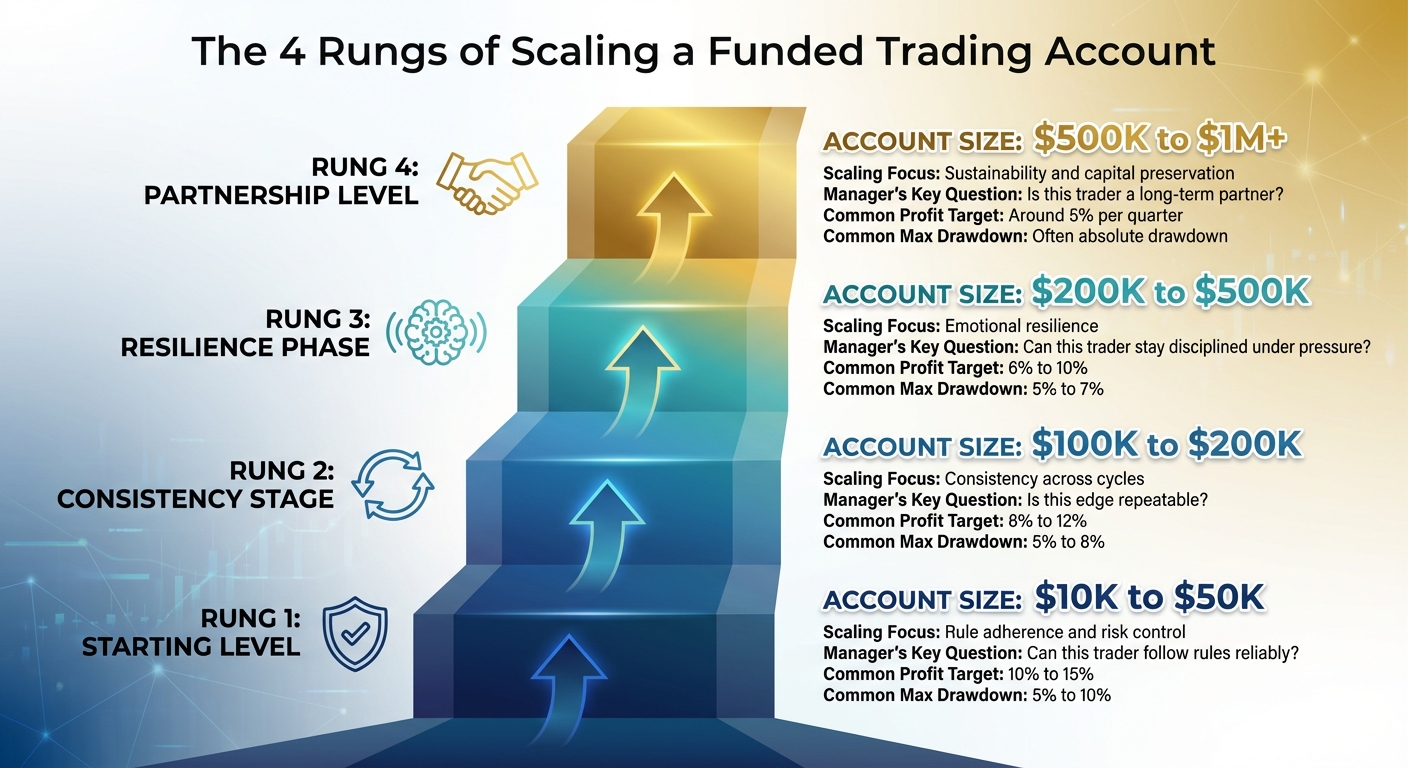
Funded Trading Account Scaling Rungs: Size, Targets, and Drawdown Limits
Metrics to Track
When monitoring your trading performance, focus on key survival metrics like realized expectancy, maximum drawdown, consecutive losses, average slippage, and intraday volatility. These metrics reveal whether your trading edge holds up in real-world market conditions.
Additionally, keep an eye on your win rate (aim for over 50%), profit factor, and win-to-loss ratio. Prop trading firms prioritize consistent performance, meeting profit targets, and adhering to drawdown limits. As your account grows, shift from fixed-dollar rules to budgets that adjust based on market volatility.
| Rung | Account Size | Scaling Focus | Manager's Key Question | Common Profit Target | Common Max Drawdown |
|---|---|---|---|---|---|
| Rung 1 | $10K to $50K | Rule adherence and risk control | Can this trader follow rules reliably? | 10% to 15% | 5% to 10% |
| Rung 2 | $100K to $200K | Consistency across cycles | Is this edge repeatable? | 8% to 12% | 5% to 8% |
| Rung 3 | $200K to $500K | Emotional resilience | Can this trader stay disciplined under pressure? | 6% to 10% | 5% to 7% |
| Rung 4 | $500K to $1M+ | Sustainability and capital preservation | Is this trader a long-term partner? | Around 5% per quarter | Often absolute drawdown |
Leverage your trading platform's dashboard and analytics tools to monitor performance in real time and avoid breaking rules. Maintain a trading journal to record every scale-up decision, including your reasoning and the results, to refine your strategy over time. Categorize mistakes into two types: mechanical (e.g., incorrect entry, missed stop) and psychological (e.g., revenge trading, fear-based exits), so you can address each effectively.
By tracking these metrics, you'll create a solid foundation for tackling the emotional challenges that come with scaling up your trading account.
Handling Psychological Pressure
Once your performance metrics are clear, it's time to tackle the emotional challenges that often disrupt disciplined trading. Larger position sizes magnify every market movement, which can lead to impulsive decisions and rule-breaking as emotions intensify.
To counter this, shift your focus from monetary outcomes to execution. Use a pre-trade checklist to confirm your setup, stop-loss, and risk percentage before entering any trade. This routine keeps your attention on meeting trade criteria rather than fixating on potential gains or losses. Regularly record your mindset to identify emotional patterns that could be affecting your performance - these patterns often explain significant swings in results.
Professional traders typically risk no more than 1% of their account balance on a single trade and use only 20% to 30% of their available margin. This approach helps keep emotional reactions in check and ensures a more measured response to market fluctuations.
Recovering From Drawdowns
After managing emotional hurdles, focus on strategies for recovering from setbacks. When experiencing a drawdown, reduce your position size to previous levels and pause trading until you regain both profitability and confidence. Use this downtime to relax or refine your trading plan.
Adapt your position sizes dynamically during periods of high volatility. Strictly adhere to your funded program's rules, including daily loss limits and maximum drawdowns, to protect your account. If an auto-trigger or manual override occurs, conduct a one-page postmortem within 48 hours to analyze the mistake and implement actionable improvements.
It's worth noting that over 90% of traders lose money in the stock market, and only about 10% achieve consistent profitability. Companies with risk management plans see a 30% boost in project success rates. Ultimately, your ability to recover from drawdowns - not just avoid them - determines your longevity in the trading world.
Conclusion
Scaling a funded account safely isn't about taking shortcuts or chasing quick wins - it's about sticking to the fundamentals: following rules, managing risk, and keeping a close eye on your performance. As Benjamin Graham wisely said, "The magic of compounding returns is the biggest mathematical discovery of all time". But remember, compounding only works when your capital is protected.
Keep your risk per trade between 1% and 2%, and increase your position sizes gradually. Tools like calculators and market-based adjustments can help ensure your risk stays proportional as your account grows. Every decision should be calculated and intentional, not based on emotion or impulse.
Platforms like For Traders provide resources designed to support steady growth, allowing you to focus on executing trades while the platform manages the technical side of things.
Recovering from drawdowns is a critical part of staying in the game. When setbacks happen, scale down your position sizes and use a trading journal to identify patterns in your mistakes - whether they're mechanical errors or psychological missteps. As noted earlier, consistent tracking and strict adherence to risk limits are non-negotiable for long-term success. While over 90% of traders lose money in the stock market, those who emphasize quality over quantity and adapt to changing market conditions often find themselves among the 10% who achieve consistent profitability.
Managing a larger account doesn't mean taking bigger risks - it means refining your approach to risk management. By applying these principles daily, you can protect your capital and build a foundation for sustainable growth.
FAQs
Why is it important to follow risk limits when managing a funded trading account?
Sticking to risk limits is crucial for keeping your funded trading account secure and setting yourself up for long-term success. It helps you avoid major losses, ensures your trading stays within program guidelines, and protects your capital from steep drawdowns.
When you follow risk limits, you build discipline, steer clear of impulsive decisions, and lay the groundwork for steady progress. This strategy not only keeps your account intact but also boosts your ability to grow and scale your trading safely over time.
What’s the best way to stay emotionally balanced while growing my trading account?
Staying emotionally steady in trading begins with a solid risk management plan. One effective approach is to keep your risk per trade consistent - typically around 1–2% of your account balance - and always use stop-loss orders to safeguard your capital. Sticking to your predefined trading rules can help you avoid impulsive, emotionally-driven decisions.
Make it a habit to regularly evaluate your performance, focusing on the process rather than obsessing over the size of your trades. If you’re feeling unsure, consider practicing with a demo account. This allows you to simulate larger trades and build confidence without financial pressure. Ultimately, patience and consistency are crucial for developing the psychological resilience needed as you grow your account.
What are the best strategies for recovering from a drawdown in a trading account?
Recovering from a drawdown calls for a steady hand and a clear plan. The first step? Keep your risk per trade in check - aim for no more than 1-2% of your account balance. During this period, it’s often wise to reduce your position sizes to safeguard your remaining capital.
Next, take a hard look at your trading strategy. Pinpoint any flaws or missteps that might have led to the losses. Stick to your plan, steer clear of emotional decisions, and focus on building consistency. Set achievable profit goals - like aiming for 7% growth - to slowly rebuild your account without exposing yourself to unnecessary risks.
And don’t underestimate the power of stepping away. If stress starts to mount, take a break to clear your mind and reset. A disciplined approach and a calm, focused mindset are your best allies on the road to recovery.
Related Blog Posts
Start Trading with For Traders
Join our platform to test your trading skills, trade virtual capital, and earn real profits. Access educational resources, advanced tools, and a supportive community to enhance your trading journey.
Start your Trading Challenge