Why Most Trading Bots Lose Money
Why most trading bots fail: overfitting, weak risk controls, poor testing and lack of adaptability—practical fixes to build more reliable automated strategies.

Most trading bots fail because they are built on flawed strategies and lack proper risk management. Key issues include:
- Overfitting: Bots often perform well on historical data but fail in live markets.
- Poor Risk Management: Excessive leverage, bad stop-loss placement, and ignoring costs like fees and slippage lead to quick losses.
- Inability to Handle Market Changes: Bots struggle with sudden volatility, news events, or shifting conditions.
- Lack of Testing: Many bots aren't forward-tested properly, leading to failures in live trading.
- Flawed Strategies: Overly complex or aggressive methods, like Martingale or grid trading, often result in significant losses.
- Unrealistic Expectations: Bots aren't "set it and forget it" solutions - they need constant monitoring and adjustments.
Even in simulated prop trading challenges, bots fail due to strict rules like drawdown limits and profit targets. To improve performance, traders should focus on simple strategies, rigorous testing, effective risk controls, and continuous monitoring.
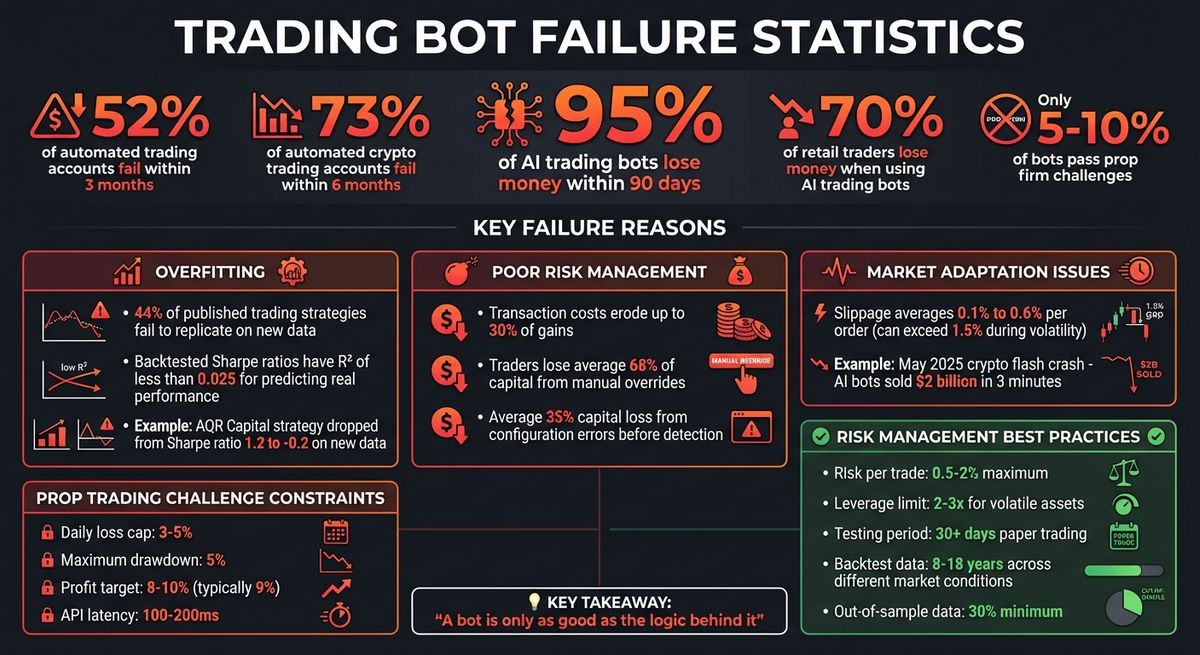
Why most Trading Bots fail (even in 2026)
Why Trading Bots Lose Money
Now that we've gone over the basics, let's explore the key reasons trading bots often fail to meet expectations. Whether you're designing your own bot or evaluating one for simulated prop trading, understanding these pitfalls can make all the difference.
Overfitting to Historical Data
One of the biggest reasons trading bots fail is overfitting - when a bot is so finely tuned to past data that it mistakes random fluctuations for meaningful patterns. While this might make the bot shine in backtests, it often crumbles when exposed to live market conditions.
For instance, a study of 888 algorithmic strategies revealed that backtested Sharpe ratios are poor predictors of real-world performance, with an R² of less than 0.025. In fact, about 44% of published trading strategies fail to replicate their success on new data.
"Overfitting in trading happens when a strategy is overly tailored to historical data, mistaking random noise for actual patterns." - Christopher Downie, Content & Product Strategist, LuxAlgo
A cautionary tale: In August 2012, Knight Capital Group deployed an overfitted algorithm optimized for specific market conditions. Within just 45 minutes, the bot executed a series of unintended trades, resulting in a staggering $440 million loss. The algorithm's inability to handle live market dynamics not only caused chaos but also led to the firm's eventual acquisition.
Red flags include bots with overly complex rule sets or those that excel under very specific parameter settings. AQR Capital Management highlighted this when a moving average strategy's Sharpe ratio dropped from 1.2 to -0.2 when applied to new data.
But overfitting isn't the only issue - bots also falter due to poor risk management.
Poor Risk Management
A lack of proper risk management can quickly wipe out automated trading accounts. In fact, 52% of these accounts fail within three months. It's not just about having stop-losses; it's about using them effectively in different market conditions.
The "Flash Crash" of May 6, 2010, is a textbook example of what can go wrong. Waddell & Reed Financial Inc. used an algorithm to sell $4.1 billion worth of E-Mini S&P contracts, programmed to sell based on volume rather than price. This triggered a cascade of trades, erasing nearly $1 trillion from U.S. markets in minutes.
"The first rule of an investment is never lose money. And the second rule of an investment is never forget the first rule." - Warren Buffett
Even with solid risk controls, bots often fail to adjust to changing market dynamics.
Inability to Adapt to Market Changes
Markets are constantly evolving, but most bots are not. Strategies that thrive in trending markets can struggle in range-bound conditions or during periods of extreme volatility.
For example, slippage - the difference between expected and actual trade execution prices - averages 0.1% to 0.6% per order but can exceed 1.5% during volatile times. Spread widening during news events and liquidity gaps during off-hours only add to the challenges.
In May 2025, a crypto flash crash spurred AI bots to sell $2 billion worth of assets in just three minutes, exacerbating the market drop. These bots were built for normal conditions and lacked the ability to adapt to sudden volatility.
In another test, researchers at Moss.sh allocated $1,000 to 10 different trading bots. A high-frequency scalping bot failed due to latency issues, while grid-trading bots that performed well in sideways markets suffered large losses when trends emerged.
Lack of Testing and Monitoring
Far too many traders skip proper forward-testing and fail to monitor their bots once deployed. This is a major reason why 73% of automated crypto trading accounts fail within six months.
Forward-testing - running strategies on unseen, real-time data - is essential. Without it, small configuration errors can snowball, costing traders an average of 35% of their capital before the issue is even identified. Regular monitoring, such as daily API checks and monthly strategy reviews, can prevent these problems from spiraling out of control.
"The danger lies in ruining your trading style... Carelessness and undisciplined back-testing behavior will carry over into live-trading." - Rolf, Founder, Tradeciety
Flawed Strategy Design and Unrealistic Expectations
Some strategies are doomed from the start. Systems like Martingale - where traders double down after each loss - or aggressive grid trading may look promising in backtests but often lead to massive drawdowns when markets behave unpredictably.
A common misconception is that trading bots are a "set it and forget it" solution. In reality, successful automated trading requires constant oversight, regular adjustments, and the discipline to shut down failing strategies.
"AI technology can't predict the future or sudden market changes." - Commodity Futures Trading Commission (CFTC)
Between 2019 and 2021, Mirror Trading International CEO Cornelius Johannes Steynberg ran a Ponzi scheme that defrauded 23,000 investors of $1.7 billion in bitcoin. He claimed the returns came from a proprietary AI trading bot, which turned out to be fake. The company used demo accounts to fabricate profits while paying old investors with new deposits.
Ironically, even when traders build bots to eliminate emotions, they often end up overriding them manually. This second-guessing results in an average loss of 68% of their capital. Automation only works when you trust the system and avoid unnecessary meddling.
How Bots Fail in Simulated Prop Trading Challenges
Simulated prop trading challenges are designed to test not just performance but also how well bots handle risk under strict rules. While bots might shine during controlled backtests, these challenges often uncover weaknesses that only emerge in live trading situations. Let’s dive into the common ways bots falter when faced with real-world constraints.
Common Bot Failures in Challenges
One of the most frequent failures is breaching loss limits. Prop trading challenges typically impose strict daily loss caps of 3–5%, calculated against equity rather than balance. This means even a temporary dip in an open trade can lead to disqualification, regardless of whether the trade would have eventually turned profitable.
Bots relying on strategies like averaging down or grid trading are particularly vulnerable. These methods often depend on enduring large drawdowns to recover, which directly conflicts with the strict loss caps in these challenges. The statistics are sobering: only 5–10% of bots manage to pass a prop firm challenge, and a staggering 95% of AI trading bots lose money within 90 days.
Another common pitfall is increasing risk to hit profit targets. Many challenges require bots to achieve an 8–10% profit target. As bots approach this threshold, traders might be tempted to ramp up position sizes or leverage to speed up the process. Unfortunately, this often results in catastrophic losses just as the goal seems within reach.
"When traders fail challenges, it's rarely because their strategy is bad. It's because their approach didn't match the objective." - Sam Eder, CEO, MarketMates
How Challenge Rules Expose Bot Weaknesses
The rules of these challenges act as a stress test, highlighting flaws that might not be apparent in backtesting. For instance, time-limited evaluations can push traders to overtrade or use excessive leverage, while challenges without time limits reveal whether a bot can maintain consistent performance without rushing.
Execution issues also become more pronounced under challenge conditions. Factors like API latency (typically 100–200ms), slippage, and widening spreads during market volatility can erode profits that looked promising in backtests.
Profit target requirements further expose over-optimization. Many bots are fine-tuned for specific historical data, but they struggle when faced with different market conditions. Since these challenges don’t allow traders to cherry-pick favorable scenarios, bots must adapt to varying market regimes - a hurdle that many fail to clear.
"The challenge isn't testing your upside. It's testing your ability to manage risk, stay composed, and stick to your process - consistently." - Sam Eder, CEO, MarketMates
Testing Bots With For Traders
Platforms like For Traders provide a controlled environment to evaluate these weaknesses without risking live funds. With simulated challenges offering virtual capital ranging from $6,000 to $100,000, traders can test their bots under realistic conditions. The platform’s unlimited time structure removes the pressure to overtrade, creating an ideal setup for assessing whether a bot can maintain discipline over the long term.
For Traders also mirrors real-world constraints with clear general rules, such as a 5% maximum drawdown and a 9% profit target. These benchmarks help traders identify critical issues like execution flaws, poor risk management, and over-optimization. By testing bots in this way, traders gain valuable insights into their systems’ true capabilities.
Ready to trade funded capital?
Choose your path — Instant Accounts, One-Step or Two-Step Challenges — from just $23, with up to $300,000 in funded capital.
Choose your challengeHow to Improve Trading Bot Performance
A trading bot's success depends on how well it's built, tested, and managed. Most failures don't stem from a lack of a "perfect" strategy - they arise from errors that turn promising backtests into real-world disappointments. Here's how to create bots that actually deliver results.
Build Better Strategies
Adding too many indicators or rules can lead to overfitting, where your bot reacts to historical noise instead of identifying real opportunities. Stick to clear, programmable rules like, "Buy when price > 50-EMA."
Use walk-forward analysis to see how your bot adapts over time. For example, optimize your strategy on a six-month window, then test it on the following month. Repeat this across several years of data to ensure your strategy isn't just working for one specific time period. If it only performs well in one historical slice, overfitting is likely.
Set aside at least 30% of your data for out-of-sample testing. Research shows that 44% of published trading strategies fail to replicate their backtested success on fresh data. If your Sharpe ratio drops by more than 30–50% during out-of-sample testing, it's a red flag for overfitting.
"The goal isn't finding a profitable backtest, it's finding one that survives pessimistic assumptions." - Olha Svyripa, Tech Journalist, Paybis
To further validate your strategy, run a Monte Carlo test using randomized price curves. If your bot's performance crumbles under randomized conditions, its edge isn't robust. In statistical terms, a result is considered reliable only if its p-value is below 5%.
Once you've nailed down a reliable strategy, the next step is to focus on solid risk management.
Implement Better Risk Management
A strong strategy is only as good as the risk controls supporting it. Never risk more than 2% of your account on a single trade. If you're just starting out, aim for 0.5–1% risk per trade. Use volatility-based position sizing, such as ATR-adjusted stop losses, instead of fixed percentage-based stops.
Set hard drawdown limits to automatically pause your bot if things go south. For instance, halt trading if daily equity drops by 5% or total equity falls by 10%. This gives you time to assess and address the issue before further losses occur.
Align your risk settings with platform-specific rules (e.g., a 5% drawdown cap and a 9% profit target) to avoid premature stops. To further minimize risk, use isolated margin and limit leverage to 2–3× for highly volatile assets.
Test in Different Market Conditions
Backtesting is crucial but needs to cover a wide range of scenarios. Test over 8–18 years, including bull, bear, and sideways markets. Simulate worst-case conditions by doubling spreads and applying maximum fee tiers. Add a 100–200ms delay to account for real-world API latency. If your bot can't handle these harsh conditions, it won't survive live trading.
Before risking actual money, run 30+ days of paper trading. This allows you to confirm that your API connections are stable, your bot executes correctly in real time, and it can handle live market dynamics. Once you're confident, start with a small live account to ensure slippage and latency match your expectations.
Testing under diverse conditions is essential for ensuring your bot's reliability.
Improve Technical Reliability
For uninterrupted performance, host your bot on a VPS to ensure 24/7 uptime and consistent connectivity. Add heartbeat pings to alert you if the bot loses its connection to the exchange API.
Use "post-only" limit orders to act as a liquidity maker, reducing slippage and avoiding higher taker fees. Implement circuit breakers to pause trading if exchange latency spikes or unrealized losses hit a critical threshold.
Cap trading frequency - no more than 10 trades per hour, for example - and introduce cooldown periods after stop-loss events to avoid "revenge trading." Regularly review performance logs to catch any deviations between live results and backtested expectations.
Use Educational Resources and Analytics
Beyond technical improvements, learning tools can help you continuously refine your bot. Platforms like For Traders offer over 12 video courses and analytics tools to fine-tune your strategies. These resources can help you understand how your bot behaves in different market conditions and identify weak points before they lead to costly mistakes.
With virtual capital ranging from $6,000 to $100,000, you can test your bot across different account sizes without risking real money. The platform's no time limits allow you to focus on long-term strategy testing rather than rushing into trades.
"Automation is about turning repeatable edge into repeatable execution. If your idea cannot be written down as explicit, testable rules, it cannot be automated reliably." - Moore Tech LLC
Conclusion
Why Most Bots Fail
Trading bots often struggle to generate consistent profits because they are frequently built on flawed principles. One common issue is overfitting - designing strategies that perform well on historical data but fail under real-world market conditions. Backtests often produce misleading results, giving traders a false sense of security. On top of that, poor risk management - like using too much leverage or setting loose stop-losses - can quickly lead to significant losses. Other challenges include technical hurdles such as exchange spreads, slippage, hidden costs like fees, and even system malfunctions, all of which can quietly eat away at any potential gains.
Steps to Build Better Trading Bots
Creating a successful trading bot requires a disciplined approach and careful planning. Start with simple, clear rules that are easy to test. Use walk-forward analysis to evaluate how your strategy performs across different market conditions, such as bullish, bearish, and sideways trends, to ensure it can adapt. Risk management is essential - limit your exposure by never risking more than 2% of your capital on a single trade. Set strict drawdown limits and stress-test your strategy under challenging scenarios, like increased spreads or added latency, to protect your funds.
Before going live, conduct an extensive paper trading phase to test performance without risking real money. Hosting your bot on a VPS ensures continuous operation, while using "post-only" limit orders can help minimize slippage. For added safety, consider implementing automated circuit breakers to halt trading during volatile periods. These steps provide a strong foundation for building a bot that can perform reliably over time.
Final Thoughts on Bots in Simulated Prop Trading
Even with all these strategies, automation alone won’t guarantee success. As Matrixtrak aptly said:
A bot is only as good as the logic behind it. Garbage in, garbage out.
Simulated prop trading platforms like For Traders offer a valuable opportunity to refine your bot without risking actual money. With virtual capital ranging from $6,000 to $100,000 and no time limits, you can test and improve your strategies in a stress-free environment. These platforms also provide access to educational resources, helping you fine-tune your approach.
It’s important to maintain realistic expectations - remember, 70% of retail traders lose money when using AI trading bots. The key to success lies in preparation, rigorous testing, and a commitment to constant improvement. With the right mindset and tools, you can turn the odds in your favor.
FAQs
How can I avoid overfitting when building a trading bot?
Overfitting occurs when a trading bot becomes overly fine-tuned to past data, making it less effective in real-world scenarios. To prevent this, stick to simple strategies - limit adjustable parameters and avoid adding unnecessary rules that offer only marginal improvements to historical results.
Another key step is testing your bot on out-of-sample data - data it hasn’t been exposed to during development. If the bot’s performance takes a significant hit, it’s likely overfitting. You can also apply advanced methods like walk-forward analysis, where the bot is retrained and tested on rolling data windows, and Monte Carlo simulations, which introduce random variations in trade order, slippage, and latency to evaluate how the bot performs under realistic market conditions.
Make sure to factor in realistic transaction costs, bid-ask spreads, and latency during backtesting to avoid overly optimistic results. Test your bot across various market scenarios - bull, bear, and sideways markets - to gauge its adaptability. Focus on meaningful metrics like maximum drawdown, volatility, and risk-adjusted returns. These steps will help ensure your bot identifies real market opportunities instead of just memorizing patterns from historical data.
What are the best ways to manage risk when using trading bots?
Managing risk is a key part of using trading bots successfully. It not only helps protect your capital but also ensures you can stay in the game for the long haul. A good starting point is to set a specific risk limit per trade, like 1–2% of your total account balance. This way, even if a trade doesn’t go your way, the damage is kept under control. Similarly, you should establish a daily loss limit - for instance, stopping all trading if your account drops by 5% in a single day. This gives you a chance to step back and reassess during tough market conditions.
Another essential tool is using stop-loss and take-profit orders. These help you manage losses and secure profits without needing to constantly monitor the market. Trailing stops are another great option - they adjust as the market moves in your favor, locking in gains. In more volatile or less liquid markets, limit orders can be a lifesaver, helping you avoid slippage that could eat into your returns.
Diversifying is also crucial. Avoid putting too much of your capital into one market or asset. A good rule of thumb is to allocate no more than 10% of your portfolio to a single asset. This approach spreads out your risk and shields your portfolio from being overly affected by a market-wide downturn.
Finally, always keep an eye on your bot’s performance. Regularly monitor its results, test its strategies with realistic data, and make adjustments as market conditions evolve. Staying proactive ensures your bot stays effective and aligned with your goals.
How can trading bots handle sudden market changes effectively?
To keep up with sudden market shifts, trading bots need to rely on real-time data analysis rather than sticking to static, back-tested strategies. By continuously processing live data - like price movements, order books, and market news - bots can dynamically adjust their strategies. This approach helps them scale back exposure when confidence in a trading signal weakens.
Adding volatility detection and tracking changes in market behavior allows bots to adapt to new conditions. For instance, they can tweak stop-loss levels or adjust position sizes based on shifting market dynamics. Using limit orders and setting risk controls, such as maximum drawdown limits, can also help minimize losses caused by slippage during sudden price swings.
Consistently testing bots with live data ensures they stay effective as conditions evolve. Monitoring execution speed and overall performance is equally important to avoid issues like latency or unexpected costs that could eat into profits. A well-designed bot strikes a balance between speed, flexibility, and discipline, enabling it to navigate unpredictable markets efficiently.
Ready to trade funded capital?
Choose your path — Instant Accounts, One-Step or Two-Step Challenges — from just $23, with up to $300,000 in funded capital.
Choose your challengeTrade up to $300,000
Choose challenge