Why Most Traders Fail Funded Challenges (and How to Succeed)
Learn why most traders fail funded challenges—risk mismanagement, emotional trading, and poor preparation—and practical steps to pass.

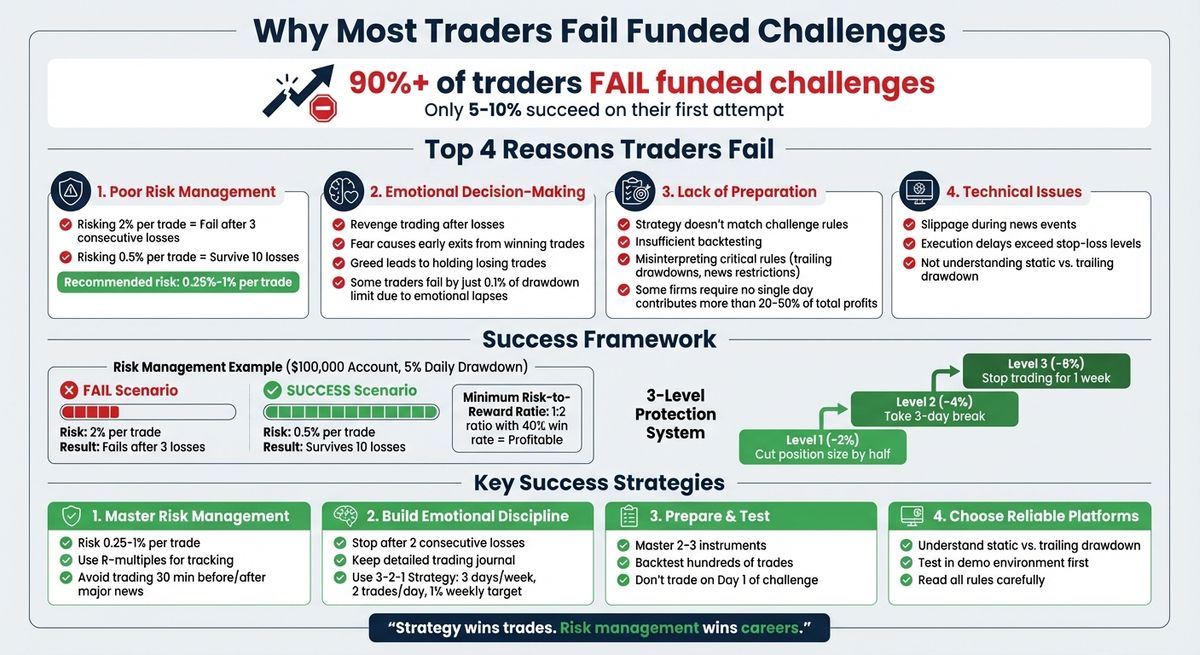
Over 90% of traders fail funded challenges. Why? It's not weak strategies - it’s poor risk management, emotional decisions, and a lack of preparation. Funded challenges test your ability to manage risk, stick to rules, and stay disciplined under pressure. Here’s how you can succeed:
- Risk Small: Risk 0.25%-1% per trade to survive losing streaks.
- Control Emotions: Avoid revenge trading, avoid overtrading, and fear-driven decisions.
- Prepare Thoroughly: Backtest your strategy, understand challenge rules, and align your approach with the evaluation criteria.
The key isn’t just hitting profit targets - it’s proving you can trade responsibly. Stay disciplined, manage risk, and test your strategy to join the 10% who succeed.
How to Pass ANY Prop Firm Challenge (and Actually Get Paid Out) | The Trader's Edge
Why Traders Fail Funded Challenges
To succeed in funded trading challenges, it's vital to understand why traders often fall short. The reasons aren't random - they're consistent, measurable, and, most importantly, avoidable. Let’s dive into the four main reasons that derail trading ambitions before they even get off the ground.
Poor Risk Management
One of the biggest pitfalls is mishandling risk. Over-leveraging is a surefire way to fail. Using oversized lot sizes in pursuit of quick profits can trigger daily drawdown limits after just one or two losses. For instance, a trader risking 2% per trade could fail a challenge after three consecutive losses in a single day. On the other hand, someone risking just 0.5% per trade could endure as many as 10 losses before hitting the same limit.
The numbers don’t lie. Seasoned traders suggest keeping risk between 0.25% and 1% per trade to weather inevitable losing streaks.
"Strategy wins trades. Risk management wins careers." - BabyPips
Another common mistake is failing to use stop-losses or adjusting them during a losing trade. This opens the door to unlimited risk and often leads to revenge trading. Some trading firms enforce strict risk ceilings, such as limiting risk to 1% per trade. Violating these limits can result in flagged accounts or denied payouts, even if the profit targets are met.
Emotional Decision-Making
Even with sound technical strategies, emotions can wreak havoc on performance. Under pressure, traders often abandon their plans and make impulsive decisions, leading to broken rules.
Revenge trading is particularly damaging. After a loss, traders may increase risk or force trades in an attempt to recover, which often results in breaching maximum loss rules. In some cases, traders fail challenges by as little as 0.1% of a drawdown limit due to emotional lapses on trades that might have eventually turned profitable.
Fear and greed are also major obstacles. Fear can cause traders to exit winning trades too early, while greed leads to holding onto losing trades, hoping for a reversal. Many traders fall into the "finish line" trap, where they abandon discipline as they near a profit target, taking unnecessary risks or entering marginal trades to speed up completion.
"Control your emotions, and your accounts will control its growth." - Abdullah Shah, Content Writer and Market Analyst
Lack of Preparation and Strategy Fit
Emotional mistakes often stem from a deeper issue: lack of preparation. A mismatch between trading style and challenge rules is a recipe for failure. For example, using a swing trading strategy in a challenge with a short time frame or restrictions on overnight positions creates immediate conflict. Even traders who pass challenges often lose their funded accounts later because their strategies don’t align with the rules or objectives.
"When traders fail challenges, it's rarely because their strategy is bad. It's because their approach didn't match the objective." - Sam Eder, CEO, MarketMates
Insufficient backtesting strategies is another common issue. Without testing their strategy over hundreds of trades, traders often underestimate its maximum drawdown, leading to overly aggressive risk settings that clash with the challenge’s limits. Misinterpreting general trading rules only makes things worse. Many traders overlook critical details like trailing drawdowns, restrictions on trading during news events, or consistency requirements.
Under pressure, unprepared traders often abandon their plans, chasing random setups that erode their edge. Some firms even require that no single trading day contributes more than 20% to 50% of total profits, which disqualifies traders who rely on a few big wins rather than a consistent approach.
Technical Issues and Rule Misinterpretation
Even the best strategy can fail due to technical problems. Slippage, spread widening during news events, and execution delays can cause trades to exceed intended stop-loss levels, resulting in unexpected drawdown violations. Understanding how your platform calculates drawdown - whether it’s static (a fixed floor) or trailing (adjusts upward with profits) - is critical.
For example, in a trailing drawdown system, a $100,000 account that grows to $103,000 would set a new floor at $97,000. Other factors, such as commission costs, execution speed, and weekend gap risks, also play a significant role, especially for scalpers and high-frequency traders. Testing your strategy in a demo account can help you identify and address these potential technical pitfalls.
How to Succeed in Funded Challenges
Once you understand the common pitfalls, the next step is to focus on actionable strategies that can help you navigate these challenges effectively. Succeeding in a funded challenge requires discipline, preparation, and consistent application of proven methods.
Master Risk Management
Protecting your capital should always be your top priority. Successful traders typically risk between 0.25% and 1% per trade to weather losing streaks without jeopardizing their accounts. For instance, if you’re managing a $100,000 account with a 5% daily drawdown limit, risking 2% per trade could lead to failure after just three consecutive losses. In contrast, risking 0.5% per trade allows you to endure up to 10 losses.
Use R-multiples to measure your trades. For example, with a $100,000 account and a 1% risk per trade, 1R equals $1,000. To pass Phase 1, your goal is to achieve +10R before hitting -10R.
Implement a 3-Level Protection System to maintain discipline:
- Level 1 (Alert at -2%): Cut your position size by half and focus only on high-quality setups.
- Level 2 (Stop at -4%): Take a mandatory three-day break to analyze what went wrong.
- Level 3 (Danger at -6%): Step away from trading for an entire week.
Always aim for a 1:2 risk-to-reward ratio at a minimum. With this setup, even if your win rate is only 40%, you can remain profitable. Monitor your equity, including open trades, as floating losses can still trigger drawdown violations.
Additionally, avoid trading during volatile periods, such as 30 minutes before and after major news events like NFP, FOMC, or CPI releases. These times often lead to slippage that could breach your limits.
"The challenge isn't testing your upside. It's testing your ability to manage risk, stay composed, and stick to your process." Sam Eder, CEO, MarketMates
Build Emotional Discipline
Even the most advanced technical skills won’t save you if emotions dictate your decisions. To succeed, you need systems in place to minimize emotional interference.
After two consecutive losses, step away from your screen. This helps avoid revenge trading - a destructive habit where traders try to recover losses impulsively. Many accounts are blown because of this emotional reaction to a bad session.
Keep a detailed trading journal. Don’t just log entry and exit points - record your emotional state, the rationale behind each trade, and whether you stuck to your plan. Over time, you’ll notice patterns, such as a tendency to overtrade on certain days or exit winning trades too early.
Consider the 3-2-1 Strategy to reduce emotional errors: limit yourself to three trading days per week, two trades per day, and aim for a 1% weekly profit target.
Here’s a quick guide to managing common emotional triggers:
Be cautious of the "finish line" trap. When you’re close to your profit target (90–95%), it’s easy to take unnecessary risks. Stay disciplined and stick to the same approach that got you there.
"Be fearful when others are greedy and greedy when others are fearful." Warren Buffett
Next, ensure your strategy is well-prepared and thoroughly tested to complement your emotional discipline.
Prepare and Test Your Strategy
Jumping into a challenge without preparation is a recipe for failure. Focus on mastering two or three instruments, such as EUR/USD or Gold, to understand their volatility patterns and how they react to news. Document every detail of your strategy, including specific entry and exit rules, and maintain a recommended risk per trade of 0.5–1%.
Before taking on a real challenge, practice on a demo account with the same capital and risk constraints (e.g., a $100,000 account with a 5% daily drawdown limit). This helps you build confidence and understand your strategy’s maximum drawdown.
Don’t trade on the first day of the challenge. Use that time to familiarize yourself with the platform, test execution speeds, and review the economic calendar. Align your strategy with the challenge’s specific rules to avoid surprises.
"Start with your objectives. Then build your strategy to meet those objectives - not the other way around." Sam Eder, CEO, MarketMates
Keep in mind that only 5–10% of traders pass prop firm challenges. Most failures aren’t due to bad strategies but a mismatch between the trader’s approach and the challenge’s rules.
Finally, support your strategy with the right tools and platforms.
Choose Reliable Platforms and Tools
A dependable trading platform is crucial for executing your strategy effectively and managing risk. Technical issues like slippage, spread widening, or execution delays can derail even the best-prepared trader, potentially causing unexpected drawdown violations.
Understand how your platform calculates drawdown limits:
- Static Drawdown: This is fixed based on your starting balance. For example, a $100,000 account with a 10% static drawdown fails once it drops to $90,000.
- Trailing Drawdown: This limit adjusts upward as your account grows. For instance, if your $100,000 account reaches $103,000, the new floor becomes $97,000.
Choose a platform that offers fair execution, minimal technical issues, and clear rules. Features like unlimited time limits and customizable trading rules allow you to trade at your own pace without unnecessary pressure. Test the platform in a demo environment to identify potential issues, such as high commission costs, weekend gap risks, or execution delays - especially if you’re a scalper or high-frequency trader.
Finally, read the firm’s FAQ and terms carefully. Some firms enforce unwritten rules, like consistency requirements (e.g., no single day can account for more than 20–50% of total profits) or strict risk ceilings (e.g., a 1% maximum risk per trade). Violating these can lead to account flagging or even payout denial.
Ready to trade funded capital?
Choose your path — Instant Accounts, One-Step or Two-Step Challenges — from just $23, with up to $300,000 in funded capital.
Choose your challengeHow For Traders Supports Your Success
For Traders tackles the typical challenges faced by traders by offering a range of evaluation options - 1-Step, 2-Step, and Instant Funding - that cater to different trading styles and experience levels. Here's a closer look at how their plans, educational tools, and advanced features are designed to help you succeed.
Plans and Pricing
For Traders provides five virtual capital tiers, each with clear profit targets and drawdown limits. These plans allow you to trade at your own pace, thanks to unlimited time limits, so you can focus on quality trades without feeling rushed.
The platform enforces a maximum position size of less than 2% per trade. For 1-Step evaluations, the daily drawdown limit is 4%, with a 5% total maximum. In 2-Step evaluations, both the daily and total drawdown limits are set at 5%.
Educational Resources and Community
Every plan includes access to 12+ video trading courses, designed to promote disciplined, process-driven trading. These courses tackle common mistakes like overleveraging and revenge trading, issues that often derail traders attempting funded challenges. To date, For Traders has supported over 45,000 students with 17+ lessons and 5 hours of on-demand video content.
Beyond the courses, you’ll also find a vibrant Discord community where you can connect with industry experts and fellow traders. This community helps combat the loneliness that can lead to emotional decision-making, while offering valuable insights. For added support, For Traders provides AI-driven tools, including ChatGPT prompts, to help you develop objective, rules-based trading plans and remove emotional bias from your strategy.
Advanced Tools for Risk Management
For Traders doesn’t stop at education and community - it also equips you with cutting-edge tools for managing risk. The platform supports professional-grade software like cTrader, DXTrade, TradeLocker, and TradingView, offering advanced charting and risk management features. These tools make it easier to implement strategies like R-multiple tracking, a method that focuses on units of risk rather than dollar amounts, helping you stay emotionally detached from account fluctuations.
To ensure consistent rewards for successful traders, For Traders offers bi-weekly payouts. They also provide structured transition plans, such as a 7-day micro-trading period, to help traders adjust to the pressures of managing a funded account.
Whether it’s through education, community support, or advanced technology, For Traders gives you the tools you need to trade with confidence and discipline.
Conclusion: How to Pass Funded Challenges
To pass funded challenges, focus on three key areas: risk management, emotional control, and thorough preparation. Many traders fail - not because they lack a profitable strategy - but because they exceed drawdown limits, overtrade during losing streaks, or misinterpret the rules. It's worth noting that fewer than 10% of traders succeed on their first attempt. These foundational principles, emphasized throughout this article, are crucial for navigating funded challenges effectively.
"The challenge isn't testing your upside. It's testing your ability to manage risk, stay composed, and stick to your process - consistently." – Sam Eder, CEO, MarketMates
Start by keeping your risk per trade between 0.25% and 1% and backtest your strategy across hundreds of trades to understand your maximum drawdown and win rate. Use the first day to familiarize yourself with platform execution, review top economic calendars, and ensure you have a clear grasp of all the rules.
For Traders simplifies the process by removing common barriers. They provide unlimited time limits, targeted video courses, an active Discord community for support, AI-driven tools for precise planning, and cutting-edge platforms like cTrader and DXTrade for real-time risk tracking.
Ultimately, success in funded challenges comes down to preparation, discipline, and utilizing the right resources. By staying committed to these principles and taking advantage of For Traders' extensive support system, you'll be well-positioned to pass your challenge and build a sustainable trading career.
FAQs
What’s the biggest mistake traders make during funded challenges?
The most common pitfall traders face is putting profit goals ahead of managing risk effectively. This mindset often results in over-leveraging, rash decisions, and emotionally-driven trades - factors that can swiftly throw your trading off course.
The foundation of successful trading lies in safeguarding your capital. Stick to a well-defined risk plan, resist the urge to chase losses, and approach every trade with a calm, disciplined strategy. Think of trading as a marathon, not a sprint - your ability to manage risk will determine your long-term success.
How can I stay in control of my emotions while trading?
Managing your emotions in trading starts with a disciplined approach. Trading isn’t about luck or impulsive decisions - it’s about sticking to a plan. Before entering a trade, ask yourself, Would a professional trader make this move? If the answer is no, then trust your strategy and skip it. Focus on process-driven goals, like consistently following your trading rules, rather than obsessing over hitting specific profit targets in a set timeframe.
Discipline thrives on structure, so build a routine that keeps you grounded. Use tools like a pre-trade checklist to stay focused, take scheduled breaks after losses to clear your head, and work on detaching from the outcome of individual trades. A trading journal is another powerful tool - it can reveal emotional patterns, such as fear or overconfidence, that might be influencing your decisions. Recognizing these patterns is the first step toward addressing them.
To keep stress in check, limit your risk per trade - for example, cap it at 1% of your account - and stick to daily loss limits. If emotions start to take over, pause. Take a deep breath, or step away for a moment to regain clarity. Practicing these habits on a demo account can help you develop the emotional toughness needed to handle real-world trading challenges.
Why is backtesting so important before attempting a funded challenge?
Backtesting plays a key role in preparing for trading challenges. By using historical market data, you can test your trading strategy to see how it might have performed in actual market conditions. This process helps pinpoint any flaws in your approach and gives you the chance to fine-tune it before putting real money on the line.
When you backtest, you’re not just testing a theory - you’re building trust in your strategy. It provides the data-driven insights needed to meet the rigorous demands of a funded challenge. With this preparation, you can approach trading with a solid plan and the discipline to stick to it.
Ready to trade funded capital?
Choose your path — Instant Accounts, One-Step or Two-Step Challenges — from just $23, with up to $300,000 in funded capital.
Choose your challengeTrade up to $300,000
Choose challenge