

Manipulative trading practices distort markets, mislead investors, and cause financial losses. They damage trust in trading systems, making it harder for prices to reflect true value. Here are five harmful tactics to watch for:
- Wash Trading: Fake buying and selling to inflate trading volume.
- Spoofing and Layering: Placing fake orders to trick others into reacting.
- Pump and Dump Schemes: Artificially inflating prices before selling off.
- Quote Stuffing: Overloading systems with rapid orders to gain an unfair edge.
- Momentum Ignition Trading: Creating false trends to profit from price spikes.
These practices harm market efficiency, erode trust, and carry severe legal penalties. Always stay informed to protect your investments.
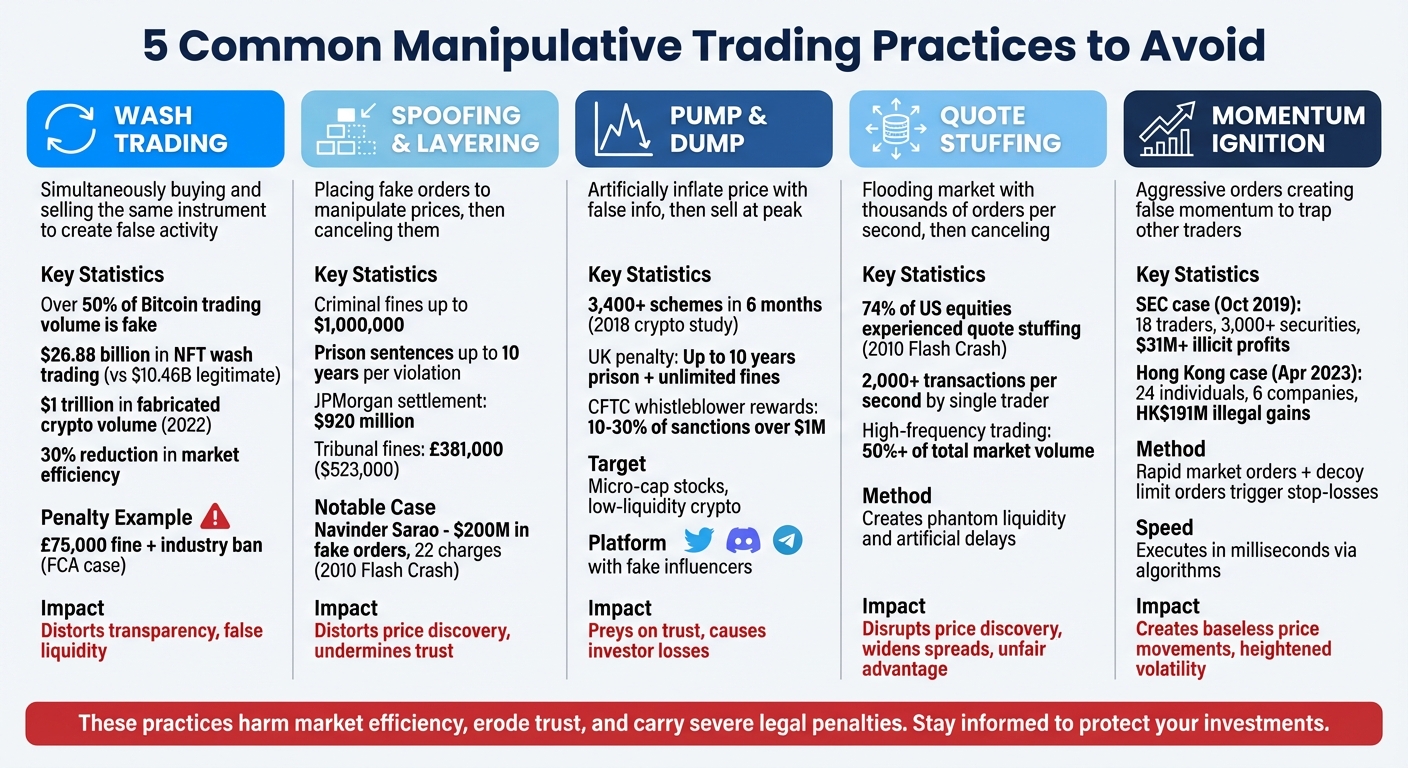
5 Manipulative Trading Practices: Tactics, Penalties, and Impact
Market MANIPULATION (Simply Explained for Beginners 2021)
1. Wash Trading
Wash trading is one of the more damaging tactics undermining the integrity of virtual markets. It involves simultaneously buying and selling the same financial instrument, creating the illusion of market activity without any actual change in ownership. The aim? To give a false impression of demand and liquidity.
"Wash trading is the practice of buying and selling a security at the same time with the intent of manipulating the market... giving the perception of increased liquidity and market interest." - Jennie Clarke, Head of Content, Global Relay
The scale of this issue is staggering. A 2022 Forbes analysis of 157 cryptocurrency exchanges revealed that over half of reported Bitcoin trading volume is likely fake or attributed to non-economic wash trades. The NFT market paints an even bleaker picture - wash trading volumes hit approximately $26.88 billion from inception through January 2023, dwarfing the $10.46 billion in legitimate trades. In total, researchers estimated $1 trillion in fabricated cryptocurrency trading volume for 2022 alone. These figures emphasize why regulators have clamped down on this practice.
Enforcement actions illustrate the gravity of wash trading. In 2021, the Financial Conduct Authority (FCA) fined Adrian Geoffrey Horn, a trader at Stifel Nicolaus Europe, £75,000 and barred him from the industry. Horn had placed paired orders in McKay Securities Plc shares to artificially meet daily trading volume thresholds. Similarly, in January 2025, Chainalysis uncovered how the "Donald J. Chump" token used bots to inflate trading volume. Over just five days, bots executed 10,341 paired orders across five addresses, generating $39,723 in fake volume - accounting for 43% of Uniswap's total volume during that period. These cases highlight the widespread harm wash trading causes.
The consequences go far beyond individual trades. Wash trading distorts market transparency, interfering with natural price discovery. High trade volumes often signal demand and liquidity, but wash trading creates a false sense of security - liquidity that disappears when traders attempt to sell. A 2025 study found that wash trading reduced market efficiency by about 30% in live trading environments. The broader impact? It erodes trust in the financial system, making it harder for participants to rely on price and volume data when making decisions. Understanding and addressing these tactics is critical for safeguarding market integrity and investor confidence by implementing risk management strategies.
2. Spoofing and Layering
Spoofing is a prohibited trading tactic where traders place large buy or sell orders without any real intention of following through. The goal? To create a false sense of supply or demand. By tricking other market participants into reacting, spoofers can manipulate prices. Once the market moves in their favor, they cancel the fake orders and execute a genuine trade on the opposite side, profiting from the artificially induced price movement.
Layering takes this deception a step further. Instead of using a single large order, traders place multiple fake orders at various price levels, crafting the illusion of a liquidity "wall" that doesn't exist. This more advanced strategy amplifies the market manipulation, making it harder to detect.
The consequences for these practices are severe. Thanks to the Dodd-Frank Act, spoofing can lead to criminal fines of up to $1,000,000, prison sentences of up to 10 years per violation, and hefty civil penalties. High-profile cases highlight these repercussions, such as JPMorgan Chase's $920 million settlement and fines totaling £381,000 (around $523,000) imposed by tribunals.
One infamous example is British trader Navinder Singh Sarao, who faced 22 charges for using algorithm-driven spoofing during the May 2010 Flash Crash. His actions manipulated $200 million in orders, contributing to a dramatic market collapse.
"While forms of algorithmic trading are of course lawful, using a computer program that is written to spoof the market is illegal and will not be tolerated."
– David Meister, Enforcement Director, CFTC
Aside from legal penalties, spoofers also risk operational pitfalls. If a legitimate order matches with a fake one before it can be canceled, traders might end up in an unfavorable position, potentially facing steep financial losses. Beyond individual risks, these manipulative practices damage the market as a whole by distorting price discovery and undermining trust, ultimately reducing market efficiency.
3. Pump and Dump Schemes
A pump and dump scheme is a two-step scam aimed at exploiting unsuspecting traders. Here's how it works: fraudsters first artificially inflate an asset's price by spreading false or misleading information - the "pump." Then, they sell off their holdings at this inflated price - the "dump" - causing the price to plummet and leaving other investors with heavy losses.
These schemes often target micro-cap stocks or low-liquidity cryptocurrencies, where even small trading volumes can cause significant price fluctuations. A striking example comes from a 2018 study, which uncovered more than 3,400 pump-and-dump schemes in the cryptocurrency market over just six months. Scammers typically rely on platforms like Twitter, Discord, and Telegram to spread hype. They often use fake influencers and bot networks to create the illusion of genuine interest. Such deceitful tactics have not only caught investors off guard but have also pushed regulators to crack down with tough enforcement measures.
Legal consequences for these schemes are severe. In the UK, offenders can face prison sentences of up to 10 years and unlimited fines.
"Pump-and-dump schemes are illegal, manipulative tactics used to artificially inflate the price of a stock or security, then sell it for a profit."
– Investopedia
This definition highlights the unethical core of these schemes: they prey on investor trust and deliberately cause financial harm for personal gain. In the U.S., the Commodity Futures Trading Commission (CFTC) incentivizes whistleblowers by offering rewards of 10% to 30% for tips that lead to sanctions exceeding $1 million. To safeguard yourself, rely on credible sources like SEC filings, be wary of unsolicited investment advice, and steer clear of promises of guaranteed returns. Much like wash trading and spoofing, pump-and-dump schemes undermine market integrity and erode trust in trading systems.
4. Quote Stuffing
Quote stuffing is one of those manipulative strategies that exploits vulnerabilities in trading systems. High-frequency traders use this tactic by flooding the market with thousands of orders per second, only to cancel them almost immediately. The goal? To overload trading systems and create artificial delays, giving the manipulator an unfair advantage over competitors. By slowing down rivals' data feeds, these traders can capitalize on fleeting price differences across exchanges, undermining the fairness of the market.
This tactic generates what experts call phantom liquidity - a misleading appearance of market depth that tricks participants into misjudging real buying or selling pressure. For instance, during the infamous 2010 Flash Crash, research revealed that over 74% of U.S.-listed equity securities experienced at least one quote stuffing event. This shows how such practices not only create phantom liquidity but also disrupt the entire market ecosystem.
"Quote stuffing is the practice of quickly entering and then withdrawing large orders in an attempt to flood the market with quotes and cause competitors to lose time in processing them."
– Investopedia
The consequences of quote stuffing are far-reaching. It disrupts price discovery, widens bid-ask spreads, and skews the playing field to favor firms equipped with high-speed infrastructure and direct exchange access. A single trader can execute over 2,000 transactions in just one second to manipulate market perception. While this practice is illegal in the United States, some traders refine their methods by randomizing order placement to dodge detection. With high-frequency trading estimated to account for at least 50% of total market volume, the threat posed by quote stuffing is substantial.
To combat this, regulators have implemented monitoring systems and enforcement actions aimed at detecting and curbing such tactics. Grasping the mechanics of these disruptive strategies is essential for creating effective compliance measures and practicing in top trading challenges to protect market integrity.
5. Momentum Ignition Trading
Momentum ignition is another manipulative strategy that shakes trust in the market by distorting its signals. Here's how it works: a trader places a series of aggressive orders to create the illusion of market momentum. This false movement draws in trend-following algorithms and retail traders, who amplify the price shift. Once the momentum peaks, the original trader exits their position for a profit, leaving others vulnerable to losses when the price inevitably reverses.
To pull off this tactic, traders often use rapid-fire market orders alongside large "decoy" limit orders. These decoy orders create the illusion of strong support or resistance levels, tricking other traders into reacting. For example, they may trigger stop-loss orders or entice others to jump into the trend, fueling dramatic price spikes. High-frequency trading algorithms make this process even more deceptive by executing these trades in milliseconds, far too fast for human traders to catch in real time.
"Momentum ignition [is] a desperate attempt to incite abrupt market moves."
– Liam Vaughan, Author
The damage caused by momentum ignition is widespread. It creates price movements that have no basis in real market fundamentals, exploiting the predictable reactions of other traders as a way to exit profitably. In October 2019, the U.S. Securities and Exchange Commission charged 18 traders for manipulating over 3,000 U.S.-listed securities through momentum ignition. This scheme generated more than $31 million in illicit profits. Similarly, in April 2023, Hong Kong authorities charged 24 individuals involved in a "ramp and dump" scheme targeting six public companies, which resulted in illegal gains of HK$191 million.
The risks to the market are serious. Momentum ignition disrupts market efficiency, leading to temporary mispricings and heightened volatility. Automated strategies like this have even caused major market disruptions in the past. To protect yourself, watch for sudden volume spikes that lack clear fundamental reasons, keep an eye on order books for large "walls" that appear and vanish quickly, and always use stop-loss orders to shield yourself from the sharp reversals that often follow these artificial trends.
How For Traders Prevents Manipulative Practices

To combat the risks of market manipulation, For Traders provides a suite of tools and resources designed to encourage ethical trading and skillful decision-making.
One standout feature is its simulated trading challenges, which allow users to test and refine their strategies using virtual capital. This setup removes the pressure of real financial stakes, reducing the temptation for impulsive, manipulative decisions. Additionally, the platform's Academy and High Performance Coaching focus on both technical expertise and fostering a disciplined mindset, steering traders away from shortcuts that could lead to unethical practices.
Transparency is another key element. For Traders enforces a clear set of trading rules, outlining acceptable behaviors and ethical boundaries. This ensures that users understand the limits before they transition to trading with real money. Moreover, the platform employs AI-driven monitoring tools to track trading activity, flagging patterns that might suggest problematic or manipulative behavior.
Beyond these safeguards, For Traders provides advanced trading tools and a supportive Discord community, offering guidance and collaboration as users navigate the complexities of the market. By focusing on skill-building and ethical practices, the platform equips traders to develop a sustainable career rooted in genuine market knowledge rather than exploiting loopholes.
Conclusion
Steering clear of manipulative trading practices is essential to maintaining market integrity and earning investor trust. Practices like spoofing, wash trading, and pump-and-dump schemes disrupt the natural process of price discovery and undermine confidence in the market.
"Ultimately the manipulator here is trying to deceive other investors and the market, in order to make a personal benefit." – Sarah Shortt, Freetrade
These deceptive strategies create an unfair environment where retail investors often bear the brunt of the losses.
Market manipulation doesn’t just harm individual traders - it impacts the broader market by reducing participation, draining liquidity, and heightening volatility. To combat this, regulatory authorities have imposed harsh penalties, including prison sentences of up to 10 years and fines reaching millions of dollars. These measures highlight the critical need for ethical trading practices and platforms like For Traders, which focus on skill-building and market awareness.
Ethical trading and continuous learning are key to a sustainable trading career. For Traders equips traders with tools like simulated challenges, educational resources, and AI-driven monitoring to promote fairness and vigilance. By fostering transparency and providing a supportive community, the platform helps traders identify warning signs and make decisions rooted in sound market analysis.
Knowledge is the most effective weapon against manipulation. As Trading Brokers aptly put it:
"A well-informed and vigilant market is the best defense against the distortions caused by manipulative practices"
Whether starting with $6,000 in virtual capital or aiming for $100,000, prioritizing ethical trading and skill development is the cornerstone of long-term success.
FAQs
How can I spot wash trading on an exchange?
Wash trading can often be spotted by looking for certain telltale signs. For instance, watch for unusually high trading volumes that don’t correspond with significant price movements. Another red flag is when the same asset is rapidly bought and sold in quick succession, often within seconds. Additionally, if the activity involves multiple accounts working together to obscure the manipulation, it’s likely an attempt to create the illusion of market activity. These patterns are key indicators of potential wash trading.
What are the red flags of spoofing in the order book?
Spoofing often involves placing large, deceptive orders designed to create a false sense of supply or demand in the market. These orders are never meant to be executed and are typically canceled just before they go through. The goal? To mislead other traders into thinking there's genuine market interest.
Be on the lookout for frequent patterns of order placement and cancellation. These can artificially distort market activity, creating a misleading picture of buying or selling pressure. Recognizing these behaviors is key to identifying and understanding spoofing tactics.
How do I avoid getting caught in a pump-and-dump?
To steer clear of pump-and-dump schemes, keep an eye out for red flags like unsolicited stock tips, claims of "guaranteed" returns, or high-pressure tactics urging you to act fast. Always cross-check any information using reliable sources and take the time to conduct your own research. Be especially wary of social media buzz or sudden price spikes that lack solid reasoning behind them. Staying alert and informed is your best defense against falling victim to these deceptive practices.
Related Blog Posts
Start Trading with For Traders
Join our platform to test your trading skills, trade virtual capital, and earn real profits. Access educational resources, advanced tools, and a supportive community to enhance your trading journey.
Start your Trading Challenge