

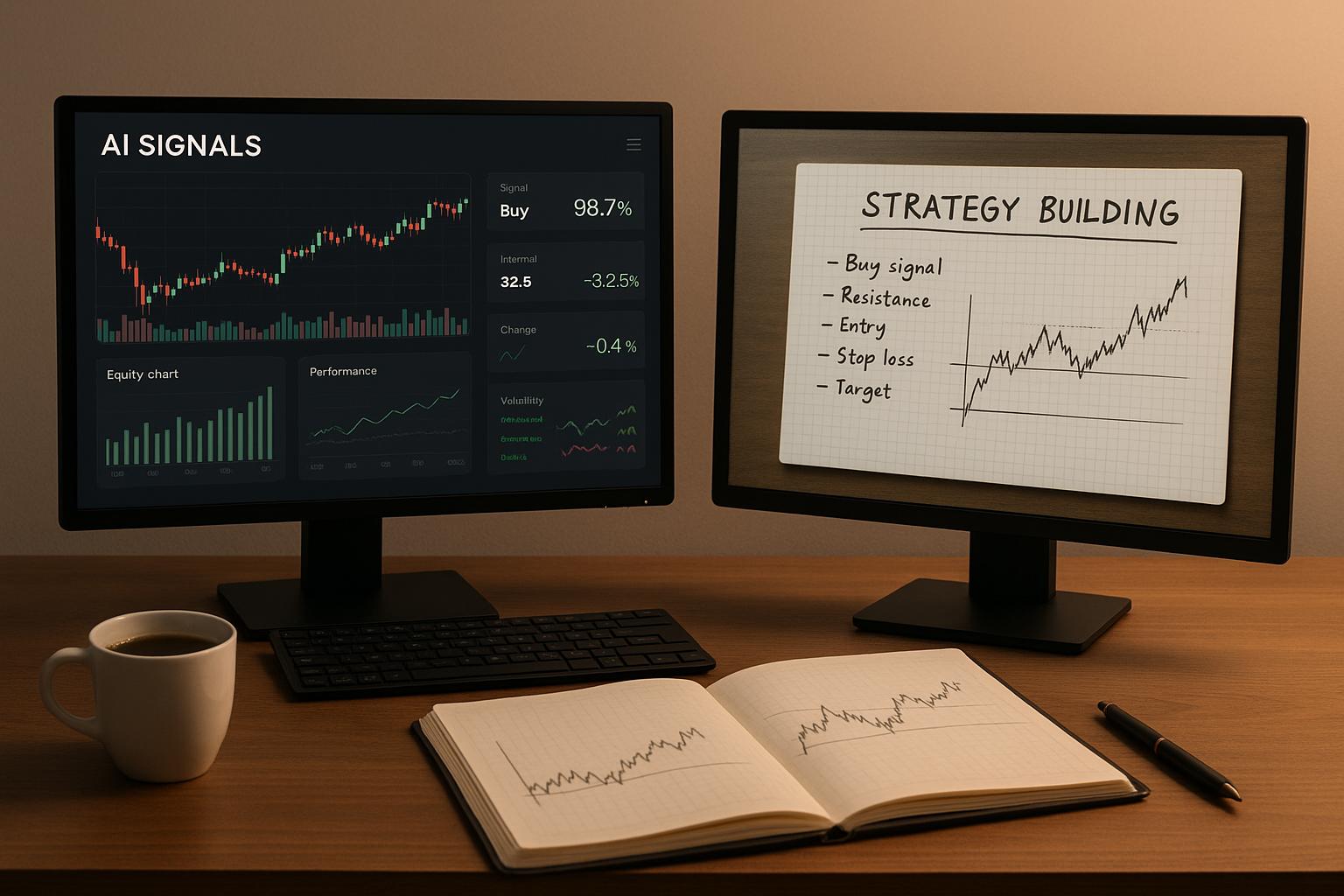
Struggling to choose between AI trading tools and manual strategies? Here's the deal: AI tools offer speed, data processing, and emotion-free decisions, while manual strategies let you stay in control, refine skills, and adapt to market nuances. Both have their strengths and challenges, and your choice depends on your goals, experience, and trading style.
Key Highlights:
- AI Signal Tools: Fast, emotion-free, and great for processing large datasets. Ideal for beginners or those short on time.
- Manual Strategies: Hands-on, skill-building, and adaptable to unique market events. Best for traders seeking full control.
- Hybrid Approach: Combine AI efficiency with human judgment for the best of both worlds.
Quick Comparison:
| Feature | AI Signal Tools | Manual Strategies |
|---|---|---|
| Speed | Executes trades in milliseconds | Slower, requires manual input |
| Data Processing | Analyzes vast datasets instantly | Limited by human capacity |
| Emotion Control | Removes emotional biases | Prone to emotional decisions |
| Learning Curve | Easier for beginners | Requires time and practice |
| Customization | Limited to pre-set parameters | Fully customizable |
| Market Adaptation | May struggle with new conditions | Flexible to unexpected events |
Pro Tip: Start with manual strategies to build core skills, then integrate AI tools for efficiency. Simulated trading platforms can help you test both approaches risk-free.
Automated vs Manual Trading (Are AI Robots Better?)
Key Differences Between AI Signal Tools and Manual Strategy Building
Understanding the distinctions between AI-driven tools and manual trading strategies is essential for traders looking to navigate the markets effectively. Both approaches offer unique benefits and challenges that shape how traders analyze data, execute trades, and refine their skills over time. Here's a closer look at how these two methods differ in critical areas.
Automation vs Human Control
At the heart of the difference between these methods is who makes the decisions. AI signal tools rely on algorithms to generate buy and sell signals based on market data. Once set up, these systems monitor the markets around the clock, execute trades without human intervention, and maintain discipline regardless of volatility or emotional pressures. This discipline is a core component for those looking to prepare for a trading challenge where consistency is key.
In contrast, manual strategy building places full control in the hands of the trader. Every decision - whether it's entry and exit points, position sizing, or risk management - is made by the individual. While this allows traders to respond flexibly to unexpected events or shifts in market sentiment, it also introduces the risk of emotional decision-making. Fear and greed can cloud judgment, leading to impulsive trades or missed opportunities. AI tools, on the other hand, remain unaffected by emotions, ensuring consistent execution even in high-pressure situations.
Data Analysis vs Personal Market Reading
AI tools shine when it comes to processing large volumes of data. They can analyze hundreds of technical indicators, track multiple timeframes, and even incorporate real-time news sentiment - all at once. These systems are designed to uncover patterns and correlations that might take human traders years to identify.
Manual trading, however, relies on selective interpretation of data and a trader's ability to "read" the market. Traders focus on specific indicators, chart patterns, and fundamental factors that align with their personal strategies. While they may process less data overall, this approach often leads to a deeper understanding of the tools and methods they choose to use. Manual traders also consider nuances like shifts in institutional activity or retail sentiment - factors that raw data alone may not fully capture.
Speed vs Customization
Execution speed is another area where AI tools have a clear edge. These systems can spot opportunities and execute trades in milliseconds, taking advantage of short-term price movements and arbitrage opportunities that manual traders simply can't match. This speed is crucial in fast-moving markets where delays can mean missed profits.
On the flip side, manual strategy building prioritizes customization. Traders can tailor their strategies to reflect their risk tolerance, market outlook, and personal preferences. By combining technical and fundamental analysis, they can create highly specific rules that adapt to market cycles and unique insights - something generic algorithms can't replicate.
Manual traders also have the ability to fine-tune risk management by adjusting position sizes, setting dynamic stop-losses, and choosing when to engage with the market based on current conditions. AI tools, in contrast, apply consistent risk parameters across all trades, which may not account for the nuances of individual situations.
Speed also plays a role in learning and adaptation. AI tools can quickly backtest and optimize strategies using historical data, allowing them to adapt to new market conditions almost immediately. Manual traders, while slower to test and refine their approaches, often gain a deeper understanding of why certain strategies succeed or fail. This slower process encourages thoughtful adjustments and long-term strategic growth.
Ultimately, the choice between AI tools and manual strategies comes down to priorities. AI tools excel in speed, consistency, and data processing, while manual trading offers flexibility, customization, and a more hands-on approach to learning and market adaptation.
AI Signal Tools: Benefits and Drawbacks
AI signal tools have changed the way traders approach the markets, offering both strengths and limitations. Knowing these pros and cons can help traders decide how to integrate automated systems into their strategies.
Benefits of AI Signal Tools
One major advantage is consistent market monitoring. AI tools never take a break - they’re always scanning markets across time zones and asset classes. This allows them to spot opportunities that might arise during off-hours or in international markets.
Another key benefit is the elimination of emotional bias. AI systems execute trades based solely on predetermined signals, without hesitation or second-guessing. This emotional detachment is especially useful during volatile periods when human traders might panic or act impulsively.
The processing power of AI tools is unmatched. They can analyze dozens of technical indicators, track news sentiment, monitor volume patterns, and assess correlations across multiple markets - all at once.
AI tools also offer backtesting capabilities, letting traders test strategies against years of historical data. This helps evaluate how a strategy might perform under different market conditions, economic cycles, and levels of volatility.
Lastly, consistent risk management is a big plus. AI systems follow rules like stop-losses, position sizing, and drawdown limits with mechanical precision. However, these advantages come with certain drawbacks.
Drawbacks of AI Signal Tools
AI tools aren’t perfect. One major issue is their over-reliance on historical patterns. These systems assume that past trends will repeat, which can lead to failure during unprecedented events.
Another challenge is the black box complexity of advanced AI systems. They often operate in ways that are difficult to understand, making it hard for traders to trust the signals or adjust strategies when performance drops.
Traders may also face reduced learning opportunities. Relying too heavily on AI recommendations can prevent traders from developing their own market intuition and analytical skills. This dependency becomes a problem when AI systems fail or produce inconsistent results.
Market adaptation challenges are another concern. AI tools often struggle to adjust quickly to new conditions, such as shifts in monetary policy or the introduction of new trading technologies. Until recalibrated, they may continue applying outdated patterns.
Finally, technical failures and connectivity issues can disrupt trading. AI systems depend on stable internet connections, reliable data feeds, and functioning servers. A glitch at the wrong moment could lead to missed opportunities or unexpected losses.
AI Tools in Practice
In simulated prop trading environments, AI tools shine in specific scenarios. For example, high-frequency scalping strategies benefit from AI’s speed, enabling dozens of micro trades to capture small inefficiencies. These small gains can add up over time.
Risk management automation is another area where AI excels, especially for traders managing multiple positions. AI systems can monitor overall portfolio risk, adjust position sizes as account equity changes, and ensure no single trade or group of trades exceeds set risk limits. This is particularly useful when managing large simulated accounts, such as $100K portfolios in advanced trading programs00K portfolios in advanced trading programs.
AI is also strong in pattern recognition, especially in trending markets. It can spot flag patterns, breakouts, and support/resistance levels across multiple timeframes, offering a comprehensive view of market structure that would be hard to achieve manually.
However, sideways or choppy markets often reveal AI’s limitations. In these conditions, conflicting signals can lead to numerous false trades and small cumulative losses. Discretionary judgment, which AI lacks, becomes crucial here.
News-driven events pose another challenge. While some AI systems include sentiment analysis, they often miss the nuances of economic data releases or geopolitical developments. For instance, a human trader might interpret a Federal Reserve statement as signaling a policy shift, while an AI tool might focus only on immediate price movements.
Ultimately, the success of AI tools depends on proper parameter tuning and regular performance reviews. Traders must learn when to trust the system and when to step in - a skill that comes with experience and a deep understanding of both market behavior and the AI tool itself. Balancing automated efficiency with human oversight is essential for effective trading.
Manual Strategy Building: Benefits and Drawbacks
Manual strategy building takes a hands-on approach, putting traders in the driver’s seat. Unlike automated systems, this method requires traders to analyze markets, make decisions in real time, and adjust strategies as market conditions shift. It’s a process that offers both advantages and challenges.
Benefits of Manual Strategy Building
- Full Control Over Decisions: Traders can react directly to market changes as they happen, ensuring their strategies remain aligned with the current environment.
- Customizable and Adaptable: This approach allows traders to craft strategies tailored to their goals and risk tolerance, adjusting methods as they gain experience and a deeper understanding of the market.
- Human Intuition and Ongoing Learning: By actively engaging with the market, traders sharpen their skills and rely on human intuition to pick up on subtle market signals that algorithms might overlook.
- Improved Risk Management: Managing each trade personally helps traders refine their risk management techniques, such as setting appropriate position sizes and stop-loss levels based on their growing expertise.
However, manual strategy building isn’t without its challenges.
Drawbacks of Manual Strategy Building
- Limited Capacity: Unlike AI tools, human traders can’t monitor multiple markets or time frames simultaneously, which may narrow the range of opportunities they can evaluate.
- Time-Intensive Learning Curve: Developing the intuition and skills needed to create effective strategies often takes considerable time and hands-on experience before achieving consistent results.
How Manual Strategies Handle Market Changes
Manual strategies shine during unexpected market events. Traders can interpret context and sentiment in ways that automated systems might miss. This advantage becomes especially important during events like economic announcements, geopolitical shifts, or sudden disruptions, where historical patterns may no longer apply.
Choosing the Right Approach for Your Trading
Deciding between AI-driven and manual trading strategies depends on your goals, experience, and overall trading style. The most effective traders often start by understanding their objectives, which helps them align their methods with what works best for their unique situation. Let’s break down how you can match your trading ambitions with the approach that suits you.
Matching Your Goals with the Right Method
Your trading goals should guide your choice of strategy. If you’re new to trading, starting with manual methods can help you build foundational skills. This hands-on experience allows you to better interpret AI-generated signals later and know when to rely on your judgment over automated recommendations.
If you’re short on time, AI tools can be a practical choice. These systems continuously monitor markets and execute trades without requiring you to stay glued to your screen. They’re particularly useful for maintaining exposure in the market while you focus on other commitments.
For experienced traders aiming to scale their operations, AI tools can take over repetitive tasks, freeing up time for strategic decision-making. On the other hand, if you prefer to maintain full control over every trade, sticking with manual strategies might feel more comfortable. Meanwhile, traders who favor systematic approaches may find AI tools appealing, as they execute trades based on pre-set, backtested parameters.
Combining Automation with Personal Judgment
Rather than choosing between AI and manual methods, many traders find success in combining the two. This hybrid approach allows you to leverage the strengths of both while mitigating their weaknesses.
AI tools are particularly effective for handling repetitive tasks like gathering market data, calculating technical indicators, monitoring positions, and executing orders. This frees up human traders to focus on higher-level tasks, such as developing strategies, analyzing market trends, and making critical decisions during unpredictable market conditions.
For instance, you could use automated systems for tasks like generating entry and exit signals, managing stop-loss orders, and calculating position sizes. Meanwhile, you can apply your judgment to assess macroeconomic trends and adjust your risk tolerance as market dynamics shift.
Testing is essential. Begin by integrating AI tools into your manual trading process and gradually increase automation as you see consistent results. Building a strong foundation in manual trading first ensures you have the expertise needed to effectively incorporate AI into your strategy.
Key Factors to Consider
Several factors can influence your decision-making process when choosing a trading approach.
- Timeframe: Day traders managing multiple positions often benefit from AI assistance, while swing traders with longer holding periods may prefer manual analysis.
- Technical Skills: If you’re comfortable with technology, you’ll likely find it easier to implement and manage automated systems.
- Capital: AI tools sometimes come with minimum account size requirements or fees, which might not be ideal for smaller accounts. Manual strategies, on the other hand, can work regardless of account size.
Flexibility is another crucial element. Markets can shift between trending, volatile, or sideways conditions, so it’s important to regularly review your performance and adjust your approach as needed.
Finally, discipline is non-negotiable. Whether you’re following AI signals or relying on manual analysis, risk management strategies and sticking to your trading rules are essential for lasting success. By staying disciplined, you create a solid foundation for achieving your trading goals.
Conclusion: Finding Your Trading Method
When choosing your trading method, it's all about aligning with your personal preferences and trading goals. Whether you lean toward AI signal tools or prefer building strategies manually, the key is finding what works best for your unique trading style and circumstances. Both options have their strengths, and understanding them can make a big difference in your success, especially when learning how to pass your first trading challenge in simulated prop trading environments.
If time is a constraint, Automated trading tools shine with their ability to monitor markets 24/7. On the other hand, if you value being deeply involved in every decision, manual strategies offer the control and customization you need. Interestingly, many traders find that they don't need to stick exclusively to one method. A hybrid approach - using AI for routine tasks while applying your judgment to critical decisions - can be a powerful combination, especially during volatile market conditions.
It's worth noting that while automated trading accounts for 60–73% of U.S. equity volume, only 10–30% of users achieve consistent profitability. This highlights an important truth: technology alone isn't enough. Success in trading still depends on sound risk management and disciplined execution, no matter which method you choose.
For Traders' platform offers a great way to explore both approaches. With its simulated trading environment, you can test AI-driven strategies alongside manual techniques without risking real money. Whether you're working with the $6,000 virtual capital plan or scaling up to the $100,000 level, the platform allows you to experiment and find the right balance between automation and manual control.
Start where you're most comfortable. If you're new to trading, focus on building foundational manual skills first. These skills will help you make the most of AI tools later. If you're an experienced trader but feel overwhelmed by constant market monitoring, integrating AI for tasks like data analysis and signal generation could be a game-changer.
Markets are always changing, and so should your approach. Techniques that work well in trending markets might need tweaking during sideways or highly volatile periods. Staying flexible while sticking to your core principles of risk management and discipline is crucial. By blending AI and manual strategies thoughtfully, you can create a trading plan that adapts to different market conditions.
Ultimately, your trading method should reflect your goals, time commitment, technical skills, and risk tolerance. Whether you go with AI, manual strategies, or a mix of both, the aim is to develop a sustainable and effective approach to trading.
FAQs
How do I decide between using AI signal tools or building my own trading strategies manually?
Choosing between AI signal tools and manual strategy building really boils down to your trading goals, experience level, and how much time you’re willing to invest.
If speed, automation, and data-driven decisions are your priorities, AI tools might be your best bet. They handle complex analyses, spot opportunities quickly, and can save you hours of work. On the flip side, manual strategies give you more control over your trades. They allow for a more personalized approach, helping you sharpen your skills and adapt to specific market conditions.
For beginners or those with limited time, AI tools can simplify the process and make it easier to get started. But if you enjoy being hands-on and customizing strategies to fit your trading style, manual trading might be more rewarding. Many traders find that a hybrid approach - using AI insights alongside manual adjustments - offers the perfect balance of efficiency and personal involvement.
What are the risks of relying solely on AI trading tools without manual input?
Relying too much on AI trading tools can be risky, especially when markets experience unexpected events or intense volatility. While these systems excel at processing historical data and identifying patterns, they often falter when faced with sudden, unpredictable shifts.
Without human oversight, traders might miss the chance to apply their own judgment or tweak strategies to address unique market situations that AI might not catch. By blending AI tools with human expertise, traders can create a more balanced and flexible trading approach.
How can traders combine AI tools and manual strategies to improve their trading results?
Traders can achieve excellent results by blending AI tools with manual strategies, capitalizing on the strengths of both methods. AI tools excel at tackling repetitive tasks, processing massive datasets, and spotting patterns with remarkable speed and precision. This not only saves time but also helps minimize errors. On the other hand, manual strategies let traders tap into their experience, intuition, and deep understanding of market dynamics to make more refined decisions.
A hybrid approach works well by assigning AI to handle tasks like generating signals or detecting trends, while traders maintain manual control over strategy tweaks and risk management. This combination ensures efficiency while preserving the human insight and flexibility that are crucial in trading.
Related Blog Posts
Start Trading with For Traders
Join our platform to test your trading skills, trade virtual capital, and earn real profits. Access educational resources, advanced tools, and a supportive community to enhance your trading journey.
Start your Trading Challenge