

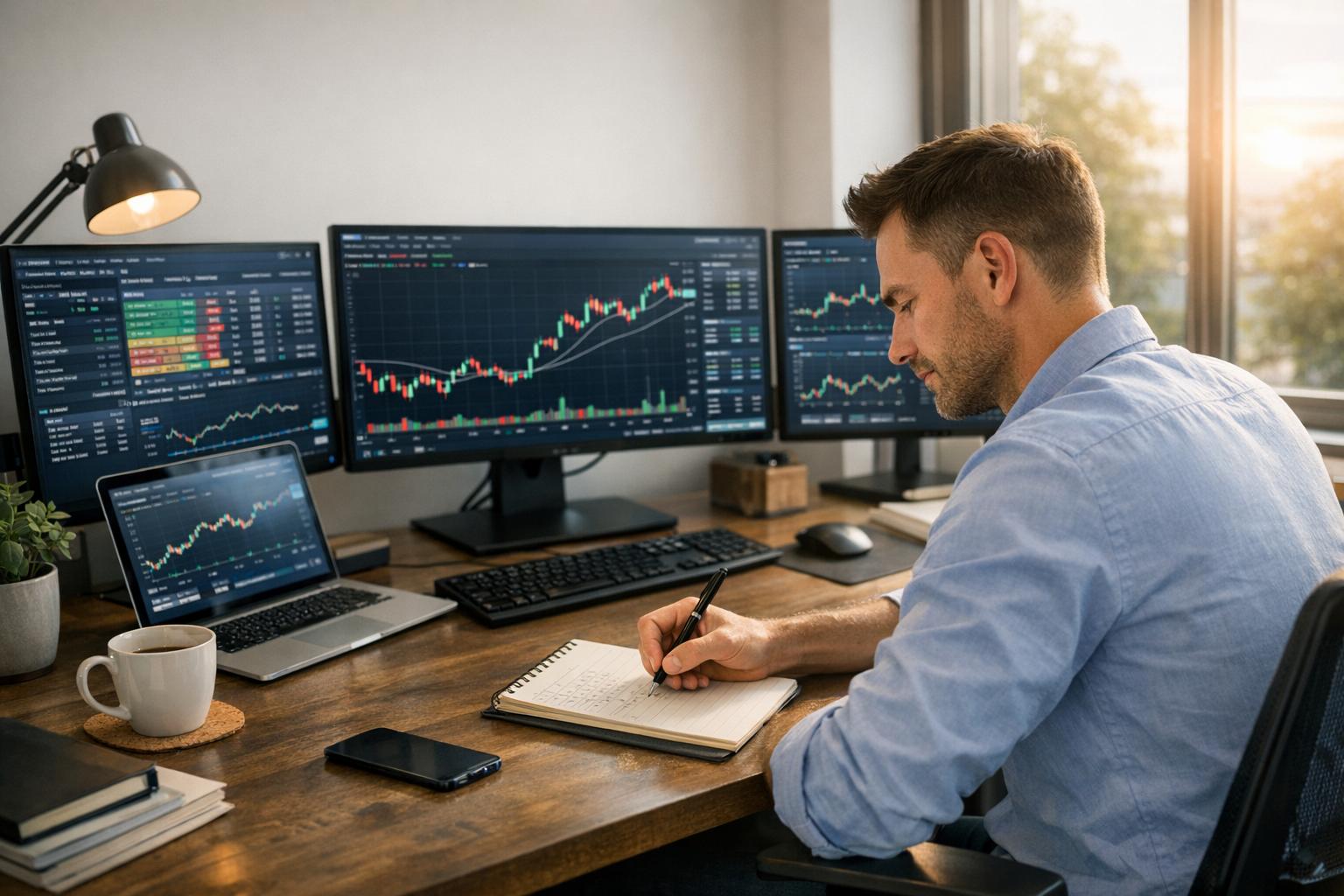
Funded trading is about using a firm's capital to trade while following strict rules. Success depends on discipline, risk management, and mindset, not just market knowledge. Here’s what makes a great funded trader:
- Discipline: Stick to a clear trading plan and avoid impulsive decisions. Most traders fail due to emotional trading, even with good strategies.
- Risk Management: Limit risk per trade (0.25%–2%) and follow drawdown rules. Proper position sizing and stop-loss orders are critical.
- Patience: Only trade high-probability setups that align with your plan. Avoid overtrading or rushing the evaluation phase.
- Mindset: Focus on execution, not profits. Control emotions like fear and greed to make consistent decisions.
- Daily Routines: Use pre-market prep, trade checklists, and post-trade journaling to improve consistency and self-awareness.
Only about 1%–7% of traders succeed in funded accounts. The key is prioritizing long-term consistency over short-term gains.
6 Brutal Truths I’ve Learned After Funding Hundreds of Traders
Why Discipline Matters in Trading
Discipline is what separates traders who thrive from those who end up blowing their accounts. Statistics show that most funded accounts breach their drawdown limits within just 30 days - not because of bad strategies, but because of a lack of psychological discipline. When you're trading with firm capital, every decision must align with strict rules. Just one impulsive trade can lead to a daily drawdown violation, abruptly ending your funded journey. This is why having a structured trading plan isn't just helpful - it's essential.
Interestingly, even the most successful professional traders are correct only 20%–30% of the time. Yet, they remain consistently profitable by sticking to disciplined risk management. A trader with a win rate as low as 30% can still make money by following a 3:1 risk-reward ratio. This shows that how you trade matters far more than how often you win. Without discipline, even the best strategy can crumble under pressure.
"Under pressure, you don't rise to the occasion - you sink to the level of your training." - Navy SEALs
Discipline also shields traders from what’s often called "systematic loss management." For instance, if your account takes a 50% loss, you'll need a 100% gain just to break even. By maintaining consistent position sizes and risk percentages - no matter whether you're up or down - you give yourself the chance to stay in the game long enough for your profits to grow.
Creating and Following a Trading Plan
A trading plan serves as your personal rulebook. It outlines when to enter trades, where to place stops, and how much to risk. To start, focus on just 2–3 instruments, such as EUR/USD or Gold. By mastering their volatility patterns and how they react to news, you'll build the confidence to stick to your plan.
Your plan should include clear, binary entry conditions. For example: “I only trade trend pullbacks during the London session when the price touches the 20-period moving average and RSI shows oversold.” This eliminates guesswork. Keep your position sizing fixed, between 0.5%–2% per trade, and set a maximum daily loss limit to avoid emotional decision-making after losses. Many proprietary firms recommend risking just 0.25%–0.5% per trade on funded accounts to focus on preserving capital. These rules are the backbone of effective risk management, which ties directly into routines and mindset strategies.
"Start with your objectives. Then build your strategy to meet those objectives - not the other way around." - Sam Eder, CEO, MarketMates
When calculating position size, use this formula: (Account Size × 2%) ÷ Pips to Stop Loss = Position Size. Always round down to maintain strict risk control. For instance, with a $100,000 account risking 2% ($2,000) and a stop loss 50 pips away, your position size is predetermined - removing emotion from the equation.
Keep your plan simple - aim for just one page. If you're hitting profit targets but still violating drawdown limits, it’s a sign your plan needs tweaking. The goal isn’t to create a perfect plan from day one; it’s to refine it continuously based on real-world performance. A clear, concise plan lays the groundwork for disciplined daily execution.
Building Daily Trading Routines
Daily routines bring consistency to an otherwise unpredictable market. Before the market opens, check top news calendars for major news events like NFP, FOMC, or CPI releases. Most proprietary firms enforce a 5-minute no-trade window around these events. Traders who ignore this rule might pass evaluations by trading news volatility but often fail during the funded stage when stricter restrictions apply.
Your pre-market routine should include identifying key support and resistance levels, reviewing volume patterns, and ensuring your internet connection is stable. Log in early to double-check your settings and avoid technical hiccups during volatile periods.
Before starting your trades, use a checklist to confirm your setups align with your plan. Limit yourself to a set number of trades - many successful traders cap it at two per day to avoid overtrading. After your session, update your trading journal. Rate your discipline on a scale of 1–10, note what went well, identify one mistake to avoid tomorrow, and review your performance against SMART objectives (Specific, Measurable, Achievable, Relevant, Time-bound) weekly or monthly.
"Amateurs trade the charts. Pros trade their mindset." - The Forex Online School
Focus on process-based goals rather than profit targets. Instead of aiming to “pass the challenge in 5 days,” commit to “following my trading plan with 100% discipline for 10 days”. Use your checklist consistently for 30 days. Over time, disciplined trading transitions from feeling forced to becoming second nature.
How to Manage Risk Effectively

Tiered Risk Management Protocol for Funded Traders by Drawdown Level
Managing risk is the backbone of success in prop trading. The reality is stark: half of traders fail because they don't size their positions properly. Even one oversized trade can wipe out weeks of hard-earned progress.
The stats are clear. If you risk 2% of your account on each trade, three consecutive losses will cost you 5%. In contrast, risking just 0.5% per trade allows for up to 10 losses while keeping you in the game. This is especially important in Forex, where strings of eight losses are not uncommon.
"Position sizing is the core guardrail that prevents one oversized loss from erasing weeks of gains." - AquaFunded
Top-tier funded traders know that fewer than 10% of participants pass Phase 1 of prop firm challenges, often because they violate drawdown limits - not because their strategies are flawed. This underscores the importance of calculated trades, strict stop-losses, and disciplined position sizing. Let’s dive into how to structure each trade with precision.
Position Sizing and Drawdown Limits
Position sizing is about allocating the right amount of capital to each trade. Smart traders use dynamic risk strategies: reduce risk after losses and increase it only after recovering. For example, if your account hits a -2% drawdown, cut your risk per trade from 0.5% to 0.25%. If it reaches -4%, drop it further to 0.1% and limit yourself to one trade per day.
The standard approach involves risking a fixed percentage of your account - typically between 0.5% and 2% - on each trade. However, on a funded account with a 10% drawdown limit, risking 2% per trade means you can only afford five or six consecutive losses before hitting the limit. That’s why many firms enforce an unofficial 1% risk ceiling; exceeding it can lead to disqualification.
To calculate your risk, follow these steps:
- Dollar Risk: Multiply your account balance by your chosen risk percentage.
- Position Size: Divide your dollar risk by the product of your stop distance and pip/point value.
For instance, on a $100,000 account risking 0.5% ($500) with a 50-pip stop loss, your position size is determined by the formula. Always round down to avoid accidental over-exposure.
This tiered approach adds a layer of protection against devastating losses:
| Drawdown Level | Risk per Trade | Trades per Day | Objective |
|---|---|---|---|
| 0 to -2% | 0.5% | 2-3 | Normal Growth |
| -2% to -4% | 0.25% | 1 | Breakeven |
| -4% to -6% | 0.1% | 1 | Survival |
| -6% or more | STOP | 0 | Analysis/Coaching |
To stay ahead, set a personal daily loss limit stricter than your firm's. For example, if the firm allows a 5% daily loss, cap yourself at 2% or 3%. This buffer accounts for slippage, commissions, and unexpected market swings. By factoring these costs into your calculations, you prioritize longevity over short-term gains.
"Strategy wins trades. Risk management wins careers." - BabyPips
Once your position sizing is in place, the next critical step is mastering stop-loss orders.
Using Stop-Loss Orders Effectively
Stop-loss orders are non-negotiable in trading. They define your risk and prevent emotional decision-making when the market moves against you. Most prop firms impose strict limits, such as a 5% daily loss cap and a 10% total drawdown ceiling. A single trade without a stop-loss could jeopardize both.
Placement is key. Use technical levels like support and resistance, or position stops just below a longer-term moving average. Another approach is to adjust stops based on market volatility using the Average True Range (ATR). Wider stops suit volatile conditions, while tighter ones work better in calmer markets. Always integrate your stop distance into your position sizing to keep your total risk within 0.5% to 1% of your account.
Aim for a risk-to-reward ratio of at least 1:2 or 1:3. For example, if you risk $500, your target profit should be $1,000 to $1,500. Even with a 40% win rate, this ratio ensures profitability - one winning trade can offset two or three losses. This is how professional traders thrive, even when they're wrong more often than right.
Trailing stops offer another layer of protection. These orders adjust upward as your trade becomes profitable, locking in gains while still allowing for potential upside. For instance, if you enter a trade at $50 with a $48 stop and the price rises to $55, you might trail your stop to $53, securing profits while leaving room for further growth.
"By living the philosophy that my winners are always in front of me, it is not so painful to take a loss." - Marty Schwartz, Author/Trader
Avoid relying on "mental stops." Markets move fast, and slippage can turn a manageable loss into a disaster before you can react. Use automated orders and stick to them. If you catch yourself widening stops to "give a trade room", you're straying from the habits that keep successful traders in the game.
"A 10% drawdown doesn't mean you're having a bad month; it means you're out of a job." - BrightFunded
The Importance of Patience and Selective Trading
Most trading losses stem from psychological challenges, not flawed strategies. Many traders struggle with resisting the urge to trade when market conditions don’t align with their plan. This is where patience becomes critical - it shifts the focus to high-probability trade setups.
The numbers back this up. Prop firms report payout rates as low as 1% to 7%. This means that while only a small percentage of traders succeed, impulsive trades driven by boredom or impatience often lead to avoidable losses. The ability to wait for high-quality setups, often called "A+ setups", is what sets professional traders apart. As Faisal from TRADEPRO Academy puts it:
"The reality is, the more boring you can make it, the more mundane you can make it... the better you will do."
Patience isn’t passive; it’s a proactive risk management tool. By being selective, you protect your capital and avoid low-probability trades that can drain your account. For example, even a strategy with a 40% win rate can be profitable if your winning trades are at least twice the size of your losing ones. This approach only works if you stick to trades that meet your criteria.
Identifying High-Probability Setups
Patience lays the groundwork, but identifying trades with a clear edge is equally important. High-probability trades don’t happen randomly - they occur when multiple factors align, such as trend direction on higher timeframes, key support or resistance levels, favorable volume, and a minimum risk-to-reward ratio of 1.5:1 or better. It’s not about finding the "perfect" trade but about stacking the odds in your favor.
Specializing in 2-3 specific instruments, like EUR/USD, Gold, or NASDAQ, can make a big difference. By focusing on a few markets, you learn their unique behaviors, how they react to news, and which setups work best. This familiarity helps you distinguish real opportunities from noise.
"Consistency comes from repetition. If you don't know exactly what you're looking for, you'll end up chasing random trades - which is the fastest way to fail a challenge."
Using a pre-trade checklist can help ensure every trade aligns with your plan. Ask yourself: Does this trade match my setup conditions? Is the market context favorable? Is my risk under 1%? Does the trade offer at least a 1.5:1 reward-to-risk ratio? These binary yes-or-no questions eliminate guesswork and keep emotions out of your decision-making process.
To evaluate your strategy’s effectiveness, calculate its Expectancy - the average profit or loss per trade. A solid strategy for prop challenges should maintain a Profit Factor (total profits divided by total losses) of at least 1.5. These metrics confirm whether your selective approach provides a real mathematical edge. Combining these criteria with disciplined risk management ensures consistency over the long haul.
Avoiding Overtrading in Simulated Challenges
Overtrading is one of the biggest traps in prop challenges. It often stems from boredom, excitement, or the urge to recover losses quickly. To manage this, limit yourself to 2–3 high-quality trades per day.
Many prop firms now offer unlimited time to complete challenges. This removes the pressure to rush and allows you to wait for trades that meet your criteria. If the market doesn’t present opportunities, it’s okay to sit on the sidelines.
Set price alerts for key levels so you only engage when your setup conditions are met. During non-trading hours, step away from your trading platform to prevent impulsive actions. Establishing a strict daily loss limit (e.g., 2%) and taking a break after consecutive losses can help you avoid emotional "revenge trading", which has ended more challenges than any bad strategy ever could.
Shift your focus from outcome-based goals (like "pass the challenge in 5 days") to process-based goals (such as "follow my plan for 10 consecutive days"). This reduces psychological pressure and emphasizes disciplined execution over immediate results. After each session, rate your discipline on a scale of 1–10 to build self-awareness. Patterns like trading when tired or bored often lead to overtrading, and identifying these habits can help you correct them. By sticking to selective trade execution, you reinforce the disciplined mindset that’s essential for long-term success in trading.
Emotional Control and Mindset
Did you know that 90% of trading success is linked to psychology rather than strategy? This explains why two traders using identical setups can experience drastically different results. Research highlights a common psychological trap: loss aversion. Essentially, people feel the pain of a loss twice as intensely as the joy of a gain. This often leads traders to hold onto losing trades for too long while cutting winning trades too soon.
The shift to making a living as a funded trader begins when you focus on execution rather than outcomes. Instead of aiming for goals like "I want to pass in 5 days", reframe your objective to something like, "I will follow my plan with 100% discipline for 10 days". By doing this, you take the emotional weight off monetary results and channel your energy into what you can actually control - your process. Professionals treat money as trading capital, not an emotional resource, which helps them stay neutral whether they win or lose.
Before entering a trade, ask yourself: "Would a funded trader take this trade?" This simple question acts as a filter, helping to prevent impulsive decisions driven by greed or FOMO. To further maintain emotional balance during tough times, many seasoned traders risk only 0.25% to 0.50% of their account per trade. This conservative approach limits drawdowns and helps avoid the psychological stress of watching your account dwindle.
Managing Fear and Greed
Fear and greed are the two biggest emotional hurdles for traders. Greed can tempt you into over-leveraging or chasing unrealistic profits, often at the expense of a solid trading plan. On the other hand, fear can make you hesitate on valid setups or cause you to exit trades prematurely, even before a stop-loss is triggered.
One effective technique is a 60-second visualization before each session. Close your eyes and picture yourself identifying your setup, executing your trade confidently, and calmly accepting a potential loss. Some traders also find that deep breathing exercises or a few minutes of meditation before trading can help regulate their emotions.
Set a hard daily limit to prevent emotional spirals. For example, stop trading for the day after three consecutive losses. Another strategy is to implement a "drawdown protocol", where you automatically reduce your position sizes after reaching a certain loss percentage. This approach allows you to rebuild confidence without putting your account at unnecessary risk.
Before executing any trade, use a binary pre-trade checklist to remove emotional bias. Confirm that the trade aligns with your setup rules, the market conditions are favorable, the risk is under 0.5%, and the reward-to-risk ratio is at least 1.5:1. As Jesse Livermore, one of the most famous traders in history, once said:
"The real money is made in sitting, not in trading."
By sticking to these practices, you create a foundation for steady improvement, which can be further strengthened with post-trade journaling.
Post-Trade Journaling for Self-Improvement
Once you've mastered emotional control, systematic journaling becomes a powerful tool for sharpening your self-awareness and refining your trading process. A trading journal acts like a mirror, reflecting how your psychology impacts your decisions. It turns subjective experiences into objective data, helping you spot patterns that might otherwise go unnoticed. Document not only what happened during your trades but also your emotions at each stage.
After every session, rate your discipline on a scale of 1–10. Write one sentence about what went well and one about what didn’t. Don’t forget to include external factors like stress, sleep quality, or personal issues - your trading performance often mirrors your life outside the markets. During your weekly review, ask yourself questions like, "Did fear or greed influence this decision?" or "Was I calm or feeling pressured?". These reflections can help you pinpoint triggers, such as overconfidence after a win or impulsivity after a loss.
Adding screenshots of your charts to your journal entries can provide helpful visual context for your emotional state during entry and exit points. If writing everything down feels tedious, try using voice-to-text tools - the goal is to build self-awareness, not to create extra work. As Ray Dalio, founder of Bridgewater Associates, wisely said:
"Pain + Reflection = Progress."
Journaling also helps you uncover cognitive biases like the "Gambler's Fallacy" (believing a win is due after a series of losses) or "Status Quo Bias" (resisting change even when market conditions shift). Over time, this practice strengthens your mental resilience by helping you learn from emotional responses and avoid repeating mistakes. Traders who consistently review their journals often turn break-even strategies into long-term profitability.
Using Proven Strategies and Tools
Building on disciplined risk management and selective trading, the use of proven strategies and advanced tools can give traders a competitive edge. The right combination enhances execution and helps navigate complex markets.
Leveraging Technical Analysis Techniques
Funded traders adjust their strategies based on market conditions. For trending markets, they often rely on pullbacks and moving average bounces. In contrast, range trading using support and resistance levels works better in choppy markets. During periods of high volatility, breakout setups confirmed by strong volume can be especially effective. This adaptability is crucial, as Blue Guardian wisely put it:
"When conditions change, the strategy either adapts or dies. Your funded account dies with it." - Blue Guardian
Recognizing shifts in market structure, such as transitions from trending to sideways movement, is key to success. Rather than predicting exact price movements, professional traders focus on "reaction zones". They ensure every setup includes multiple confirmations and aim for a risk-to-reward ratio of at least 1.5:1. For example, with a 2:1 ratio, you only need a 33% win rate to break even, while a 3:1 ratio requires just 25%. Position sizing is determined by the distance between the entry point and the stop-loss - not by confidence levels. A common formula is: (Account size × 2%) ÷ Pips to stop-loss.
Specializing in 2–3 instruments, such as EUR/USD, Gold, or NASDAQ, allows traders to understand their unique volatility patterns. Documenting setups in a "trading playbook" with clear rules and screenshots builds consistency and discipline. These technical insights lay the groundwork for utilizing advanced platforms that align with dynamic trading strategies.
Using Advanced Trading Platforms
Your choice of trading platform can significantly impact execution speed, risk management, and overall performance. Funded traders rely on platforms like DXTrade, TradeLocker, and cTrader for their advanced features. For instance, TradeLocker integrates seamlessly with TradingView, offering advanced charting without switching tools, while cTrader includes copy-trading capabilities with an equity-to-equity ratio model for trade volume calculations. These platforms often feature automated stop-loss orders to reduce emotional decision-making, as well as tools like real-time exposure monitoring, Value at Risk (VaR) analysis, and correlation tracking to manage multiple positions effectively. Although MetaTrader 5 is widely used, some firms opt for Match-Trader or custom platforms for institutional-level execution.
When choosing a platform, consider how well it supports your trading style. For example, if you trade around news events, check whether the platform allows you to open or close positions within five minutes of major announcements - some funded accounts restrict this during live trading, even if it’s permitted during evaluations. The ideal platform should feel intuitive and complement your preferred analysis methods, whether that’s price action, volume profiling, or screening techniques. With the right platform in place, traders can further enhance their strategies through AI-powered tools.
AI-Driven Risk Management in Prop Trading
AI tools are revolutionizing how funded traders manage risk and refine their strategies. An estimated 80% of financial institutions now use AI-driven trading systems. These tools bring institutional-grade analytics, sentiment analysis, and automation to a broader audience. By executing trades based on predefined criteria, AI removes emotional bias and adjusts trading parameters in real time.
In 2025, Good Market introduced "Smart Assist Intelligence", an AI tool that automatically manages position sizes and limits drawdowns at top prop firms. Beyond execution, AI-driven sentiment analysis scans news, social media, and earnings reports to identify trending stocks and potential market-moving events, enabling traders to adjust risk exposure proactively. As Oleks Gorpynich highlighted:
"The real power of AI isn't in its ability to help extremely optimized financial institutions. It is in its ability to democratize trading, providing more accessibility to the average investor." - Oleks Gorpynich
AI can also backtest strategies to ensure the historical Maximum Drawdown (MDD) stays within 50–60% of the limits set by prop firms, creating a crucial safety buffer. Automating consistency rules, such as daily profit caps or loss limits that disable trading once reached, ensures compliance with firm requirements. Additionally, AI tools calculate metrics like "Expectancy" (average profit per trade), helping traders estimate how many trades are needed to meet funding goals without over-leveraging. With near-zero latency, AI algorithms analyze market data and execute trades with remarkable precision.
Conclusion
Excelling in funded trading isn’t about chasing perfect strategies or making flawless predictions. Instead, it hinges on mastering the core principles that distinguish seasoned professionals from beginners: risk management, patience, emotional control, and consistency. As The Forex Online School aptly states:
"Amateurs trade the charts. Pros trade their mindset."
A staggering 80% of funded accounts fail because traders struggle to transition from a challenge-focused mentality to a sustainable, long-term approach. The difference? Successful traders prioritize protecting their capital over seeking quick wins and treat trading as a structured business rather than a high-stakes gamble. Psychology plays an outsized role in trading success - 70% to 90%, to be exact. Even the best strategy won’t work if you can’t execute it under pressure.
Beyond disciplined execution, continuous learning is essential for navigating ever-changing markets. Tools like pre-trade checklists, detailed trading journals, and adaptable risk management during downturns can help refine your approach. Platforms like For Traders offer advanced resources, including AI-driven risk management, educational content, and a supportive community to give traders a competitive edge.
To wrap up the essentials: focus on process-driven goals rather than profit targets. Limit your trades to 1–3 high-quality opportunities per day, concentrate on a small selection of instruments, and take breaks after hitting major milestones to maintain emotional balance. With the right mindset and tools, you can join the select group of traders who achieve lasting profitability.
FAQs
How can traders develop better discipline in funded trading?
To develop discipline as a funded trader, it’s essential to approach trading as a serious profession, not just a pastime. Start by crafting a detailed, rule-based trading plan. This plan should clearly define the markets you’ll focus on, the setups you’ll trade, and your risk management strategy - such as limiting your risk per trade to 0.1%–0.5% of your account. The key is consistency: stick to your plan no matter how the market behaves. Keep a trading journal to track every trade, assess your discipline, and identify any decisions driven by emotion.
Shift your focus toward process-oriented goals rather than fixating on specific profit targets. For instance, aim to follow your trading plan perfectly for the next 10 trading days instead of trying to reach a set dollar amount. This approach keeps you grounded and helps you avoid emotional traps like chasing losses or overtrading.
Adopt a mindset centered on capital preservation and steady progress rather than quick wins. When you start trading with a funded account, take a day or two to observe the market without placing trades. Then, begin with small, controlled positions - risking, for example, just 0.1% per trade. As you gain confidence, you can gradually increase your trade sizes while maintaining a structured routine. By committing to clear rules, managing risks thoughtfully, and staying emotionally neutral about outcomes, you’ll cultivate the discipline required to succeed as a funded trader.
How can I manage emotions like fear and greed while trading?
Managing emotions like fear and greed is a key factor in achieving consistent trading success. The first step is to recognize these emotions as normal but manageable. Before starting each trading session, take a moment to evaluate your mental state. Are you feeling anxious, overly confident, or influenced by recent outcomes? This kind of self-check helps you enter the market with a clear and balanced mindset.
Shift your focus to process-driven goals instead of fixating on profit targets. Follow your trading plan closely and view each trade as an opportunity to test your strategy, rather than a personal victory or failure. To maintain discipline, set strict risk limits by allocating a fixed percentage of your capital to each trade. This approach helps reduce the chances of making impulsive decisions.
Adopting practical habits can also make a significant difference. Keep a trading journal to track your decisions and uncover emotional patterns over time. Take short mindfulness breaks, especially after major wins or losses, to reset your focus. Finally, stick to a consistent trading routine. These practices can help you remain calm, focused, and in control, ensuring that emotions don’t steer your trading decisions.
Why is patience important for success as a funded trader?
Patience is a key trait for traders working with funded accounts. It plays a crucial role in maintaining discipline and adhering to strict risk management rules. Instead of jumping at every market movement, patient traders wait for high-probability setups. This not only helps them avoid impulsive decisions but also minimizes unnecessary losses.
In the world of funded trading, consistent and steady profits often outweigh the appeal of occasional big wins. A patient approach allows traders to give their trades the time they need to develop, stick to stop-loss levels, and focus on incremental gains. These small, consistent successes align well with the expectations of most funding programs. By cultivating patience, traders can make better decisions, manage their emotions effectively, and follow their trading plans - essential ingredients for long-term success with a funded account.
Related Blog Posts
Start Trading with For Traders
Join our platform to test your trading skills, trade virtual capital, and earn real profits. Access educational resources, advanced tools, and a supportive community to enhance your trading journey.
Start your Trading Challenge