

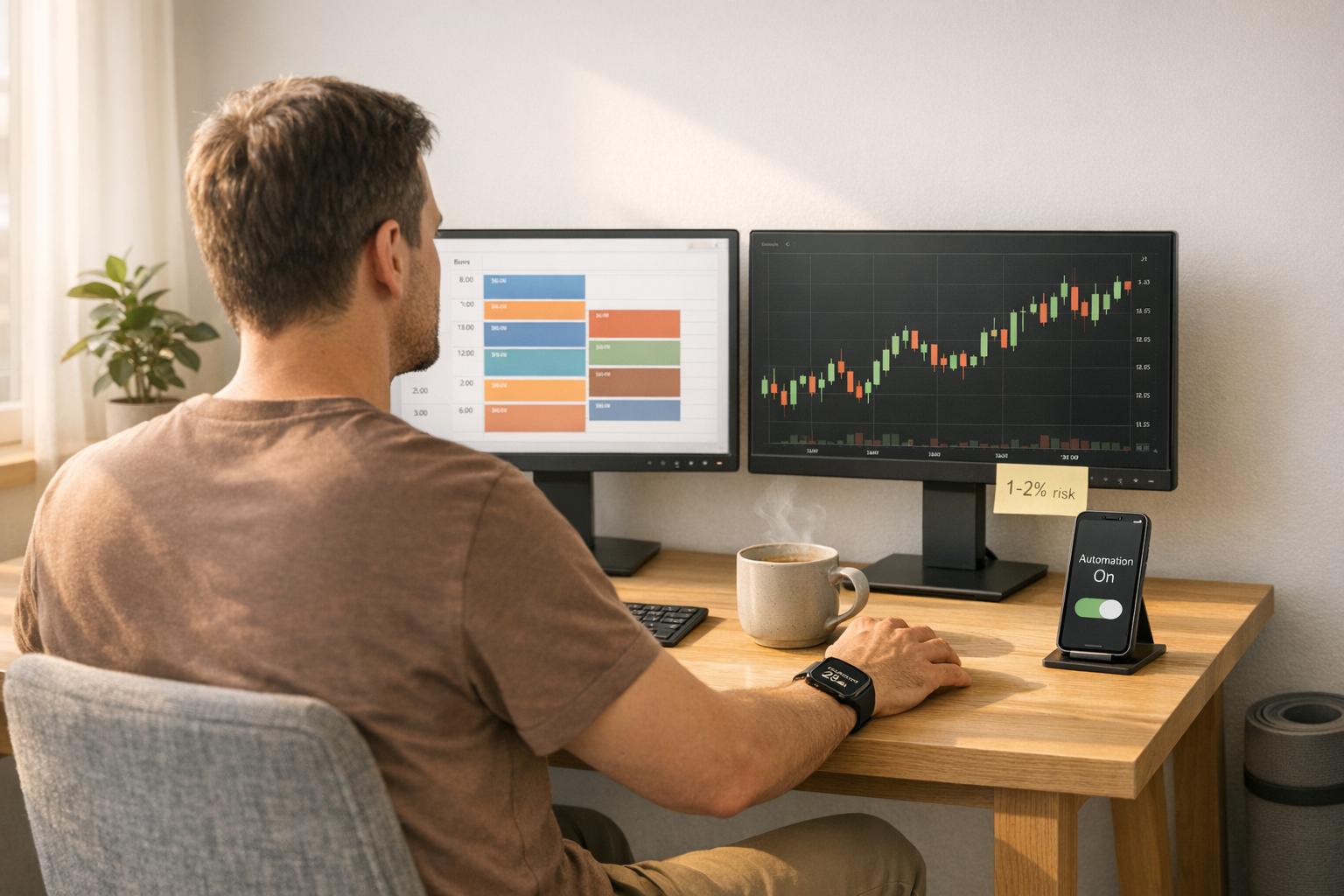
Balancing trading with daily life can feel overwhelming, especially when juggling work, family, and personal commitments. The key is managing time, energy, and focus effectively. Here’s how you can make it work:
- Time Management: Map out your daily schedule and allocate realistic trading hours (e.g., 2–4 hours). Use tools like price alerts and weekend analysis to save time.
- Set Clear Goals: Define specific, measurable trading objectives (e.g., "earn $500 monthly" or "20% portfolio growth in six months") and focus on high-impact tasks.
- Structured Routine: Create a consistent daily trading plan that includes preparation, active trading, and post-market reviews.
- Risk Management: Follow the 1–2% rule for position sizing and use stop-loss orders to protect your capital.
- Emotional Discipline: Use pre-trade checklists, take breaks after losses, and maintain a trading journal to manage emotions and improve decision-making.
- Leverage Resources: Use educational tools, AI-driven risk management, and community support to streamline learning and stay motivated.
- Prioritize Well-Being: Schedule rest days, limit trading hours, and maintain boundaries between trading and personal life to avoid burnout.
Trading success isn’t about grinding endlessly - it’s about working smarter, staying disciplined, and protecting your mental health.
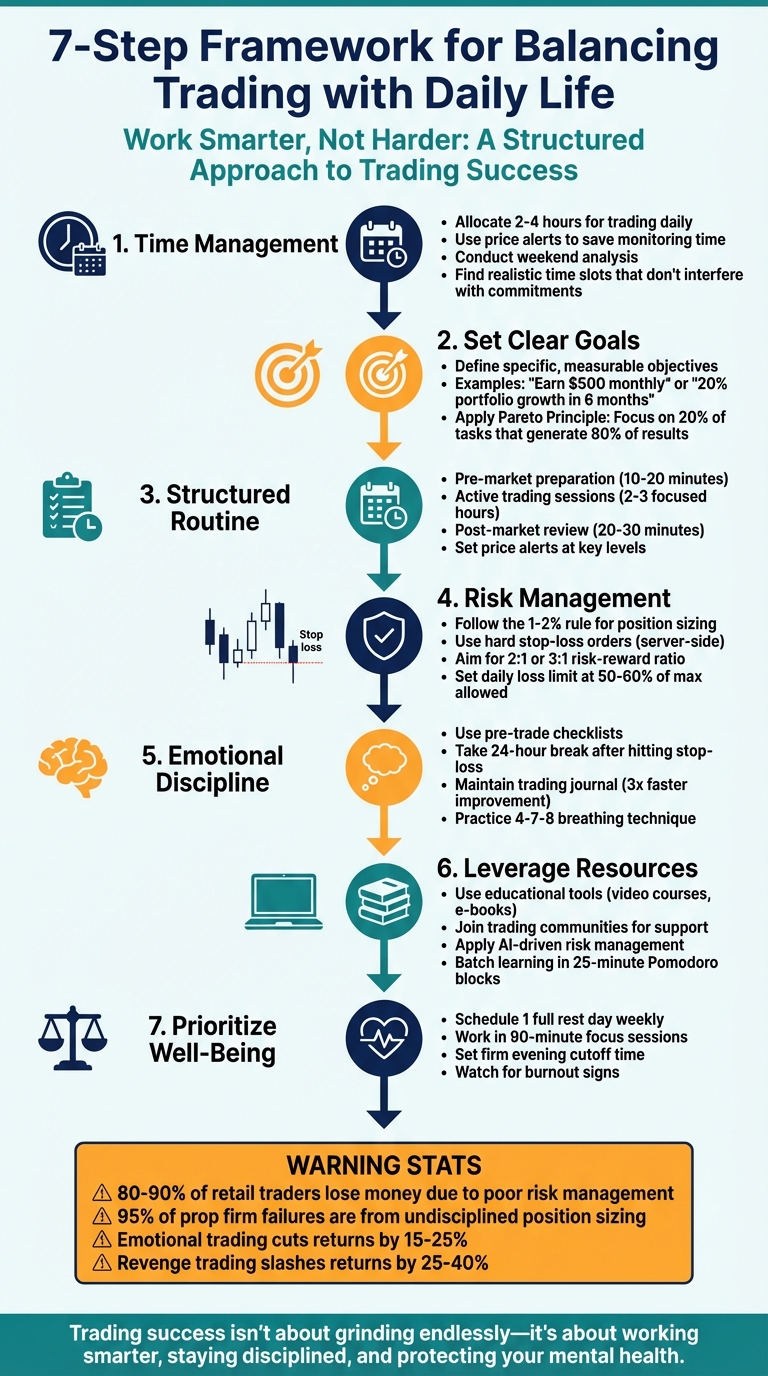
7-Step Framework for Balancing Trading with Daily Life
Tips for Better Trading-Life Balance: Your Trading Career vs Your Family Life 👨👩👧👦
Assess Your Time and Trading Goals
Take a close look at how you spend your time and set clear trading goals. If you work a standard 9-to-5 job, you likely have 2–4 hours of free time each day after factoring in 8 hours for work, 8 hours for sleep, and 1–2 hours for commuting. The real question is: how will you make the most of those hours? Knowing your time limitations and defining your trading objectives is key to maintaining a healthy balance.
List Your Daily Commitments
Start by mapping out your daily activities - work, family obligations, exercise, meals, and self-care. This simple step shows you where your time goes. As FundedNest explains:
"The issue isn't a lack of time. It's a lack of intentional attention".
Once you've outlined your schedule, you'll see opportunities to fit trading into your day. For instance, you could listen to trading podcasts or market updates during your morning commute. Maybe you have 30 minutes before work to prepare for the market and 20 minutes in the evening to review your trades. The idea is to find realistic time slots that don’t interfere with your essential commitments.
After organizing your schedule, it's time to define what you want to achieve with trading.
Define Clear Trading Goals
Steer clear of vague ambitions - be specific and measurable. For example, aim for goals like "earn $500 monthly" or "grow my capital by 20% in six months". Having well-defined targets helps you focus your limited time on the most impactful activities. Apply the Pareto Principle: identify the 20% of tasks that generate 80% of your results, and make those your priority.
Customizable trading plans are a helpful tool for setting profit targets and risk limits that align with your lifestyle. Whether your goal is consistent monthly earnings or long-term portfolio growth, establishing these parameters upfront reduces uncertainty and sharpens your focus. Dan Buckley, Head Market Analyst at DayTrading.com, puts it well:
"Productivity isn't about doing more tasks – it's about doing the right tasks efficiently".
Finally, think about whether your schedule aligns better with day trading (which demands active participation during market hours) or swing trading (which allows for more flexibility with positions held over days or weeks).
Create a Structured Trading Routine
Having a structured routine is essential to systematize your trading approach. As Kevin Cabana from Trade Momentum puts it:
"You don't rise to the level of your goals - you fall to the level of your systems".
The idea is to build a schedule that works in harmony with both the market's rhythms and your daily life. While professional traders often spend 60 to 90 minutes on their morning preparation, you can adjust this based on your availability. The key is consistency - not perfection. Even a quick 10-minute routine can be more effective than having no routine at all. By aligning your trading schedule with your goals and commitments, you create a disciplined and systematic way to engage with the market.
Schedule Your Trading Sessions
Timing is everything. High-liquidity periods, like the overlap between the London and New York trading sessions, provide the best opportunities due to increased volume and volatility. For those balancing trading with full-time jobs, Nial Fuller suggests checking charts twice a day for just 10–20 minutes. Many traders also use the New York Close at 5:00 PM EST as the end of the trading day, as it's ideal for analyzing daily charts and setting up end-of-day trades.
To save time, set price alerts at key levels so you don’t have to monitor charts continuously during non-critical periods. Use weekends for a broader weekly chart analysis, which can free up valuable time during the workweek.
Include Preparation and Review Time
Before the market opens, dedicate time to reviewing overnight price movements, checking the economic calendar, and narrowing your focus to 3–5 instruments for your watchlist. To keep emotions in check, create "If-Then" triggers, such as: "If I lose two trades in a row, I pause for 20 minutes". Take a few moments (30 seconds to 5 minutes) to mentally rehearse executing trades according to your plan.
Once your trading session ends, step away from your screens for 15–20 minutes to reset mentally. Then, spend 20–30 minutes on a post-market review. This includes recording trade details, calculating key statistics, and assessing how well you adhered to your rules. Taking this time not only sharpens your skills but also helps maintain a healthy work-life balance. To stay focused during active sessions, hide your P&L display to avoid fixating on monetary outcomes. As Nial Fuller advises:
"Analyzing the market less often and tracking your live trades less often is also much better for your long‑term trading performance".
Focus on Risk Management and Emotional Discipline
Once you've established a structured trading routine, the next priority is protecting both your capital and your mindset. Without solid risk and emotional management, trading can quickly spiral out of control. Think of it this way: trading without risk management is like driving a car without brakes - it might feel exhilarating for a moment, but it’s bound to end in disaster. The numbers back this up: 80-90% of retail traders lose money, largely due to poor risk management practices. Even worse, about 95% of prop firm evaluation failures are tied to undisciplined position sizing and breaching drawdown limits. To avoid becoming part of these statistics, you need to follow a handful of principles that safeguard both your finances and peace of mind.
Apply Effective Risk Management
Seasoned traders swear by the 1-2% rule: never risk more than 1-2% of your account balance on a single trade[17,18]. This isn't just a guideline - it’s survival math. For example, if you’re working with a $10,000 account, risking only $100 per trade ensures that even a losing streak won't wipe you out financially or emotionally. Here’s a simple formula to calculate your position size:
Position Size = (Account Balance × Risk %) ÷ Stop Loss Distance[17,18].
Always use hard stop-loss orders set on the server, not mental stops. Server-side stops eliminate emotional decision-making and automatically close trades if the market moves against you. To handle market volatility, base your stop-loss levels on the Average True Range (ATR) indicator, typically using 1.5x to 2x ATR[17,18]. This approach keeps your risk consistent, no matter how volatile the market gets.
Your risk-reward ratio (RRR) is another key factor in your profitability. Aiming for a minimum RRR of 2:1 or 3:1 allows you to stay profitable even with a win rate as low as 30-40%[17,18]. For example, with a 1:3 RRR, you’d only need a 25% win rate to break even.
Here’s an example of how this works in practice: one trader completed a $100,000 prop firm challenge by risking just 0.75% ($750) per trade. They maintained a 58% win rate and a 1:2 RRR over 18 days, closing all positions 15 minutes before major news events. Their disciplined approach resulted in a profit of $10,847.
To prevent emotional decisions like revenge trading, set a "circuit breaker" - a daily loss limit of 50-60% of your maximum allowed loss.
As HorizonAI wisely points out:
"Your trading strategy doesn't matter if your risk management is broken. You can have a 70% win rate and still blow up your account with one overleveraged trade."
For Traders offers AI-powered risk management tools that can automate market analysis and send real-time alerts. These tools reduce the mental burden of constant monitoring, helping you avoid impulsive decisions and freeing up time for other responsibilities.
Once your risk management is in place, it’s time to focus on managing your emotions.
Keep Your Emotions in Check
Emotional trading can take a serious toll on your returns, cutting them by 15% to 25%. Revenge trading - the urge to immediately recover losses - can be even worse, slashing returns by 25% to 40%. Instead of relying on willpower, build systematic habits to remove emotion from the equation. A pre-trade checklist is a great starting point. Before every trade, confirm your entry criteria, check your position size, and assess your emotional state. This process turns impulsive reactions into disciplined actions.
Shift your mindset from focusing on profits and losses to sticking to your plan. Reward yourself for following your trading process, not just for winning trades. This shift reinforces good habits and helps separate your self-worth from market outcomes. If you hit a daily stop-loss or experience three consecutive losing trades, enforce a mandatory 24-hour trading break to reset emotionally. Even a short 30-60 minute break after a loss can help you avoid revenge trading.
When stress levels rise, try the 4-7-8 breathing technique: inhale for 4 seconds, hold for 7, and exhale for 8. This simple exercise can calm your nervous system during high-pressure moments. Also, create a dedicated trading workspace and keep trading apps out of personal spaces like your bedroom. This separation helps prevent burnout and keeps your personal life free from trading-related stress.
Keeping a trading journal is another powerful tool. Record not just your entry and exit points but also your emotional state before and after each trade[20,21,23]. Traders who consistently journal improve their performance three times faster than those who don’t. Documenting feelings like anxiety, confidence, or frustration can reveal emotional triggers and patterns. Paul Bratby, founder of XBrat Software Solutions, emphasizes:
"Achieving a healthy work-life balance for traders is not a sign of weakness or a lack of commitment; it is a strategic necessity for longevity and peak performance."
Limit your active trading to 2-3 focused hours daily. This ensures better decision-making and reduces mental fatigue. Set a specific time each evening to disconnect from market-related activities, including checking quotes on your phone. This boundary helps maintain a clear divide between trading and personal time[1,19]. Remember, trading is a long game, and pacing yourself is essential for both financial success and personal well-being.
Use Resources to Save Time and Improve Skills
Once you've set up your risk and emotional management framework, the next step is finding ways to work smarter. Using the right tools and connecting with like-minded individuals can save you from wasting time on trial-and-error and endless research. Leveraging structured learning and shared knowledge can help you grow faster without disrupting your daily routine.
Take Advantage of Educational Resources
For Traders offers a range of learning materials, including video courses and e-books, tailored for traders navigating simulated challenges. These resources are designed to fit into your schedule - whether it's 15–30 minute video sessions or quick e-book chapters you can read during breaks. This lets you build your skills during downtime, keeping your trading hours focused on execution.
One standout resource is the platform's 65+ page e-book, "How to Pass a Trading Challenge in 2026." Covering over 15 key topics like strategy development, risk management, and common pitfalls, this e-book is a go-to guide for traders. It's available as a free digital download, so you can reference it whenever needed. The video courses dive into practical topics like AI-driven risk management and creating custom trading rules, delivered in short, digestible segments.
To make the most of these tools, try batching similar tasks to avoid distractions and improve focus. For example, dedicate a 25-minute Pomodoro block to watching a video module or reading a chapter. This method helps you absorb knowledge without cutting into work, family time, or active trading. And when combined with community insights, it can significantly streamline your learning process.
Connect with the Trading Community
The For Traders Discord community is another valuable resource, offering real-time support and shared learning opportunities. Whether you're stuck on a technical issue or struggling with emotional discipline, you can tap into the collective experience of traders who’ve faced and overcome similar challenges. This shared knowledge can save you hours of solo research, cutting your troubleshooting time in half.
Beyond problem-solving, the community provides accountability and motivation - essential when you're juggling trading with other responsibilities. Members share strategies, virtual trades, and tips for customizing rules. A quick 15-minute check-in on Discord during a break can keep you connected to fresh insights without overloading your schedule. Staying engaged with the community ensures you're always learning while staying focused on what matters most.
Balance Rest, Review, and Personal Well-Being
After honing your skills and engaging with the trading community, it’s crucial to protect your most important resource - your mental and physical health. Trading demands sharp decision-making, and that’s impossible if you’re running on fumes. Structured rest and regular self-assessments are key to staying disciplined and executing sound risk management strategies.
Take Regular Rest Days
Rest isn’t a luxury - it’s essential for maintaining peak performance. Studies confirm that decision-making suffers significantly without regular breaks. Trading is no exception. Fatigue leads to mistakes that even the best strategies can’t prevent.
Balancing trading with personal well-being is essential for long-term success. Set aside at least one full day each week with no exposure to the markets - no charts, no news, no portfolio checks. This gives your brain the chance to fully recharge.
During active trading days, work in 90-minute focus sessions followed by 15–20 minute breaks away from screens. Pushing beyond your natural focus limits increases the likelihood of errors and erodes discipline. Tools like AI-powered alerts or Expert Advisors on a VPS can monitor the markets during your breaks, ensuring you only engage when the conditions are right.
At the end of your trading day, establish a clear shutdown routine. This could involve closing browser tabs, silencing notifications, or taking a short walk to signal that the day is done. Set a firm cutoff time in the evening after which you won’t engage with anything market-related - not even a quick check of stock prices on your phone.
Once you’ve prioritized proper rest, shift your energy toward reviewing your performance and refining your approach.
Review Your Performance Regularly
A clear mind makes performance reviews much more effective. Regular evaluations help transform daily trading experiences into actionable insights. Consider implementing a three-tier review system:
- Daily review (5 minutes): Reflect on your discipline by rating it on a 1–10 scale. Assess your emotional state and identify one specific area to improve tomorrow. This quick exercise helps you process the day’s events and move forward.
- Weekly review (30 minutes): Dive into performance metrics like win rate, risk-to-reward ratio, and profit factor. Look for patterns - do certain times of day or specific instruments yield better results? Tag trades with the strategy used and your emotional state (e.g., FOMO, hesitation, or confidence) to identify the "80/20 pattern", where 20% of your trades drive 80% of your profits.
- Monthly deep dive (1–2 hours): Analyze strategy expectancy, psychological tendencies (like revenge trading), and set three measurable goals for the next month. Watch for warning signs like a win rate dropping by 10% or more over two weeks, increasing average losses, or sudden spikes in trade volume. As Cory Mitchell, CMT, puts it:
"A failure or trading mistake is any time the trading plan wasn't followed".
If you notice signs of burnout - like constant fatigue, irritability, or feeling indifferent to both wins and losses - take a structured recovery approach. Start with a 3-day break from all market exposure. Then, spend 4 days reflecting on the root causes, followed by 7 days rebuilding your trading framework with strict screen time limits. Next, dedicate 7 days to paper trading to reinforce new habits before returning to live trading with reduced risk levels for at least 14 days. This process is an investment in your long-term success. As NYCServers highlights:
"Your brain is biologically incapable of sustained high-level analysis for more than roughly 90 minutes without a genuine break. Trading through the dip isn't discipline. It's self-sabotage".
Conclusion
Balancing the demands of trading with your daily life isn’t about grinding endlessly - it’s about working smarter and with intention. The strategies shared in this guide emphasize one key idea: success in trading requires structure, not just screen time. As Dan Buckley, Head Market Analyst at DayTrading.com, aptly says:
"Productivity in trading isn't just about hours. It's about turning both your money and your minutes into something that compounds."
Start by building a routine: include pre-market preparation, set trading hours, and review sessions after the market closes. Prioritize activities that truly move the needle. Tools like price alerts, automation, and predefined risk limits help streamline your workflow and reduce impulsive decisions.
Treat your mental energy like your financial capital - it’s limited and needs to be managed wisely. Dedicate at least one uninterrupted hour each day to focused work, take regular rest days, and maintain a trading journal. If you notice signs of burnout, such as exhaustion or irritability, don’t push through. Instead, take a step back and follow a structured recovery plan.
To reinforce these habits, use reliable trading tools and resources. Platforms like For Traders offer educational content, community support, and customizable setups to help you grow without compromising personal time. Their features include video courses, AI-driven risk management tools, and an active Discord community. You can also practice discipline and test strategies risk-free through simulated challenges, while bi-weekly payouts reward consistent performance.
FAQs
Which trading style fits a full-time job best?
Swing trading and trading during specific hours are excellent options for those juggling a full-time job. Swing trading works well because it involves holding positions for several days or even weeks, which means you don’t need to watch the market constantly. Another approach is to create a fixed schedule for trading during specific times that fit around your work hours. This way, you can stay focused on your job without feeling the pressure to monitor the markets all day.
How do I set position size with the 1–2% rule?
The 1–2% rule is a straightforward way to manage risk in trading. The idea is simple: never risk more than 1–2% of your account balance on a single trade.
Here’s how it works: Start by calculating 1–2% of your total account balance. For example, if you have $50,000 in your account, 1% of that is $500. This $500 represents the maximum amount you’re willing to lose on a single trade.
Next, use this number to determine your position size. Divide the dollar amount you're risking ($500 in this case) by the distance to your stop-loss. The stop-loss represents the price difference between your entry point and the level at which you’ll exit the trade to limit losses. This calculation ensures that even if the trade goes against you, your losses stay within the limits you’ve set.
By sticking to the 1–2% rule, you maintain disciplined risk management and protect your capital from significant drawdowns.
What are the signs I should take a trading break?
Feeling fatigued, emotionally drained, or disconnected from the markets? These could be signs that it’s time to pause your trading activities. Other red flags include persistent stress, dwindling motivation, and a noticeable dip in performance. Catching these symptoms early allows you to step away, recharge, and avoid deeper burnout. Remember, taking breaks isn’t just about self-care - it’s also key to staying sharp and effective in your trading.
Related Blog Posts
Start Trading with For Traders
Join our platform to test your trading skills, trade virtual capital, and earn real profits. Access educational resources, advanced tools, and a supportive community to enhance your trading journey.
Start your Trading Challenge