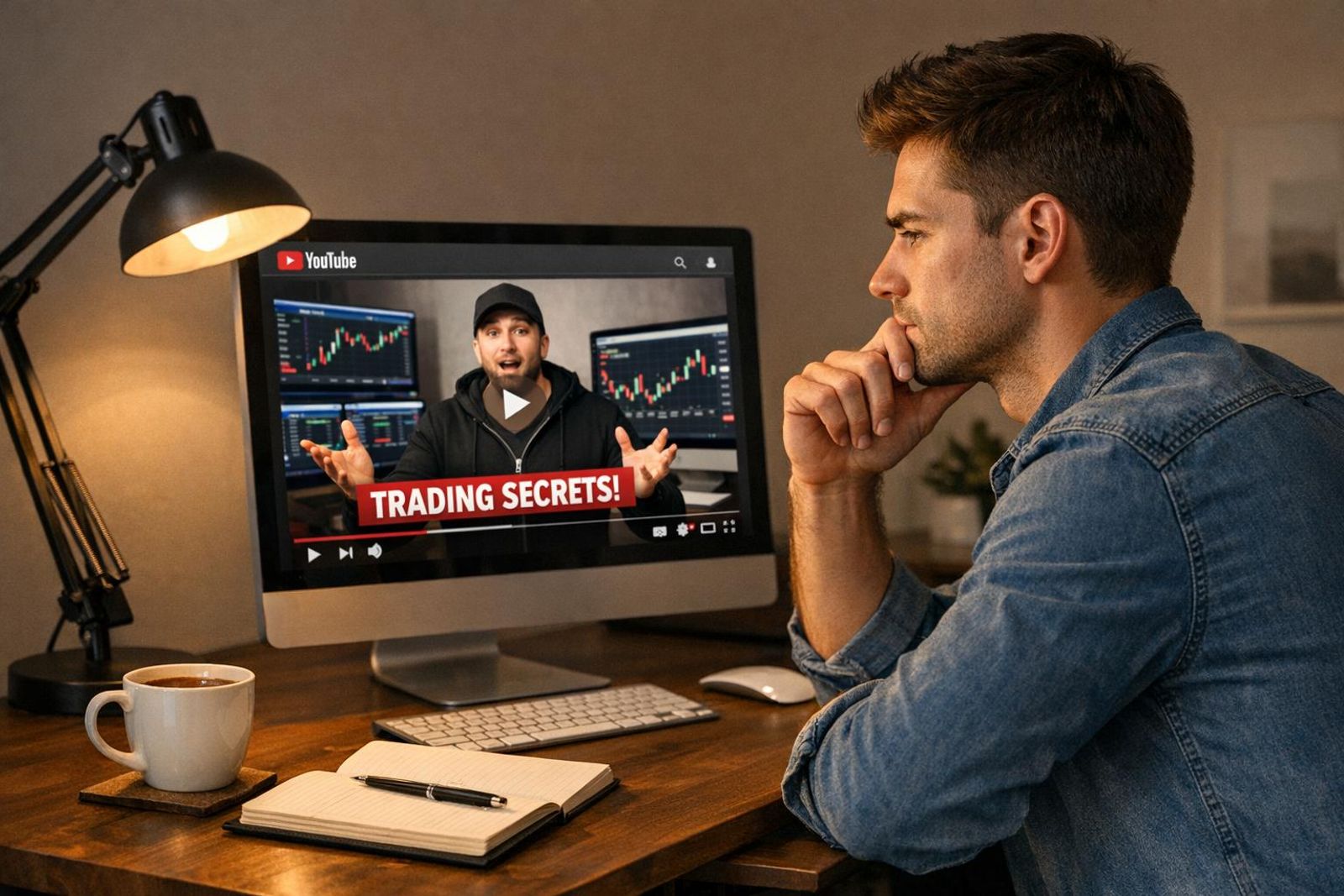
Should You Trust YouTube Trading Gurus?
What a trading guru actually is, where "furu" came from, and a 10-minute audit — incentives, track record, regulators — to run before you buy any course.
By Lenka Rož Schánová · Operations & Risk, For Traders
A trading guru is anyone who sells trading education, signals or mentorship to retail traders — usually through YouTube, Discord or Telegram — while positioning themselves as a consistently profitable trader. A "furu" (fake guru) is the subset whose income comes from courses, signal subscriptions and affiliate rebates rather than from trading, and the difference is verifiable in about ten minutes using free public databases.
Key takeaways
- "Furu" is trader slang for fake guru — someone whose real business is selling access, not trading a live account.
- The single most useful question is not "is he profitable?" but "how does he get paid?" — affiliate rebates, prop firm referral links and course upsells pay whether you win or lose.
- Screenshots, TradingView chart mark-ups and Discord call-outs are not track records; a verified Myfxbook/FX Blue link or a full broker statement with trade count, drawdown and R:R is.
- Five free checks — FINRA BrokerCheck, SEC IAPD, NFA BASIC, SEC EDGAR and Investor.gov — take under five minutes and catch most fabricated credentials.
- The FTC's April 2022 action against Ross Cameron and Warrior Trading ended with $2.9M in refunds distributed to more than 20,000 people in January 2023 — guaranteed-return marketing is an enforcement target, not a grey area.
- The only honest test of anything a guru teaches is forward-testing it on simulated capital under fixed rules — daily loss limits, max drawdown, defined risk per trade — before real money touches it.
Watch: related video
What is a trading guru — and what is a "furu"?
A trading guru is anyone who monetises a public trader persona through education, signals, or mentorship. A "furu" — fake guru — is the subset whose real income comes from that monetisation, not from the markets. The line between the two isn't vibes or follower count. It's a paper trail, and it usually takes about ten minutes to check.
Furu meaning and where the word came from
Furu meaning: a contraction of "fake" and "guru," used to describe someone who presents as a profitable trader publicly while actually earning through course sales, signal subscriptions, or broker/prop firm referral commissions. Furu trading culture grew out of FX and crypto Twitter (now X) and forums like ForexFactory and r/Forex during the 2010s, as retail traders started comparing notes on why their favourite "8-figure trader" never posted a verified brokerage statement. It's not slang anymore — it's standard vocabulary in prop trading and retail FX circles, and it exists because the population of people calling themselves trading gurus needed a word for the ones who weren't.
The four types: educator, lifestyle marketer, signal seller, affiliate funnel
When you ask "are trading gurus legit," you're really asking a four-part question. Almost every account claiming trading-guru status falls into one of these buckets — or, honestly, straddles two:
| Type | Primary revenue | Tell |
|---|---|---|
| Educator | Course/mentorship fees, kept modest | Publishes losing trades and drawdown, teaches process not calls |
| Lifestyle marketer | Course fees inflated by persona | Dubai backdrop, rented supercar, screenshots with no verified statement |
| Signal seller | Recurring Discord/Telegram subscriptions | Unverifiable fills, cherry-picked wins, vague entry timestamps |
| Affiliate funnel operator | Broker or prop firm referral commissions | "Free" content pushes one broker/challenge repeatedly, no disclosure |
Note the overlaps: a genuinely competent trader can still run a signal-seller or affiliate-funnel business model, because that model is easier to scale than one-to-one mentorship. Skill and monetisation method are two separate axes — don't collapse them into one judgment.
Why "guru" isn't automatically an insult
The goal here isn't cynicism, it's a filter. Plenty of legitimate educators call themselves trading gurus without being fake trading guru operators — they teach position sizing, risk-to-reward, and process discipline, and they're upfront that most retail traders lose money, including some of their own students. The word "guru" describes reach and public positioning, not honesty. What separates a real one from a furu is whether their income actually depends on your trading improving, or just on your subscription renewing.
How do I spot fake trading gurus on social media before buying their signals?
Check the incentive first: who actually pays this person, and does it depend on your trading improving or just on your card renewing? Then check the track record (a verified broker statement or MyFxBook-style link, never a screenshot), check the regulator databases for any claim of "licensed" or "registered," check whether losing trades ever get published, and forward-test the method on simulated capital before you let any subscription auto-renew. Ten minutes of digging usually tells you everything a 45-minute sales webinar won't.
The 10-minute audit, in order
- Minute 0–2, monetisation: Open the bio, the pinned comment, the link tree. Is there a course, a signal subscription, an affiliate link to a broker or prop firm? If the answer is yes and there's no visible funded account or personal capital at risk, the income is coming from you, not the market.
- Minute 2–5, track record: Look for a live-linked account (MyFxBook, FX Blue, or a broker's own verified widget) rather than a PDF or a cropped screenshot. Screenshots can be edited in ninety seconds; a live link updates in real time and shows drawdown history you can't hide.
- Minute 5–8, regulator check: If they claim to be a licensed advisor or fund manager, search the name against the CFTC registration lookup or your national regulator's public register. Most trading gurus aren't registered anything — that's not illegal, since most are just educators, but claiming a license they don't hold is a hard red flag.
- Minute 8–10, content sample: Scroll back three to six months. Do you find any post admitting a losing week, a blown trade, a drawdown day? If every single post is a green candle and a Lambo, that's curation, not a track record.
Red flags vs green flags — and how to verify each one
| Signal | What it looks like | How to verify in under 2 minutes |
|---|---|---|
| Red flag | Only winning trades posted, no dated losing screenshots | Scroll 6 months back — count losses vs wins mentioned |
| Green flag | Publishes losing trades and drawdown days openly | Cross-check dates against major news events (NFP, FOMC) for consistency |
| Red flag | "Verified" track record is a cropped screenshot | Ask for the live MyFxBook/FX Blue link — refusal is itself the answer |
| Green flag | Live-linked, third-party-hosted statement | Click the link, check it updates and matches claimed instrument (XAUUSD, US100, etc.) |
| Red flag | Claims to be "SEC licensed" or "regulated fund manager" | Search the name on the CFTC or national regulator database |
| Red flag | Income depends entirely on course/signal sales, no funded or personal capital shown | Check bio links — affiliate codes to brokers or prop firms are the tell |
What to do if you're already subscribed
Cancel the recurring charge first — do this before you do anything else, because the sunk cost of a subscription is exactly what keeps people paying for content they've stopped trusting. Keep the material you've already paid for; there's often something usable in there even from a furu. Then run the same audit above on your own timeline, and separately, forward-test any signal or strategy on simulated capital for at least twenty to thirty trades before you'd ever trust it with real risk again. If the method can't survive that on a demo, it wasn't going to survive your live account either.
Five red flags that show a trading guru isn't actually trading
A guru who's actually in the market talks in probabilities, drawdowns, and losing streaks. A guru who's selling you a dream talks in guarantees, win rates, and screenshots. Here are the five trading guru red flags you can check in the time it takes to watch one more video.
Guaranteed returns and "risk-free" language
"Guaranteed 20% a month" or "risk-free entry" are phrases no legitimate operator can use — the FTC has been explicit that nobody can promise investment returns, guaranteed or otherwise. The CFTC's own investor-education material is blunter still: there is no such thing as a risk-free investment. If a guru's pitch leans on either word, that's not marketing shorthand — it's the tell.
No verified track record — only screenshots and hindsight charts
Look for the chart mark-up posted after the move — entry arrow drawn on a candle that already closed, stop-loss line added once price already respected it. A real track record comes from a broker statement, MyFXBook, or a prop firm dashboard with a start date and running equity curve, not a cropped balance screenshot with the timestamp cut off.
Selling the course harder than they teach the method
Count the minutes: if 3 of a 12-minute video are strategy and 9 are urgency ("only 20 spots left"), the funnel is the business model, not the trading. The SEC Office of Investor Education has flagged this exact pattern in influencer cases — performance claims that can't be substantiated, wrapped around a paid product.
Vague answers to specific questions
Ask "what was your stop?" or "what was your position size?" and watch what comes back. A real trader gives you a number — 15 pips, 0.5 ATR, 1% of account. "Depends on the setup" to a specific question about a specific trade already posted is evasion, not nuance.
Risk is never mentioned in a single video
This is the one that catches XAUUSD and US100 traders specifically. "200 pips a day on gold" or "NSDQ scalp, 90% win rate" claims sound huge until you ask for the drawdown figure that goes with them — and it never shows up. A 90% win rate with no max-loss-per-trade disclosed can still blow an account on the other 10%. If risk sizing, daily loss limit, or max drawdown isn't part of the content, on gold or anywhere else, the guru isn't managing risk on camera because there's no live risk to manage.
Follow the money: how a guru gets paid whether you win or lose
A guru with a broker affiliate rebate or IB (introducing broker) deal gets paid per lot you trade — not per dollar you make. That single fact flips the incentive structure: a subscriber who overtrades a losing account and churns through volume is worth more than one who trades twice a month and quietly compounds gains.
Broker and IB rebates — paid on your volume, not your P&L
Under a standard IB rebate commission arrangement, a broker pays the guru a fixed amount — often a fraction of a pip, or a flat sum per standard lot — every time you place a trade through their link. It doesn't matter if that trade hits your stop or your target. This is why some gurus push high-frequency scalping "systems" heavy on signals: more entries means more lots, means more rebate, regardless of your account curve. Ask yourself whether the trading style being sold matches a trader who profits from your fills, or one who profits from your results.
Prop firm affiliate links and the referral economics
Prop firm affiliate links work the same way, just on evaluation fees instead of spread. The guru earns a commission when you buy a Challenge — and in some affiliate models, again when you pay to re-attempt after failing. A 90%+ industry-standard failure rate on evaluations, which is genuinely common across the prop space, means a guru running this model can profit heavily from an audience that mostly doesn't pass. That doesn't make every recommendation dishonest — a legitimate educator can point you toward a challenge provider they've vetted and disclose the commission openly. The problem isn't the affiliate link. It's the silence around it.
The course upsell ladder: free → $97 → $2,000 mentorship
Watch the funnel, not the promise. Free YouTube content builds trust and audience. A low-ticket course, often $97–$297, filters for buyers and covers ad spend. The real revenue sits at the top: $1,000–$2,000+ "mentorship" or signal-room access, usually sold with urgency mechanics — "12 seats left," "price goes up Sunday midnight," a countdown timer on the sales page. Those are marketing levers, not trading edges. A genuine setup on XAUUSD or NSDQ doesn't expire because a cart closes at midnight; the market's still open Monday.
None of this — rebates, affiliate links, course tiers — is automatically disqualifying. Trading course upsell funnels and trading signal sellers scam headlines both exist because the incentive is misaligned, not because every paid product is a scam. Undisclosed income is the red flag, not income itself. So ask directly, in a DM, before you pay for anything: "Do you receive any rebate, commission or affiliate payment tied to where I trade or which firm I sign up with?" A straight answer, with numbers, is a good sign. A dodge is your answer too.
Track-record forensics: what counts as proof and what doesn't
To verify a trader's track record, you need a third-party verified link showing full trade history and broker verification — a screenshot never qualifies, no matter how green it looks. If someone's "proof" can be edited in Photoshop before it hits your feed, it isn't proof, it's marketing.
Verified Myfxbook / FX Blue links vs cropped screenshots
A Myfxbook verified account pulls data directly from the broker's server via API — the guru can't cherry-pick which trades appear or hide the losers. Same logic applies to FX Blue statements. Both show open date, close date, lot size, and running balance for every single trade, not just the win streak someone chose to screenshot. If a guru links you a live Myfxbook or FX Blue profile, click through and check the "verified" badge — not every listed account has one, and unverified accounts can still be manually edited by the owner.
Cropped screenshots posted to Instagram or X prove nothing except that someone owns image-editing software. If that's the only "evidence" on offer, treat the account balance as fiction until proven otherwise.
Full statements: trade count, average R:R, max drawdown
A real statement covers the entire trading period, not a filtered 90-day window that happens to exclude the blown account from last winter. Before you take a strategy or signal service seriously, you want three numbers disclosed together, not in isolation:
- Trade count — a claimed 80% win rate on 12 trades is noise, not a strategy. You need volume before a win rate means anything.
- Average R:R — this has to reconcile with the win rate. A 1:3 R:R with a 70% win rate produces a specific equity curve slope; if the actual curve is steeper or choppier than that math allows, something's off.
- Max drawdown — if this number doesn't exist anywhere in the statement, assume it's being hidden because it's ugly.
Also check: is the account size disclosed, and is it labelled clearly as live or simulated capital? A guru running a demo account and calling it a "funded challenge pass" without disclosure is misrepresenting risk, not skill.
The arithmetic that exposes an impossible equity curve
Run the numbers yourself before you believe the chart:
| Claimed metric | Sanity check | Red flag if... |
|---|---|---|
| Win rate + R:R | Expected equity slope should match curve smoothness | Curve is a straight 45° line with no drawdown ever visible |
| Trade count | Statistical significance needs 100+ trades minimum | Big claims resting on under 30 trades |
| Max drawdown | Should be present and match the equity dips | Not disclosed at all, or "0%" |
| Account balance | Should be a real number, not just % | Only percentage gains shown, balance hidden |
Common dodges worth flagging immediately: "my broker doesn't support Myfxbook," "I don't share my account for privacy," or results posted purely as percentage gains with no balance attached. Any one of those, alone, might be innocent. All three together on one profile is a pattern. Separately, TradingView published ideas are worth something — they're timestamped, so you can verify a directional call was made before the move, not after. But a published idea proves someone called a direction, not that they executed it, sized it correctly, or survived the drawdown along the way. Treat it as partial evidence for analysis, never as proof of trading results.
The regulator check: five free databases, five minutes
Here's how to check if a trader is regulated: pull the guru's full legal name and firm name, then run both through five free government databases. A clean, matching result across all five takes about five minutes and tells you more than a hundred hours of YouTube content.
FINRA BrokerCheck and SEC IAPD — what to type in
Go to BrokerCheck and search the person's full legal name (not their trading alias) or their firm's CRD number, if they've published one. SEC IAPD works the same way for investment advisers. A clean result shows registration status, employment history, and zero disclosures. A disclosure event means a regulatory action, customer complaint, or civil judgment is on record — it doesn't automatically mean fraud, but it means you read the details before sending them money.
NFA BASIC for futures and forex operators
If the guru trades futures or forex and claims to manage money or sell signals as a business, search their name or NFA ID in NFA BASIC. Anyone soliciting funds for futures trading in the US is supposed to be registered here. No listing plus a "join my fund" pitch is a red flag, full stop.
SEC EDGAR
EDGAR is where registered advisers and firms file disclosures. Search the firm name — if they claim to run a fund or manage client assets, there should be a filing trail. No trail means no fund, whatever the Discord bio says.
Investor.gov and Form CRS
Investor.gov is the SEC's public-facing lookup tool and rolls several of the above searches into one interface. If the guru is a registered investment adviser, they're legally required to give you a Form CRS — a one-page relationship summary explaining fees, conflicts of interest, and disciplinary history. No Form CRS on request from someone claiming to be an adviser is disqualifying by itself.
Credentials that mean something: CFA, CFP
CFA and CFP designations are issued by third-party bodies (CFA Institute, CFP Board) with public verification tools — you can look up the charter or certification directly on their sites. A "certified professional trader" badge issued by the guru's own academy is not a credential; it's a marketing asset they printed themselves.
Important nuance: plenty of gurus show up nowhere in any of these five databases, and that's not automatically illegal. Selling courses, signals, or mentorship as "education" doesn't require registration. What disqualifies them is claiming to be a licensed adviser or offering to manage your money without being registered anywhere — that's the exact gap enforcement has gone after. The FTC's 2022 complaint against Ross Cameron and Warrior Trading led to $2.9 million distributed to more than 20,000 people in January 2023, and a separate digital-marketer settlement returned $1.2 million to affected traders. Both cases were built on public claims that didn't match the public record — which is precisely what these five databases exist to catch.
| Database | Search input | Clean result looks like |
|---|---|---|
| FINRA BrokerCheck | Full legal name or CRD number | Active registration, no disclosures |
| SEC IAPD | Full legal name or firm name | Registered adviser status, clean history |
| NFA BASIC | Name or NFA ID | Active NFA membership, no adverse actions |
| SEC EDGAR | Firm name | Filing history matches fund claims |
| Investor.gov | Name (adviser lookup) | Form CRS available on request |
GuruLeaks1 and exposé accounts: leads, not verdicts
Watchdog accounts like GuruLeaks1 are useful for generating leads, not for closing the case — treat every "trading guru exposed" thread as a starting point that still needs verification against the databases above. Searching a name plus "scam" or "exposed" before you hand over money is normal due diligence at this point, and it's worked: GuruLeaks1 has surfaced fabricated equity curves, backtested screenshots sold as live fills, and undisclosed affiliate deals that no regulator ever flagged, because regulators generally don't police marketing copy on YouTube.
What watchdog accounts do well
Crowdsourced exposé accounts have manpower a solo trader doesn't. They pull old deleted tweets, cross-reference course sale timestamps against claimed "live" trade dates, and DM former students who signed NDAs but talk anyway. GuruLeaks1-style threads have caught gurus running the same "verified" account screenshot across three different funnels, months apart, with different balances pasted in. That's genuine forensic work, and it moves faster than any regulator ever will on YouTube trading course scams that don't involve securities fraud in a technical sense.
Where they fail as due diligence
An accusation thread is not a verdict, and treating it like one is its own kind of bias. Watchdog accounts are unaudited — no one fact-checks the fact-checker. Some are run by competing course sellers settling scores under a mask of consumer protection. Some monetise their own following with merch, Patreon tiers, or "who's next" anticipation that rewards drama over accuracy. Screenshots get cropped, quotes get clipped mid-sentence, and a guru who genuinely blew an account on one bad NFP day can get painted the same as one running a full Ponzi structure. Outrage spreads faster than correction; retractions rarely get the same reach as the original callout.
How to cross-check an accusation in ten minutes
- Trace it to the source. Find the original document, video, or trade confirmation the thread is citing — not a screenshot of a screenshot. If you can't locate the primary artifact, weight the claim as unverified.
- Check for an on-record response. Did the accused address it directly, with specifics, or issue a vague "haters gonna hate" non-denial? Silence and deflection are data points too.
- Check for institutional follow-through. Did any regulator, platform (YouTube, Discord, payment processor), or court filing act on it? A chargeback pattern or a suspended affiliate account carries more weight than a thousand replies.
- Rank your evidence. Primary sources — sworn statements, court filings, chargeback records, verified trade confirmations — outrank secondary sources — paraphrased recaps, reaction videos, anonymous "insider" quotes.
Bottom line: let GuruLeaks1 and similar watchdog accounts generate your questions — then answer those questions with FINRA BrokerCheck, SEC IAPD, NFA BASIC, or SEC EDGAR, the way you would have before you ever saw the thread. A guru who's clean on the public record survives an exposé account's worst day. One who isn't won't survive five minutes of your own lookup.
Ready to trade funded capital?
Choose your path — Instant Accounts, One-Step or Two-Step Challenges — from just $23, with up to $300,000 in funded capital.
Choose your challengeGreen flags: what a trading educator worth paying for actually does
A legitimate trading educator sells process, not certainty — and everything they publish is designed to be tested, not just believed. Flip your screening from "what's wrong with this guru" to "does this person do the five things a real educator does," and the decision gets a lot faster. Most furus fail at least three of them in the first video you watch.
Publishes losing trades and drawdown periods
Every account that trades long enough has a losing month — the S&P 500's worst 12-month stretches still sit inside decades of positive returns, and no trading system is different. A trader worth learning from posts the red months next to the green ones, without a caption explaining why it "doesn't count." If someone's public track record is an unbroken green line, either they're not showing you the whole book, or the account is too new to have hit its first real drawdown yet. Ask to see a losing week before you ask to see a winning one — the reaction tells you more than the P&L.
Teaches process, risk and position sizing — not just entries
Entries are the easy 10% of trading; risk per trade and position sizing are the 90% that actually determine whether you're still solvent in a year. A credible educator states risk per trade as a fixed percentage — 0.5%, 1%, whatever their max drawdown tolerance allows — and shows you how position size is calculated from stop distance, not from conviction. They'll walk through where the stop sits, what specifically invalidates the setup, and what their average R:R and expectancy look like across a real sample size, not a cherry-picked ten trades. If the answer to "what's your expectancy" is a vibe instead of a number, that's not a rule set — it's a story.
No urgency, no guarantees, transparent pricing and refunds
Countdown timers and "doors close tonight" language exist to short-circuit the due diligence you're doing right now — a real course doesn't need it because the content doesn't expire. Look for a flat, once-stated price, a plain refund policy, and upfront disclosure of any affiliate relationship (broker kickbacks, signal-service cuts) before you pay a cent. None of that guarantees profitability — nothing legitimately does — but it means the incentive structure is aligned with you learning, not you staying subscribed.
The single strongest green flag: they want you to forward-test their method yourself, on a demo or small size, before you scale it — not copy their calls in real time. That's the difference between teaching a skill and running a signal service with a course wrapped around it. And to be clear, good education is genuinely worth paying for; the problem was never the price tag, it's a funnel built on urgency and unverifiable claims instead of a rule set you can check.
Signal rooms: can a Discord or Telegram group ever be defensible?
Rarely, and only if the group publishes what it's actually claiming — most Discord signal groups and Telegram signals can't survive that test, because the entry you saw in the screenshot isn't the entry you got. Do trading signals work? Sometimes the idea behind them does. The execution almost never scales to a room of 400 subscribers.
Why copied entries rarely survive fills and slippage
A signal posted "buy XAUUSD 2,412" reaches you and 400 other people across different brokers, different spreads, and different latencies, all at once. During a London-session volatility spike — the kind gold produces around a data print or a stop run through a round number — that price is gone in seconds. Your fill depends on your broker's execution speed, your connection, and how wide the spread runs at that exact moment. Slippage of 20-40 points on gold during a fast move isn't unusual, and it eats the edge before you've even started managing the trade. Multiply that across a room, and you get 400 different outcomes from one "signal" — most of them worse than the one screenshotted for the results channel. Worse, plenty of rooms never post a stop at all. No stop means no defined risk, which means the "win" they show you later is unfalsifiable — there's no losing scenario on record to check it against.
What a defensible signal service would have to publish
If a signal service wants to be taken seriously, here's the bar:
- Timestamped entries posted before the move, not screenshotted after
- A published stop and target alongside every entry, no exceptions
- A verified live account actually trading the same signals it sells — not a "backtest" or a demo
- A full win/loss ledger, including scratched and stopped-out trades, not just the winners
- A stated max drawdown figure, not just a headline win rate
Almost no room clears all five. The ones that clear even three are worth a longer look.
The subscription maths most subscribers never run
A $99/month signal room costs roughly $1,200 a year. Add your own spread and commission on every copied trade, and your edge has to clear that $1,200 before you've made a single dollar of performance reward. Run the number against your average trade size: if you're trading 0.1 lots on XAUUSD, $1,200 a year is a lot of pips you need the signals to generate net of slippage, fees, and the fills you actually got — not the fills in the screenshot.
Signals can be a legitimate learning aid if you journal every call, back-check the timestamp against the real chart, and track your own fill against theirs. As a substitute for a rule set you can execute alone, on your own account, at your own broker's spread — they're a poor one.
Is paying a trading guru ever worth it?
Pros
- A structured curriculum can compress months of unfocused YouTube-hopping into a testable framework
- Good educators shorten the feedback loop by naming the mistakes you can't see in your own journal
- Community accountability genuinely helps some traders hold to rules they'd otherwise break alone
- Paid material with a refund window and transparent pricing carries limited downside if you audit it first
Cons / risks
- Most pricing is built around recurring subscriptions and upsells, not a finished, self-contained product
- Affiliate and rebate income means the seller can profit from your volume regardless of your results
- Copied entries transfer no skill — you learn nothing you can execute when the room goes quiet
- No course can substitute for a forward-tested rule set under real drawdown and daily loss limits
Ready to trade funded capital?
Choose your path — Instant Accounts, One-Step or Two-Step Challenges — from just $23, with up to $300,000 in funded capital.
Choose your challengeFrequently Asked Questions
What is a trading guru?+
A trading guru is anyone who publicly teaches, sells signals, or sells courses around trading — the label itself is neutral, only the behavior behind it isn't. Legitimate educators show verified track records, disclose how they actually earn money, and teach process over hype. The problem is the term has been hijacked by "furus" — fake gurus who never trade real size but sell the lifestyle. Before you trust anyone's calls, separate the teacher from the marketer: one builds your skill, the other builds their funnel.
What does furu mean in trading?+
"Furu" is trader slang for "fake guru" — someone who markets themselves as a trading expert without a verifiable track record of actually trading profitably. The term spread through Twitter/X and Discord trading circles as a shorthand callout, usually paired with screenshots exposing inflated PnL or recycled chart calls. It's not just an insult — it's become a filter traders use before subscribing to any signal service. If someone's content is 90% lifestyle flexing and 10% actual trade breakdowns, the furu label usually fits.
How do I spot a fake trading guru?+
Check whether their claimed results are independently verifiable — a real trader can link a broker statement, MyFxBook, or funded account dashboard, not just a cropped screenshot. Watch for lifestyle-first content (cars, watches, "I made $50K today") with almost no risk management discussion. Real educators talk about losing trades, drawdown, and R:R as much as wins. If someone won't show a live account, refuses to discuss losses, or pressures you into a paid group with urgency tactics, treat that as your answer.
What are red flags that a YouTube trading guru isn't real?+
Five flags come up again and again: no verifiable broker statement (only screenshots), inconsistent PnL numbers between videos, heavy reliance on affiliate broker links for income, urgency-based sales funnels ("only 10 spots left"), and zero discussion of losing trades or drawdown. A trader actually risking capital talks about stop-outs and bad weeks — it's part of the job. Content that's all wins, all the time, with a course pitch every third sentence, is a marketing operation wearing a trading costume.
How do I verify a trader's track record?+
Real proof is a linked, time-stamped account — a broker statement, a prop firm funded account dashboard, or a verified tool like MyFxBook/FX Blue that shows trade history, not just equity curve screenshots. What doesn't count: cropped PnL images, backtested equity curves presented as live results, or "verified" badges the guru issued themselves. Ask directly for the account number's verification link or a live screen-share of an open platform. If they dodge the question or get defensive, you have your answer without needing a second one.
How does a trading guru make money if not from trading?+
Most income comes from course sales, signal subscriptions, and broker affiliate rebates — not the trading itself. A furu earns a commission every time someone opens an account through their referral link, regardless of whether that person ever profits. Signal groups charge monthly fees whether the calls hit or miss. This is why so much guru content pushes broker sign-ups and "limited time" course bundles — the real revenue model is audience monetization, and your trading results are irrelevant to their paycheck.
Which regulator databases can I check for a broker or trader?+
Check the FCA Register (UK), NFA BASIC (US futures/forex), ASIC Connect (Australia), or CySEC's public register — search the firm or individual's name plus registration number if the guru provides one. Type the exact broker name a guru promotes, not just the guru's own name, since most gurus aren't individually licensed advisors. If a promoted broker doesn't show up, or shows warnings/revoked status, that's a hard stop. These databases are free and take under two minutes to search.
Is GuruLeaks1 a reliable source for exposing fake traders?+
Exposé accounts like GuruLeaks1 aggregate screenshots, leaked chat logs, and inconsistencies in gurus' claimed results — useful as a starting point, not as final proof. Treat their posts the way you'd treat any single source: cross-check the specific claim (a mismatched PnL screenshot, a contradicted timestamp) rather than accepting the overall narrative wholesale. Drama and genuine evidence often mix in the same thread. Use these accounts to generate questions to verify yourself, not as a substitute for checking a regulator database or a linked account.
What separates a legitimate trading educator from a furu?+
A legitimate educator shows real, linked trading results, discusses losses and drawdown openly, and teaches process — risk sizing, R:R, journaling — rather than selling a lifestyle. Green flags include transparent fee structures (no hidden affiliate kickbacks), consistent strategy across time instead of chasing whatever's trending, and encouraging you to forward-test ideas on simulated capital before risking real money. If their content would still be useful to you with the sales pitch removed, that's a strong signal they're teaching, not just marketing.
How do I test a guru's strategy without risking real money?+
Forward-test it on a demo account or a funded evaluation using simulated capital, running the exact entry/exit rules for at least 30-50 trades before judging it. Track win rate, average R:R, and max drawdown against what the guru claims — most inflated strategies fall apart once you strip out cherry-picked examples. A Two-Step Challenge or demo environment gives you real market conditions without account risk, which is exactly how you should vet any signal service or strategy before ever funding a live account.
Written by
Lenka Rož Schánová
Operations & Risk, For Traders
Lenka focuses on the operational and risk side of running a prop trading firm — the rules behind evaluations, why drawdown limits exist, and the patterns that distinguish traders who pass from those who don't. She writes for traders who want to understand the framework they're trading inside, not just the markets they're trading.
Follow on LinkedInReady to trade funded capital?
Choose your path — Instant Accounts, One-Step or Two-Step Challenges — from just $49, with up to $300,000 in funded capital.
Choose your challengeRelated Blog Posts
Trade up to $300,000
Choose challenge