

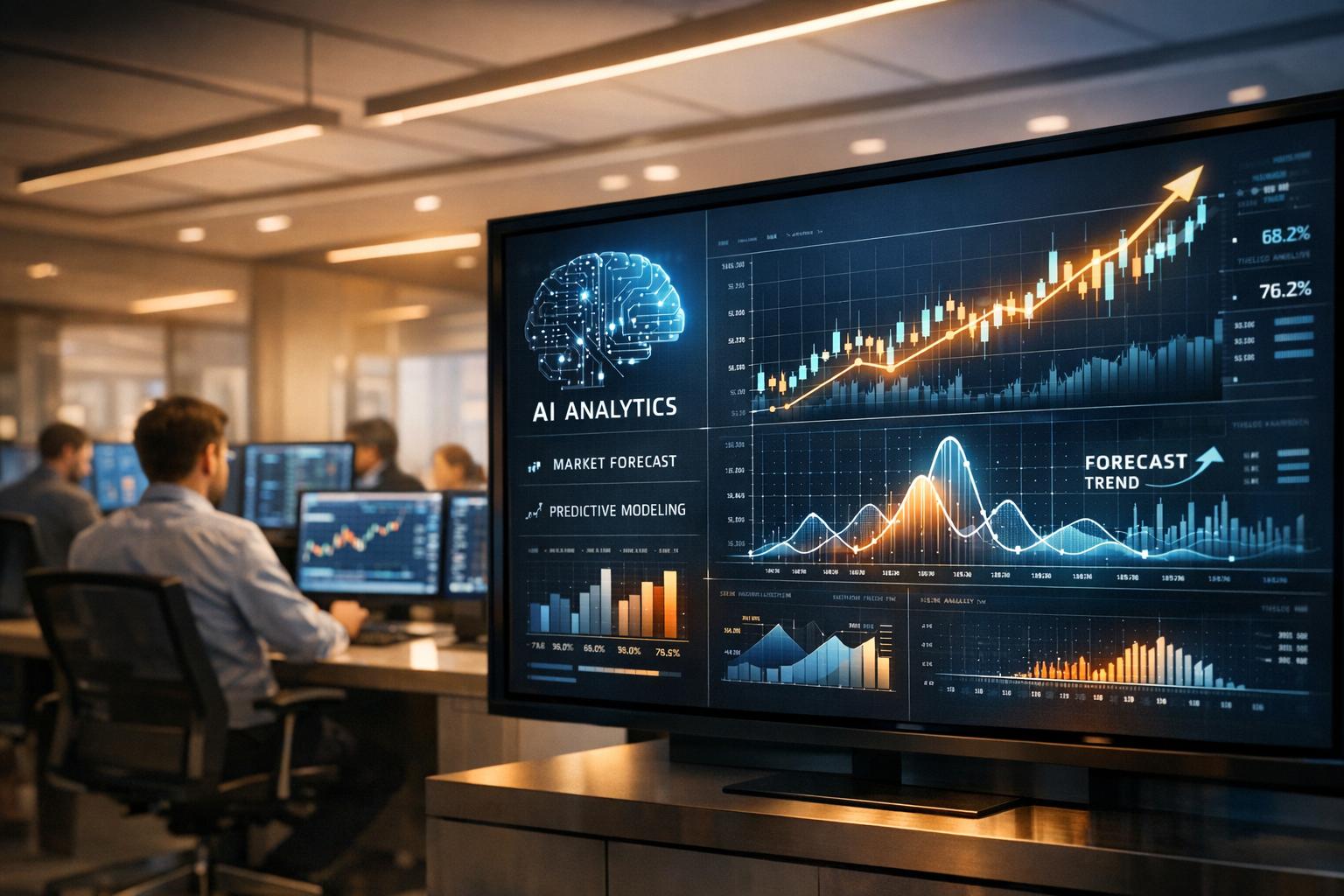
AI has transformed proprietary trading by improving speed, accuracy, and risk management. Here's what you need to know:
- Algorithmic Trading Dominates: 60%-70% of trades are algorithmically executed, with AI systems analyzing data in microseconds.
- Risk Management Tools: AI monitors trades in real time, enforcing general rules like drawdown limits and flagging risky behaviors instantly.
- Predictive Analytics: Machine learning predicts risks, identifies patterns, and runs stress tests to assess strategies under extreme conditions.
- Automated Trading: AI algorithms process vast data, optimize trade execution, and adjust dynamically to market changes.
- Challenges: Issues include data quality, overfitting in backtesting, high infrastructure costs, and model transparency. These must be carefully managed.
AI is a critical tool for modern trading, offering unmatched efficiency in data analysis, trade execution, and risk control. However, success depends on high-quality data, compliance, and strategic integration.
Prop Firm CEO: I Analyzed 50,000 Traders, THIS Is What The Top 1% Do!
AI-Driven Risk Management Tools
Gone are the days when risk management meant manually checking spreadsheets at the end of the day. Today, AI systems monitor every trade in real time, ensuring rules like low drawdown limits, lot size restrictions, and exposure caps are followed. If a trader crosses a threshold - like a 5% drawdown - the system takes immediate action. This could mean closing positions, pausing accounts, or even disabling them entirely to prevent further losses.
This modern approach also flags risky behaviors as they happen, such as revenge trading, using excessive leverage, or exploiting algorithmic loopholes. Alerts are sent instantly through dashboards, email, or platforms like Telegram and Slack, keeping both traders and administrators informed. These advancements are transforming how risk is managed, especially in simulated trading setups.
Real-Time Risk Monitoring in Simulated Trading
Simulated prop trading environments depend on constant monitoring to ensure traders perform consistently on a large scale. AI-powered platforms excel at tracking thousands of accounts simultaneously. By analyzing activity throughout the trading day, these systems act quickly while minimizing false alerts.
For Traders, a leading platform, uses AI to enforce a strict 5% drawdown limit across all virtual accounts. The system tracks floating losses and active exposure in real time, avoiding the delays often seen with traditional systems. This level of precision helps maintain the integrity of trading strategies.
Predictive Analytics for Risk Assessment
AI doesn’t just track risks - it predicts them. Machine learning models analyze historical data to estimate the likelihood of drawdowns and assess risk-adjusted profitability. These systems can also spot patterns that signal trouble, like a trader who suddenly starts aggressive trading outside their usual hours.
"AI-powered systems excel at sifting through massive streams of market data, often flagging early warning signals and subtle correlations that might escape human analysis."
– Rahul Gupta, AI Solutions Architect, Evergreen
Predictive analytics also powers scenario simulations and stress tests. AI runs thousands of market downturn scenarios to evaluate how a strategy might perform under extreme conditions. This proactive approach helps firms identify weak spots early, allowing traders to adjust strategies before risks escalate. Considering that 88% of losses in failed prop firms are tied to poor risk systems or monitoring, predictive AI shifts the focus from reacting to anticipating, addressing one of the industry’s biggest challenges.
Automated Trading Algorithms
AI-powered algorithms have reshaped the way trades are executed in proprietary trading. These systems can process millions of data points in milliseconds, uncovering opportunities that would be impossible for humans to detect. In fact, by 2021, about 70% of all trading volume in the U.S. stock market was driven by AI-based algorithmic trading.
These algorithms excel at optimizing trade execution by identifying ideal entry and exit points, minimizing transaction costs, and dynamically adjusting strategies in real time. They also analyze unstructured data - like supply chain disruptions or commodity price shifts - to reveal correlations that might signal profitable trades. Using reinforcement learning, these models continuously refine their strategies without needing manual updates, adapting to ever-changing market conditions.
"AI and its algorithms are reshaping financial markets by bringing unmatched speed, efficiency, and precision to trading and stock market prediction in comparison to humans."
– David Wu, Michigan Journal of Economics
The numbers back this up: the global algorithmic trading market was valued at $15.55 billion in 2021 and is expected to grow at an annual rate of 12.2% through 2030. The influence of AI in this space is evident, with over half of patent applications for algorithmic trading since 2020 featuring AI elements - up from just 19% in 2017. Additionally, a 2023 survey revealed that 9 out of the top 10 hedge fund managers rely on AI to boost portfolio returns. This growing reliance on AI is setting the stage for its integration across a variety of trading platforms.
AI-Powered Algorithmic Trading on DXTrade, TradeLocker, and cTrader
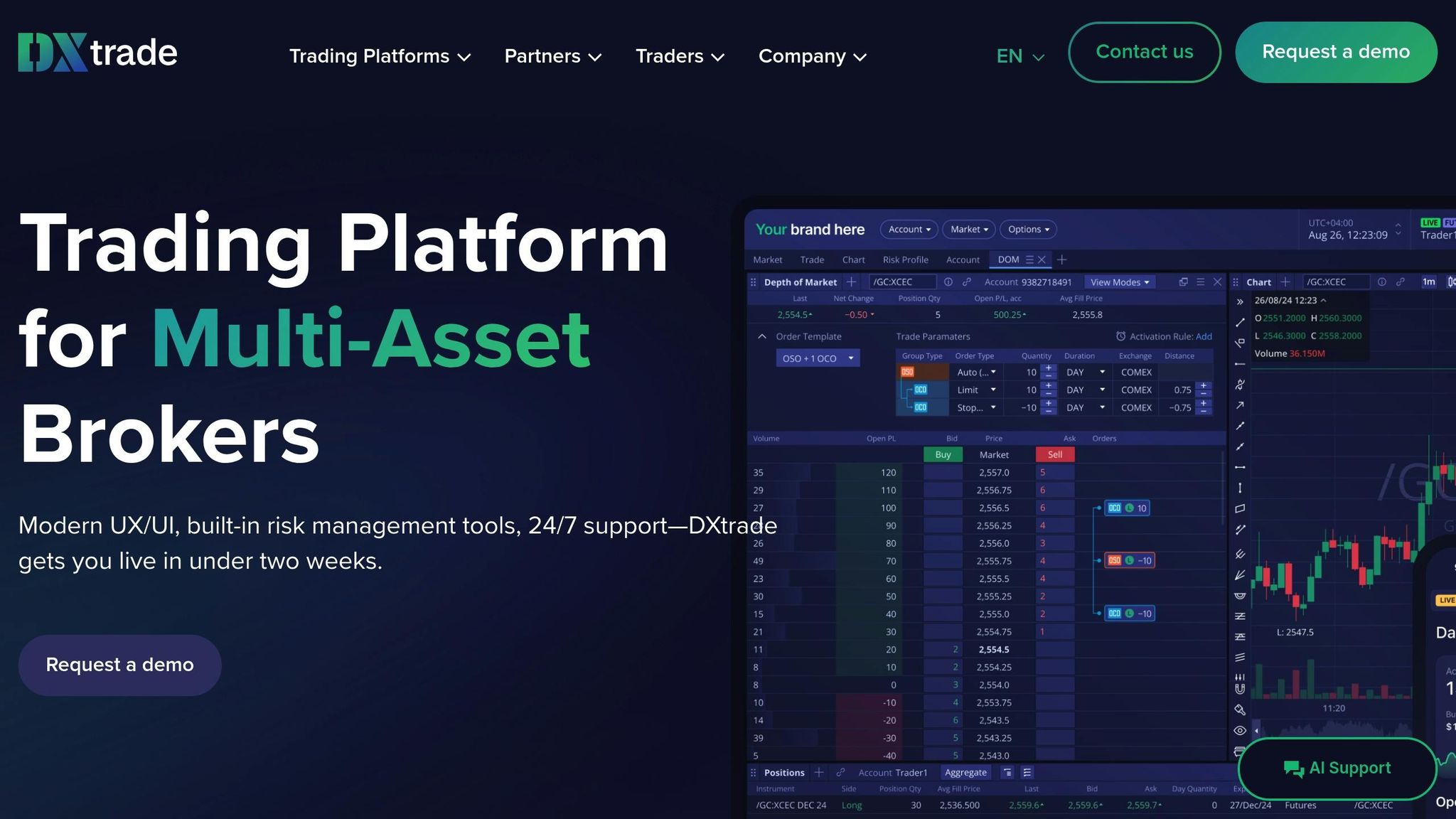
Modern trading platforms like DXTrade, TradeLocker, and cTrader have embraced AI to revolutionize automated strategies. These platforms now go beyond basic rule-based automation, enabling high-frequency trading by analyzing real-time order flow, market microstructure, and liquidity data simultaneously. For Traders, for example, uses these tools to deliver AI-enhanced execution on virtual capital accounts. Whether it's a scalping strategy executing hundreds of trades daily or a swing trading approach holding positions for days, AI adapts and optimizes strategies dynamically.
AI's ability to process complex reports, such as Federal Reserve minutes, within 15 seconds of release is a game-changer. This speed is especially critical in simulated proprietary trading, where traders must meet profit targets while adhering to strict drawdown limits.
These algorithms are designed to align with the evolving demands of trading. Different AI-driven strategies serve unique purposes:
- Mean reversion algorithms: Use indicators like Bollinger Bands, RSI, and moving averages to spot overbought or oversold conditions.
- Momentum-based systems: Employ deep learning to detect real-time price trends.
- Market-making strategies: Focus on profiting from bid-ask spreads through dynamic spread adjustments.
- Arbitrage algorithms: Exploit price discrepancies between exchanges using lightning-fast execution and low-latency APIs.
Customizable AI Solutions for Different Trading Styles
AI's flexibility allows traders to tailor strategies to their specific needs, making advanced trading tools accessible to everyone. Platforms like Capitalise.ai let users automate strategies using plain language, eliminating the need for coding skills. Similarly, tools like AutuGPT can generate code for specific strategies - such as Grid, Martingale, Bollinger Bands, or RSI - on platforms like cTrader.
Each trading style benefits from AI in unique ways. For scalpers, algorithms focus on analyzing tick data and executing dozens (or even hundreds) of trades daily with tight stop-losses to minimize overnight exposure. On the other hand, swing trading AI combines technical analysis with insights from fundamental data and sentiment analysis, managing fewer trades per week but allowing for wider stop-losses to account for overnight gaps. For instance, CNN-based bots have shown consistent performance, achieving a 2% profit per trade in simulations.
"AI algorithmic trading enables financial trading to be made more democratic since it is based on the usage of significant data and provides all traders with the tools needed to conduct quick, precise, and bias-free investment decisions."
– IEEE Xplore
Large firms also exemplify the scalability of AI in trading. Squarepoint Capital, for example, has a Data Science unit with 14 specialists spread across New York, London, and Hong Kong. They use supervised and deep learning techniques to forecast returns over timeframes ranging from five minutes to ten days. Similarly, Man Group unveiled ManGPT, an internal generative AI platform, in 2023. By 2024, 40% of its employees were using the tool, and 20% of the AI-generated code had made it into production.
AI-powered platforms now offer specialized tools for diverse strategies - whether scalping, short-term, or long-term trading. Traders can subscribe to individual AI-generated signals or adopt comprehensive strategies, offering flexibility across various asset classes. These solutions are particularly useful in simulated proprietary trading, where AI-driven backtesting allows traders to refine strategies before live deployment, ensuring they perform well under different market conditions.
Predictive Analytics in Simulated Prop Trading
Predictive analytics is reshaping how traders approach simulated prop trading, moving the focus from reactive strategies to proactive decision-making. By leveraging AI, traders can analyze massive datasets - like tick data, order books, and volatility clusters - to anticipate market movements. This concept aligns with what Exegy refers to as "negative latency", where market moves are predicted before they even happen.
Machine learning models, including random forests and deep neural networks, play a crucial role by identifying statistical edges in both historical and real-time data. These advanced models excel at uncovering non-linear relationships and subtle micro-patterns that traditional methods often overlook. A survey from 2025 revealed that more than 50% of financial firms consider AI essential to their operations, underscoring its growing importance. These predictive tools not only help identify market trends but also fine-tune performance strategies.
Using AI to Identify Market Trends
AI processes market data in milliseconds, enabling traders to make swift, informed decisions. Natural Language Processing (NLP) adds another layer by analyzing sentiment from sources like news, social media, and earnings calls, translating global events into actionable insights in real time.
In November 2025, Man Group showcased their proprietary AI workflow, AlphaGPT, which operates as a three-part system: an "Idea Person" for hypothesis generation, an "Implementer" for Python code creation, and an "Evaluator" for statistical testing. This system has proven its ability to generate alpha signals that meet rigorous institutional standards. Ziang Fang, Senior Portfolio Manager at Man Numeric, described the synergy between humans and AI:
"AlphaGPT doesn't replace human judgment but amplifies it. The most effective use of the system involves human researchers working alongside AI, with each contributing their unique strengths".
Multi-agent frameworks enhance this process further. These systems, powered by large language models (LLMs), bring together agents specializing in fundamental, sentiment, and technical analysis to create a comprehensive market view. For example, in 2024, researchers from UCLA and MIT introduced TradingAgents, a multi-agent framework designed to simulate a professional trading firm. During experiments conducted between June and November 2024, this system significantly improved cumulative returns and Sharpe ratios for stocks like AAPL, GOOGL, and AMZN compared to traditional rule-based strategies. This level of precision in trend identification forms the backbone of strategies that consistently achieve profit targets.
Meeting Profit Targets with AI
Building on the role of automated systems and risk management, predictive analytics now enables traders to make goal-specific adjustments with greater confidence. By providing data-driven recommendations, these tools eliminate uncertainty and guide traders toward their objectives. In simulated trading environments, reinforcement learning agents fine-tune parameters like position sizing and stop-loss placement, automatically adapting or exiting trades to maintain predefined risk thresholds. This capability is particularly valuable in challenges like the For Traders Trading Challenge, where participants aim for a 9% profit while adhering to strict 5% drawdown limits.
AI also mitigates psychological biases such as fear and greed, ensuring that trading rules are consistently applied without impulsive deviations. Additionally, the technology monitors real-time exposure, adjusting leverage or exiting trades when risk limits are exceeded - an essential feature for passing prop firm challenges.
Since 2020, AI's role in algorithmic trading has skyrocketed, with over 50% of related patents incorporating AI. Even AI-driven ETFs have shifted to monthly rebalancing schedules, showcasing the technology's transformative impact on modern trading strategies.
Benefits and Challenges of AI in Prop Trading

AI in Prop Trading: Key Benefits vs Challenges Comparison
The integration of AI in proprietary trading offers impressive results, yet it also introduces complexities that require careful consideration. Understanding both the benefits and challenges can help traders and firms make smarter decisions about adopting these technologies.
Advantages of AI in Trading
AI can process vast amounts of data in mere milliseconds, enabling it to generate trading signals faster than any human could manage. This speed extends to execution, where algorithms make rapid decisions to minimize transaction costs and optimize the timing of both limit and market orders.
The efficiency gains from AI are hard to ignore. Firms integrating AI have reported cost reductions of 25%-40%. Specific areas also see measurable improvements: technology and software development can advance by 20%, investment management by 8%, and risk and compliance functions by 5%. For example, DBS Bank achieved an 11% compound annual growth rate (CAGR) in net profit and an 8% revenue CAGR through a comprehensive technology-driven approach.
AI also removes emotional biases from trading, ensuring decisions stick to predefined rules. This consistency strengthens both risk controls and execution speed, key components of automated trading strategies.
Another standout benefit is hardware acceleration. GPUs, for instance, can speed up back-testing processes by over 100 times. NVIDIA's H200 architecture highlights this capability, offering a 114x speed increase for long-range financial simulations.
But with all these advantages come challenges that firms need to address thoughtfully.
Challenges of AI Integration
One of the most critical challenges lies in the quality of data. Poor or inaccurate data can lead to flawed models, undermining trading strategies.
Overfitting is another concern. When models focus on noise instead of genuine market signals, they become unreliable. Additionally, the widespread adoption of similar AI models can create a kind of "market monoculture", increasing systemic risks and making markets more vulnerable to herding behavior during shocks.
The opacity of deep learning models - often referred to as their "black box" nature - adds another layer of complexity. These models can make decisions that even their developers struggle to explain, raising concerns among regulators and risk managers.
Philip Fried, Regulatory Compliance Manager at MyFundedFutures, underscored the importance of compliance when his firm partnered with ACA Group to implement the ComplianceAlpha® platform for market abuse surveillance:
"Traders suffer when firms treat compliance as an afterthought. We treat governance as a foundational pillar".
Jonathan Hall, an External Member of the Bank of England's Financial Policy Committee, also highlighted the risks of over-reliance on similar models:
"The financial incentive to allocate capital towards alternative models will not be there... [leading to] a 'monoculture' in the financial system".
Infrastructure costs represent another significant hurdle. Building and maintaining AI pipelines, which include GPUs, cloud storage, and data lakes, demands substantial investment. Compounding this issue, many asset managers allocate 60% to 80% of their technology budgets to maintaining older systems, leaving only 20% to 40% for adopting transformative AI solutions.
To better understand the trade-offs, here's a side-by-side comparison of the key benefits and challenges:
Comparison Table: Advantages vs. Challenges
| Advantage | Description | Challenge | Description |
|---|---|---|---|
| Speed | Processes data in milliseconds; enables rapid execution | Data Dependency | Relies on clean, high-quality data; poor inputs lead to errors |
| Cost Efficiency | Cuts total costs by 25%-40% | Infrastructure Costs | Requires significant capital for GPUs, cloud storage, and talent |
| Objectivity | Removes emotional biases like fear and greed | Model Opacity | Decisions from "black box" models are hard to explain |
| Scalability | Monitors thousands of instruments simultaneously | Overfitting Risk | Models may overfit to noise rather than true signals |
| Adaptability | Can adjust to new market regimes in real time | Systemic Risk | Similar algorithms can amplify market shocks |
Future Trends in AI and Simulated Prop Trading
Emerging AI Technologies in Trading
The future of AI in trading is shifting beyond traditional algorithms to embrace agentic trading frameworks. These frameworks rely on specialized AI agents that manage the entire trading process - from analyzing data to executing trades. A 2025 backtest by Columbia University researchers demonstrated the potential of this approach, achieving an impressive Sharpe ratio of 2.63 and a maximum drawdown of just -3.59%.
Another exciting development is Retrieval-Augmented Generation (RAG), which connects AI models to real-time financial data. This reduces errors like hallucinations and creates auditable decision trails. Meanwhile, reinforcement learning is helping trading systems refine strategies by continuously learning from market feedback. Add to that the power of multimodal data fusion, which combines insights from text, audio, and visual data, and traders gain a deeper understanding of market dynamics that might otherwise go unnoticed.
Jifeng Li from Columbia University's SecureFinAI Lab highlighted the unique challenges and opportunities the financial market presents for AI:
"The financial market is a prime environment for AI agents due to its rapid dynamics and low signal-to-noise ratio."
These advancements are paving the way for platforms that seamlessly integrate cutting-edge AI with practical trading tools and education.
For Traders' Role in the Future of Trading

For Traders is at the forefront of blending new AI technologies with practical trading education. The platform’s customizable trading rules and virtual capital plans give traders a safe space to test AI-driven strategies without putting real money on the line.
As the focus in prop trading shifts from aggressive marketing to risk-led strategies, AI is playing a central role in areas like risk management and behavioral analysis. For Traders is uniquely positioned to capitalize on this trend. Its platform combines advanced machine learning with real-time monitoring to enforce drawdown rules automatically and detect patterns that traditional systems might miss.
Traders can choose from virtual capital plans ranging from $6,000 to $100,000, allowing them to experiment with AI tools in various market conditions. The platform also integrates with advanced trading systems like DXTrade, TradeLocker, and cTrader, ensuring compatibility with sophisticated algorithmic strategies. Plus, bi-weekly payouts reward consistent performance, adding an extra layer of motivation.
Jonathan Godsall, Partner at McKinsey & Company, underscored the transformative power of AI in the financial sector:
"AI is emerging as a transformative force, with some asset managers starting to harness the technology to fuel the next wave of productivity."
For Traders is harnessing this potential by combining advanced AI capabilities with robust educational tools, empowering traders to not only use AI but also understand its role in shaping the future of trading.
Conclusion
AI is reshaping proprietary trading operations by enhancing efficiency and foresight. With real-time anomaly detection and behavioral analysis, AI helps mitigate risks before they escalate. Automated systems, powered by self-learning algorithms, run around the clock, while predictive analytics dig into massive datasets - like news sentiment and social media trends - to anticipate market movements that could easily elude human analysts. These advancements highlight AI's growing role in risk management, trade execution, and market forecasting.
Consider this: 90% of hedge fund traders now leverage AI to boost portfolio returns, and 68% of financial services firms prioritize AI-driven risk management as a key strategy, significantly cutting operational costs. Jon Light, Head of OTC Products at Devexperts, offers a word of caution:
"Start with a real problem and find the right AI solution for it. Don't create a problem just because you think you need AI".
The firms adopting AI are leaving those clinging to outdated systems in the dust. Since 2020, over 50% of patent applications for algorithmic trading have included AI technologies. Platforms like For Traders embody this progress, merging advanced AI capabilities with practical tools for both simulated and live trading environments.
However, success with AI isn't just about adding new tools to the mix. It starts with ensuring high-quality data, launching pilot programs to tackle specific challenges, and keeping human oversight in critical decision-making. Upskilling your current team can often be more effective than hiring externally. Companies that view AI as a fundamental driver of competitiveness - not just another tech upgrade - are the ones poised to thrive in this evolving landscape.
FAQs
How is AI transforming risk management in proprietary trading?
AI is transforming how proprietary trading firms handle risk, offering faster and more precise solutions compared to traditional methods. By leveraging machine learning models, AI processes massive datasets - like market trends, order-book activity, and economic indicators - in real time. This enables the detection of anomalies, identification of unusual trades, and anticipation of sudden market shifts. The result? Firms can act proactively, addressing risks before they escalate into losses and shifting from reactive to predictive risk management.
AI also streamlines critical risk management tasks. For instance, dynamic position-sizing algorithms automatically adjust trade sizes based on live risk evaluations, while portfolio optimization tools suggest rebalancing strategies to reduce exposure. These advancements not only tighten control over drawdowns but also minimize human error and support scalability. With AI, proprietary trading firms can manage risk more effectively, safeguard capital, and remain agile in rapidly evolving markets.
What challenges do trading firms face when integrating AI?
Integrating AI into proprietary trading firms isn't without its challenges. One of the biggest hurdles is maintaining data quality. AI models are only as good as the data they're trained on, and if the inputs are noisy or flawed, the results can lead to poor decisions and, ultimately, financial losses.
Another concern lies in the complexity and lack of transparency in machine learning algorithms. These systems can be difficult to interpret, making it essential for firms to validate their models thoroughly and ensure they don't exhibit unintended behaviors that could disrupt trading or impact markets negatively.
Then there's the issue of regulatory compliance. Trading firms need to meet stringent oversight standards to uphold market integrity and retain investor confidence. Adhering to these regulations while integrating new AI technologies can be a tricky balancing act.
Lastly, practical obstacles like aging technology, a shortage of specialized talent, and the need for hefty infrastructure investments can make adopting AI a significant challenge for many firms. These barriers often require careful planning and resources to overcome.
How do AI algorithms adapt to shifting market conditions?
AI algorithms are built to keep up with the ever-shifting dynamics of the market by analyzing real-time data nonstop. They leverage tools like predictive analytics, dynamic position sizing, and real-time model adjustments to spot trends, catch irregularities, and fine-tune trading strategies as market conditions change.
What’s more, these algorithms can retrain themselves automatically, staying in sync with the latest market movements. This ability to adjust quickly gives proprietary trading firms an edge, enabling them to handle volatility more effectively, minimize risks, and make smarter decisions in high-speed trading environments.
Related Blog Posts
Start Trading with For Traders
Join our platform to test your trading skills, trade virtual capital, and earn real profits. Access educational resources, advanced tools, and a supportive community to enhance your trading journey.
Start your Trading Challenge