

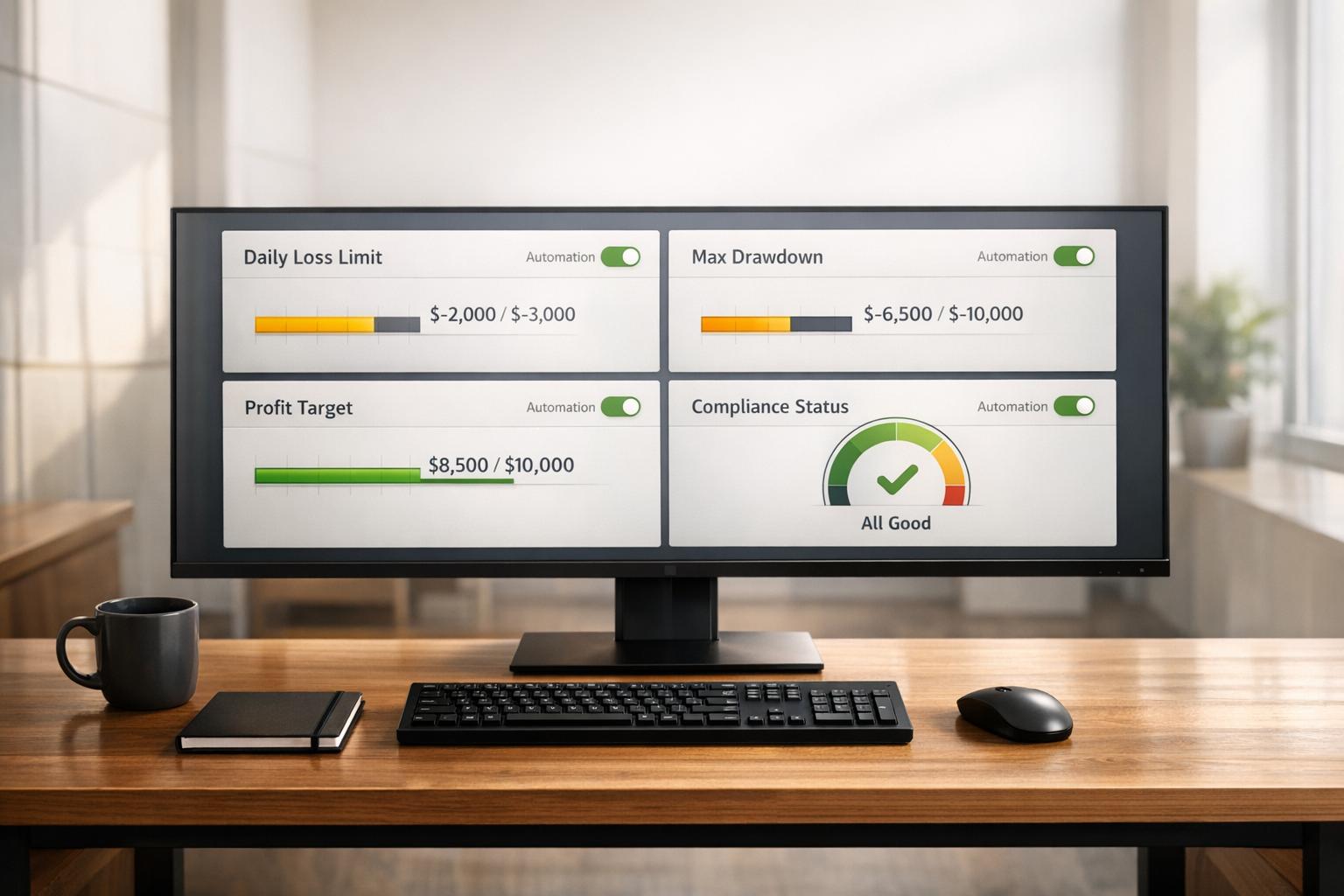
Want to succeed with prop firms? Here’s the deal: these companies give you access to trading capital, but only if you can follow their strict rules. Most traders fail because they don’t manage risk properly. To pass, you’ll need to meet profit targets while staying within limits like daily loss caps and maximum drawdowns.
Key Takeaways:
- Daily Loss Limits: Exceeding these (e.g., 5% of your account) leads to disqualification.
- Profit Targets: Typically 6%-10% in Phase 1; 5% in Phase 2.
- Consistency Rules: Some firms limit how much profit can come from a single day.
- Restricted Strategies: High-frequency trading, grid systems, and copy trading are often banned.
- Monitoring: Track metrics like equity and drawdowns in real-time to avoid violations.
Pro Tip: Create a prop-firm-approved trading plan tailored to your firm’s rules. Use automation tools to monitor limits and reduce risk as you approach profit targets.
Passing a prop firm challenge isn’t about making the most money; it’s about managing risk like a pro. Stick to the rules, and you’ll gain access to capital. Break them, and you’ll join the majority who fail.
Prop Firms EXPLAINED: The Rules, the Traps, and the Ones I Trust Most
Main Trading Rules at Prop Firms

Prop Firm Trading Rules Comparison: FTMO vs Topstep vs The5ers vs FundedNext
Prop firms operate with a clear set of trading rules designed to protect their capital and assess traders' discipline. These guidelines are the foundation for distinguishing responsible trading from risky behavior. Below, we’ll break down the most critical rules traders need to understand.
Daily Loss Limits and Maximum Drawdown
The daily loss limit (DLL) is the maximum amount you’re allowed to lose - realized or unrealized - within a single trading day. For example, on a $100,000 account with a 5% daily loss limit, you cannot lose more than $5,000 in one day. Exceeding this amount, even by a small margin, results in immediate account termination. Similarly, the maximum drawdown (MDD) sets the total allowable loss from your account’s peak or starting balance. For a $100,000 account with a 10% max drawdown, your equity cannot drop below $90,000.
Prop firms calculate these limits differently, often resetting at specific times. FTMO resets at midnight CET, while Topstep does so at 5:00 PM ET. Their calculation methods also vary. FTMO uses a balance-based approach, measuring limits based on the higher of the previous day’s closing balance or starting equity. Topstep, on the other hand, uses a fixed dollar amount regardless of account growth. Some firms employ a trailing drawdown, which adjusts upward as your equity grows, while others use a static drawdown that remains unchanged from the start. If you’re holding a losing position during the reset, those losses will count against the new day’s limit.
For example, a funded FTMO trader with a $100,000 account faced an intraday unrealized loss of $4,800 during a volatile Non-Farm Payroll release. One more adverse move could have breached the $5,000 daily limit.
| Account Size | Firm | Daily Loss Limit ($) | Max Drawdown ($) | Drawdown Floor |
|---|---|---|---|---|
| $25,000 | FTMO | $1,250 | $2,500 | $22,500 |
| $100,000 | FTMO | $5,000 | $10,000 | $90,000 |
| $25,000 | The5ers | $1,000 | $1,250 | $23,750 |
| $100,000 | FundedNext | $5,000 | $10,000 | $90,000 |
| $50,000 | Topstep | $1,000 | $2,000 (Trailing) | Variable |
Daily loss limit violations are the leading cause of failure in prop firm challenges, accounting for about 80% of terminated funded accounts. To avoid this, traders must closely monitor unrealized P&L, as most firms include intraday peaks in their calculations - even if the position recovers later.
Profit Targets and Consistency Requirements
Meeting profit targets is just as important as managing losses. These targets typically range from 6% to 10% for Phase 1 and around 5% for Phase 2. For instance, on a $100,000 FTMO account, hitting the Phase 1 target requires generating $10,000 in profit. While the goal itself might seem straightforward, the challenge lies in achieving it consistently.
Many firms enforce consistency rules to prevent traders from relying on a single lucky day to pass. For instance, The5ers requires that no single trading day contributes more than 50% of total profits, while FundedNext caps the best day at 40%. If you make $6,000 on the first day of a challenge with a $10,000 target, you’ll need to keep trading until that $6,000 represents less than the allowed percentage of your total profit.
This creates what traders call the "last mile" trap. As traders approach the target, the pressure to force trades increases. For example, a Topstep trader with a $100,000 account took 12 trades in one session while trying to close their challenge. Each loss averaged $180, but the total hit $2,160, exceeding the $2,000 fixed daily loss limit and resulting in termination.
"A fast start isn't always an advantage. A $1,500 day one followed by anything smaller creates a problem the moment your total profits catch up to a point where day one represents more than 30% of the total." - Prop Firm App Team
Consider the math: On a $50,000 challenge with a $4,000 profit target and a 30% consistency rule, any single day earning over $1,200 (30% of $4,000) will require additional trading days to balance out that day’s impact.
Trading Restrictions and Banned Strategies
Prop firms also prohibit certain strategies that either exploit the system or pose excessive risk. Here are some common restrictions:
- High-frequency trading (HFT): Most firms ban strategies involving trades with frequencies under 5 seconds.
- Grid trading and martingale systems: These are widely prohibited due to their high-risk nature.
- Copy trading: Copying trades from other accounts or signal providers is not allowed. Most firms only permit self-developed EAs (Expert Advisors); off-the-shelf bots are generally banned.
- News trading: While allowed by firms like FTMO, Topstep, The5ers, and FundedNext, trading during high-impact news events can be risky due to slippage and widened spreads.
- Weekend holding: Policies vary - Topstep prohibits holding futures positions over the weekend, while FTMO, The5ers, and FundedNext allow it.
- Hedging: Running opposite positions in correlated accounts is typically forbidden, as it’s seen as a way to manipulate risk exposure.
Here’s a real-world example: A trader on The5ers Hyper Growth account ($100,000) opened three positions - long GBP/USD, long EUR/USD, and short USD/CHF. Since all three pairs were correlated to the US Dollar, a sudden USD rally caused all positions to draw down simultaneously, reaching a 2.8% daily loss - just shy of the firm's strict 3% limit. This highlights the importance of understanding correlations alongside the rules.
| Rule | FTMO | Topstep | The5ers | FundedNext |
|---|---|---|---|---|
| News Trading | Allowed | Allowed | Allowed | Allowed |
| Weekend Holding | Allowed | Not Allowed (Futures) | Allowed | Allowed |
| EAs / Bots | Own EAs only | Yes | Yes | Own EAs only |
| Copy Trading | Not Allowed | Not Allowed | Not Allowed | Not Allowed |
| Consistency Rule | None | None | Best day ≤ 50% | Best day ≤ 40% |
| Daily Loss Limit | 5% (Balance-based) | Fixed $ amount | 3–4% | 5% |
These restrictions are designed to filter out risky or unsustainable trading practices. Following these rules is essential to maintaining a compliant trading strategy.
How to Prepare for Rule Compliance
Knowing the rules of your prop firm is just the start - you need systems in place to follow them every day. Often, the difference between passing and failing a challenge comes down to preparation rather than trading ability. The key is being ready to navigate strict daily loss limits and consistency rules. Here’s how you can set yourself up for success.
Learn Your Firm's Specific Rules
Before you even buy a challenge, read the rulebook thoroughly. Marketing materials might emphasize profit potential but skip over critical details like drawdown mechanics or consistency requirements. The reality? Only 10–15% of traders pass on their first try, and most failures happen because they didn’t fully understand the rules.
Turn percentages into dollar amounts. For example, on a $100,000 account, a 5% loss means $5,000. As Gary M., Founder of Trader's Second Brain, explains:
"If you cannot write your hard fail number in dollars before the session, you should not be trading the challenge".
Understand how your firm calculates drawdown. For instance, FTMO uses a static drawdown, where the floor remains fixed (e.g., $90,000 on a $100,000 account). On the other hand, Topstep uses a trailing end-of-day drawdown that adjusts as your equity grows. If your firm has a consistency rule - like The5%ers’ 50% cap or FundedNext’s 40% cap on your best trading day - review your trading history to see if your style aligns with these limits.
Once you’ve nailed down the specifics, you can design a trading plan that respects these constraints.
Build a Rule-Compliant Trading Plan
Your trading plan should fit within the firm’s rules like a glove. Start by setting a personal daily loss limit at half the firm’s official limit. For example, on a $100,000 FTMO account with a $5,000 daily loss limit, stop trading once you hit $2,500. This buffer can keep a bad session from spiraling into a total account failure.
Keep individual stop-losses to 1% of your account balance. On a $100,000 account, that’s $1,000 per trade. Risking more - say, 3% - could lead to a 14.2% drawdown after just five consecutive losses, which would breach most firms’ max drawdown limits.
Stick to fixed trading hours to avoid overtrading. For instance, trade only between 7:30 AM and 10:30 AM New York time. This schedule helps you avoid low-liquidity periods where slippage can blow past your stop-loss levels. Focus on mastering one reliable setup instead of chasing every opportunity.
Review Before and After Each Trading Session
A disciplined review routine is essential for staying compliant. Before you even log in, go through a pre-session checklist. Check the economic calendar for major news events like NFP, FOMC, CPI, or GDP, and close any open positions before these releases to avoid unexpected slippage. Look at higher timeframes (daily or 4-hour) to ensure your trades align with the broader market trend.
Write down your critical failure thresholds - like your daily loss limit and max drawdown - in your trading journal before starting the session. This simple habit forces you to acknowledge your boundaries and helps keep emotions in check.
After trading, journal every trade. Record why you entered, your stop-loss and target levels, the outcome, and how you felt during the trade. Review your journal weekly to identify patterns. For example, are you losing more after lunch or taking unnecessary trades after hitting your daily target? The Prop Firm App Team emphasizes:
"A challenge passed with an 8% return over 20 days with no rule violations is a better outcome than one passed in 5 days with three near-misses and an account that rode the drawdown limit twice".
When you’re close to your profit target - say, 75% of the way there - tighten your rules. Reduce position sizes and only take your highest-confidence setups. This strategy helps you avoid forcing trades, which can lead to costly mistakes just as you’re about to succeed.
Monitoring and Automation for Compliance
Once you’ve built strategies that align with trading rules, the next step is ensuring they stay on track. This is where monitoring becomes critical. A solid trading plan is incomplete without real-time tracking of limits. Interestingly, daily loss violations are the top reason traders fail prop firm challenges - more frequent than hitting max drawdown or missing profit targets. In fact, 80% of funded traders lose their accounts due to the 5% daily loss limit rule. The key to avoiding this? Focus on tracking the right metrics and automating risk management. Real-time monitoring is the glue that connects your planning to execution.
Track Key Metrics in Real-Time
One of the most crucial metrics to monitor is your equity, not just your balance. Many firms consider unrealized P&L when calculating limits. Even if a trade eventually closes in profit, your account could be disqualified if the floating loss touches the limit - even for a moment. This makes continuous equity monitoring essential, especially during periods of high market volatility.
Before you start trading, know your exact dollar-value limits. For instance, on a $100,000 FTMO account, the daily loss limit is $5,000 (5%). Keep in mind that these limits reset at midnight CET. Write down your "hard fail" number in dollars and display it prominently on your screen.
For rules like trailing drawdowns, track your "high-water mark" - the highest equity level your account has reached. At firms like Topstep, the drawdown floor adjusts upward with your profits but never moves back down.
Use Automation Tools
Real-time tracking is essential, but automation takes it to the next level by actively protecting your account from breaches. Tools like Pulsar Terminal and Pro Risk Manager offer features like "Prop Firm Protection", which automatically closes all positions before your limits are breached. These tools often include a safety buffer to account for slippage, ensuring that your account stays compliant. Unlike manual monitoring, these platforms oversee your entire account, preventing multiple trades from collectively violating firm rules.
Set up staged alerts at key thresholds - 50%, 70%, and 90% of your daily loss limit. These alerts, delivered through Telegram, email, or platform notifications, can help you avoid emotional "revenge trading" that often leads to bigger losses. Accounts that use automated frameworks for position sizing and risk enforcement have shown a 67% decrease in daily limit breaches compared to manual approaches.
Additionally, consider pausing trading 15 minutes before and after high-impact events like FOMC or NFP announcements. These events can cause rapid price spikes that might trigger your daily limits in seconds, even if your strategy is otherwise sound.
Daniel Harrington, a Senior Trading Analyst, sums it up perfectly:
"The daily loss limit doesn't catch sloppy traders. It catches good traders on bad days who refuse to accept that the day is done".
Common Mistakes and How to Avoid Them
Even with a well-thought-out plan and the right tools, many traders stumble when attempting prop firm challenges. The failure rate is staggeringly high - ranging between 80% and 90%. Only about 10–15% of traders succeed on their first try. The issue often isn't a lack of trading skill but rather the mistakes made under the intense pressure of evaluation. These missteps can derail compliance and jeopardize the chance of retaining a funded account. Being aware of these pitfalls and learning how to sidestep them can make all the difference.
Overtrading and Exceeding Risk Limits
One of the most common mistakes is letting emotions override a risk management plan to pass a challenge. The pressure to recover losses or hit profit targets often leads to impulsive decisions, like overtrading. This happens when traders start taking lower-quality setups, which increases the likelihood of hitting daily loss limits.
Overleveraging is another risky behavior. Some traders max out their lot sizes to reach profit targets faster, but this leaves no room for error. For instance, risking 3% per trade means just five consecutive losses could result in a 14.2% drawdown. To avoid this, stick to risking no more than 1% of your account balance per trade. Additionally, set a personal daily stop-loss at half the firm’s limit. For example, if the firm allows a $500 daily loss, stop trading once you hit $250.
As you approach 75% of your profit target, it’s wise to tighten your rules. Reduce position sizes and focus only on the highest-quality setups. As the Prop Firm App Team advises:
"The challenge doesn't give bonus points for finishing early. Pass the challenge by being the most disciplined version of yourself, not the most ambitious one".
Not Adjusting Strategies for Firm Rules
Even the most effective trading strategies can fail if they don’t align with a prop firm’s specific rules. For example, a strategy designed for high-volatility markets might conflict with rules like an intraday trailing drawdown, where the risk buffer shrinks as your equity peaks - even if your trades end in profit.
Consistency rules also pose challenges. Many firms require that no single day accounts for more than 30–40% of total profits. If your strategy relies on capturing one big move per week, you might hit the profit target but still fail due to uneven profit distribution. Before starting a challenge, review your strategy’s historical performance. If your best trading days account for more than 30% of your weekly gains, consider spreading your trades more evenly across sessions.
It’s also crucial to confirm that your strategy adheres to the firm’s restrictions. For instance, some firms prohibit trading during high-impact news events like FOMC or NFP releases, while others may disallow holding positions overnight or over the weekend. As Gary M., Founder of Trader's Second Brain, puts it:
"If you cannot write your hard fail number in dollars before the session, you should not be trading the challenge".
Failing to Monitor Account Metrics
Neglecting to monitor account metrics in real time is another critical mistake. Without a clear understanding of your firm’s drawdown model, you risk mismanaging your account. For example, static drawdowns (used by firms like FTMO and FundedNext) set a fixed loss threshold based on your starting balance. In contrast, trailing drawdowns (used by Topstep) adjust upward as your equity grows, making risk management trickier during profitable runs. Intraday trailing drawdowns are even stricter, recalculating the loss threshold based on your peak equity during the session.
To stay on top of your metrics, set up automated alerts to warn you as you approach your daily loss limit. If you’ve used more than 60% of your weekly drawdown buffer by mid-week, reduce your position sizes by half for the rest of the week. Displaying the firm’s limits prominently can also help keep you focused. As The Prop Firm Guide explains:
"The traders who stay funded longest aren't the ones who predict the market best - they're the ones who manage risk with precision every single day".
Keeping a close eye on your metrics is key to maintaining compliance and successfully navigating the challenge.
Conclusion
Passing a prop firm challenge isn't about being a market wizard - it’s about mastering risk management. With failure rates hovering between 80% and 90%, only about 10–15% of traders succeed on their first try. What sets successful traders apart isn’t their ability to predict the market; it’s their commitment to sound risk management and following the rules.
As highlighted in The Prop Firm Guide:
"A prop firm challenge isn't a trading competition. It's a risk management test. The firms aren't looking for the trader who can make the most money - they're looking for the trader who won't blow up their capital."
To align with the risk-focused nature of these challenges, consider these strategies:
- Before trading, define your maximum loss in dollar terms, not just percentages, and set personal limits at half of the firm's thresholds to create a buffer.
- Monitor your equity in real time, as floating losses count toward your daily drawdown even before trades are closed.
- As you approach 75% of your profit target, scale back your risk to protect your gains.
Equally important is tailoring your strategy to the firm's specific rules. For instance, swing trading won’t work at firms that ban overnight positions, and scalping might falter under strict intraday drawdown rules. Many traders fail not because of bad market calls, but due to technical disqualifications like violating news trading restrictions, breaking consistency rules, or misunderstanding drawdown calculations.
Success in these challenges comes down to adapting to the rules and turning structure into a foundation for consistent, long-term gains.
FAQs
Does unrealized P&L count toward my daily loss limit?
Unrealized profit and loss (P&L) usually factors into your daily loss limit, though the exact method depends on the firm. In most cases, firms calculate this limit by combining both realized and unrealized losses. If your total losses - whether from closed positions (realized) or open positions (unrealized) - go beyond the allowed limit, your account could face suspension or even termination. To steer clear of such issues, keep a close eye on both realized and unrealized losses throughout your trading day.
How do I calculate my exact 'hard fail' numbers in dollars?
To figure out your 'hard fail' numbers, start by identifying the risk limits set by the prop firm. These typically include factors like daily loss limits, maximum drawdowns, and profit targets. Once you have these percentages, convert them into dollar amounts based on your account size.
For example, if the daily loss limit is 5% on a $100,000 account, that means you can lose up to $5,000 in a single day. Understanding these figures is essential to ensure you stay within the firm's rules and avoid failing the challenge.
What’s the difference between static and trailing drawdown?
A static drawdown is a set limit established at the beginning of a trading challenge and remains constant throughout. For example, on a $50,000 account with a $2,000 drawdown limit, the maximum loss allowed would always be $48,000, no matter how much the account grows or declines.
On the other hand, a trailing drawdown adjusts based on your account's performance. As your account balance reaches new highs, the drawdown limit rises accordingly. However, if your account starts to decline, the drawdown limit tightens, reducing the buffer and increasing the risk during volatile periods.
In short:
- Static drawdowns provide stable, predictable risk limits.
- Trailing drawdowns are more flexible but can expose traders to higher risks during fluctuations.
Related Blog Posts
Start Trading with For Traders
Join our platform to test your trading skills, trade virtual capital, and earn real profits. Access educational resources, advanced tools, and a supportive community to enhance your trading journey.
Start your Trading Challenge