


Prop firms are reshaping forex trading by offering traders access to company capital instead of requiring them to risk their own savings. Traders pay an evaluation fee (e.g., $89 for a $10,000 account) to prove their skills in a challenge. If successful, they gain access to funded accounts ranging from $10,000 to $500,000, keeping 70–90% of the profits.
Key points:
- Evaluation Process: Traders meet profit targets (8–12%) while adhering to strict risk limits (e.g., 2–5% daily loss).
- Profit Sharing: Most firms offer payouts every 14–30 days, with top traders scaling accounts up to $5 million.
- Success Rates: Only 14% pass evaluations, and 7% earn payouts (average $7,000).
- New Trends: AI tools, instant funding, and blockchain technology are improving operations and transparency.
This model reduces financial risk for traders, promotes skill-based funding, and is driving changes across the forex industry.
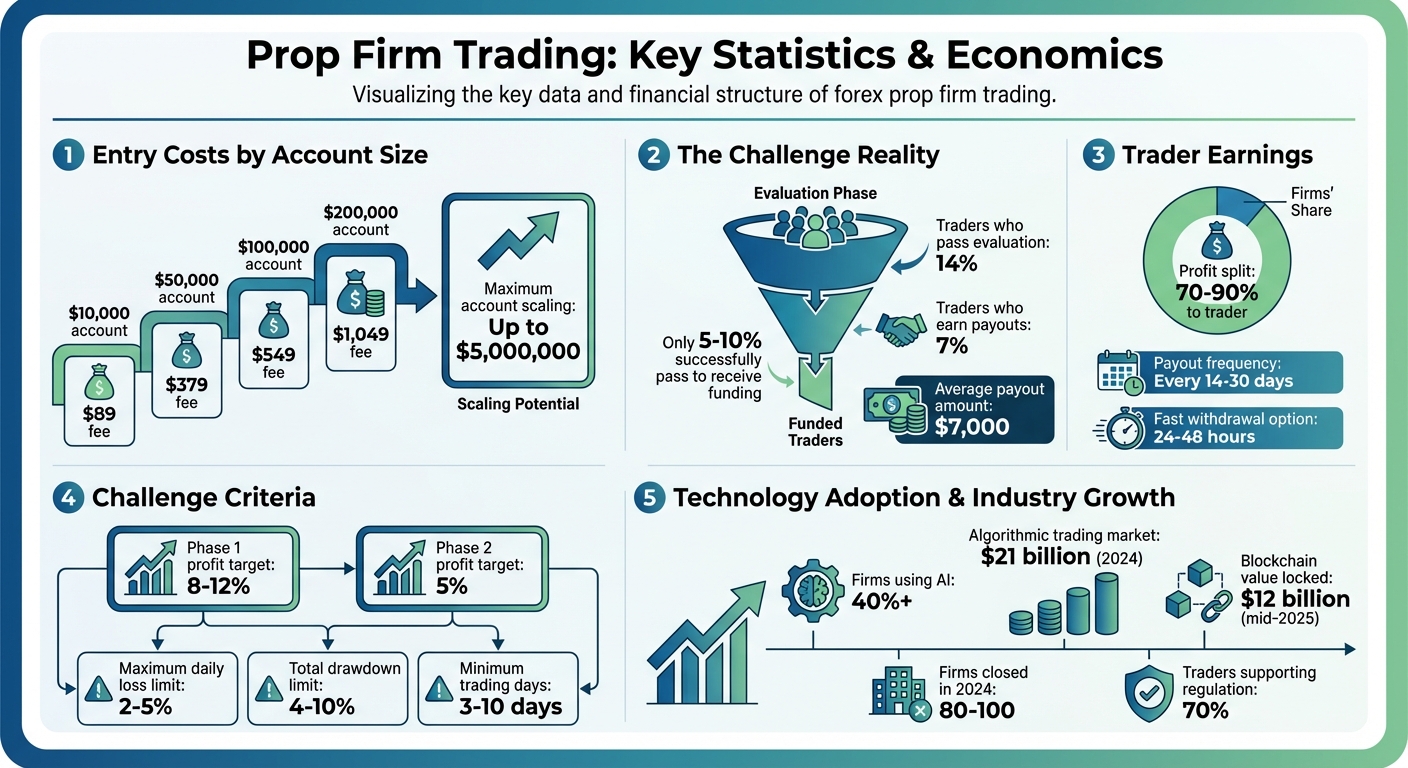
Prop Firm Trading Statistics: Success Rates, Fees, and Profit Sharing
Prop Firms 2025: How To Pass The Challenge & Actually Get Paid - E145
How Prop Firms Work: Business Models and Structure
Prop firms operate by generating revenue through evaluation fees and profit-sharing arrangements. Evaluation fees typically range from $89 for a $10,000 account to $1,049 for a $200,000 account, with only about 5–10% of traders successfully passing the evaluation process. This means most participants pay fees without advancing, while only a small percentage receive funding. These fees are a key part of the firm's income model and set the stage for the evaluation processes.
"Most firms make money when traders fail. We built Global Forex Funds to change that."
– Sam, CEO, Global Forex Funds
Evaluations are conducted using simulated accounts to test traders' adherence to specific rules and manage risk. Even after passing the evaluation, many firms continue to use demo accounts during the funded stage to further control exposure.
Trading Challenges and Performance Evaluation
The evaluation process typically involves two phases. In Phase 1, traders must meet profit targets of 8–12%, all while adhering to strict risk limits. Phase 2 then confirms their performance with a smaller profit target of 5%.
Risk management is a critical component. Traders are required to operate within a maximum daily loss limit of 2–5% and a total drawdown limit of 4–10%. Additionally, firms often enforce a minimum trading period - usually between 3 and 10 days - to prevent traders from achieving targets through a single high-risk trade.
Here’s an example of evaluation fees from FXIFY:
| Account Size | Challenge Fee |
|---|---|
| $10,000 | $89 |
| $50,000 | $379 |
| $100,000 | $549 |
| $200,000 | $1,049 |
Some firms are introducing new challenge models to refine the evaluation process. These include three-step targets and instant funding options with tighter drawdown rules. Others have removed time limits entirely, allowing traders to focus on high-quality setups without the stress of deadlines [11, 14].
To maintain fairness and sustainability, firms often restrict certain trading strategies such as Martingale systems, high-frequency trading, latency arbitrage, and trading during major news events.
Profit-Sharing and Risk Management Systems
Once traders pass the evaluation, the focus shifts to profit-sharing and risk control. Profit splits are typically 70–90% in favor of the trader. Payouts are made every 14 to 30 days, although some firms offer faster options, allowing withdrawals within 24 to 48 hours.
Even after funding, strict risk limits remain in place. Breaching daily loss caps or drawdown thresholds results in the immediate termination of the account.
"The arrangement creates a mutually beneficial partnership: traders gain capital, and firms gain performance-based revenue."
– Myfxbook
For traders who consistently perform well, scaling plans offer rewards. For example, achieving a 10% profit target over three consecutive months might lead to a 50% increase in account size. Some firms allow traders to scale up their accounts to as much as $5 million over time. These scaling plans, combined with limits on daily losses and drawdowns, ensure the firm's capital remains protected.
For Traders: A Simulated Prop Trading Platform
For Traders provides a simulated forex trading experience where participants can test their skills using virtual capital. The platform combines trading challenges with educational resources, turning trader performance into real earnings. Users can access professional trading platforms like cTrader, DXTrade, and TradeLocker, alongside AI-powered tools designed to manage risk and monitor activity. This approach reflects the growing focus on balancing performance with risk management in the trading industry.
Virtual Capital Plans: From $6K to $100K Accounts
For Traders offers five virtual account plans, ranging from $6,000 to $100,000, with entry fees between $46 and $413. Each plan comes with a 9% profit target and a 5% maximum drawdown limit. Traders who meet these requirements earn a 15% share of their profits, with payouts available every two weeks. To ease the pressure of deadlines, the platform allows unlimited time to complete the challenges. Additionally, traders gain access to over 12 video trading courses, enhancing their learning experience.
| Account Size | Challenge Fee | Profit Target | Max Drawdown | Profit Share |
|---|---|---|---|---|
| $6,000 | $46 | 9% | 5% | 15% |
| $15,000 | $91 | 9% | 5% | 15% |
| $25,000 | $163 | 9% | 5% | 15% |
| $50,000 | $233 | 9% | 5% | 15% |
| $100,000 | $413 | 9% | 5% | 15% |
These plans are designed to replicate the prop trading model, offering a structured path from simulation to profit-sharing.
Trading Platforms and Educational Tools
Traders can choose from multiple professional trading platforms, including cTrader, DXTrade, and TradeLocker, ensuring flexibility based on individual preferences. The platform also equips users with a variety of educational tools like video trading courses, forex strategy e-books, and performance tracking dashboards. The inclusion of AI-driven risk management tools helps traders stay within their drawdown limits and avoid breaking any rules, making it easier to maintain discipline.
Payouts and Flexible Trading Options
For Traders mirrors traditional prop trading firms by providing a balance between flexibility and risk management. Profit withdrawals are processed bi-weekly, giving traders regular access to their earnings once targets are achieved. The platform also allows users to customize certain trading rules to align with their personal strategies. With no time constraints on completing challenges, traders can focus on identifying high-quality setups rather than feeling rushed. This flexibility encourages more thoughtful and risk-aware trading practices.
How Prop Firms Are Making Forex More Accessible
Trading with Firm Capital Instead of Personal Funds
Prop firms have transformed forex trading by removing the need for traders to rely on large personal savings. Instead of requiring tens of thousands of dollars to trade, individuals can gain access to accounts ranging from $5,000 to over $1,000,000 by paying a relatively small evaluation fee. These firms provide the trading capital, which significantly reduces the financial risk for traders. This setup not only protects personal finances but also opens the door for more people to participate in forex trading.
When trading with a prop firm's capital, the trader's risk is limited to the evaluation fee. As the OANDATeam puts it:
"The prop trading firm shoulders the risk associated with any trading losses incurred by the trader, while the trader is entitled to a share of the profits generated".
This model allows skilled traders, even those without substantial savings, to participate. Huzefa Hamid, Senior Analyst at DailyForex, highlights this accessibility:
"Prop firms create low barriers to entry to access external capital to trade. Anyone in the world, in any time zone, can apply".
For example, FundingPips offers access to a $50,000 simulated capital account for a $289 fee, and the platform has enabled traders to collectively earn over $180 million.
Performance-Based Funding Models
Prop firms not only lower the barriers to entry but also reward traders based on their performance. Funding is typically awarded to those who meet specific profit and risk management targets. This merit-based system ensures that traders who consistently perform well can access significant amounts of trading capital, regardless of their initial savings.
To maintain fairness and sustainability, prop firms use various evaluation models. The standard approach involves two-phase challenges where traders must meet profit targets in consecutive stages to prove consistency. Some firms offer three-step challenges, which spread the evaluation process across three phases with progressively lower profit targets, such as 8%, 5%, and 3%. These challenges often come with reduced entry fees. For seasoned traders, instant funding models provide immediate access to trading capital in exchange for a higher upfront fee.
Many firms also offer scaling plans, which allow traders to increase their capital allocation - by 25%, 50%, or even doubling it - once they hit specific performance milestones. This structure not only incentivizes consistent performance but also provides opportunities for traders to grow their accounts over time.
Future Developments in Prop Trading and Forex Markets
Evolving Evaluation Methods and Profit-Sharing Structures
The traditional two-phase challenge model in proprietary trading is undergoing a transformation. Some platforms are moving away from evaluation phases entirely, giving traders immediate access to real capital and live trading environments instead of relying solely on simulated accounts. This shift toward A-book execution models - where trades directly connect to live liquidity - ensures better alignment between the interests of firms and traders.
Artificial intelligence is playing a growing role in these changes. Many firms now use AI to monitor trader behavior during challenges, providing real-time alerts to help traders stay within risk parameters.
Profit-sharing structures are also becoming more flexible. As traders prove their consistency, firms are offering scaling plans, which increase capital allocation over time. This gives skilled traders a clear path to grow their accounts without needing to go through additional challenge stages.
These advancements are laying the groundwork for further technological progress in prop trading operations.
Technology's Impact on Prop Firm Development
Technological advancements are driving the evolution of prop firms, especially as firms refine their evaluation models. AI and machine learning are at the forefront of these changes. For example, XTX Markets, a British algorithmic trading firm, uses AI to manage around $250 billion in trades daily. This level of automation enables firms to process vast amounts of data and execute trades within milliseconds, seizing opportunities that only exist for a fleeting moment.
As Bohdan Kachur from Fintatech explains:
"For prop firms seeking sustainable profitability, AI isn't optional anymore - it's the foundation of a modern edge."
Beyond speed, Natural Language Processing (NLP) tools are being used to analyze news, social media, and analyst reports, turning market sentiment into actionable trading signals. Autonomous Prop Desks now feature systems capable of learning, optimizing, and executing trades with minimal human involvement.
Blockchain technology is also making waves in the industry by improving transparency. Some firms are experimenting with decentralized models where smart contracts automate payout schedules and enforce risk management rules. These contracts distribute profits automatically once performance targets are met. By mid-2025, tokenization platforms had locked in over $12 billion in value, highlighting the growing interest in blockchain-based financial systems.
The impact of these technologies is evident. Over 40% of prop firms currently use AI, and the algorithmic trading market surpassed $21 billion in 2024. These tools are transforming everything from fraud detection - such as identifying account farming and latency arbitrage - to offering personalized coaching based on individual trading patterns.
Conclusion: The Long-Term Effects of Prop Firms on Forex
Prop firms have reshaped forex trading by offering traders access to institutional capital based on their skills and discipline, rather than their personal financial resources. With accounts ranging from $50,000 to $200,000 available for a relatively modest evaluation fee, these firms have lowered the barriers to entry, making forex trading more accessible to a global audience. This evolution is fostering a more inclusive trading community on an international scale.
However, the road to success remains challenging. Only about 7% of traders successfully earn a payout, highlighting the importance of discipline and adherence to strict requirements. These high standards are helping to professionalize retail trading. For instance, over 40% of prop firms now incorporate AI for real-time risk management, and the enforced risk parameters are teaching traders the critical skills needed to transition from casual trading to a more professional approach.
"Prop firms have become an important niche in the trading ecosystem. They bridge the gap between retail trading and professional finance by giving individuals access to institutional-level capital." - Alec Furrier
The industry itself is undergoing significant change. With 80-100 firms shutting down in 2024 alone and regulatory bodies like the CFTC stepping in, the sector is consolidating around business models that are built to last. Established brokers such as OANDA and IC Markets have started launching their own prop trading divisions, adding a layer of stability and trust to the space. Nearly 70% of traders now support greater regulatory oversight, recognizing that regulation will help weed out questionable operations and strengthen the industry's reputation.
Simulation platforms are also playing a key role in this transformation. For Traders, for example, offers simulated trading challenges with virtual accounts ranging from $6,000 to $100,000. These platforms allow traders to hone their skills without putting their own money on the line. By combining simulation with real-world risk management principles, tools like these reflect the ongoing evolution of forex trading.
As technology continues to advance and regulatory frameworks become more defined, prop firms are carving out a lasting role in the forex landscape. They are not only providing traders with opportunities to access the markets but also equipping them with the tools and discipline needed to build sustainable careers in trading.
FAQs
What challenges do traders face when working with proprietary trading firms?
Traders aiming to work with proprietary trading firms often face a tough hurdle: passing rigorous evaluation processes. These assessments usually demand that traders achieve a specific profit target while operating within strict risk limits. For example, many firms enforce a maximum overall loss of 5-10% and cap daily drawdowns at about 5%. This structure can be nerve-wracking, as a single bad trade could potentially derail the entire effort to secure funding.
On top of that, time constraints to complete these evaluations add another layer of stress. Firms might also enforce rules like consistency requirements, platform limitations, and evaluation fees, which can make the process more challenging - and expensive. Meeting these expectations often pushes traders to sharpen their strategies and fine-tune their risk management approaches to align with the firm’s standards.
Success in this environment requires traders to strike a careful balance: hitting profit targets while maintaining disciplined risk management, all within the framework of the firm’s rules and deadlines. Mastering these challenges is essential for earning funding and thriving in the competitive world of proprietary trading.
How are AI and blockchain transforming proprietary trading?
AI and blockchain are transforming proprietary trading by delivering smarter, faster, and more efficient systems. AI tools play a crucial role by leveraging advanced analytics, machine learning, and pattern recognition to help traders uncover opportunities and manage risks with greater precision. They also handle repetitive tasks, giving traders more bandwidth to focus on high-level strategies.
At the same time, blockchain technology brings secure and transparent transaction processes to the table. It simplifies settlements, enhances data accuracy, and minimizes operational inefficiencies. For proprietary trading firms, this means improved accountability and streamlined operations. Together, these technologies are driving a more dynamic and competitive trading landscape.
Why do most traders struggle to pass prop firm evaluations?
The low success rate in prop firm evaluations can be traced back to the tough rules and intense pressure traders face. These evaluations often require traders to hit specific profit targets while staying within strict risk parameters, like daily loss limits, maximum drawdown percentages, and position size restrictions. Even a minor slip-up can result in disqualification, making it clear that discipline and strict adherence to rules are just as critical as trading expertise.
On top of that, many prop firms generate a significant portion of their revenue from evaluation fees. This creates a system where the thresholds are intentionally challenging, ensuring only a small fraction of participants make it to the next stage. When you combine steep fees, psychological strain, and rigid criteria, it’s no surprise that most traders struggle to secure a funded account.
Related Blog Posts
Start Trading with For Traders
Join our platform to test your trading skills, trade virtual capital, and earn real profits. Access educational resources, advanced tools, and a supportive community to enhance your trading journey.
Start your Trading Challenge