

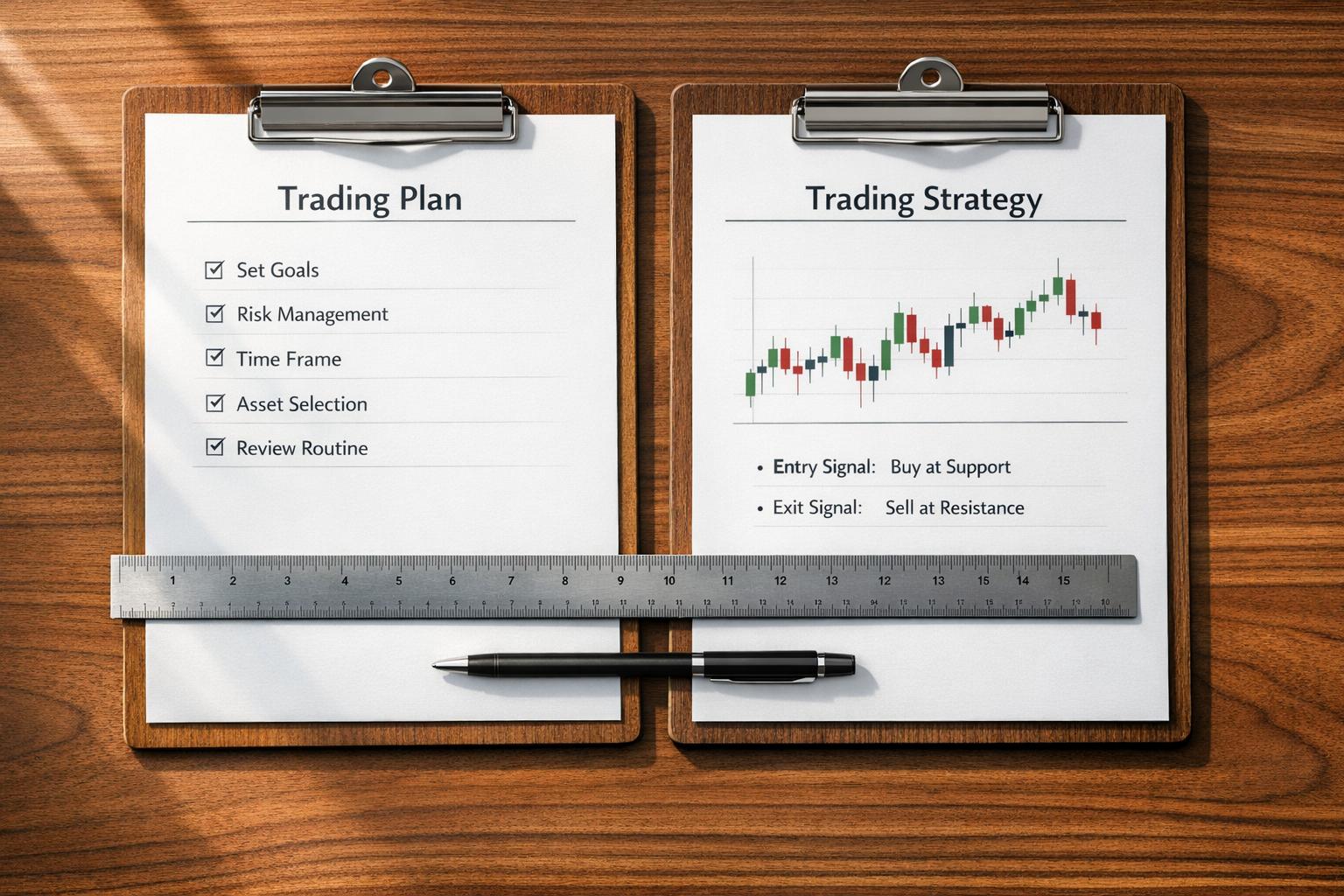
A trading plan is your complete guide to managing your trading activities, while a trading strategy focuses on how you execute trades. Here's the breakdown:
- Trading Plan: Covers everything - goals, risk management, daily routines, psychology, and performance tracking. It keeps you disciplined and helps avoid emotional decisions.
- Trading Strategy: A set of rules for entering and exiting trades, often based on technical or fundamental analysis.
Quick Overview:
- Scope: A plan is broad, guiding the entire trading process; a strategy is narrow, focusing on trade execution.
- Purpose: Plans ensure discipline and long-term success; strategies identify trade opportunities.
- Components: Plans include risk rules, routines, and reviews; strategies include entry/exit rules and signals.
- Flexibility: Plans evolve over time; strategies can be fixed or discretionary.
Key takeaway: A strategy is part of your plan. Without a solid plan, even the best strategy can fail. Combine both to trade effectively.
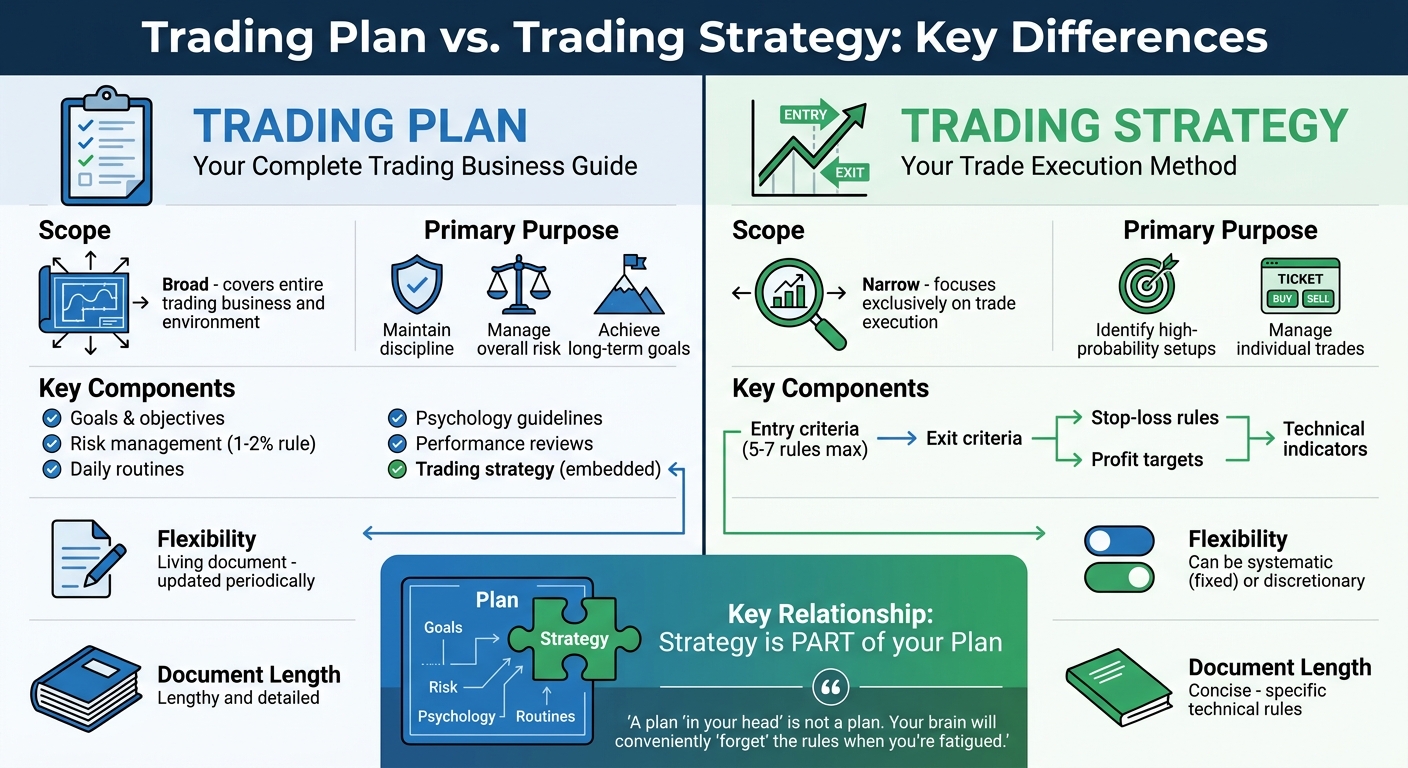
Trading Plan vs Trading Strategy: Key Differences Comparison
What Is a Trading Plan?
Definition of a Trading Plan
A trading plan is a written guide that outlines every detail of your trading approach - what markets to trade, when to open and close positions, how much capital to risk, and how to evaluate your performance. This isn’t something you can just keep in your head; documenting it is key, especially when emotions might cloud your judgment.
"A trading plan is your business blueprint. It transforms trading from gambling into a systematic business with defined processes." - PipsPal
Think of it as a tailored roadmap designed around your goals, risk tolerance, and daily routine. By laying out a clear structure, it helps you stay disciplined and consistent, even when faced with challenges.
"A plan 'in your head' is not a plan. Your brain will conveniently 'forget' the rules when you're fatigued, or after reaching a daily loss limit." - Technical Analysis Pro
Main Components of a Trading Plan
An effective trading plan includes several key elements: trading objectives, entry and exit rules, risk management strategies, and performance reviews.
- Trading objectives: These focus on capital allocation and setting specific, measurable goals, such as annual return targets.
- Risk management: A critical component, this often involves limiting risk to 1-2% of your capital per trade.
- Entry and exit rules: Clear guidelines for when to enter or exit trades and which assets to focus on.
- No-trade conditions: Situations to avoid trading, such as during major news events, when fatigued, or after hitting a daily loss limit.
- Performance reviews: Regular evaluations to track progress and refine strategies.
Together, these components create a structured, disciplined approach that can help traders achieve consistent results over time.
What Is a Trading Strategy?
Definition of a Trading Strategy
A trading strategy is a structured set of rules that guides decisions on buying and selling securities. While a trading plan outlines your overall approach to trading, the strategy zeroes in on the specific rules for executing trades.
"A trading system [strategy] covers the rules used to enter and exit trades. A trading plan contains the system but covers more: e.g., risk management, daily routine, etc." - Huzefa Hamid, Senior Analyst, DailyForex.com
These strategies rely on technical or fundamental triggers to produce measurable signals. These signals can then be tested using tools like technical indicators, fundamental analysis, or quantitative models.
Main Components of a Trading Strategy
Here’s a closer look at the essential parts of a trading strategy:
- Technical indicators: Tools like moving averages or MACD help generate actionable signals.
- Entry criteria: These rules define the specific market conditions or price movements required to initiate a trade.
- Exit criteria: Predefined rules for when to take profits or cut losses.
A strategy also incorporates timeframes - such as 5-minute, 4-hour, or daily charts - to evaluate signals. A widely used framework involves four stages: Condition (market state), Setup (pattern formation), Trigger (action event), and Invalidation (proof the idea is wrong). This structure helps traders stick to objective rules, steering clear of emotional decisions.
"A strategy is just your method (your entry/exit logic). A plan is the strategy plus risk rules plus a review routine." - Gabriela Anicic, Social Media Specialist, TradeLocker
Trading strategies can be broadly classified into three types:
- Technical strategies: Focused on price action and chart patterns.
- Fundamental strategies: Built around economic data and company performance.
- Quantitative strategies: Use large datasets and statistical models to find market inefficiencies.
To keep things manageable and actionable, it’s recommended to limit entry criteria to 5–7 specific rules. This avoids overcomplicating the process and ensures trades can be executed efficiently in real-time.
Trading Plan versus Trading Strategy ✅📉📄
Main Differences Between Trading Plans and Trading Strategies
Building on the definitions above, let's dig into how trading plans differ from trading strategies.
Scope and Focus
A trading strategy is essentially a piece of the larger puzzle that is the trading plan. The strategy hones in on the nuts and bolts of executing trades - things like when to enter, where to set a stop-loss, and when to lock in profits. Meanwhile, a trading plan takes a broader view, covering everything from long-term financial goals to daily routines, risk tolerance, and even mental preparation.
"A trading strategy is your method for finding setups (e.g., breakout trading or trend following). A trading plan is broader - it wraps the strategy in a framework that includes risk rules, psychology guidelines, and performance review processes." - Philip Grinevich, CEO, Plancana
Think of it this way: the strategy is about the how of trading, while the plan is about the why and when. The trading plan acts as a guide to keep you grounded and focused, no matter the market conditions. On the other hand, the strategy provides the specific rules for engaging with price movements.
Components and Purpose
The main differences also show up in their components. A trading plan includes financial goals, risk management rules (like the 1% rule, where no trade risks more than 1% of your account), daily routines, and even tax considerations. It’s a comprehensive framework that integrates the trading strategy.
In contrast, a trading strategy is more laser-focused. It’s all about the specifics of executing trades - entry points, stop-loss levels, and profit targets.
The purpose of each is also distinct. A trading plan is designed to help traders stay disciplined, manage risk, and work toward long-term goals. A trading strategy, however, is all about identifying high-probability setups and managing individual trades.
Grasping these distinctions is crucial for effectively combining both elements, which will be explored in the next section.
Comparison Table: Trading Plan vs. Trading Strategy
| Attribute | Trading Plan | Trading Strategy |
|---|---|---|
| Scope | Broad: Covers the entire trading business and environment | Narrow: Focuses exclusively on trade execution |
| Primary Purpose | To maintain discipline, manage overall risk, and achieve long-term goals | To identify high-probability setups and manage individual trades |
| Key Components | Goals, risk management, routine, psychology, and the strategy itself | Entry criteria, stop-loss rules, and profit targets |
| Flexibility | A living document updated periodically based on performance reviews | Can be systematic (fixed rules) or discretionary (subjective interpretation) |
| Document Length | Often lengthy and detailed, covering various scenarios | Usually concise, consisting of specific technical rules |
How Trading Plans and Strategies Work Together
Combining Plans and Strategies
A trading strategy and a trading plan are like two sides of the same coin - each relies on the other to function effectively. The strategy defines the specific conditions to act on (like spotting a bull flag or an EMA crossover), while the plan establishes the framework: how much to risk, when to trade, and how to stay composed under pressure. Even the best strategy can lead to losses without a solid plan to guide position sizing and emotional control.
These two elements work in tandem by ensuring that key parts of the plan are checked before executing a trade. For example, before acting on a strategy signal, a trader might ask: Does the trade have a risk-to-reward ratio of at least 2:1? Is the stop-loss set to limit risk to under 1% of the account? Is the trade happening during the intended trading hours? By verifying these details, traders eliminate impulsive decisions and stick to a disciplined approach.
"A trading plan is a written set of rules that governs all your trading decisions. It is not a static document, but a living guide that evolves with your experience." - Pietro Di Lernia, Author & Analyst
Many seasoned traders also follow a "Red Day" rule. This means stopping all trading for the day if losses reach 2-3% of their account. It’s a simple but effective way to prevent small losses from snowballing into something harder to recover from.
Integration Table: Plan and Strategy Elements
Here’s a breakdown of how trading plans and strategies align in practice:
| Trading Plan Element | Trading Strategy Element | Integration Outcome |
|---|---|---|
| Risk Management | Position Sizing | Ensures stop-loss levels fit within the plan’s 1% maximum risk guideline |
| Market Selection | Setup Identification | Filters out trades in markets with low liquidity or large spreads |
| Daily Routine | Execution Windows | Restricts trading to high-volatility periods, such as the NY Open |
| Behavioral Rules | Trade Management | Avoids revenge trading or hasty exits by enforcing breaks after consecutive losses |
| Market Filters | Strategy Selection | Guides switching between trend-following and mean reversion strategies as needed |
Example: Using Both in Simulated Trading
Let’s consider how this integration works during simulated trading. On platforms like For Traders, traders can practice these principles with virtual capital. For instance, a trader starts their day by reviewing the economic calendar, a core step in their plan, to avoid trading during major news events. Next, they spot a bull flag pattern on a 15-minute chart - a signal from their strategy. However, before entering, they ensure the price is above the 200 SMA, a condition outlined in their plan.
To stick to their risk rules, they calculate the position size so that a 10-pip stop-loss equals $100 on their $10,000 demo account - keeping the risk at 1%. After the trade concludes, they log the results in a trading journal, noting whether all plan rules were followed. Platforms like For Traders even offer a $25K virtual capital simulation (priced at $163), which helps traders develop habits by combining strategy execution with structured risk management.
Conclusion
A trading strategy outlines how and when to enter trades, while a trading plan focuses on managing risk, maintaining routines, and staying disciplined under pressure. Without combining these two elements, even the best strategy can lead to losses.
Most retail traders skip creating a written plan, which often contributes to their high failure rates. A well-thought-out plan removes emotions from decision-making during stressful moments, turning trading into a structured, systematic process instead of a gamble.
This combination is key for managing risk effectively. The good news? You can practice both your strategy and plan without risking real money. Platforms like For Traders provide simulated trading challenges. For instance, the $25K Virtual Capital simulation - available for $163 - lets you test your setups while adhering to strict risk guidelines. You can track your decisions in a trading journal and review your performance over time. This type of practice helps develop the habits and discipline needed for consistent results.
FAQs
What should I include in a written trading plan?
A well-thought-out trading plan acts as your roadmap, helping you make informed decisions. It should cover essential elements like the markets and instruments you'll focus on, clear entry and exit rules, and risk management parameters such as position sizing and stop-loss levels. Additionally, include a daily routine to maintain consistency.
Your plan should also outline specific strategy rules, set behavioral guidelines to keep emotions in check, and establish a review schedule for assessing and adjusting your approach as markets shift. Aim for a plan that's detailed enough to provide structure but flexible enough to adapt to changing conditions.
How do I backtest a trading strategy before risking money?
To test a trading strategy's effectiveness, use historical market data to simulate trades. Apply your strategy's entry, exit, and risk management rules to this data through backtesting tools. Focus on evaluating key performance metrics like profitability, drawdowns, and win/loss ratios. Use these insights to tweak and improve your strategy before committing real money to live trading.
When should I update my trading plan or strategy?
You should revisit and update your trading plan whenever there are major shifts in your performance, market conditions, or personal circumstances. A good habit is to conduct regular reviews - quarterly, for example - to ensure your plan stays aligned with both your goals and the current market environment.
If you notice inconsistent results, or if your risk management strategies and entry/exit rules aren't working as intended, it's a clear signal that adjustments are needed. Keeping your plan up-to-date helps you maintain discipline and can lead to better overall performance.
Related Blog Posts
Start Trading with For Traders
Join our platform to test your trading skills, trade virtual capital, and earn real profits. Access educational resources, advanced tools, and a supportive community to enhance your trading journey.
Start your Trading Challenge