Trading Psychology: Self-Awareness Techniques
Practical self-awareness methods—journaling, pre-trade checks and emotion tagging—to curb impulsive trades and boost discipline.
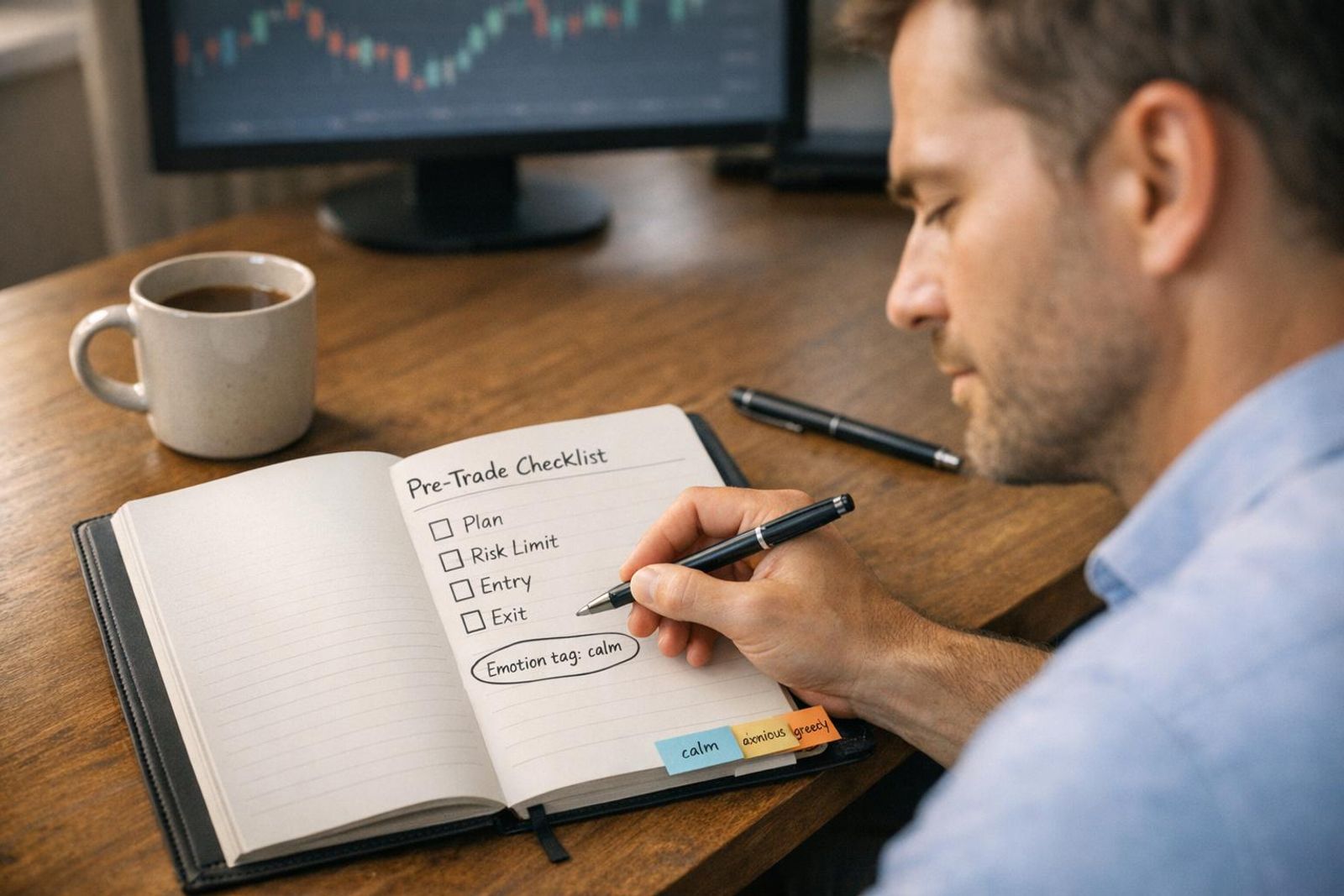
Most traders fail not because they lack technical skills, but because emotions like fear, greed, and frustration cloud their judgment. The key to overcoming this? Self-awareness. Recognizing your emotional and mental triggers can help you stay disciplined and stick to your trading plan. This article outlines practical techniques to build self-awareness and improve trading performance.
Key Takeaways:
- Self-awareness is about observing your emotions and thoughts without letting them dictate your actions.
- Tools like trading journals, pre-trade check-ins, and emotion tagging can help you identify patterns and avoid impulsive decisions.
- Common emotional triggers like FOMO or revenge trading often lead to poor outcomes. Naming these emotions creates a pause for better decision-making.
- Regular journaling and post-trade reviews can accelerate improvement, with traders improving skills nearly twice as fast when consistently analyzing their performance.
The Trading Super Power: Self-Awareness (Use it to stop mistakes before they happen, here's how)
What Self-Awareness Means for Traders
In trading, self-awareness is about recognizing your thoughts, emotions, and impulses without bias before making decisions. It’s the ability to step back and observe your mental and emotional state, helping you avoid knee-jerk reactions. This skill is the foundation for practical techniques that improve trading discipline and decision-making.
A lot of trading mistakes happen when concerns about profits or losses push you into a reactive mindset. Self-awareness helps you break free from that cycle, allowing you to make deliberate and thoughtful choices instead of acting out of emotional urgency.
By sharpening your awareness, you can identify the mental traps and thoughts that lead to poor decisions. For instance, anxiety might cause you to exit a winning trade too early, or anger might push you to double your position size after a loss. Self-awareness also helps you pinpoint your emotional "breaking point" - the moment when your rational trading plan starts to unravel, often at a moderate intensity level, like 6 out of 10. As trading psychology coach Jonathan Turpin explains:
"Trading is identity in motion".
This process can also uncover hidden insecurities and biases. For example, beliefs like "I don't deserve wealth" can lead to self-sabotaging behaviors. Recognizing these patterns allows you to address them and align your trading strategies with your desired outcomes.
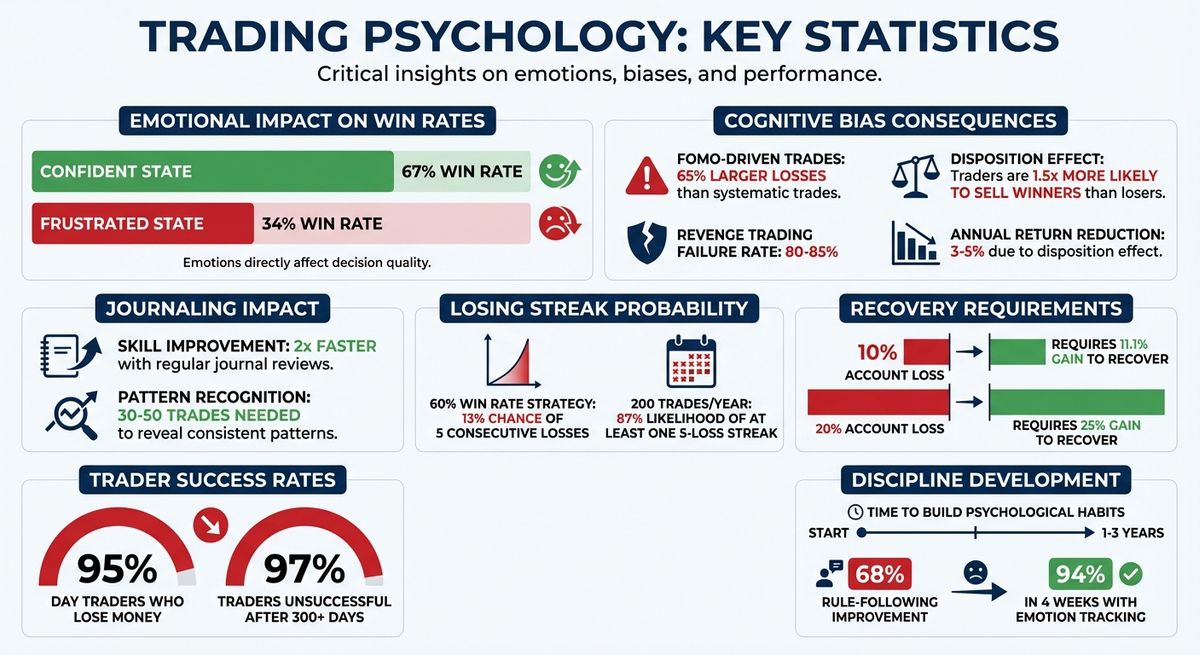
Without self-awareness, repeating harmful habits becomes almost inevitable. Take the disposition effect, for example: traders are 1.5 times more likely to sell a winning position than a losing one, a behavior that can reduce annual returns by an estimated 3% to 5%. Understanding the triggers behind these patterns is key to breaking them and improving your results.
It’s not about eliminating emotions - that’s unrealistic. Instead, it’s about identifying the emotions, like frustration, FOMO, or revenge trading, that often lead to mistakes. Naming these emotions gives you a critical pause, a moment to choose discipline over impulsiveness. For instance, noticing a thought like "I need to get that money back right now" creates an opening to step back and stick to your plan. These moments of awareness are where disciplined, effective trading begins.
Practical Techniques to Build Self-Awareness
Building self-awareness isn't some abstract concept - it’s about using specific, repeatable methods to better understand your behavior, recognize emotional triggers, and make smarter decisions, especially under pressure. Below are some practical techniques you can incorporate into your trading routine.
Journaling Your Trades and Emotions
A trading journal is more than a record of numbers - it’s a tool to track both your strategies and your mindset. Log details like entry and exit points, profit and loss, and the reasoning behind each trade. But don’t stop there. Note your emotional state during and after the trade. As Gary M., founder of Trader's Second Brain, explains:
"The journal doesn't forget. Memory is reconstructive. After a losing day, your brain rewrites history to minimize the sting."
The key is consistent review. Spend 5–10 minutes daily to log trades and check for immediate mistakes. Dedicate 30–60 minutes weekly to calculate your win rate, analyze your best and worst trades, and set a clear goal. Monthly reviews (1–2 hours) can uncover deeper patterns, like losing consistently at certain times or under specific emotional conditions.
Analyzing 30–50 trades often reveals consistent patterns in performance. Traders who review their journals regularly tend to improve their skills about twice as fast as those who don’t.
To make the most of your journal, tag each trade with emotions like FOMO, Revenge, Calm, or Boredom. If a negative tag appears twice in one session, take a mandatory break or end trading for the day. Write down your thesis before entering a trade, such as, “I expect a bounce off the 50 SMA,” and later compare it to what actually happened. This habit sharpens your ability to spot patterns over time.
Include screenshots of your entry and exit points. These snapshots can reveal trends or setups you might overlook in real time. Finally, record your immediate post-trade thoughts while the experience is fresh. Waiting until later can lead to "emotionally filtered" recollections that distort the truth.
Beyond tracking trades, it’s equally important to monitor your mental state.
Checking Your State Before Trading
Your mindset before placing a trade can have a bigger impact than you might think. Start each session by rating your energy, stress, and focus on a scale from 1 to 10. Reflect on factors like sleep quality, nutrition, and any lingering stress from outside the trading world. As Finwiz.io puts it:
"The strategy tells you what to do; psychology determines whether you actually do it."
Set a personal threshold for when not to trade. For example, if your stress level hits 6 or higher, that might be the point where discipline breaks down. Research shows emotional states directly affect win rates: trades made in a "Confident" state often achieve a 67% win rate, while trades made in a "Frustrated" state drop to 34%.
Spend 5–10 minutes practicing deep breathing to clear your mind. Then, review your trading rules and visualize approaching each trade calmly. Define success for the day by your ability to follow your plan - not by hitting a specific profit target.
Identifying Your Cognitive Biases and Patterns
Cognitive biases can derail even the most technically skilled traders. Biases like confirmation bias, loss aversion, overconfidence, and FOMO lead to impulsive decisions. In fact, trades driven by FOMO result in losses about 65% larger than those planned systematically. Revenge trading - trying to recover losses immediately - fails 80% to 85% of the time.
To counteract these tendencies, start by naming the emotion behind an impulsive action, whether it’s anxiety, greed, or boredom. Use a pre-trade checklist with at least five criteria that must be met before entering a trade. Writing down three potential failure points for a trade can also help challenge any bias. If you feel an emotional surge, remember that the physiological lifespan of an emotion is about 90 seconds - pause and let it pass before acting.
Take the example of Julian, a Forex trader. In late 2025, he reviewed 40 trades and discovered that 80% of his losing trades occurred on days when his stress level exceeded 3 out of 5 and he tagged trades as "FOMO." His win rate on those trades was just 18%. By setting a rule to stop trading when his morning stress level exceeded 3, he raised his overall win rate to 58% in three months - without changing his technical strategy.
Ready to trade funded capital?
Choose your path — Instant Accounts, One-Step or Two-Step Challenges — from just $23, with up to $300,000 in funded capital.
Choose your challengeBuilding Emotional Resilience Through Self-Awareness
Self-awareness isn't just about understanding your emotions - it's about using that understanding to build the resilience needed to navigate setbacks, handle market volatility, and stay disciplined under pressure. Resilience, in this context, means bouncing back from challenges and using them as opportunities to grow. Together with self-awareness, resilience reinforces the discipline needed for success.
Learning from Your Losses
One of the most important steps in building emotional resilience is learning how to turn losses into valuable lessons. Losses are an unavoidable part of trading. Even with a strategy that has a 60% win rate, there’s still a 13% chance of experiencing five consecutive losses. For someone making 200 trades annually, there’s an 87% likelihood of facing at least one such streak. These statistics make it clear: losing streaks are inevitable.
What matters is how you respond to them. Start by categorizing each loss into one of three buckets: strategy failure (when your trading edge isn’t present), execution failure (when you deviate from your own rules), or statistical variance (the natural randomness of trading). This categorization helps you decide whether to tweak your strategy, improve your discipline, or simply accept the loss as part of the process.
Documenting your emotions after a loss can also make a big difference. Whether you write them down or say them out loud, this practice helps shift your brain from a reactive "fight or flight" mode to a calmer, more reflective state. Another helpful approach is to ask yourself: What advice would I give someone else in this situation? This kind of self-coaching creates distance from your emotions, enabling more objective decision-making.
When you hit a defined drawdown threshold, consider immediately reducing your position size. For example, after three consecutive losses, cutting your risk by 50% can help lower emotional pressure and protect your capital. Remember, a 10% account loss requires an 11.1% gain to recover, while a 20% loss demands a 25% gain. Protecting your capital isn’t just smart - it’s essential for long-term success.
If you encounter a severe losing streak, take a break. Step away from your trading screens for at least a day. Physical activity, such as exercise, can help reduce cortisol levels and boost endorphins, improving your mental state. You can also use mental rehearsal during pre-market preparation: visualize a frustrating loss, then imagine yourself calmly executing your "slowing down" routine. This kind of mental practice can prepare you to handle real-life setbacks with greater control.
Managing Stress and Maintaining Emotional Control
Once you've learned to process losses, managing stress becomes crucial to prevent emotional triggers from influencing your trading decisions. High-stress situations can activate the "fight or flight" response, which suppresses the reflective part of your brain (the prefrontal cortex) and makes impulsive decisions more likely. Self-awareness helps you recognize these moments and turn emotional reactions into data points rather than actions.
Identifying your breaking point is the first step. This is the level of emotional intensity - say, a 6 out of 10 - where your ability to follow your trading plan typically falters. As Cory Mitchell, CMT, explains:
"Self-awareness is knowing when and how a trade could hit our breaking point, and planning for it."
Once you’ve identified your threshold, create specific rules to guide your actions during those moments. Instead of fighting intense emotions, adjust your approach. For example, you might use tighter trailing stops or set smaller profit targets to reduce stress while protecting your capital.
Slowing down is another highly effective way to manage stress during volatile markets. Techniques like slow, deep breathing or meditation can help you regain a calm, focused state. It’s hard to stay emotionally overwhelmed when your body is relaxed. Apps like Headspace can support this practice, making it easier to incorporate into your daily routine.
Stephanie Barros, a high-performance coach, highlights the importance of building habits that become second nature:
"Traders don't rise to goals. Goals live in the prefrontal cortex... Systems live in automatic pathways. When you're stressed, you'll execute whatever you've embedded."
This underscores a key point: discipline isn’t an innate trait - it’s a skill you develop through practice. Repeated disciplined actions strengthen neural pathways until they become automatic. For most traders, it takes one to three years of active trading to build strong psychological habits and emotional discipline.
To maintain emotional control throughout your trading day, follow a structured routine. Start by reviewing any mistakes during your pre-market preparation. Take a midday break to reset, and at the end of the day, assess your performance to ensure you don’t carry negative patterns forward. This kind of structured approach complements the self-check practices discussed earlier, creating a solid foundation for consistent discipline.
Making Self-Awareness Part of Your Daily Trading Routine
Self-awareness needs to be woven into every part of your trading process. The best way to develop this skill is by focusing on three key phases: pre-trade preparation, during-trade monitoring, and post-trade review. Each phase plays a crucial role in helping you stay grounded and disciplined.
Start your day with a quick mental and physical check-in before logging into your trading platform. Ask yourself: How are you feeling emotionally - calm, stressed, or anxious? Then look at your physical state. Did you get enough sleep? Are you hydrated? Are there external pressures affecting your focus? This structured pre-trading routine acts as a safeguard against letting market stress take over. If you’re sleep-deprived or emotionally off-balance, it’s better to step back and skip trading for the day. Once you’ve established your readiness, carry this awareness into your trading session.
While trading, practice real-time emotion tagging. If you notice feelings like FOMO (fear of missing out), fear, or overconfidence creeping in, take a moment to label the emotion. That brief pause can help you avoid impulsive decisions. If a negative emotion shows up repeatedly - say, twice in one session - take a 20-minute break. One seasoned trader saw his rule-following rate jump from 68% to 94% in just four weeks by implementing emotion tracking and mandatory cooldowns during his sessions.
Ending your trading session with a review is just as important. At the close of each day, reflect on how well you stuck to your plan and jot down any emotional triggers you noticed. Then, at the end of the week, set aside 30 to 45 minutes for a deeper psychological review. How many sessions did you follow your rules? How many times did you break them? Look for patterns - whether it’s reacting to news, frustration over missed opportunities, or personal stress - and choose one specific area to improve on for the next week. As Brett Steenbarger, Ph.D., wisely points out:
"There is no loss of discipline without a prior loss of self-awareness".
Conclusion
Self-awareness lays the groundwork for disciplined trading. Brett Steenbarger, Ph.D., puts it perfectly:
"There is no loss of discipline without a prior loss of self-awareness".
The numbers back this up. Studies show that as many as 95% of day traders lose money, with 97% of those trading for over 300 days ending up unsuccessful. What separates the winners from the rest often isn't their strategy - it's their mindset. The ability to recognize and pause before emotions like fear, greed, or frustration take over can be the deciding factor between sustained success and failure.
Practical tools like pre-trade check-ins, emotion tagging, and post-session reviews help turn self-awareness into a usable skill. Research from 2016 revealed that traders with stronger "interoceptive ability" - the awareness of physical sensations tied to emotions - achieved greater profitability and stayed in the market longer. This means paying attention to your heart rate, muscle tension, or breathing during trading isn't just about wellness; it's a genuine edge in the market.
FAQs
How can I identify my emotional breaking point while trading?
Pay close attention to how you respond to stress, setbacks, or even successes while trading. These reactions can reveal a lot about your emotional limits. Take a moment to step back and honestly evaluate your feelings, considering how they might be affecting your decisions.
Visualization exercises can be especially helpful here. Picture situations where your emotions might push you toward risky choices - like overconfidence after a win or hesitation after a loss. Recognizing these patterns is crucial. It allows you to manage your emotions more effectively and stick to your trading plan with greater discipline.
What should I write in a trading journal besides entries and exits?
When keeping a trading journal, don’t just log your entries and exits. Record the why behind your trades - your reasoning, emotional state, any mistakes, and even behavioral tendencies. Include details like your trade setup rationale, emotional triggers you noticed, or moments when you broke your own rules. By documenting habits, cognitive biases, and shifts in your mindset, you can uncover patterns that impact your performance. This approach not only boosts self-awareness but also helps sharpen your trading psychology over time.
How can I stop FOMO or revenge trading in the moment?
To handle FOMO effectively, consider using the '90-second reset protocol'. Here's how it works: take a moment to pause, pinpoint what's triggering your feelings, assess your existing plan, and then decide whether to proceed or step back.
When it comes to revenge trading, a different approach is key. After a loss, give yourself at least 15 minutes before making another trade. If you experience two losses in a row, it’s often best to stop trading for the rest of the day. These deliberate breaks act like mental circuit breakers, helping you avoid impulsive decisions driven by emotions.
Ready to trade funded capital?
Choose your path — Instant Accounts, One-Step or Two-Step Challenges — from just $23, with up to $300,000 in funded capital.
Choose your challengeTrade up to $300,000
Choose challenge