

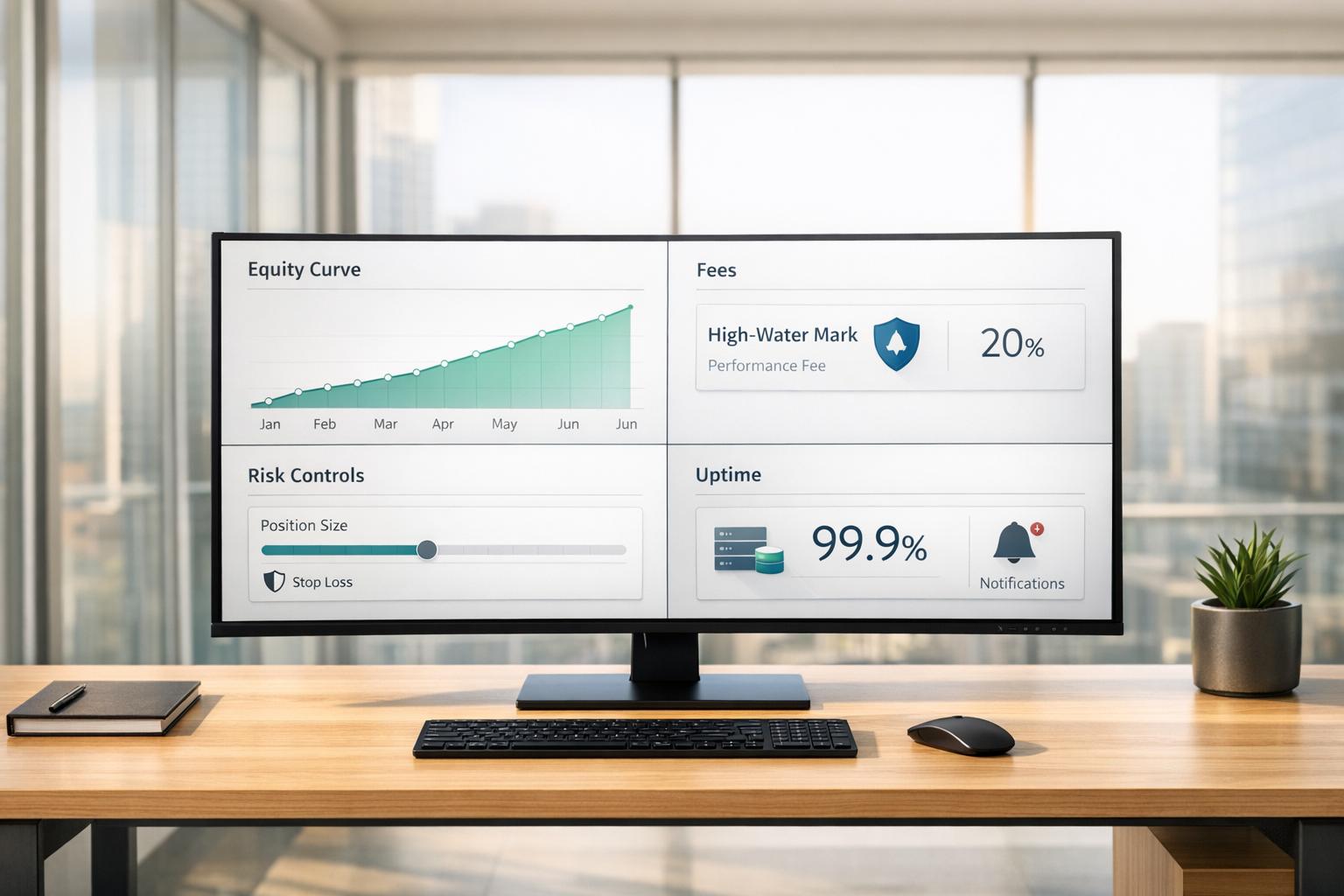
Best practices for cTrader Copy Trading Providers focus on building trust, attracting followers, and maintaining a strong trading strategy. Here's what you need to know:
- Set up your strategy properly: Use a dedicated hedging account, configure visibility settings, and align fees with copier expectations (e.g., performance fees capped at 30%).
- Write clear strategy descriptions: Explain your trading style, risk parameters, and realistic return targets to set transparent expectations.
- Choose fair fees: Opt for performance-based fees like the High-Water Mark model to align your success with your copiers' success.
- Ensure copier-friendly trading: Use one of the best VPS providers for uninterrupted trading and avoid strategies like micro-scalping that can harm copier returns.
- Be transparent with performance: Share both equity and balance curves, and invest your own money to demonstrate confidence in your strategy.
- Communicate regularly: Provide updates during market volatility or drawdowns and notify copiers of any fee changes in advance.
- Follow platform rules: Maintain activity (at least one trade every 72 hours) and adhere to cTrader’s fee caps and ranking metrics.
cTrader Copy: How to provide strategies
1. Set Up Your cTrader Copy Strategy the Right Way
Getting your technical setup right is the first step to attracting copiers. Begin by opening a dedicated trading account through your broker's portal. Most brokers require a hedging account type for strategy providers, as netting accounts aren’t supported. Once your account is ready, go to the Copy tab in cTrader and set up your strategy. This includes naming your strategy, writing a description, setting a minimum investment, and deciding on a fee structure. A solid setup not only ensures smooth operations but also helps build trust with potential copiers. After that, configure your strategy’s visibility and activity settings.
Two key settings often overlooked are visibility and activity requirements. You can choose to make your strategy public - visible to everyone - or keep it private, sharing access via a direct link. Regardless of visibility, cTrader requires at least one trade every 72 hours to maintain your listing. If your strategy remains inactive for 30 days or more, it will be automatically removed from the platform.
Your fee structure also plays a role in how your strategy ranks. Strategies with performance-only fees tend to rank higher, as cTrader penalizes those with management or volume-based fees. Fee limits are capped at 30% for performance fees, 10% for management fees, and $10 per million in volume fees. Opting for a performance-only fee structure shows your interests align with those of your copiers, fostering trust.
Another way to boost your strategy’s appeal is by investing your own capital. According to cTrader:
"The more funds the strategy provider invests in their own strategy, the higher the strategy will show in the rank. Investors find fair enough when Strategy Providers invest their own funds in their strategy too."
Lastly, set a minimum investment that matches your trading approach. A low minimum might cause syncing issues for copiers, especially with high-margin positions. Be sure to clearly outline the required leverage in your strategy description to avoid confusion.
2. Write Clear and Accurate Strategy Descriptions
Once your technical setup is ready, the next step is crafting a strategy description that builds trust. This is your chance to make a strong first impression with potential copiers. As Deriv Academy explains:
"A well-maintained and clearly communicated strategy profile can help you build trust and attract more investors."
To create an effective strategy description, focus on these key points:
Start by outlining your trading style in simple terms. Are you a scalper, a day trader, or a swing trader? Mention whether you trade manually or use cBots, and clearly state which markets or instruments you specialize in. This allows potential copiers to see if your approach aligns with their preferences and risk tolerance.
Next, provide details about risk parameters and financial requirements. Include information like the minimum leverage required and the realistic minimum investment needed to follow your strategy effectively. Without enough capital, accounts can fall out of sync and miss trades.
Be transparent about drawdowns and performance metrics. Share figures like Max Balance Drawdown or Profit Factor, and explain what they mean. This honesty sets expectations and helps copiers stay patient during inevitable market fluctuations.
Finally, set realistic return targets. Promising monthly returns of 200%–1,000% can be a red flag for experienced investors. Instead, focus on achievable goals that reflect a stable and sustainable strategy. A grounded, honest description will attract copiers who are in it for the long haul.
3. Set Fees and Investment Conditions That Make Sense

cTrader Copy Trading Fee Structures Compared
Choosing the right fee structure is essential - it shows you’re aligned with your copiers’ goals. On the flip side, poorly designed fees can drive serious investors away. By setting fees that match copier expectations, you reinforce the trust built through your strategy profile.
cTrader Copy offers three types of fees: performance fees (capped at 30%), management fees (capped at 10% annually), and volume fees (capped at $10 per million units traded per side). Your job is to pick the combination that best suits your strategy. Let’s break down what works and why.
Many strategy providers lean toward performance fees, often using the High-Water Mark (HWM) model. Why? Because it’s fair. With HWM, you only earn fees when your strategy hits a new profit high. If your strategy dips and later recovers, copiers won’t pay twice for the same gains. A common benchmark to start with is the "20% and 2%" model - a performance fee of 20% paired with a modest management fee of 2–5%. This signals that you’re focused on steady, long-term growth rather than chasing quick wins.
Volume fees, however, need extra thought. Frequent volume fees can pile up, cutting into copiers’ returns. In many cases, a performance-based structure is the smarter choice, as it ties your earnings directly to the success of your strategy.
Once your fees are set, it’s time to fine-tune your investment conditions. Start by setting a realistic minimum investment. This step builds on the foundation you’ve already established with your cTrader account settings. cTrader Copy uses an equity-to-equity model: if you have $50,000 in your account and an investor has $5,000, they’ll copy 10% of each of your positions. But here’s the catch - if the minimum investment is too low, the proportional position size might drop below the broker’s minimum lot size (usually 0.01 lots). When that happens, copied trades can fall out of sync. To avoid this, set a minimum investment high enough to cover your largest typical position. And don’t forget to clearly specify the recommended leverage - it’s a small detail that can make a big difference.
4. Build a Trading Process That Works for Copiers
To justify your fee structure, your trading must be consistent and reliable. Copiers aren’t just focused on your returns - they’re counting on a steady, predictable process day in and day out.
Start by ensuring uninterrupted trading activity. A Virtual Private Server (VPS) can keep platforms like cTrader running 24/5, even if your local internet connection fails. As NYCServers explains:
"Missed trades due to disconnections can create position mismatches between your account and the strategy you're copying."
Even one missed trade can disrupt copier accounts and damage their trust in you. Maintaining technical uptime and ensuring smooth execution are critical to building confidence in your strategy.
Reliability, however, goes beyond just connectivity. Your trading method must consistently deliver results. One common pitfall for strategy providers is micro-scalping - aiming for tiny gains of 1–3 pips per trade. Execution delays of just 1–2 seconds, along with broker spreads and commissions, can easily erase these slim profits for copiers, even if the overall strategy appears profitable. As FX_Quant points out:
"Swing trades provide copiers with better cushion (Protection) against commissions and spreads, as they trade less AND make more per trade saving copier massive sums of money."
By targeting larger moves per trade, you give copiers a better opportunity to achieve results that align with yours.
Don’t skip stop losses. A significant drawdown - like 50% or more - could indicate you’re holding onto losing trades instead of cutting them. Aim to keep your equity line close to your balance line. A widening gap between the two often signals open losing positions are piling up, which could lead to margin calls for your copiers. Effective risk management like this is a cornerstone of a copier-friendly strategy.
5. Show Performance Data Honestly
If you want to build trust with copiers, transparency is key - especially when it comes to performance data. It’s not enough to showcase impressive ROI numbers without giving the full picture. For example, a 300% ROI might sound amazing at first glance, but if it was achieved on a $100 account or involved an 80% drawdown, it paints a very different story. To build confidence, you need to provide accurate metrics alongside context, much like you would with clear strategy descriptions and fee structures.
One way to do this is by showing both your equity curve and your balance curve. Here’s why: the balance curve only reflects closed trades, while the equity curve includes open positions in real time. If your balance curve looks smooth but your equity curve is all over the place, it could signal hidden open losses. As FX_Quant, a strategy provider, explains:
"If ROI is too good to be true especially in a single month, skip to next provider. if a provider can grow an account 200-1,000% monthly, the claims are suspect, they'll be hired immediately in biggest hedge funds in the world."
Metrics like a win rate over 95% or a profit factor below 1.0 can also raise red flags. A high win rate might mean losses are being avoided rather than booked, while a profit factor under 1.0 indicates an overall unprofitable strategy. Providing this context ensures that your performance data doesn’t mislead and instead builds credibility.
To take it a step further, consider linking your account to third-party analytics platforms like Myfxbook or FXBlue. These tools offer deeper insights, such as Maximum Adverse Excursion (MAE), which tracks how far a trade went against you before it closed. This level of detail goes beyond what cTrader’s native metrics provide.
Finally, putting your own money into your strategy can be a powerful trust signal. As cTrader mentions: "The more funds you invest in your own strategy, the higher the strategy will show the rank. Investors find fair enough when Strategy Providers invest their own funds in their strategy too." By investing your own capital, you show alignment with your copiers’ interests and demonstrate confidence in your approach.
6. Keep Copiers Informed With Regular Updates
Sharing transparent performance data is just the start; maintaining regular communication is what solidifies trust. Once you've established credibility with accurate metrics, consistent updates help keep copiers informed and reassured. Remember, copiers are entrusting you with their money, and that trust can be fragile - especially during tough times like market volatility or losing streaks. Keeping them in the loop during these periods is essential.
As cTrader advises: "Keep your community updated and let them know about the current circumstances in your trading activity or your upcoming movements when things go wrong." When facing drawdowns, a clear and concise explanation of recent events and your planned next steps can make all the difference in whether a copier sticks with you or decides to leave.
Take FX_Quant as an example. In July 2021, they used Telegram (@FX_Quant) and Twitter (@FXQuant_) to provide market updates and inform followers about their decision to pause trading during major news events. This approach effectively managed expectations and kept their audience engaged. You can use similar social media platforms alongside cTrader's built-in tools - like the Investor Access Link and discussion tab - to maintain open communication with your copiers.
If you're planning to adjust your fee structure, it's critical to communicate these changes well in advance. On cTrader, fees can only be modified when a strategy is stopped and has no active investors. Sudden fee changes without prior notice can damage trust, so giving copiers time to evaluate and decide whether to stay under the new terms is key. Clear, upfront communication about fees reinforces your dependability.
Beyond real-time updates, consider reviewing your strategy analytics on a weekly or monthly basis, as recommended by Deriv Academy. This helps you identify trends early and provide your copiers with concrete, data-backed updates rather than vague reassurances. Consistency in these updates is just as important as the information itself.
7. Stay Reliable and Follow Platform Rules Over Time
Building long-term trust isn’t about one standout month - it’s about consistent actions over time. One way to ensure reliability is by running your strategy through a VPS. A VPS provides uninterrupted connectivity 24/5, which helps you avoid missed trades caused by outages.
But technical reliability is just one part of the equation. Staying compliant with cTrader's platform rules is equally important. For example, adhering to cTrader’s strict fee caps shows transparency and maintains integrity.
Another key factor is how the cTrader ranking system evaluates providers. It uses an "Equity Based ROI" metric, which considers returns in relation to the amount of your own funds invested in the strategy. This discourages providers from using low-balance accounts to artificially boost ROI. Experienced investors and the platform’s algorithm tend to filter out such accounts. As FX_Quant wisely advises:
"If ROI is too good to be true especially in a single month, skip to next provider... if too good to be true, stay away."
By consistently meeting these standards, you demonstrate your commitment to reliability, which reassures your copiers.
Additionally, maintaining an all-time ROI above -90% and executing at least one trade every 72 hours are essential requirements. Failing to meet these benchmarks can quietly remove your account from active listings. Think of these rules as the baseline for sustaining success and trust over the long haul.
Conclusion
Becoming a successful cTrader Copy strategy provider boils down to three key habits: transparency, consistency, and professionalism. These elements play a major role in attracting and keeping copiers.
Your profile serves as your trading résumé. A well-crafted description, accurate performance data, reasonable fees, and steady communication all demonstrate that you're a provider worth following. As Deriv Academy aptly states:
"Transparency is your best friend here. A well-maintained and clearly communicated strategy profile can help you build trust and attract more investors."
Another often-missed trust signal? Putting your own money into your strategy. This shows you're not just collecting fees - you’re trading right alongside your copiers.
FAQs
How much money should I invest in my own strategy?
Investing at least $1,000 of your own money into your strategy is a smart move. Why? It shows you believe in what you're offering. This personal investment not only boosts your strategy's ranking but also makes it more appealing to potential investors. By putting your own funds on the line, you demonstrate commitment, which can build trust and confidence among those considering following your lead.
What minimum investment helps copiers avoid trade sync issues?
The minimum amount needed to prevent trade synchronization issues depends on the strategy provider. Generally, this ranges from $100 to $1,000, though the exact figure varies depending on the specific strategy you're following.
Which fee model is fairest for copiers long term?
The performance fee model based on the high-water mark is widely regarded as the fairest long-term option for copiers. This system ensures that fees are only applied to new profits, creating a clear alignment between the interests of strategy providers and copiers. By concentrating on net gains, it encourages transparency and accountability, offering a balanced approach that benefits both sides in the long run.
Related Blog Posts
Start Trading with For Traders
Join our platform to test your trading skills, trade virtual capital, and earn real profits. Access educational resources, advanced tools, and a supportive community to enhance your trading journey.
Start your Trading Challenge