

Dynamic diversification is a game-changer for proprietary traders. It’s not just about spreading risk - it's about actively managing it based on performance, market conditions, and risk limits. Here's what you need to know:
- What it is: Dynamic diversification adjusts risk allocation across strategies and markets in real-time.
- Why it matters: It minimizes the impact of losses, especially in prop trading where strict drawdown limits (6–10%) and profit targets (8–10%) exist.
- How it works: Use uncorrelated strategies and assets (like Forex, indices, commodities) to balance risk. For example, combining three independent strategies can reduce portfolio drawdown by 40–60%.
- Key tips:
- Allocate more to strategies performing well; reduce exposure to underperformers.
- Avoid over-diversification - focus on strategies with low correlation (<0.35).
- Scale risk cautiously and use drawdown-based sizing to protect your account.
Dynamic diversification isn’t a set-it-and-forget-it process. It’s about staying flexible, managing risks, and ensuring no single loss derails your progress.
35) Using Multiple Trading Strategies to Diversify your Portfolio
Core Principles of Diversification for Simulated Prop Trading
Understanding why diversification matters is just as important as knowing how to implement it - especially when trading virtual capital under strict account rules.
Types of Risk That Diversification Addresses
Diversification is designed to address several types of risk that can undermine a simulated trading account.
Strategy risk is a common blind spot for traders. This risk stems from relying on a single trading approach. For instance, in volatile or choppy markets, a trend-following strategy can quickly drain your account. Pairing it with a mean-reversion strategy can help create balance: when one struggles, the other often performs better. In simulated prop trading, recognizing this risk allows you to adjust your strategy mix as market conditions evolve.
Market and sector risk is more widely recognized. A single geopolitical event or economic report can impact an entire asset class. By spreading capital across forex, indices, and commodities, you reduce the chance of a single event wiping out your drawdown room in one session. This is crucial when managing allocations in real time.
Timing risk happens when too much exposure is concentrated in one session or timeframe. Balancing scalping vs swing trading allocations ensures your capital isn’t overly tied up in unfavorable conditions. Poor timing is a major pitfall, with over 80% of prop firm challenge failures linked to inadequate risk management.
These risks highlight the importance of selecting diverse asset classes to counterbalance volatility effectively.
Asset Classes Available for Diversification
Reducing these risks starts with choosing asset classes that don’t move in tandem.
Most simulated prop accounts offer access to forex major and minor pairs, equity indices (like US30, NAS100, and DAX), commodities such as gold and crude oil, and increasingly, cryptocurrencies. Each of these responds differently to economic events, interest rate shifts, and market sentiment. The goal isn’t to trade every asset - it’s to select instruments that behave independently, so you can dynamically adjust your portfolio as conditions change.
Systematic trader Rob Carver sums it up well:
"Diversification is a free lunch, but you still need to get to the buffet..."
Research on trend-following systems across 102 instruments showed that broad diversification can improve a portfolio’s Sharpe Ratio by over 4.5 times compared to trading a single instrument. Even adding just two or three uncorrelated instruments can significantly smooth your equity curve.
How Correlation Affects Portfolio Diversification
Even when assets seem unrelated, their correlation plays a critical role in achieving true diversification.
Take ES (S&P 500) and NQ (Nasdaq-100) futures as an example. Their correlation is typically above 0.90 during most trading sessions. Trading both isn’t diversification - it’s essentially doubling your exposure to the same market movement. The same issue arises in forex: EUR/USD and GBP/USD often show correlations between 0.7 and 0.9 because both pairs involve the US dollar as the quote currency.
"Correlation risk is the hidden danger that makes traders think they're diversified when they're actually doubling down on the same bet." - Paul, Founder, Proptradingvibes.com
Here’s a simple guideline: if the absolute correlation between two instruments or strategies is below 0.35, they’re genuinely independent and offer real diversification. But when correlation hits 0.60 or higher, you’re essentially replicating your risk. If you must trade two highly correlated assets, reduce the size of each position to half of your usual risk to limit overall exposure.
Correlations, however, aren’t static. Instruments that seem uncorrelated during calm markets can suddenly move together during major sell-offs or global macro events. Regularly reviewing correlations - not just at the start of your portfolio construction - helps keep your diversification dynamic and effective.
Dynamic Diversification Strategies for Prop Traders
Adjusting Diversification Based on Account Performance
Diversification isn't a "set-it-and-forget-it" concept - it needs to evolve as your account performance changes. A key approach here is drawdown-based sizing, where you calculate risk based on your available drawdown room rather than your full account balance. For instance, on a $50,000 account with a $2,500 drawdown limit, risking 1% of that room means allocating just $25 per trade. As your cushion shrinks, you reduce your risk per trade accordingly, ensuring you can weather tough times.
When scaling up, proceed cautiously. A good rule is to scale down faster than you scale up. Increase exposure in small 25% increments only after establishing a profit cushion and locking in your drawdown floor. As funded trader Jimmy Peter Eriksson wisely noted:
"Systems fail temporarily, structures should not."
Eriksson exemplifies this principle. Managing $400,000 across four $100,000 accounts as of January 2024, he divided his Expert Advisors across these accounts to prevent one strategy's poor performance from jeopardizing his entire portfolio. This disciplined structure led to over 20 payouts totaling $36,000.
Setting Total Portfolio Risk Limits
Managing risk isn't just about individual trades - it’s about controlling your overall exposure. A solid guideline is to cap total open risk at 3% of your equity. For example, if you're trading correlated pairs like EUR/USD and GBP/USD, split your risk - allocate 0.5% to each pair so the combined exposure stays within your 1% per-trade limit.
Another critical safeguard is a daily circuit breaker. If you lose 25–30% of your available drawdown room in a single day, stop trading immediately. Similarly, after three consecutive losing trades, take a break for the day. These measures help prevent the snowball effect of trading through a bad market phase or strategy mismatch.
Here’s how risk management shifts depending on your account phase:
| Account Phase | Risk Metric | Recommended Action |
|---|---|---|
| Evaluation | 1% of drawdown room | Prioritize survival; avoid scaling up |
| Funded (floor locked) | 1.5% of cushion | Gradually scale up in 25% increments |
| Drawdown (<50% room) | Reduce daily budget | Lower daily loss limits proportionally |
| High volatility/news | 0% (flat) | Close positions before major events |
These strategies help create a solid foundation for more session-specific diversification approaches.
Using Time-of-Day Filters in Diversification
Not all trading hours are created equal. Just as you manage risk across positions, aligning your capital allocation with session-specific characteristics can further refine diversification. Applying the same risk allocation across all hours overlooks a key advantage: session-based volatility.
A practical method is session-based capital rotation. Match assets to the sessions where they’re most active - for example, trade USD/JPY and gold during the Asian session, GBP/USD during London, and indices or XAU/USD in New York. This approach takes advantage of session-specific volatility patterns. Similarly, align strategies with session behavior. Trend-following strategies often thrive during London’s breakout periods, while mean-reversion setups work better in quieter intraday ranges.
For daily risk allocation, a useful model might assign 7% to the Asian session, 8% to London, and 15% to New York, reflecting where the most volatility - and opportunity - tends to occur. Additionally, reduce position sizes by 50% on Fridays to account for the risk of weekend gaps.
Connecting Diversification with Risk Management
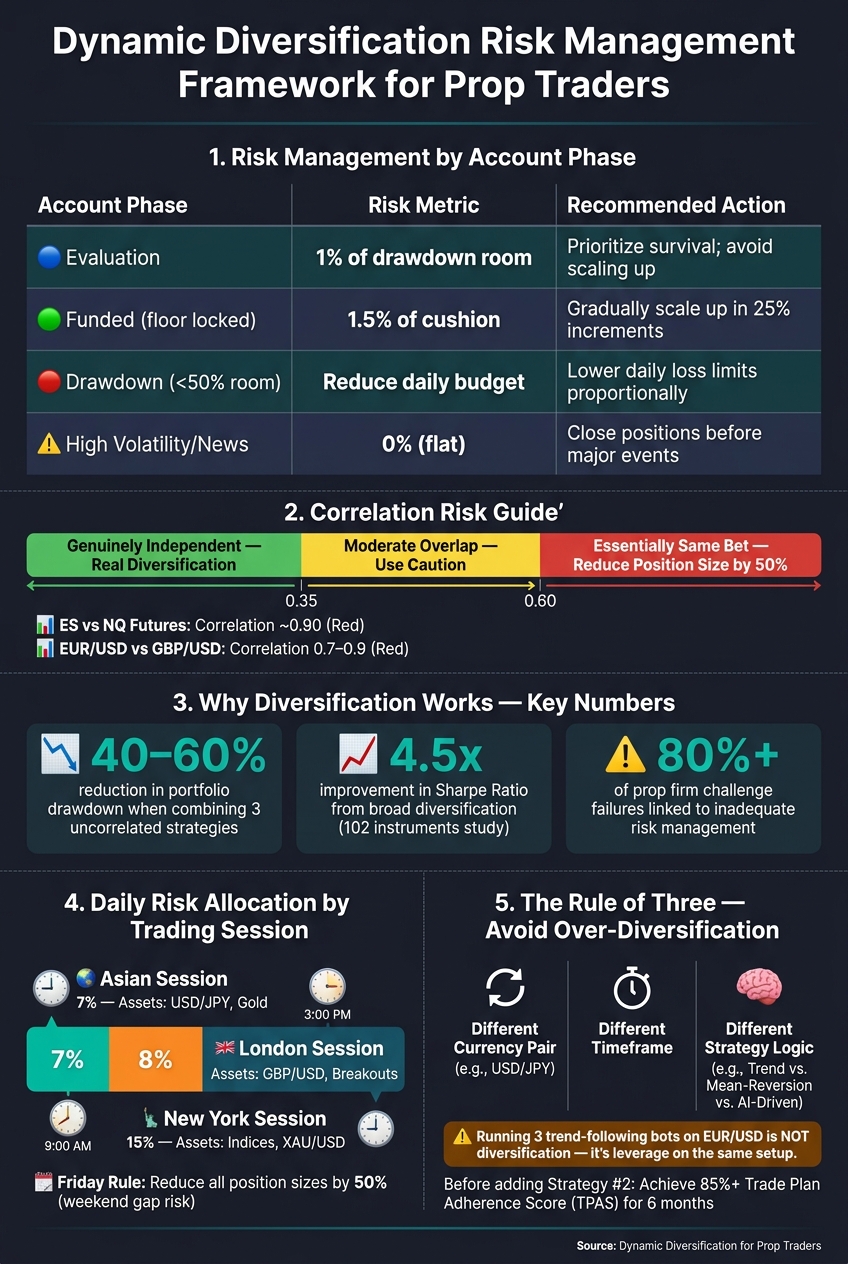
Dynamic Diversification Risk Management Framework for Prop Traders
Aligning Risk Per Trade with Portfolio Diversification
When managing multiple strategies, reducing the risk per trade becomes essential. For example, professional proprietary traders handling several funded accounts often limit their per-trade risk to just 0.25%–0.50%. This approach safeguards the overall drawdown buffer across all positions. Think about it: if you replicate a 1% risk trade across five accounts, you're essentially putting 10% of your entire drawdown allowance on just two trades. That’s a huge gamble. Understanding the truth about prop trading firms is vital when navigating these high-stakes environments.
A practical solution? Implement a portfolio-level kill switch. This involves setting a threshold - say, a 2% aggregate portfolio loss in a single session - that automatically closes all trades. This kind of "circuit breaker" prevents losses from spiraling out of control. By adopting these controls, you can dynamically adjust your diversification strategy based on performance metrics.
Using Performance Metrics to Guide Diversification
Two metrics should be front and center when fine-tuning diversification: correlation and drawdown.
Start by tracking each strategy's daily profit and loss over at least 60 days. Use a spreadsheet to calculate Pearson correlation. If the value is below 0.3, the strategies are independent; above 0.6, they’re likely redundant. As Diego Arribas Lopez explains, the true aim of running multiple strategies isn’t to amplify returns - it’s to smooth out your worst-case scenarios.
Drawdown is another critical factor. Combining three uncorrelated strategies can slash portfolio drawdown by 40–60% compared to relying on just one system. And when scaling risk, set realistic expectations. Use a Profit Factor (PF) of 1.2 as your baseline. If backtests show a much higher PF, take it with a grain of salt - real-world results often fall short of backtested projections.
Avoiding Over-Diversification
While diversification is essential, overdoing it can backfire. Over-diversification happens when strategies overlap too much. For instance, running three trend-following bots on EUR/USD isn’t diversification - it’s just adding leverage to the same market setup. This redundancy not only dilutes effectiveness but also increases the likelihood of mistakes. Adding a second strategy raises the chance of discipline failures by 30–50%, while a third can demand 2.2–2.8× the mental effort of managing a single system.
A better approach is the "Rule of Three": ensure each strategy operates with a different currency pair, timeframe, and logic. For example, you might combine a momentum vs mean reversion strategies, and an AI-driven Gold strategy. Each one targets a distinct market condition.
"Single-strategy concentration produces 4–8 month drawdown periods that aren't strategy failure - they're regime mismatch that diversification across strategies could have softened." - Gary M., Founder of Trader's Second Brain
Before adding a second strategy, ensure your first one achieves a Trade Plan Adherence Score (TPAS) of 85% or higher for at least six months. The idea is simple: build a strong foundation before scaling up. By managing per-trade risk, focusing on key metrics, and avoiding redundancy, you can create a trading portfolio that’s both balanced and adaptable.
Applying Dynamic Diversification in Simulated Prop Trading
Building a Diversification Plan for Simulated Challenges
When creating a diversification plan for simulated trading challenges, start by establishing clear, written rules. These should outline the number of instruments you’ll trade, set a per-trade risk cap, and define acceptable correlation thresholds before entering any positions.
Choose instruments that span different asset classes, timeframes, and trading strategies. For instance, in a simulated challenge, you could combine a trend-following Forex strategy on USD/JPY with a mean-reversion approach on GBP/USD. This mix helps maintain independent exposure within your challenge account. To further enhance diversification, consider adding a breakout strategy on Gold, as historical data shows that breakout and range-trading strategies often have correlations between -0.3 and -0.5.
A critical simulation-specific rule is to avoid overlapping counter-currency exposure. For example, holding XAU/USD and EUR/USD in the same direction effectively doubles your exposure to USD, creating hidden risks that can quickly drain your drawdown buffer. Setting up a solid diversification framework like this prepares you for rigorous testing.
Testing Diversification Strategies in Virtual Portfolios
Once your diversification rules are in place, test them in a risk-free environment. Start by splitting historical data into in-sample and out-of-sample segments. Then, use Monte Carlo simulations to evaluate potential drawdowns under various market conditions. These tests are vital for ensuring your strategy can withstand the dynamic nature of live trading.
"The 95th percentile drawdown from Monte Carlo is a far better basis for position sizing than your backtest drawdown." - Quanthop
Monte Carlo simulations can help you calculate the 95th percentile drawdown (P95). This metric is essential for adjusting position sizes to align with your risk limits. For example, if your simulated challenge allows a 25% drawdown but the Monte Carlo P95 indicates a 42% drawdown, you’ll need to scale your positions to about 60% of their original size.
Using For Traders to Practice Diversification

After fine-tuning your strategy through simulations, test it in a live demo environment using For Traders. Their Challenge Accounts offer access to a wide range of instruments, including Forex, Crypto, Futures, Indices, Metals (like Gold, Silver, and Platinum), and Energies (such as Brent, WTI, and Natural Gas). This variety is ideal for building uncorrelated portfolios.
The platform’s AI Coach helps identify concentration risks, like over-reliance on a single asset or a narrow trading timeframe. Meanwhile, the Drawdown Protection tool tracks real-time floating PnL against a 2% intraday threshold, providing automated risk management.
For Instant Accounts, the Consistency Rule ensures that your best single trading day doesn’t exceed 15% of your total profit. This encourages a balanced, multi-day, multi-instrument trading approach. Additionally, microlot support and partial closures make it easier to distribute exposure across multiple instruments without breaching daily drawdown limits, which range from 3% to 6% depending on the account type.
Conclusion: Key Takeaways for Prop Traders
Building on the strategies and risk controls discussed earlier, dynamic diversification is a cornerstone for successful proprietary trading. This approach adjusts to market shifts, account performance, and the inherent risks of your strategies. The idea is simple yet powerful: spread your risk across uncorrelated assets and strategies to ensure that no single setback derails your overall progress.
Keeping Diversification Simple and Effective
Diversification doesn’t have to be overly complex. Combining uncorrelated asset classes - such as Forex, indices, and commodities - can help smooth out returns while keeping your portfolio manageable.
"Capital allocation is not 'set and forget.' Markets evolve, strategies drift, and your risk tolerance should adapt." - ForexPropFirms
Each strategy you employ serves as a risk driver. Instead of allocating capital based solely on dollar amounts, focus on how much risk each strategy contributes. Use metrics like 30-day and 90-day Sharpe ratios and maximum drawdowns to guide your allocations. Only scale up strategies that demonstrate strong, risk-adjusted performance. Regularly reassessing your allocations ensures they remain relevant to current market conditions rather than outdated assumptions. To manage emotional decision-making, professional traders typically limit exposure to 1%–5% of their total account value per trade.
By keeping these principles straightforward, traders can naturally integrate automated tools and continuous learning into their routine to stay disciplined.
Leveraging Tools and Education to Strengthen Your Strategy
Automation can be a game-changer for maintaining disciplined diversification. Tools that enforce risk management rules help avoid over-leveraging or concentrating too much in a single market direction.
Platforms like For Traders offer practical solutions to apply these principles. Their AI Coach, for example, flags concentration risks in real time, while Drawdown Protection acts as a safeguard against intraday losses. As For Traders explains: "Our data shows that a large portion of failed trading accounts is linked to hitting drawdown limits... in many cases, this is not caused by the strategy itself, but by loss of control during intraday trading".
Pairing these automated tools with educational resources - such as video courses, e-books, and community forums - provides a structured way to refine your skills and build confidence in your diversification strategy.
FAQs
How many strategies should I run at once?
Most retail traders find it beneficial to operate with 2-3 strategies simultaneously. This approach can help lower drawdowns and create a steadier income flow. That said, it’s important to first focus on mastering one strategy and achieving consistent, strong results with it. Trying to juggle more than three strategies can lead to discipline issues and may actually undermine the benefits of diversification.
How often should I recalculate correlations?
For daily strategies, make sure to recalculate correlations every day. Take time to review the correlation matrix on a weekly basis. If you notice any significant deviations that stick around for more than 10 days, it’s a good idea to reassess and confirm the data’s accuracy.
How do I size trades using drawdown room?
Sizing trades with enough room for drawdowns means figuring out your risk capital - the amount of equity you’re willing to risk before hitting your drawdown limit. A common approach is to use 1.5%-2% of this risk capital to set your dollar risk per trade. To calculate your position size, divide this dollar risk by the product of your stop distance (in ticks) and the tick value. This method helps you control risk while still giving your trades the chance to grow.
Related Blog Posts
Start Trading with For Traders
Join our platform to test your trading skills, trade virtual capital, and earn real profits. Access educational resources, advanced tools, and a supportive community to enhance your trading journey.
Start your Trading Challenge