Scaling Plans in Prop Trading Firms Explained
How prop firms scale traders: profit targets, drawdown limits, evaluation periods, and staged capital increases.

Scaling plans in prop trading firms are structured programs that allow traders to manage increasingly larger amounts of capital as they demonstrate consistent profitability and disciplined risk management. Here's how they work:
- Start Small, Grow Big: Traders begin with a base account (e.g., $50,000) and earn capital increases by meeting profit targets (typically 10–15%) while adhering to strict drawdown limits (usually 5–10%).
- Performance Over Time: Firms evaluate traders over set periods (e.g., 30–90 days) to ensure consistent returns (e.g., 2–3% monthly) and risk control.
- Rewards for Success: Hitting milestones leads to account boosts (e.g., 25%–100%), higher profit splits (up to 90%), or increased trading limits.
- Focus Shifts as You Scale: Smaller accounts test basic skills, while larger accounts emphasize long-term stability and disciplined management.
Scaling plans benefit both traders and firms by fostering gradual growth, reducing stress, and ensuring readiness for managing larger capital. For example, FTMO increases account size by 25% every four months for traders who meet profit targets, while platforms like For Traders offer additional tools, such as AI coaching, to support growth.
The key to success? Steady returns, strict risk control, and a focus on percentages rather than dollar amounts. Scaling is a step-by-step process that rewards patience and discipline.
How Scaling Plans Work
Qualification and Evaluation Process
Scaling plans often start with a 30–60 day evaluation period, during which firms test your ability to maintain profit consistency and manage risk effectively. This isn't about making flashy, one-time gains; instead, firms look for repeatable strategies and steady performance. For instance, traders who consistently achieve 2–3% monthly returns are preferred over those who post a 10% gain one month but follow it with a 5% loss.
Risk management is a key focus. Firms closely monitor drawdown usage, expecting traders to keep it within 50–60% of the allowed limit. This signals that you're prepared to handle larger capital responsibly. Beyond profits, your compliance with rules is equally critical. Even minor infractions, if they don’t lead to account termination, can delay your progress. Firms typically conduct performance reviews every 60 to 90 days, checking not just your profit and loss (P&L) but also your drawdown usage, adherence to rules, and ability to stay composed under pressure.
Only traders who meet strict profit and drawdown standards are allowed to advance to the next level.
Profit Targets and Drawdown Limits
To progress through a scaling plan, you’ll need to hit specific profit targets while staying within tight drawdown limits. Profit targets generally range from 5% to 20% of your account balance, depending on your tier. For example, FTMO requires traders to achieve a 10% net profit over four months, with at least two of those months being profitable.
Drawdown limits, typically between 5% and 10% of your account size, act as more than just safety measures. They’re also key evaluation criteria. Staying well within these limits shows that you have the discipline needed to manage large amounts of capital. As you climb the ranks, profit targets often become more modest, but the expectations for risk management grow stricter. At higher levels - accounts ranging from $500,000 to $1,000,000 or more - firms may only require about 5% profit per quarter, emphasizing long-term stability over short-term gains.
Hitting these benchmarks qualifies you for the next stage: capital increases.
Capital Increases and Review Periods
Once you’ve proven your consistency and discipline, firms reward you with scheduled capital boosts. These increases typically range from 25% to 100% of your current account size. For example, The5ers' High Stakes program takes an aggressive approach, doubling account sizes at each milestone - allowing traders to scale from $20,000 to a potential $4,000,000.
A smooth equity curve often inspires more confidence than higher but erratic profits. Some firms even adopt alternative scaling methods. Topstep, for instance, ties growth to your risk management by increasing the number of contracts you’re allowed to trade based on the profit buffer above your drawdown floor, rather than simply boosting the account balance. This approach directly links capital growth to how well you manage risk.
These systems ensure that scaling is tied to both performance and disciplined trading habits.
4 Step Plan To Scale Your Prop Trading (Safely)
Scaling Requirements by Account Size
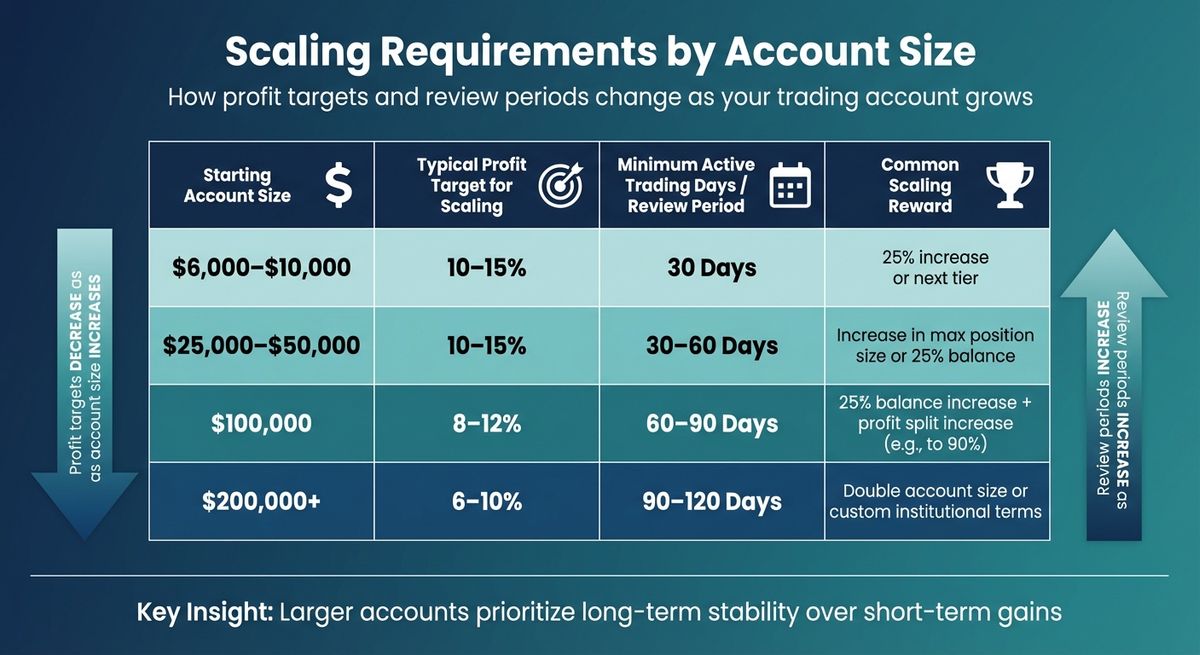
As your account size grows, so do the expectations and requirements for scaling. Smaller accounts are all about proving you can stick to the rules and handle basic risks. But as the account size increases, the focus shifts to demonstrating consistent performance over extended periods, especially when managing larger sums of capital. Profit targets tend to decrease, while review periods and risk management standards become more rigorous.
For example, a $10,000 starter account typically requires a 10–15% profit gain within 30–60 days to qualify for scaling. On the other hand, accounts exceeding $500,000 demand a 5% profit gain per quarter and at least 120 days of consistent trading to ensure you can responsibly manage significant capital. FunderPro emphasizes this principle:
"Risk management is the core priority. Capital allocation grows only when a trader demonstrates discipline, stability, and respect for defined loss limits." – FunderPro
This approach highlights how metrics and expectations shift as account sizes increase.
Scaling Metrics Comparison Table
Here’s a breakdown of typical scaling metrics by account size:
As the table shows, profit targets decrease as account sizes grow, while the required review periods lengthen. This gradual shift reflects what firms prioritize at different levels: smaller accounts test your ability to execute strategies effectively, while larger accounts focus on long-term capital preservation and disciplined management.
Ready to trade funded capital?
Choose your path — Instant Accounts, One-Step or Two-Step Challenges — from just $23, with up to $300,000 in funded capital.
Choose your challengeHow For Traders Handles Scaling
Virtual Capital Plans and Account Features
For Traders offers a variety of virtual capital accounts ranging from $6,000 to $100,000, designed to reward consistent trading performance. You can choose from different funding challenges, including Fast (1-Step), Classic (2-Step), Strike (3-Step), or Instant, with most plans featuring unlimited time limits, a 9% profit target, and a 5% maximum drawdown. Once you hit these targets, you’ll enjoy an 80% profit split, and some plans even go up to 90%. Payouts are bi-weekly, and to date, the platform has distributed over $9 million globally, with traders earning an average reward of approximately $4,043 on a $100,000 account.
A standout feature of For Traders is its AI Coach, which analyzes your trading patterns and provides actionable feedback to fine-tune your risk management strategies. This ensures you’re prepared to handle larger account sizes as you scale. To remain eligible for scaling and rewards, traders must execute at least one trade every 30 days and achieve a minimum of three profitable days, each with at least a 0.5% gain.
These structured plans are designed to encourage consistent growth while seamlessly integrating with For Traders' educational and support resources.
Education and Support Resources
Scaling up requires more than just hitting profit targets - it also demands strong educational backing and consistent support. For Traders addresses this through its For Traders Academy, which provides video courses, live sessions, and coaching tailored to trading psychology. These resources are crafted to help traders develop the mental discipline necessary to manage larger capital responsibly.
The platform also fosters community engagement through its Discord community, where traders can connect daily, share strategies, and access "level up" resources. This real-time interaction, combined with AI-driven performance insights and comprehensive educational tools, creates a well-rounded support system. Together, these resources empower traders to transition from smaller accounts to managing larger, institutional-level capital with confidence.
Tips for Scaling Success
Risk Management and Consistent Performance
When scaling an account, keeping performance steady is no small feat. It requires a careful approach to risk management and a focus on consistency.
One key strategy is to adjust your risk as your account grows. For instance, risking 1% per trade might be reasonable with a $50,000 account. But when trading with $1,000,000 or more, scaling down to 0.25% per trade can help manage the emotional strain that comes with handling larger sums.
Another useful tactic is drawdown buffering. If your account experiences a 3% drawdown, reduce your position sizes by half. At a 5% drawdown, it’s wise to stop trading for the day altogether. This approach helps to safeguard your account from further losses.
Firms that successfully scale often prioritize steady monthly returns over chasing big, volatile profits. A consistent 2–3% monthly return signals reliability, which is critical for long-term growth. Interestingly, sticking to your trading plan 95% of the time often outweighs having a high win rate. These practices, combined with solid technology and community support, can make scaling more manageable.
Using AI Tools and Community Support
Tech tools and a supportive community can be game-changers for traders looking to scale effectively.
For example, platforms like For Traders' AI Coach analyze your trading behavior in real time. By identifying emotional triggers, these tools help you fine-tune your risk management before problems arise. Features like automated stop-losses and profit targets are especially helpful during volatile market conditions, as they eliminate the need for emotional decision-making. Enabling Order Confirmation can also prevent accidental trades, keeping your strategy on track.
Daily trade reports are another essential tool. Reviewing these after the market closes can help you plan position sizes for the next session, especially since many platforms only update contract limits once a day. Beyond tech, engaging with communities like Discord provides access to real-time advice and insights from experienced traders who have already navigated the challenges of scaling. These shared experiences can offer practical tips and reassurance as you grow.
Conclusion
Scaling plans offer a clear path for traders to transition from passing challenges to building a lasting trading career. These plans reward disciplined trading by emphasizing consistent performance and careful risk management, ultimately leading to larger capital allocations. This approach can transform prop trading from a side hustle into a full-time career. The focus here isn’t on chasing massive wins but on managing capital responsibly.
"Scaling is the real path to long-term growth in prop firms, not just passing challenges." Edris Derakhshi, Founder of TradingRage
To scale successfully, traders should aim for steady monthly returns - typically around 2–3% - while staying within drawdown limits. Thinking in terms of percentages rather than fixed dollar amounts reflects a mindset geared toward long-term growth. Many prop firms reward this disciplined approach by increasing account sizes for traders who consistently meet profit targets.
For Traders supports this journey by offering virtual capital plans that allow traders to grow equity based on daily P&L. Their resources include video courses, AI-driven risk management tools, and a vibrant Discord community to help traders refine their strategies and monitor progress.
Scaling in prop trading requires a structured, patient approach. Think of it as a marathon, not a sprint: focus on protecting your funded account, and capital increases will naturally follow.
FAQs
How do scaling plans determine when I can level up?
Scaling plans determine if you're ready to move to the next level by assessing your ability to maintain steady profitability and meet specific benchmarks set by the firm. These benchmarks typically include hitting profit targets, following risk management guidelines, and demonstrating consistent trading performance over a set timeframe.
What happens if I hit the profit target but break a rule?
If you meet your profit target but violate a rule, most prop trading firms will disqualify you from scaling up or increasing your account size. Following the rules is crucial for responsible trading, and breaking them can cost you the chance to advance.
How should I reduce risk as my account size grows?
To manage risk as your account grows, stick to strict risk management practices and follow your prop trading firm's scaling guidelines. Only increase your trade size gradually after meeting specific benchmarks for performance, discipline, and risk management. These scaling plans typically emphasize steady profitability and careful risk control, aiming to support long-term success while keeping risks in check.
Ready to trade funded capital?
Choose your path — Instant Accounts, One-Step or Two-Step Challenges — from just $23, with up to $300,000 in funded capital.
Choose your challengeTrade up to $300,000
Choose challenge