5 Steps to Optimize Sharpe Ratio
Measure your baseline Sharpe Ratio, then boost risk‑adjusted returns with low‑correlation diversification, disciplined position sizing and stops, indicator timing, and backtesting.

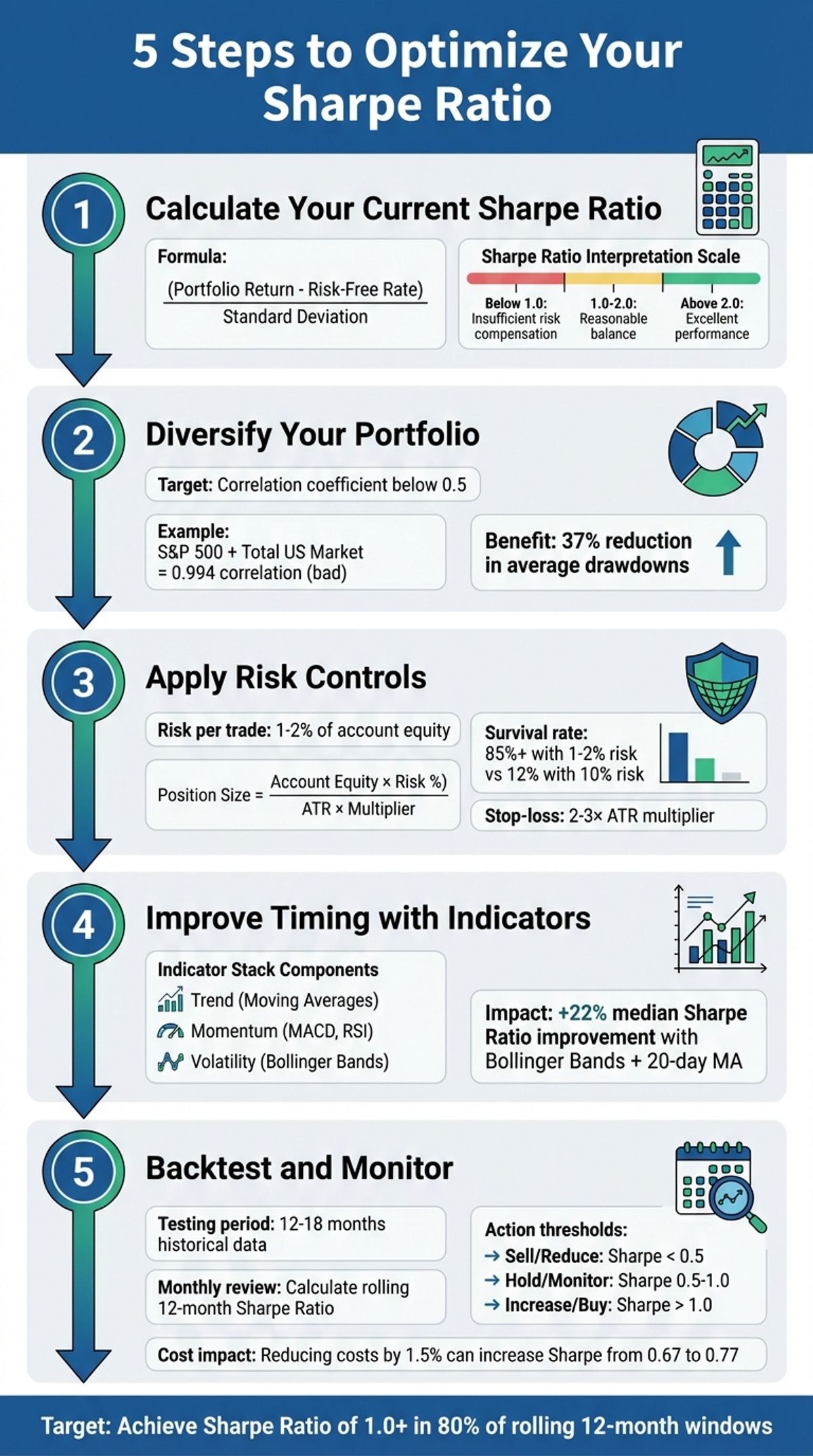
The Sharpe Ratio measures how much return you earn for the risk you take. A higher ratio means better risk-adjusted performance. Here's a quick summary of how to improve it:
- Calculate Your Current Sharpe Ratio: Use the formula: (Portfolio Return - Risk-Free Rate) / Standard Deviation of Returns. Start with accurate data and annualize the results for consistency.
- Diversify Your Portfolio: Reduce volatility by adding low-correlation assets like different currencies, commodities, or global indices.
- Apply Risk Controls: Limit risk per trade to 1-2% of your account and use stop-loss orders to manage losses.
- Improve Timing with Indicators: Use tools like moving averages, RSI, or Bollinger Bands to refine entry and exit points.
- Backtest and Monitor: Test strategies on historical data, review monthly performance, and adjust based on results.
The Sharpe Ratio Is Lying to You (Sharpe Optimization in Python)
Step 1: Calculate Your Current Sharpe Ratio
Before you can work on improving your risk-adjusted returns, you need a clear picture of where you currently stand. Calculating your baseline Sharpe Ratio gives you a measurable starting point, showing whether your current strategy is delivering enough return for the level of risk you're taking.
The Formula and Key Components
The Sharpe Ratio formula is simple: (Average Portfolio Return – Risk-Free Rate) / Standard Deviation of Returns
Here’s what you’ll need to calculate it:
1. Portfolio Return (Rₚ): You can calculate your periodic returns using this formula: (Current NAV – Previous NAV) / Previous NAV. For more precision, use the logarithmic return formula: ln(Current NAV / Previous NAV).
2. Risk-Free Rate (Rₓ): The yield on U.S. Treasury bills is a common benchmark. For example, in mid-2025, the 3-month Treasury bill yield was around 5.2%. If you're working with daily returns, divide the annual risk-free rate by 252 (the approximate number of trading days in a year).
3. Standard Deviation (σₚ): This measures the volatility of your portfolio. In Excel, use the STDEV.S function on your excess returns (Return – Risk-Free Rate). If you’re using Python, the numpy.std function works with the same data.
To compare fairly across different timeframes, annualize your Sharpe Ratio. Multiply your daily Sharpe Ratio by √252 for daily data, √52 for weekly data, or √12 for monthly data.
"A Sharpe Ratio of 1 means you earned 1 unit of return for every unit of risk taken. That's generally seen as decent performance." – Financial Models Lab
When performing these calculations, always use net returns. Subtract transaction costs and slippage from your gross returns. Ignoring these costs can inflate your ratio and lead to misleading conclusions.
Using Simulated Trading Data
To get an accurate Sharpe Ratio, you’ll need at least one year of data from your trading activity, even if it’s from a demo account. This ensures your results aren’t distorted by short-term market fluctuations or lucky streaks.
Platforms like For Traders provide detailed performance data across various virtual capital plans, from $6,000 accounts to $100,000 accounts. Export your daily NAV values and organize them into a spreadsheet with three columns: Date, Closing NAV, and Periodic Return. Use the percentage change between each day’s closing NAV to create your return series.
With this data, calculate the average daily excess return and its standard deviation. Then, annualize your Sharpe Ratio by multiplying by √252. Here’s what your results mean:
- Below 1.0: Your returns don’t sufficiently compensate for the risk.
- 1.0–2.0: A reasonable balance between return and risk.
- Above 2.0: Excellent performance.
This baseline Sharpe Ratio becomes your benchmark. As you move through the next steps, you’ll be able to track how your adjustments affect your risk-adjusted returns. With this foundation in place, you’re ready to dive into portfolio diversification and other optimization strategies.
Step 2: Diversify Your Virtual Portfolio
After calculating your baseline Sharpe Ratio, the next move is to manage portfolio volatility through diversification. Lowering volatility improves your Sharpe Ratio by reducing the denominator while keeping returns steady. Diversification works because assets with low correlation balance out your equity curve - when one asset dips, another might rise. This approach helps you select assets that perform differently under changing market conditions.
Choosing Assets with Low Correlation
To diversify effectively, focus on assets with weak or negative correlations. Aim for correlation coefficients below 0.5 - higher values indicate that assets move together, offering little diversification benefit. For instance, trading the S&P 500 alongside a total U.S. stock market fund provides minimal protection because their correlation is a staggering 0.994. Instead, explore a mix of asset classes: currencies like the Swiss Franc (CHF) or Australian Dollar (AUD), energy commodities like Brent Crude, and indices from different regions.
"Low correlation is the engine of diversification. Two assets can be volatile on their own, yet if they zig and zag at different times, the portfolio's overall volatility falls." – QuantLabs
Platforms such as For Traders offer tools like DXTrade and TradeLocker, enabling you to trade forex pairs, commodities, and indices from a single account. Before taking a new position, check asset correlations. For example, the U.S. Dollar and Gold often exhibit a negative correlation, making them strong hedging options. Similarly, AUD reflects Chinese economic trends, while Cocoa prices are influenced by West African weather - two completely unrelated factors that can help stabilize your portfolio. In one simulated $100,000 portfolio, removing high-volatility assets like Aluminum and Bitcoin while focusing on uncorrelated options like Brent Crude increased expected profit and loss from $102 to $451.
Automated Diversification Tools
Manually rebalancing a portfolio can be time-consuming, but automation simplifies the process. AI-driven tools adjust positions in real time based on volatility and correlation, applying Risk Parity principles to ensure every position contributes equally to overall risk.
For Traders integrates AI-powered risk management across account sizes, from $6,000 to $100,000. These tools automatically remove positions that add unnecessary volatility without improving returns. Studies show that proper position sizing can reduce average drawdowns by 37% over a 12-month period. Automated rebalancing not only saves time but also helps maintain a more stable portfolio and a higher Sharpe Ratio.
Step 3: Apply Position Sizing and Risk Controls
Once you've diversified, the next critical step is managing the risk of individual trades. Proper position sizing is what turns market uncertainty into something you can handle. Here's a telling statistic: 90% of traders fail not because their strategies are bad, but because they take on too much risk per trade. For instance, if you risk 10% of your account on each trade, just seven consecutive losses can wipe out over half (52%) of your account. However, if you stick to a 2% risk per trade, you could survive more than 35 consecutive losses.
How to Size Your Positions
One of the most effective methods is fixed fractional sizing, where you risk only 1–2% of your account equity on each trade. For example, if you're trading on For Traders, which imposes a 5% maximum drawdown rule, keeping your risk at 1% per trade ensures you stay within limits - even during tough market conditions. The formula to calculate position size is simple: Position Size (Units) = (Account Equity × Risk %) / (ATR × Multiplier) [28, 31].
Let’s break it down with an example:
- Imagine you have a $25,000 account, and you risk 1% ($250) per trade.
- If the Average True Range (ATR) is 2.00 and you use a 2.5× multiplier, your stop distance is 5.00 points.
- Dividing $250 by 5.00 gives you a position size of 50 units.
This method adjusts to market conditions automatically. If volatility increases and the ATR rises to 3.50, the same $250 risk with a 3.0× multiplier (10.50-point stop) would reduce your position size to about 23 units. This keeps your dollar risk consistent while protecting against overexposure during volatile periods [28, 31]. Sticking to the 1–2% rule significantly improves your odds of surviving as a trader - 85%+ compared to just 12% for those risking 10% per trade.
Setting Stop-Loss Orders
Stop-loss orders are your safety net. Setting stops at 2–3 times the ATR places them beyond market noise, while still limiting your downside risk [33, 34]. For most swing trades, a 2.0× ATR multiplier strikes the right balance between giving the trade room to develop and protecting your account. Here's how to calculate stops:
- For long trades: Entry Price – (ATR × Multiplier)
- For short trades: Entry Price + (ATR × Multiplier).
You might also want to consider trailing stops, like the Chandelier Exit, which adjust as prices move in your favor. Some traders prefer moving their stop to break-even after the price moves 1.0× ATR, effectively eliminating risk once the trade gains momentum. It's always better to use server-side stops rather than mental stops. Server-side stops execute automatically, even if your internet connection fails, which helps you avoid unexpected losses [35, 7].
Real-Time Risk Monitoring
Managing multiple trades manually can get messy. That’s why tools like those offered by For Traders are so useful. Their AI-driven risk management system works for accounts as small as $6,000 and as large as $100,000. These tools track both realized and unrealized losses in real time - especially important in simulated trading environments where open positions count toward drawdown limits [35, 28].
The system also monitors "portfolio heat", or the total open risk across all trades. Keeping this within the recommended 4–8% range helps prevent correlated assets from amplifying your risk [29, 31]. By continuously monitoring your exposure, you can maintain a steady performance profile, which directly helps improve your Sharpe Ratio. In fact, traders who follow proper position sizing have seen average drawdowns drop by 37% over a year, leading to better overall performance.
When combined with your earlier strategies, these risk controls create a solid foundation for optimizing your Sharpe Ratio and achieving consistent results.
Ready to trade funded capital?
Choose your path — Instant Accounts, One-Step or Two-Step Challenges — from just $23, with up to $300,000 in funded capital.
Choose your challengeStep 4: Improve Entries and Exits with Technical Indicators
Once you've nailed down your position sizing and risk controls, it's time to focus on sharpening your trade timing. While technical indicators won't directly lower your trade risk, they can guide you to better entry and exit points, potentially increasing your returns. This can enhance your Sharpe Ratio by boosting returns (the numerator) without adding to volatility (the denominator). Essentially, you're fine-tuning your trades to maximize efficiency.
The Role of an Indicator Stack
Using an "Indicator Stack" is a common approach among experienced traders. This involves combining different types of indicators for a more comprehensive view:
- Trend indicators like Moving Averages to determine the direction of the market.
- Momentum indicators such as MACD or RSI to gauge the strength of price movements.
- Volatility indicators like Bollinger Bands to assess price range and risk.
The key is to avoid redundancy - using multiple indicators from the same category can lead to confirmation bias, which undermines your decision-making. As AlgoStorm explains:
"Indicators are derivatives of price. They don't predict the future - they interpret the past and present".
This means indicators should always be backed up by actual price action and trading volume for confirmation.
Combining Indicators for Better Signals
A smart way to improve your entries is by pairing at least two independent indicators. For instance, if the RSI shows an oversold condition (below 30) and the MACD gives a bullish crossover, the combined signal is much stronger than relying on either one alone. However, don't forget to check for a surge in volume - price movements without volume support could just be noise. If volume doesn't confirm the signal, it's often better to wait for more clarity.
Bollinger Bands are particularly useful for spotting volatility ranges. When the price touches the upper or lower band, it may indicate a reversal or breakout. Backtesting has shown that adding volatility metrics like Bollinger Bands to a 20-day moving average can improve the median Sharpe Ratio by 22%. For MACD and DMI strategies, research suggests a 5-day lookback period works best across various markets. Keep your setup streamlined - two to four well-chosen indicators are usually enough. More than that, and you risk overloading yourself with conflicting signals.
Building Your Technical Analysis Skills
To refine your use of technical indicators, structured learning is essential. Platforms like For Traders offer video courses and e-books tailored to DXTrade and TradeLocker systems. These resources cover everything from basic indicator setups to advanced strategies, allowing you to practice in simulated trading environments. Testing your strategies in a risk-free setting is one of the quickest ways to improve your timing and, ultimately, your Sharpe Ratio. Combining education with hands-on practice ensures you’re well-prepared to make more informed trading decisions.
Step 5: Backtest, Monitor, and Adjust
With your risk controls fine-tuned and trade timings carefully aligned, the next step is all about testing, reviewing, and refining. Backtesting and ongoing monitoring allow you to evaluate your strategy's performance and make adjustments to improve your Sharpe Ratio over time.
Backtesting Across Multiple Timeframes
Start by running your strategy on historical data using walk-forward validation. This involves training your model on a 12–18 month period and then testing it on an unseen timeframe. This approach helps confirm that your Sharpe Ratios remain steady across different market conditions.
Testing across various timeframes is equally critical. Weekly timeframes often outperform daily ones in Sharpe Ratios, as they filter out market noise and reduce transaction costs. For example, using Bollinger Bands alongside a 20-day moving average has been shown to boost the median Sharpe Ratio by 22% in backtests. Platforms like For Traders offer demo accounts where you can safely test strategies ranging from intraday (5-minute or hourly) to daily and weekly setups. Focus on identifying stable parameter ranges instead of fixating on a single "perfect" value.
Don't forget to factor in real-world friction. Ignoring transaction costs can inflate profitability by as much as 30%. To ensure your strategy holds up under real conditions, double the estimated fees and slippage in your simulations. As Finaur aptly explains:
"Backtesting is not a way to predict the future. It is a way to prevent obvious mistakes."
Once you’ve gathered solid backtesting results, the next step is to regularly review your strategy's performance.
Monthly Performance Reviews
Set aside time each month to evaluate your strategy. Calculate your Sharpe Ratio and compare it to your baseline. Use rolling 12-month windows, shifting by one month at a time, to assess how consistent your results are and to identify any seasonal trends. A strong strategy should achieve a Sharpe Ratio of at least 1.0 in 80% of these windows.
Keep a detailed log of each strategy version, including metrics like CAGR, maximum drawdown, and Sharpe Ratio. This makes it easier to identify performance changes. Assets with Sharpe Ratios below 0.5 should raise concerns - consider reducing or removing them. On the other hand, increasing allocations to assets with Sharpe Ratios above 1.0 or 1.2 can enhance your overall risk-adjusted returns. Research shows that proper position sizing alone can reduce average drawdowns by 37% over a year.
In addition to backtesting and reviews, seeking external input can provide valuable insights.
Getting Feedback from the Trading Community
Engage with other traders to refine your strategy. Joining platforms like For Traders' Discord community allows you to share backtesting results and receive constructive feedback. Teams that collaborate with peers often uncover execution-model mismatches within just 48 hours. By discussing your results, you can identify biases such as "look-ahead bias" (using future data in past simulations) or "survivorship bias" (ignoring delisted assets).
Sharing your monthly performance reviews with others helps you stay accountable and exposes you to new perspectives. Whether you’re fine-tuning parameters or testing a fresh idea, the collective experience of a trading community can accelerate your learning curve. As Forvest Research puts it:
"Good backtesting isn't about predicting prices - it's about understanding your strategy's character before money meets volatility."
Conclusion
This guide has broken down the essentials of improving risk-adjusted returns. To enhance your Sharpe Ratio, focus on increasing returns while keeping volatility under control. The process involves calculating your baseline, diversifying with low-correlation assets, implementing strict risk controls, refining entry and exit strategies, and consistently backtesting your approach.
Each step plays a specific role: starting with a baseline calculation to set expectations, diversification to smooth out market fluctuations, position sizing and stop-loss strategies to maintain consistent risk, technical indicators to fine-tune timing, and backtesting to ensure your strategy holds up beyond isolated successes. As Pham The Anh aptly explains:
"The Sharpe Ratio answers a critical question: How much return am I getting for each unit of risk I'm taking?"
These methods aren't just theory - they deliver measurable results. For instance, disciplined risk management can reduce average drawdowns by 37%, directly boosting your Sharpe Ratio. Even small adjustments, like cutting trading costs by 1.5% annually, can elevate a Sharpe Ratio from 0.67 to 0.77. A real-world example is the AlgoXpert 1st Alpha strategy, which achieved a verified 3.15 Sharpe Ratio in January 2026 through rigorous design and risk management. The evidence is clear: consistent application of these techniques leads to tangible improvements.
Ready to refine your strategy? For Traders provides the tools and resources to make it happen. From AI-driven backtesting and automated risk management to real-time performance tracking in demo accounts, you can test strategies without real-world risks. The platform also offers educational resources like video courses and e-books to help you master key concepts like technical analysis and position sizing. Plus, the active Discord community provides feedback and accountability as you work toward achieving your target Sharpe Ratio.
FAQs
What Sharpe Ratio is “good” for my strategy?
A Sharpe Ratio above 1.0 is typically viewed as a positive sign, showing strong returns relative to the risk taken. When the ratio climbs above 2.0, it’s often regarded as an indicator of exceptional performance. To build a solid investment strategy, it’s wise to target a Sharpe Ratio above 1.0 across most evaluation periods.
While higher ratios generally mean better risk-adjusted returns, always weigh this metric against your specific strategy and personal risk tolerance to get a clearer picture of performance.
How much data do I need to trust my Sharpe Ratio?
The amount of data you’ll need depends on your specific strategy and portfolio. To get accurate estimates for both average returns and volatility, you’ll need a solid chunk of historical data.
Typically, using several months to even years of daily or weekly data is recommended for reliable results. If you rely on too little data, especially for strategies with higher volatility, your Sharpe Ratio calculations may end up being unreliable.
How do costs and slippage change my Sharpe Ratio?
Costs and slippage can chip away at your Sharpe Ratio by both increasing risk and cutting into returns. Slippage - essentially the gap between the price you expect to trade at and the price you actually get - tends to show up in volatile or low-liquidity markets. This not only raises trading costs but also eats into your net profits. On top of that, trading fees and commissions pile on additional expenses. The result? Lower excess returns and higher risk, both of which drag down your Sharpe Ratio.
Ready to trade funded capital?
Choose your path — Instant Accounts, One-Step or Two-Step Challenges — from just $23, with up to $300,000 in funded capital.
Choose your challengeTrade up to $300,000
Choose challenge