

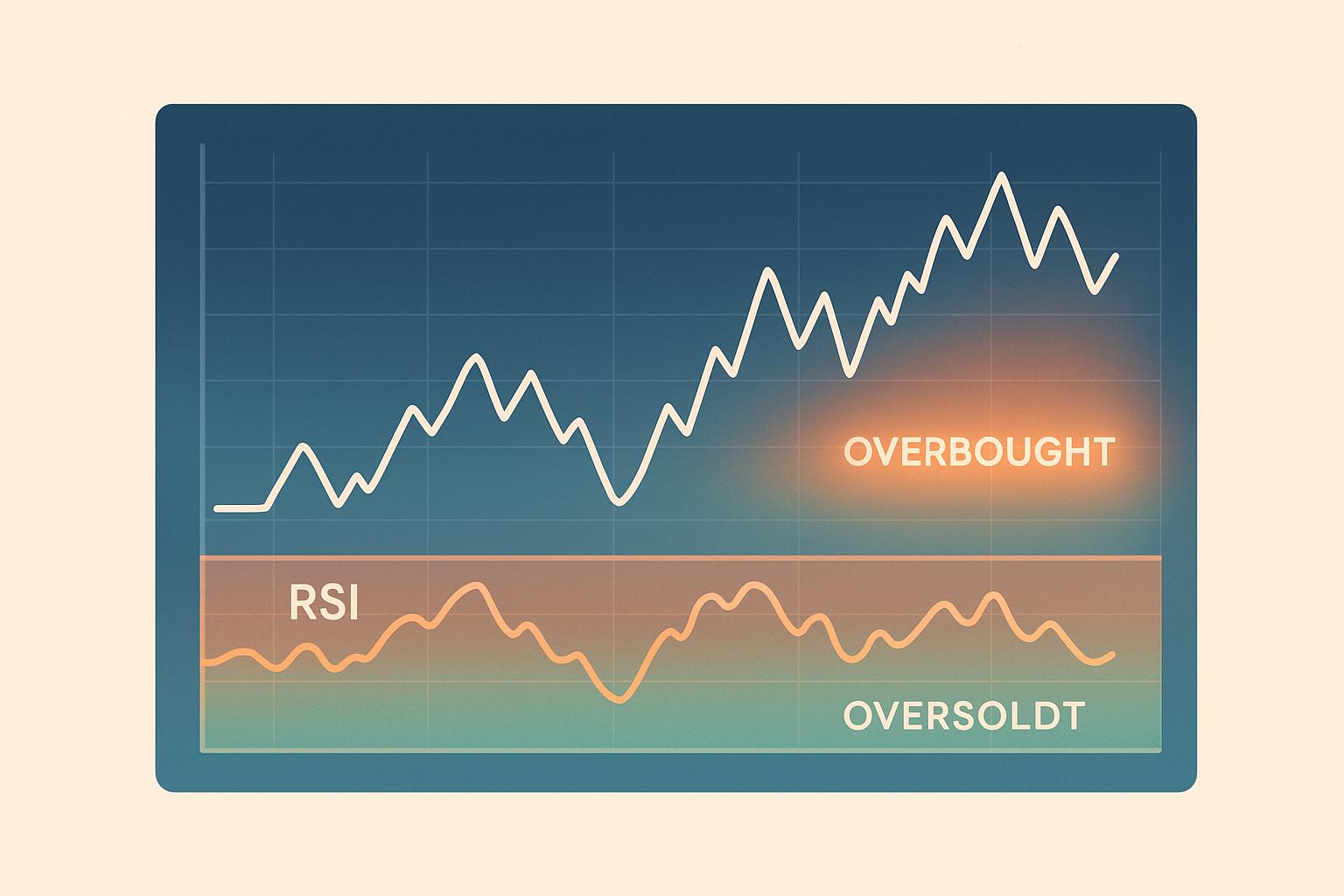
The Relative Strength Index (RSI) is a widely-used tool in trading to identify overbought and oversold market conditions. Here's what you need to know:
- RSI Basics: RSI measures price momentum on a scale of 0 to 100. Readings above 70 suggest overbought conditions, while below 30 indicates oversold.
- Key Thresholds: Standard levels are 70/30, but they can be adjusted for trends (e.g., 80/40 in strong uptrends or 60/20 in downtrends).
- Improving Accuracy: Combine RSI with other tools like Bollinger Bands, Average True Range (ATR), or Stochastic Oscillator for better trade signals.
- Settings for Different Markets:
- Stocks: 14-21 period, OHLC4 calculation.
- Forex: 9-14 period, Close price.
- Crypto: 7-9 period, OHLC4 for volatility.
Quick Tip: Use multiple timeframes, confirm signals with volume and divergence, and always apply risk management strategies like stop-loss orders and proper position sizing.
Overbought and Oversold Signals
70/30 RSI Levels Explained
The Relative Strength Index (RSI) helps spot potential market reversals by identifying overbought and oversold conditions. When the RSI moves above 70, it suggests the market may be overbought, hinting at a possible pullback. On the other hand, if the RSI drops below 30, it indicates an oversold condition, signaling a potential recovery.
| Market Condition | Suggested RSI Levels | Purpose |
|---|---|---|
| Ranging Market | 70/30 | Standard levels for sideways markets |
| Strong Uptrend | 80/40 | Reduces false sell signals |
| Strong Downtrend | 60/20 | Accounts for sustained selling |
These levels can shift depending on market conditions, so understanding them is crucial before factoring in broader market trends.
Reading RSI with Market Trends
Thresholds alone aren’t enough - market context is essential. In strong trends, the RSI can stay in extreme zones for extended periods, which is normal and doesn’t always signal an immediate reversal.
To make RSI signals more reliable, keep these tips in mind:
- Look at multiple timeframes to confirm potential reversals.
- Check for volume spikes to validate extreme RSI readings.
- Align RSI signals with the overall market trend.
- Pay attention to price-RSI divergence for additional clues.
Combining RSI with other technical tools can greatly improve its accuracy and usefulness.
RSI in Practice: Demo Trading
Setting Up RSI on Demo Accounts
You can practice RSI trading without risk by using For Traders' demo accounts. Start by setting the RSI with a 14-period lookback and 70/30 thresholds. These settings work well in most situations, but you can tweak them to 9- or 11-period lookbacks depending on your trading preferences.
RSI and Supporting Indicators
Once your demo account is ready, you can strengthen RSI signals by using additional tools. Here are some indicators that work well with RSI:
| Indicator | Purpose | How It Complements RSI |
|---|---|---|
| Bollinger Bands | Measures volatility | Confirms signals during notable price changes |
| Average True Range | Assesses price range | Validates RSI signals in volatile conditions |
| Stochastic Oscillator | Confirms price momentum | Aligns with RSI using its 80/20 thresholds |
These tools work together to provide a clearer picture of potential trades.
Sample Trade Using RSI
Let’s look at an example using EUR/USD:
- The RSI moved into overbought territory (above 70).
- Bollinger Bands expanded, signaling increased volatility.
- The Average True Range (ATR) indicated a momentum shift.
- Price hit resistance at the mid-line of the Bollinger Bands.
Under these conditions, a sell order was placed. The trade resulted in a 400-pip gain when RSI dropped below 30.
To improve your strategy:
- Use RSI across multiple timeframes for confirmation.
- Look for divergence between price and RSI.
- Set stop-loss orders near clear support or resistance levels as part of your risk management rules.
- Pay attention to trading volume during active market periods.
Risk Management with RSI
Custom RSI Settings
Tailoring RSI settings to match market conditions and your trading approach can improve the accuracy of signals. While the default 14-period RSI with 70/30 thresholds is commonly used, tweaking these parameters can help you better navigate specific market scenarios.
Here’s a quick guide to modifying RSI settings for different conditions:
| Market Type | RSI Period | Threshold Levels | Best Application |
|---|---|---|---|
| Volatile/Intraday | 7-9 periods | 70/30 | Quick response to price fluctuations |
| Range-bound | 14 periods | 70/30 | Suitable for standard conditions |
| Trending | 28 periods | 90/10 | Identifying sustained trends |
Key adjustments to consider:
- Period Length: Shorter periods are more responsive, ideal for fast-moving markets like intraday trading. Longer periods smooth out noise, making them better for identifying trends.
- Threshold Levels: In strong trending markets, thresholds like 90/10 can help reduce false signals, especially in extended rallies or sell-offs.
RSI-Based Risk Controls
After fine-tuning your RSI settings, applying disciplined risk management is crucial. Studies in forex markets show that RSI divergence strategies, when paired with proper risk controls, can yield a 57.9% success rate.
Here are a few strategies to manage risk effectively:
- Position Sizing: Adjust position sizes based on RSI readings and market volatility.
- Stop-Loss Placement: Set stop-loss orders near key support or resistance levels that align with RSI signals.
- Multiple Timeframe Validation: Confirm RSI signals across different timeframes to ensure reliability.
For trending markets, consider these additional measures:
- Managing Uptrends: Use an upper RSI threshold near 80 to signal potential sell opportunities. Monitor for RSI divergence to spot signs of weakening momentum.
- Downtrend Precautions: Look for RSI divergence patterns, such as prices making new lows while RSI forms higher lows. This often hints at a potential reversal and a chance to adjust your strategy accordingly.
Master the RSI Indicator (ULTIMATE In-Depth Guide)
RSI Settings Performance
Fine-tuning RSI settings through performance testing helps optimize how it's applied in trading strategies.
Testing different RSI configurations highlights how adjustments - like changing the period length or tweaking overbought and oversold levels - can make RSI more responsive to market movements.
RSI Threshold Results
Backtesting reveals that shorter periods, such as 7 or 9, are better at detecting quick price shifts while reducing market noise. On the other hand, a longer period, like 28, paired with customized thresholds, is more effective at identifying sustained trends. Using the OHLC4 calculation (the average of Open, High, Low, and Close prices) smooths out fluctuations and offers a clearer momentum perspective.
It's important to tailor RSI settings to specific market conditions instead of relying on default values. Traders should align these parameters with their trading timeframe, the current market environment, and their overall strategy.
These findings provide a foundation for the strategic adjustments covered in the summary of RSI best practices.
Summary: RSI Best Practices
Here's a quick recap of how to effectively use RSI (Relative Strength Index) for better trading decisions.
Validate RSI signals carefully. Use multiple timeframes and confirm signals with other indicators. For example, when RSI drops below 30 (oversold), look for bullish candlestick patterns and increased volume. Similarly, RSI readings above 70 (overbought) are more reliable when matched with bearish patterns and resistance levels.
Suggested RSI Settings by Market Type
| Market Type | Recommended RSI Settings | Key Notes |
|---|---|---|
| Stocks | 14-21 period, OHLC4 | Longer timeframes; check volume for confirmation |
| Forex | 9-14 period, Close price | Analyze across multiple timeframes |
| Crypto | 7-9 period, OHLC4 | Shorter periods to handle volatility |
These settings help you adjust RSI use to different market dynamics.
Risk management is essential. Watch for divergence - when price moves don't align with RSI readings - as this can signal potential reversals. Use stop-loss levels based on price structure and aim for a 2:1 reward-to-risk ratio to keep trades balanced.
Adapt RSI settings to match market conditions. Shorter periods (7-9) work better during volatile times, while longer periods (14-21) help filter out noise in trending markets.
"Always use additional tools (e.g., trend analysis, support/resistance levels) to confirm signals." - Mind Math Money
FAQs
How can I customize RSI settings to match different market conditions and trading strategies?
To tailor the RSI indicator to different market conditions and strategies, you can adjust its lookback period or calculation method. For example, shortening the period (e.g., from 14 to 7) can make the RSI more sensitive to price changes, while lengthening it provides smoother signals. Additionally, consider experimenting with alternative price inputs, such as using the average of the open, high, low, and close (OHLC4), to refine its responsiveness.
Customizing RSI settings allows you to align the indicator with your trading preferences, whether you're focusing on short-term trades or long-term trends. Testing these adjustments in simulated market scenarios can help you identify what works best for your strategy.
How can traders combine RSI with other technical indicators to improve trading accuracy?
Combining the RSI (Relative Strength Index) with other technical indicators can enhance the precision of trading signals. For instance, pairing RSI with trendlines helps confirm potential breakouts or reversals, while volume analysis can validate the strength of these movements.
Additionally, integrating RSI with chart patterns like double tops, double bottoms, or support and resistance levels can provide a more complete picture of market conditions. By using these tools together, traders can make more informed decisions and refine their strategies for better results.
Why should traders consider market trends and context when using RSI to identify overbought or oversold conditions?
Traders should always factor in market trends and context when interpreting RSI signals because overbought and oversold levels are not definitive buy or sell indicators. In strong upward or downward trends, the RSI can remain in these zones for an extended period, which may lead to misleading signals if the broader market environment is ignored.
For example, in a strong uptrend, an overbought RSI might simply reflect sustained bullish momentum rather than an imminent reversal. By combining RSI analysis with an understanding of market context, traders can make more informed decisions and avoid acting on false signals.
Related Blog Posts
Start Trading with For Traders
Join our platform to test your trading skills, trade virtual capital, and earn real profits. Access educational resources, advanced tools, and a supportive community to enhance your trading journey.
Start your Trading Challenge