

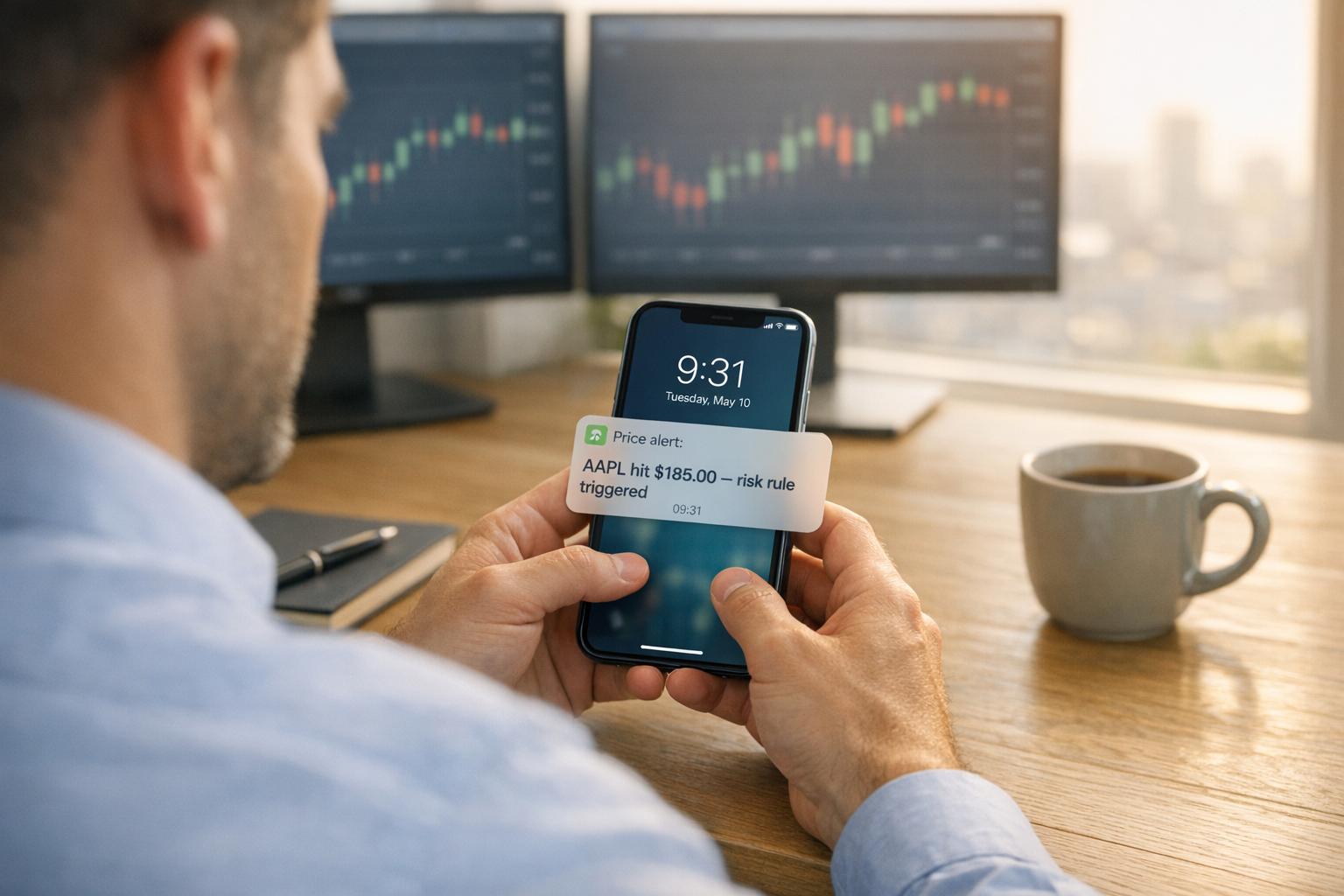
Real-time alerts are a must-have for traders who want to stay ahead in fast-moving markets. These alerts notify you instantly when specific market conditions are met, helping you save time, manage risks, and make better decisions. Here’s what they offer:
- Risk Management: Alerts help you avoid major losses by notifying you of market changes before they spiral out of control.
- Faster Decisions: Instant updates ensure you can act quickly on opportunities or exit risky positions.
- Efficient Monitoring: Automate tracking for multiple stocks or assets, freeing up time for more critical tasks.
- Rule Compliance: Alerts help enforce your trading plan, ensuring you stick to your strategies and limits.
- Reduced Emotional Trading: By automating notifications, you rely on data instead of emotions, leading to more disciplined trades.
These tools simplify trading, reduce stress, and help you focus on high-quality opportunities. Whether you're day trading or managing a portfolio, real-time alerts are essential for staying in control.

5 Key Benefits of Real-Time Trading Alerts Infographic
1. Better Risk Management
Risk Mitigation Capabilities
Real-time alerts take risk management to a whole new level by shifting the focus from damage control to proactive prevention. By integrating live market data with your positions and orders, these alerts provide instant feedback on market, credit, and operational risks. This allows traders to operate efficiently while staying within set limits.
One standout feature is the "risk-off" alert. This type of alert warns you to reduce exposure or pause trading when market or sector conditions take a turn for the worse - even if your individual positions haven't yet reached their stop-loss levels. Think of it as your early warning system, helping you avoid the chaos of multiple positions turning against you during a market-wide selloff. These immediate alerts ensure traders can respond quickly to sudden shifts in the market.
Speed of Notifications
In fast-moving markets, every second counts. A delay of just a few moments can mean the difference between a manageable 2% loss and a devastating 10% loss. Real-time alerts give traders the edge they need to exit positions before losses spiral out of control. This is especially critical during sharp market movements or when unexpected news breaks. Markets like cryptocurrency, known for their volatility, are a prime example where such alerts prove invaluable.
"Real-time risk monitoring provides a clear understanding of drawdowns and portfolio structure. This enables timely adjustments to position sizes and prevents cascading losses." - TradeLink
Some platforms go even further by automating the process, triggering orders immediately after an alert. This eliminates any delay between receiving the notification and taking action. You can also customize alerts for specific scenarios, such as margin positions or risk-to-reward ratios, ensuring you're informed the moment a critical threshold is breached. These rapid notifications not only help minimize losses but also encourage adherence to your trading rules.
Rule Adherence Support
Real-time alerts are like guardrails for your trading strategy, helping you stick to your risk management plan without relying solely on willpower. For example, setting an alert at a 7% drop threshold can automatically trigger a sell, preventing deeper losses.
"Real-time trade performance monitoring is not just a tool but a necessity... It enables risk management, enhances discipline, ensures strategy transparency, and boosts overall efficiency." - Tradelink.pro
To avoid false alarms, the best systems combine multiple conditions - like price drops paired with volume spikes - to ensure alerts are triggered only during meaningful market moves. This approach helps traders focus on significant changes rather than reacting to every minor fluctuation. Together, these features create a powerful risk management system, allowing traders to stay within their limits and avoid unnecessary exposure.
2. Faster Decision-Making
Speed of Notifications
In fast-paced markets, time is money. Real-time alerts ensure you're notified the moment an actionable opportunity arises, saving you from the tedious task of manually scanning charts. This split-second advantage can be the difference between securing a profitable trade or watching it slip away.
"A bot is not as outlandish as it sounds. Traders need to aggregate and filter through tremendous amounts of data quickly and will rely on technology to help if it is available."
– Mike Khouw, CNBC Contributor
These immediate notifications lay the groundwork for automation, which further simplifies and speeds up decision-making.
Automation and Efficiency
Quick notifications naturally integrate with automated trading systems, boosting efficiency. Automated alerts can track dozens of tickers simultaneously - something no human can manage manually. This means you can stop staring at charts all day and focus on more critical decisions, like setting position sizes or refining your timing. Alerts are delivered in under a second through platforms like Telegram, SMS, or mobile push notifications.
On top of that, combining multiple conditions - like a price breakout occurring alongside high trading volume - helps weed out false signals. This ensures your attention is directed toward high-probability opportunities. For day traders, who often have just 90 seconds to act before a market move becomes less favorable, this level of automation is essential to stay competitive.
Tired of Missing Stock Moves in Real Time?
3. More Efficient Trading
Real-time alerts don't just speed up decision-making - they also streamline the entire trading process by automating routine monitoring tasks.
Automation and Efficiency
Think of real-time alerts as a supercharger for your monitoring capabilities. While most traders can manually track only 20–50 stocks at a time, automated systems can scan thousands of symbols simultaneously. This means you're no longer held back by the limits of manual chart monitoring.
AI-powered platforms take this to the next level, analyzing up to 1.8 million market events each month and identifying potential catalysts 1,800 times faster than traditional research methods. In fast-moving intraday markets, where a few seconds can make or break a trade, this kind of speed can be a game-changer.
"Alerts separate the monitoring phase from the decision phase. Your system handles the monitoring. You only engage when there's a signal worth evaluating."
– Stock Alarm Team
This level of efficiency ensures you're not just working faster but also smarter, allowing you to focus only on the most promising opportunities.
Rule Adherence Support
High-quality alert systems don't just notify you of market activity - they help enforce your trading rules. For instance, an alert for a breakout might only trigger when specific conditions are met, such as:
- The price is above VWAP (Volume Weighted Average Price)
- Relative volume (RVOL) exceeds 1.8x
- A candle closes above a key resistance level
By requiring multiple criteria to align, these systems filter out noise and reduce the likelihood of impulsive trades. This ensures your energy is spent only on setups with a higher chance of success. This level of discipline is essential when you prepare for a trading challenge where rule adherence is strictly monitored.
This approach not only supports better rule adherence but also complements the risk management strategies and decision-making advantages discussed earlier. By turning alerts into a decision support system, you maintain discipline and stay focused on high-quality trades, ultimately enhancing your overall performance.
4. Easier Compliance with Trading Rules
Rule Adherence Support
Real-time alerts simplify staying compliant by acting like an accountability partner, flagging potential rule violations before they happen.
Take the 3‑5‑7 rule as an example. This risk management framework limits single trade risk to 3% of your capital, caps total portfolio exposure at 5%, and targets a minimum reward of 7% per trade. When your position starts approaching these thresholds, the system sends you alerts, helping you stick to your plan when it matters most.
"Automated alerts act as your early warning system, flagging unusual trades or compliance gaps in real-time."
– Smartria
These alerts are tailored to separate opportunities from risks, like highlighting potential gains or stop-loss triggers. This way, you’re less likely to be caught off guard by sudden market changes. Plus, by automating these checks, you free up mental bandwidth, making it easier to focus on smart, calculated decisions.
Impact on Trader Psychology
By automating routine monitoring, real-time alerts take the pressure off constant market tracking. This reduces the mental strain of trading under pressure, especially in fast-paced environments. With less decision fatigue, it’s easier to stick to your trading rules consistently. Ultimately, this automation fosters a calmer, more measured approach to trading, even during volatile market swings.
5. Less Emotional Trading
Real-time alerts, alongside risk management and automation tools, play a key role in encouraging disciplined trading by minimizing emotional decision-making.
Automation and Efficiency
With real-time alerts, you can separate the process of monitoring markets from making trading decisions. The system does the heavy lifting by keeping an eye on the market and notifying you only when important signals arise. This separation not only conserves your mental energy but also prevents the fatigue and poor judgment that can come from endlessly staring at charts.
Managing a watchlist of 20 to 50 stocks can quickly lead to information overload, which often results in impulsive choices. Alerts help you stay focused by highlighting only the most critical signals. By automating the monitoring process, you can oversee your entire watchlist without feeling the need to obsess over every price fluctuation. This reduces the temptation to react emotionally to minor market changes.
Impact on Trader Psychology
Real-time alerts don’t just streamline trading - they also help traders manage emotional stress. Instead of relying on gut feelings, alerts guide you toward data-driven decisions. Staring at price movements all day can trigger impulsive actions or excitement over market volatility. Alerts ensure you act only when specific, pre-set conditions are met, helping you avoid rash, emotion-fueled decisions.
"If an alert is not likely to change your decision, it should probably not exist. Every notification consumes attention, and attention is one of the few finite resources in intraday trading." – Marcus Ellery, Senior Market Editor
Alerts also address loss aversion, the tendency to feel losses more intensely than gains. By setting predefined risk levels and exit points, you take the pressure off making tough decisions in real time. You’re not debating whether to close a losing position in the heat of the moment - you’re simply following the plan you created when you were thinking clearly. This objective, data-first approach strengthens trading discipline and reduces the likelihood of costly emotional errors.
Conclusion
Real-time alerts tackle some of the biggest hurdles in trading: managing risk, acting quickly, maintaining efficiency, following rules, and keeping emotions in check. By automating risk controls, alerts help protect your capital. They also enable traders to respond swiftly to market opportunities.
This system creates a structure where every trade follows clear, predefined guidelines. Discipline is the backbone of trading success. For traders, strict parameters - like a 5% maximum drawdown or a 9% profit target - mean that a single impulsive mistake could derail progress. Alerts act as your ever-watchful assistant, allowing you to focus on executing your strategy. They reduce the mental strain of constantly monitoring charts and help prevent rash decisions.
"Stock alerts are an absolute MUST for selling options and more passive 'set it and forget it' type trading. Alerts enable me to work AND trade." – Hasselhoff, Top Trader, Xtrades
When you align alerts with your trading rules, they become a tool to reinforce your strategy rather than replace your skills. Alerts should match your plan’s technical indicators and risk parameters, giving you the confidence to stick to your approach - even during uncertain times. They prompt action only when your preset conditions are met, helping to keep emotions out of the equation.
FAQs
Which alert types should I set up first?
Start by setting up alerts that focus on critical market movements, like breakouts, volume surges, or momentum changes, since these often highlight potential opportunities. You should also enable alerts for major news events, such as mergers, earnings reports, or key company announcements. To avoid being bombarded with irrelevant notifications, tailor your alerts to match your trading strategy. For example, focus on price level breaks or specific signals from technical indicators that align with your approach. This way, you’ll stay informed without feeling overwhelmed.
How do I reduce false or noisy alerts?
To cut down on false alarms or unnecessary alerts, focus on creating fewer but more precise notifications that align closely with your trading strategy. Target critical conditions, such as major breakouts or significant volume changes, rather than tracking minor price fluctuations. Concentrate on high-probability signals and consider using different alert methods - like push notifications for crucial events and less disruptive options for smaller updates. This streamlined approach helps reduce distractions and enhances your ability to make well-informed decisions.
Can alerts automatically place trades for me?
Alerts can't automatically execute trades on your behalf. Their purpose is to keep you informed about potential trading opportunities, so you can decide and act manually. Think of alerts as a notification system - they help you stay aware, but the actual trading decisions remain in your hands.
Related Blog Posts
Start Trading with For Traders
Join our platform to test your trading skills, trade virtual capital, and earn real profits. Access educational resources, advanced tools, and a supportive community to enhance your trading journey.
Start your Trading Challenge