

AI is transforming risk monitoring for proprietary trading firms. By analyzing vast amounts of trade data in real time, AI predicts risks before they escalate, outperforming outdated manual methods. Key benefits include:
- Faster risk detection: AI systems process data instantly, identifying issues like revenge trading or leverage and risk.
- High accuracy: Predicts trader profitability with 93% accuracy after just ten trades.
- Cost savings: Firms using AI tools have reported savings of $1.94 million over two years.
- Reduced losses: AI-driven monitoring has cut account blowouts by 50% and drawdown violations by 35%.
These advancements enable firms to move from reactive risk management to proactive strategies, ensuring better capital protection and improved decision-making. AI is no longer optional - it's a critical tool for modern prop trading success.
Research on AI Predictive Analytics in Prop Trading Risk
What Studies Show About AI in Risk Reduction
AI is proving to be a game-changer in risk management for proprietary trading. Early research into AI's accuracy in predictive analytics has been validated by recent studies. For instance, AI models can now predict a trader's long-term profitability with an impressive 93% accuracy after analyzing just their first ten trades. This is a significant leap compared to traditional methods, which required months of data to achieve similar results.
A key shift brought about by AI is moving risk management from a reactive approach to a proactive one. In December 2025, researchers Tianyu Fan, Yuhao Yang, and their team introduced "AI-Trader", the first live evaluation benchmark for large language model agents in finance. This study tested six prominent LLMs across U.S. stocks, A-shares, and cryptocurrencies, concluding that robust risk control is essential for cross-market autonomous trading. This underscores the need for advanced risk-control algorithms to navigate the complexities of trading environments.
The practical outcomes of these advancements are striking. By 2025, firms using AI tools reported a 50% reduction in account blowouts compared to those relying on traditional methods. AI-driven risk alerts have also cut drawdown violations by 35%, while automated monitoring has decreased the time needed for risk assessments by 25%. These improvements stem from AI's ability to enforce rules instantly and detect patterns like revenge trading or excessive leverage, even when analyzing as few as the last 50 trades. Such results highlight AI's ability to deliver measurable benefits in real-world trading scenarios.
Real Examples from Trading Firms
The practical application of AI-driven analytics is best illustrated by real-world success stories. In December 2025, AIBI.Global revealed that a proprietary trading firm using its JET AI analytics platform boosted its net profit by $1.94 million over two years. This was achieved by improving internal risk classification and identifying high-risk traders early, which allowed for more precise A-book and B-book flow balancing. The platform's ability to uncover complex abuse patterns - such as mirrored trades, scalping windows, and latency exploitation - gave the firm a critical advantage in safeguarding capital from toxic trading flows.
"Working with matured performance data is like driving forward while looking in the rearview mirror." – AIBI.Global
Beyond financial performance, firms have seen significant reductions in rule violations. Automated AI alerts have led to a 30% drop in rule breaches and evaluation failures. Additionally, AI has proven invaluable in distinguishing between intentional rule-breaking and genuine trader errors, a capability that becomes increasingly critical as firms expand their operations globally. These advancements show how AI is not just about profits - it's about creating a more controlled and efficient trading environment.
Real-Time Anomaly Detection with Machine Learning
Identifying Risks Before They Grow
Real-time anomaly detection, powered by machine learning, builds on predictive analytics to tackle potential risks before they escalate into larger problems.
These machine learning models continuously monitor live market data and trader behavior, identifying deviations from normal patterns. This allows them to flag risks like revenge trading, excessive leverage, or sudden strategy changes before they result in major losses. Unlike basic rule-based systems, these AI tools go a step further by reconstructing trade data. This helps uncover complex tactics that traditional monitoring might overlook - such as mirrored trades, latency exploitation, or coordinated activities across accounts. By doing so, they can differentiate between intentional violations and honest mistakes, safeguarding capital while allowing genuine traders the benefit of the doubt.
Additionally, these systems integrate streaming data from sources like news feeds, social media, and trading platforms. This enables them to quickly identify emerging threats or hidden risks tied to correlated positions, ensuring a more comprehensive risk management approach.
Faster Risk Response Times
In trading, speed is everything. AI-powered systems excel here by sending near-instant alerts through platforms like Telegram, Slack, or email whenever risk thresholds are breached. Automated actions - such as closing positions or pausing accounts - kick in immediately, minimizing losses by removing the influence of human error or emotional decision-making.
"AI enforces trading conditions at scale and with perfect accuracy, eliminating the need for employees to manually track trader progress across spreadsheets or multiple platforms." – EAERA™
These proactive measures enhance earlier risk management strategies by addressing issues in real time. This shift from reactive to proactive monitoring is reshaping the landscape of proprietary trading. Instead of examining failures after the fact, AI anticipates market volatility and liquidity challenges before they happen. This capability, once reserved for top-tier institutions, is now becoming a standard feature in advanced prop trading platforms.
With these advancements, real-time risk management is no longer optional - it’s a core component of modern prop trading systems.
AI Tools vs. Traditional Risk Management Methods
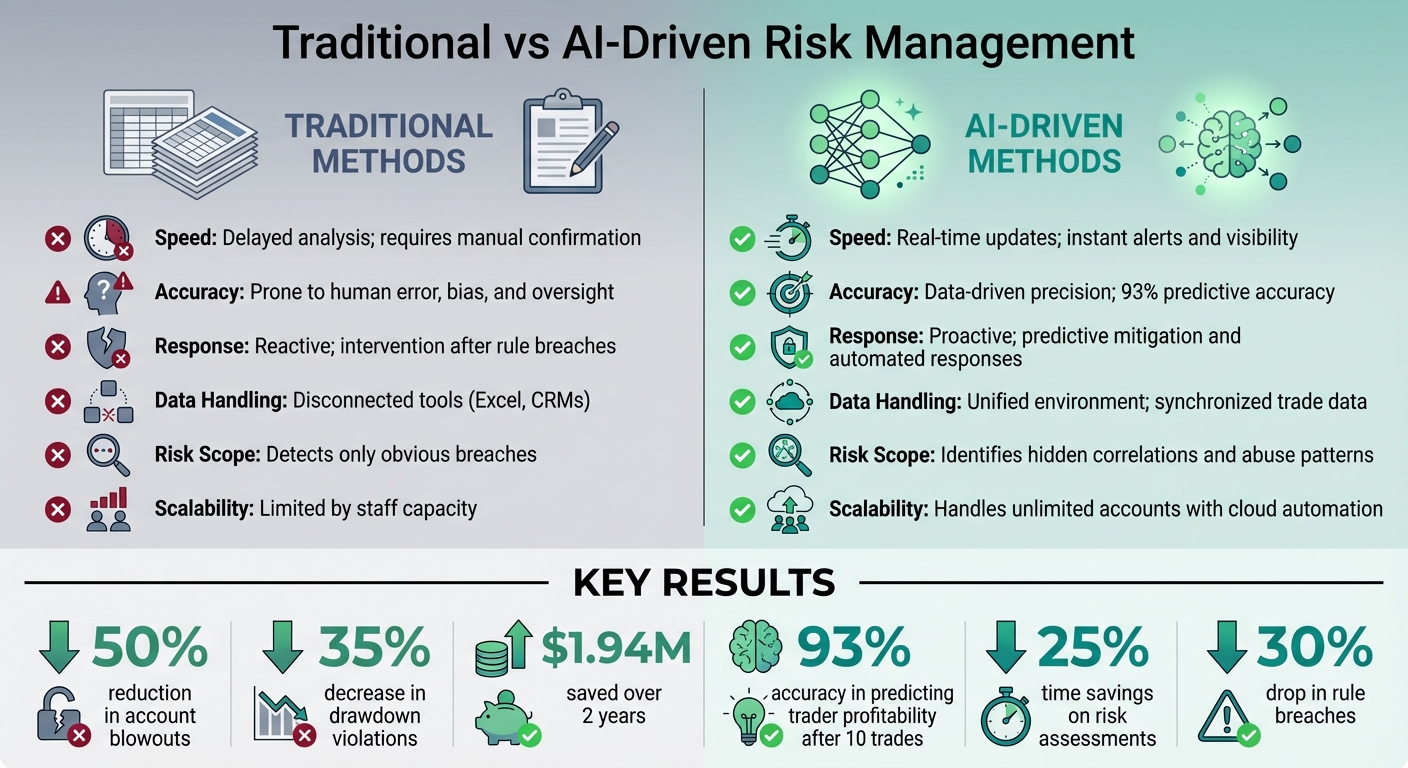
AI vs Traditional Risk Management in Prop Trading: Performance Comparison
Traditional vs. AI-Driven Risk Management
The contrast between traditional and AI-driven risk management methods is stark. Older approaches often rely on manual processes like spreadsheets, delayed reporting, and reactive strategies - only addressing risks after problems arise. Human oversight in these systems can lead to errors and blind spots. For instance, traditional methods struggle to monitor hundreds of accounts simultaneously or identify subtle behavioral patterns, such as revenge trading.
AI changes the game by automating these tasks with impressive precision. For example, AI tools boast a 93% accuracy rate in predicting trader profitability after just ten trades. One prop firm even reported that AI-driven risk classification saved $1.94 million over two years by identifying high-risk traders early on.
Here’s a side-by-side comparison to highlight the differences:
| Aspect | Traditional Methods | AI-Driven Methods |
|---|---|---|
| Speed | Delayed analysis; requires manual confirmation | Real-time updates; instant alerts and visibility |
| Accuracy | Prone to human error, bias, and oversight | Data-driven precision; 93% predictive accuracy |
| Response | Reactive; intervention after rule breaches | Proactive; predictive mitigation and automated responses |
| Data Handling | Disconnected tools (Excel, CRMs) | Unified environment; synchronized trade data |
| Risk Scope | Detects only obvious breaches | Identifies hidden correlations and abuse patterns |
| Scalability | Limited by staff capacity | Handles unlimited accounts with cloud automation |
"AI will never replace a founder's judgment, risk and dealing teams' experience... It works like a ridiculously fast, highly accurate assistant that analyzes trading behavior giving teams routing suggestions, but leaving every decision in human hands"
The table and quote illustrate how AI-driven methods bring improvements in speed, accuracy, and scalability. These advantages help firms achieve better trading outcomes and reduce losses, offering a clear edge over traditional systems.
Better Scenario Analysis and Stress Testing
Beyond real-time risk detection, AI transforms scenario analysis by running continuous simulations of intricate market conditions. Traditional methods often rely on fixed scenarios - testing portfolios against predefined downturns - on a quarterly or monthly basis. This approach leaves firms exposed to unanticipated market changes.
AI tools, on the other hand, simulate complex, multi-variable scenarios in real time. They analyze unstructured data sources like news feeds, social media, and geopolitical updates to predict market volatility that manual methods might overlook. For instance, when the Federal Reserve releases meeting minutes, AI can process the document and trigger market insights within 15 seconds, compared to the several minutes required for human analysis. Companies using AI for stress testing report 50% faster reporting and save up to 25% of the time spent on planning.
Additionally, AI leverages advanced models like convolutional neural networks (CNNs) and long short-term memory networks (LSTMs). These models detect nonlinear patterns and correlations that traditional linear regression analysis might miss. This ability allows AI to uncover risks hidden in correlated positions across different assets or systems. By integrating these advanced testing methods with proactive risk management, firms can stay ahead in an increasingly complex market environment.
AI Risk Tools in Simulated Prop Trading Platforms
AI Features on For Traders

For Traders is reshaping simulated trading environments by incorporating AI to strengthen risk management. Their proprietary AI system operates 24/7, analyzing trading data to maintain fairness. Currently in beta, this system supports the platform's risk department by monitoring trades to spot users attempting to bypass challenge rules or engaging in undisciplined trading practices rather than executing strategies with precision.
The AI ensures fairness by automating notifications and processing data continuously. This approach guarantees that only legitimate traders advance to a For Traders Account or qualify for payouts. As the risk department explains:
"The fact that [users] are participating in our challenge shows us that they are the best... users who cheat the rules are not welcome on our platform because it's not fair to the great traders who work really hard"
In addition to fraud detection, the AI offers real-time tracking of profit and loss, monitoring daily drawdowns to prevent breaches. Traders benefit from visual countdowns to their maximum loss limits, helping them stay within safe boundaries. The system also flags excessive lot sizes, unsafe leverage, and correlated positions that might create hidden risks. These features prepare traders to manage risk effectively in actual trading scenarios.
By integrating these capabilities, the platform not only protects capital but also creates a learning environment that helps traders refine their skills.
Benefits for New and Experienced Traders
AI-powered risk tools provide valuable benefits for both beginners and seasoned traders, enhancing their development and performance.
For new traders, the system introduces discipline through lockout simulations. When daily loss limits are approached, trading is paused, allowing novices to practice sound habits without risking real money. This is crucial since over 80% of prop firm challenge failures are due to poor risk management rather than flawed strategies. Automated guidance directly addresses this common hurdle.
Experienced traders gain from personalized risk profiling. The AI learns each trader's behavior patterns and establishes their "safe zone." Alerts are sent when traders deviate from these successful habits, such as over-leveraging while trading correlated pairs like EUR/USD and GBP/USD. By treating these pairs as combined exposure, the system helps avoid unnecessary risks. Given that only 10% to 15% of participants pass typical prop firm challenges, these AI tools offer a competitive edge to those aiming to succeed.
The Future of Risk Monitoring in Prop Trading
Main Points to Remember
AI is reshaping how proprietary trading firms approach risk management. Instead of scrambling to address issues after they arise, firms now rely on AI to anticipate market volatility and potential losses before they happen. This shift allows for proactive strategies rather than reactive problem-solving.
The numbers back it up. AI's ability to spot risks early enables firms to allocate resources more strategically, focusing support where it’s needed most. It also handles complex tasks that would be overwhelming for human teams, such as detecting patterns like revenge trading or emotionally driven decisions that could signal heightened risk. As AIBI.Global puts it:
"AI will never replace a founder's judgment, risk and dealing teams' experience, or the human nuance behind making decisions... It works like a ridiculously fast, highly accurate assistant".
These advancements are setting the stage for even more sophisticated AI applications in prop trading.
What's Next for AI in Prop Trading
With the proven benefits of AI, the industry is gearing up for the next generation of risk management tools. One major development is dynamic position sizing, where algorithms adjust leverage in real-time based on market volatility and individual trader risk profiles. Firms are also moving toward unified risk ecosystems, eliminating the inefficiencies of fragmented spreadsheets and disconnected tools. This gives risk and management teams access to synchronized, real-time data.
Behavioral profiling is becoming more sophisticated, with AI analyzing unconventional data sources like news updates and social media to identify potential market risks instantly. The momentum is reflected in the numbers: the global AI trading market, valued at $11.2 billion in 2024, is projected to grow to $33.45 billion by 2030. By 2023, nearly 65% of hedge funds had incorporated AI and machine learning into their trading strategies, and proprietary trading firms are quickly following suit. The takeaway is clear - AI-driven risk management is no longer a luxury but a necessity for staying competitive.
FAQs
What trade data does AI risk monitoring track in real time?
AI risk monitoring keeps an eye on real-time trade data to spot potential risks and unusual patterns. By analyzing key metrics like market anomalies, price shifts, and trading activity, it helps traders stay alert to unexpected changes and make informed decisions.
How does AI tell risky behavior from normal strategy changes?
AI pinpoints risky behavior by evaluating trading patterns, detecting irregularities, and leveraging real-time data to identify deviations from standard strategies. This approach enables it to respond effectively to shifting market conditions and the unique actions of individual traders, leading to more precise risk management.
When should a prop firm trigger auto-actions like pausing or closing trades?
A proprietary trading firm needs to automatically respond when risk limits are breached. This includes situations like approaching daily loss thresholds or when market conditions and exposure levels pose heightened risks. By using AI tools, these factors can be monitored in real-time, allowing for quick actions to protect capital and ensure adherence to risk management policies.
Related Blog Posts
Start Trading with For Traders
Join our platform to test your trading skills, trade virtual capital, and earn real profits. Access educational resources, advanced tools, and a supportive community to enhance your trading journey.
Start your Trading Challenge