

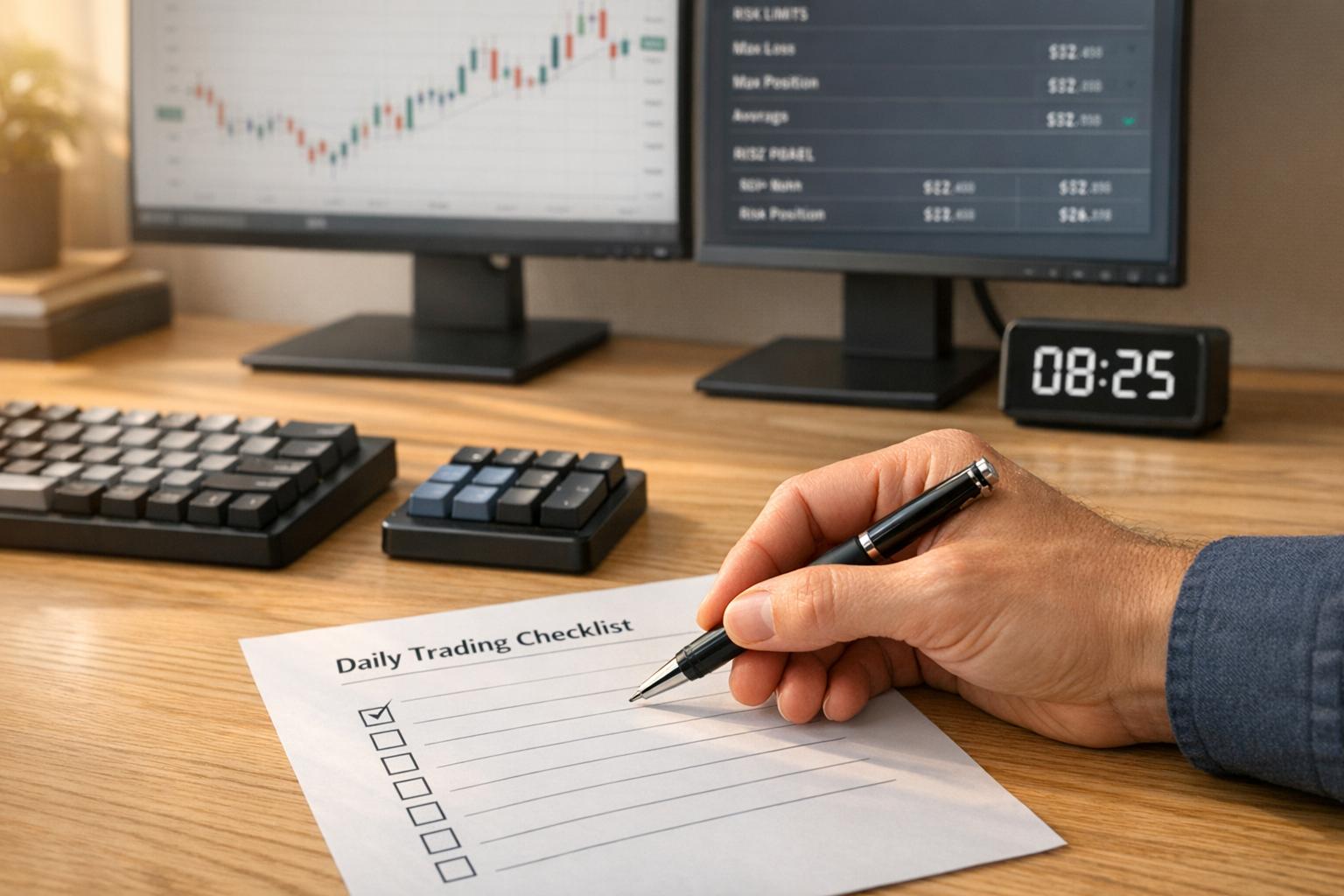
Consistency in trading is more important than brilliance. Success isn’t about winning every trade or having the perfect strategy - it’s about managing risk, controlling emotions, and sticking to a plan. Prop trading firms test this by enforcing strict rules like daily drawdowns and profit targets, which highlight the importance of disciplined behavior over impulsive decisions.
Key takeaways:
- Decision fatigue weakens judgment after prolonged mental effort, leading to impulsive trades or poor risk management.
- Emotions like fear, greed, and frustration can derail trading. Recognizing and regulating these emotions is crucial.
- Structured routines (pre-market preparation, checklists, scheduled breaks) build discipline and help maintain focus under pressure.
- Process-driven trading with clear, rule-based systems and automation reduces emotional interference and promotes consistency.
Shift your mindset from "Will this trade win?" to "Does this align with my plan?" Success in trading comes from structure, not raw talent or motivation.
Discipline, Patience & Consistency The Trader’s Real Edge 📈
Decision Fatigue and How It Affects Trading Performance
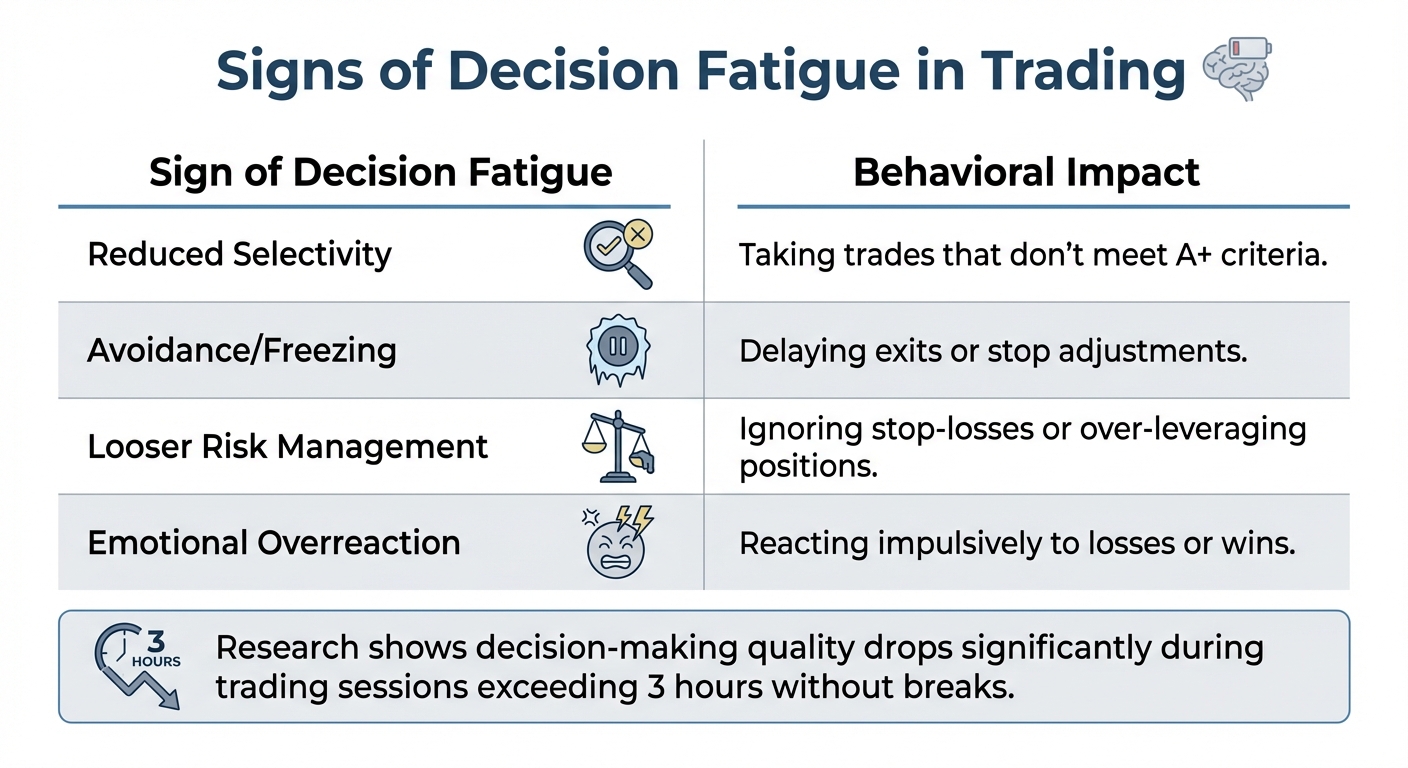
Signs of Decision Fatigue in Trading and Their Behavioral Impact
Decision fatigue refers to the decline in decision-making quality after extended periods of mental effort. For traders, it’s not about physical exhaustion - it’s when your brain shifts from careful analysis to impulsive reactions. This happens because the prefrontal cortex, the part of the brain responsible for logical thinking and risk evaluation, becomes less effective as mental energy depletes. The result? Planning takes a back seat, and snap judgments take over.
Trading environments are particularly demanding, draining mental resources faster than many other professions. The constant need to monitor price changes, react to news, and analyze charts requires endless micro-decisions. Since the brain consumes a lot of energy during these processes, even traders with well-defined strategies can fall into impulsive behaviors or avoid making decisions altogether when their mental reserves run low.
"Decision fatigue is a hidden enemy in trading. Even experienced traders can make poor decisions after long periods of analysis, screen time, and repeated choices."
Under these conditions, mental exhaustion amplifies emotional responses. Losses feel more catastrophic, wins seem more urgent, and traders are more likely to break their own rules. This can lead to revenge trading, overconfidence, or even decision paralysis. Prop trading firms often implement strict daily drawdowns and consistency requirements to test how traders handle this psychological pressure.
"Lack of discipline is often blamed for poor trades. In reality, many mistakes occur because the trader is mentally exhausted. Decision fatigue weakens discipline even when rules are clear."
- Gotrade Team
Signs of Decision Fatigue in Trading
Decision fatigue doesn’t come with obvious warning signs. In fact, it can disguise itself as confidence or urgency, making it tricky to spot. You might feel sharp and focused, even as your judgment starts to slip. One key indicator is reduced selectivity - taking trades that don’t meet your top-tier criteria but seem “good enough” at the moment. This often includes justifying setups that your trading plan would otherwise reject.
Another red flag is emotional overreaction. Fatigue can distort your perception, making losses feel more threatening and wins seem like opportunities you must seize immediately. This emotional imbalance can lead to revenge trading after losses or overconfidence following wins. You might also notice avoidance or freezing - delaying decisions like adjusting stop-losses or closing positions because the effort feels overwhelming.
Physical signs are just as telling. Long trading sessions without breaks often lead to poor risk management, such as ignoring stop-losses, taking oversized positions, or breaking position-sizing rules. Research shows that decision-making quality drops significantly during trading sessions that exceed three hours without breaks. If you find yourself constantly flipping between charts or checking irrelevant updates, it’s a sign that your mental energy is running low.
| Sign of Decision Fatigue | Behavioral Impact |
|---|---|
| Reduced Selectivity | Taking trades that don’t meet A+ criteria |
| Avoidance/Freezing | Delaying exits or stop adjustments |
| Looser Risk Management | Ignoring stop-losses or over-leveraging positions |
| Emotional Overreaction | Reacting impulsively to losses or wins |
Identifying these patterns can help traders take steps to restore their decision-making abilities.
How to Combat Decision Fatigue
Combating decision fatigue is essential for maintaining the discipline needed to trade effectively. One of the best strategies is to separate analysis from execution. Conduct your market analysis outside of active trading hours. Use this time to build watchlists, identify setups, and define entry/exit criteria. When trading live, stick to your pre-planned strategy instead of making decisions on the fly.
Physical checklists can also be a game-changer. Before executing any trade, compare it against written criteria. This simple step acts as a mental reset, helping you stay analytical even when your energy is low.
"The goal is not to be smarter, but to reduce unnecessary thinking."
- Gotrade Team
Automation is another effective tool. Use stop-loss orders, take-profit levels, and price alerts to reduce the need for constant monitoring. Limit your daily trades to 3–5 high-quality setups to conserve mental energy. Similarly, focus on 2–3 assets per session instead of juggling multiple charts.
Scheduled breaks are crucial. Work in focused 45–50 minute blocks, followed by 10–15 minutes away from your screen. After a loss, take at least 15 minutes to clear your mind before returning to trading. Professional traders often view rest and even full days off as essential parts of their risk management, not indulgences. Additionally, getting 7–9 hours of quality sleep supports the emotional control and focus that trading demands.
Simplifying your trading strategy can also help. The fewer variables you need to consider, the less mental energy it takes to follow your rules consistently.
Managing Emotions: Fear, Greed, and Revenge Trading
Emotions don't just play a minor role in trading - they can completely derail decision-making. When fear, greed, or frustration take over, the limbic system - the brain's emotional center - kicks in and overrides the prefrontal cortex, the part responsible for logical thinking and self-control. Essentially, the brain reacts to financial losses as though they were physical threats, triggering a fight-or-flight response that leads to impulsive "recovery" trades. On the flip side, winning streaks activate variable ratio reinforcement, the same dopamine-driven reward system that keeps people glued to slot machines.
These biological responses have measurable effects on trading outcomes. For example, the pain of losing feels about twice as intense as the pleasure of an equivalent gain. This imbalance often leads to break-even anchoring, where traders focus more on recovering their initial balance than adapting to current market conditions. Studies show that during volatile markets, 73% of active traders experience stress, and 35.3% admit that emotions influence their decisions. Interestingly, a 1999 study found that overconfidence among the most active traders resulted in average annual returns of just 11.4%, compared to 18.5% for those who traded less frequently.
Common Emotional Patterns in Trading
Emotions in trading tend to follow predictable patterns:
- Fear: Fear often causes hesitation, premature exits, or outright paralysis, especially after unexpected losses or during rapid market movements.
- Greed: Greed can lead to overtrading, excessive leverage, and ignoring stop-losses. After a winning streak, traders may feel invincible, doubling their positions or abandoning their strategies altogether.
- Revenge trading: This occurs when traders view losses as something to "win back", leading to impulsive trades with larger positions in an attempt to recover quickly.
These behaviors often intensify during specific market phases. Euphoria makes risks seem trivial, anxiety causes hesitation, and denial keeps traders holding onto losing positions in hopes of a rebound. Panic leads to emotional exits, while frustration fuels revenge trading. Modern trading platforms can amplify these tendencies with gamified features like virtual confetti, push notifications, and commission-free trading, all of which encourage reactive decisions. Recognizing these emotional cycles is the first step toward controlling them.
How to Regulate Emotions
Managing emotions effectively requires a structured approach rather than relying on willpower, which can quickly deplete under stress. Here are some strategies to help traders stay consistent:
- Set predefined limits: Implement circuit breakers, such as a daily drawdown cap (e.g., -2R or twice your risk unit). Once the limit is hit, shut down your trading platform to prevent further losses.
- Take breaks after losses: After experiencing a loss, step away for 20–30 minutes. This pause allows cortisol levels to drop, helping you regain clarity of thought.
- Emotion tagging: When feelings like FOMO, fear, or revenge arise, label them. Research shows that naming emotions reduces their intensity and encourages rational thinking. Use a trading journal to track these emotions, and if a particular one keeps surfacing, take counter-actions like pausing, reviewing your checklist, or scaling down your position size. Journaling has been linked to a 23% increase in profitability.
- Breathing exercises: Techniques like Box Breathing (inhale for 4 seconds, hold for 4 seconds, exhale for 4 seconds, pause for 4 seconds) or the 4-7-8 method (inhale for 4 seconds, hold for 7 seconds, exhale for 8 seconds) can activate the parasympathetic nervous system, restoring prefrontal cortex function within minutes. These methods can cut impulsive decisions by nearly 42%.
- Mindfulness and visualization: Mindfulness meditation can reduce overthinking by 35%. Visualization exercises - spending 5–10 minutes imagining yourself executing your trading plan under challenging conditions - can lower emotional decision-making by 38%.
"The consistency you seek is in your mind, not in the markets."
- Mark Douglas, Author of Trading in the Zone
Building Consistency Through Routines and Habits
Stress can drain willpower, but consistency thrives on routines and well-designed processes. Instead of relying on unpredictable self-control, you can create consistency by setting up systems that automate decision-making through predefined rules. This approach reduces mental strain and keeps you focused on execution.
Daily routines serve as the foundation for discipline, making it second nature over time. Think of routines as the seatbelts that safeguard your trading capital during volatile market conditions. The key is to establish these habits before the trading day begins, rather than hoping for discipline to kick in when the market gets hectic.
"Consistency is a byproduct of structure, not motivation."
Performance Data on Trading Routines
The benefits of structured routines extend beyond mental clarity - they lead to measurable performance gains. For instance, proprietary trading firms favor traders who can consistently deliver stable 8% returns while maintaining disciplined risk management, such as risking only 1–2% per trade, over those with erratic profit cycles. This emphasis highlights the importance of practices like limiting daily losses to 2–3% and adhering to a 1–2% risk cap per trade. These habits are the backbone of long-term success.
Some firms, like FundedNext, even reward disciplined traders with profit splits as high as 95% for demonstrating steady performance and strict risk control. By focusing on sticking to routines rather than obsessing over short-term profits, traders build the resilience needed to weather market ups and downs.
How to Build Effective Trading Routines
The evidence is clear: structured habits are the cornerstone of consistent, risk-conscious trading. A well-designed routine typically divides the trading day into three main phases: pre-market preparation, active trading, and post-trade review.
Start your day with a mindset check before diving into the charts. Take a moment to assess your emotional state - are you calm, anxious, or rushed? Instead of setting profit goals, focus on process-oriented targets like "I will only take A+ setups". Visualization can also help. Mentally rehearse executing your plan smoothly, even during volatile moments, so your brain can respond automatically under stress.
During the trading session, use a written checklist to ensure every trade meets your predefined criteria. This reinforces discipline and keeps you aligned with your strategy. To avoid decision fatigue, schedule short breaks - 10 to 15 minutes - to reset and maintain focus.
After the session, maintain an emotion log to capture your feelings before, during, and after trades. Review this log weekly to uncover psychological triggers and behavioral patterns. Don’t overlook the importance of rest - plan full rest days to recharge your mind and prevent fatigue, which can compromise decision-making and emotional control.
| Routine Phase | Action Item | Psychological/Metric Impact |
|---|---|---|
| Pre-Market | Mindset Check & Visualization | Reduces emotional reactivity and FOMO |
| Execution | Pre-Trade Checklist | Improves rule adherence |
| Mid-Session | Scheduled Breaks | Resets focus, combats decision fatigue |
| Post-Market | Journaling & Emotion Log | Identifies emotional triggers and patterns |
Process Design for Consistency: Lessons from Psychology Research
Creating structured routines is a great starting point for building discipline, but effective process design takes it a step further. It turns that discipline into a system you can rely on, even in high-pressure situations. The reality is, willpower fades when stress levels rise. That’s why designing repeatable processes that can run almost on autopilot is so important.
When emotions like frustration or anxiety kick in, your ability to follow complex plans can weaken. This is where rule-based processes shine - they cut through the noise by removing ambiguity. They allow your brain to focus on quick, objective decisions, essentially turning your expertise into a streamlined process.
Here’s a compelling statistic: In a survey of 64 active traders, nearly 50% of successful traders used rule-based systems, while none of the unsuccessful ones did. Additionally, successful traders scored higher on the "Conscientiousness" trait, which reflects their ability to stick to predefined plans. The takeaway? Success isn’t about raw talent - it’s about having the right structure in place.
"Willpower is finite and unreliable under stress. Process is repeatable and scalable."
Process-Based Strategies for Prop Traders
A solid process starts with clear, binary rules that eliminate guesswork. Forget vague advice - create rules like these: Does the setup meet all three confluences? Is the risk below 1%? Have you hit a 2% daily loss? If the answer to any of these is "no", the trade doesn’t happen. It’s that simple.
Using tools for funded traders like a setup qualification checklist is a must. Before entering a trade, confirm that every criterion is met. For example, if your strategy requires three confluences but only two are present, you reject the trade - no exceptions, no relying on gut feelings. This level of structure keeps emotions from taking over.
Another key tactic is setting hard daily stops. For instance, cap your losses at 2–3% and limit yourself to 2–4 setups per day. If you hit these limits, shut down your platform immediately. This isn’t about being overly cautious - it’s about preserving your mental energy for future opportunities. Prop firms often prefer traders who aim for steady profits (like 8%) while risking no more than 1–2% of their equity, rather than those chasing big wins with high drawdowns.
Automation is another game-changer. Use tools like stop-loss orders, take-profit targets, and price alerts to remove the need for real-time emotional decisions. When your stop-loss is triggered, the trade closes automatically, saving you from second-guessing yourself or making impulsive moves.
The mindset shift happens when you stop asking, "Will this trade win?" and start asking, "Does this align with my plan?". This focus on sticking to your plan, rather than obsessing over outcomes, is what separates consistent traders from those who burn out chasing quick profits. By pairing binary decision rules with automation, you eliminate the need for emotional overrides.
This approach works hand-in-hand with technology, which further minimizes emotional trading.
Using For Traders to Optimize Your Trading Process

For Traders provides a flexible framework to help you refine your trading process. You can set precise risk parameters, like a 5% maximum drawdown or specific profit targets, and enforce them automatically with AI-driven risk management tools. Their advanced platforms - DXTrade, TradeLocker, and cTrader - make it easy to automate stop-losses and take-profit orders.
The platform also emphasizes education and community support. Its resources and active Discord community help reinforce disciplined trading habits. During the evaluation phases, For Traders sets clear expectations with 9% profit targets and strict drawdown limits. This structure encourages traders to build consistent and repeatable processes instead of reacting emotionally. Plus, the bi-weekly payout schedule helps shift the focus from daily fluctuations to long-term performance.
Conclusion
Consistency in trading doesn't hinge on motivation or raw talent - it thrives on structure. Psychological studies show that relying on willpower alone, especially under stress, is a recipe for impulsive decisions. Without clear routines, emotions take over, clouding judgment and derailing strategy.
The solution lies in creating systems that keep emotions in check. Develop awareness loops to spot emotional triggers before they disrupt your plan. Use precise checklists to eliminate guesswork, and implement strict stop-loss rules and cooldown periods to avoid revenge trading. The key is to focus on sticking to your process, rather than fixating on individual trade outcomes.
This is where For Traders bridges the gap between theory and practice. The platform equips you with tools like customizable risk settings, AI-driven safeguards, and structured evaluation phases, ensuring disciplined habits take root. By enforcing profit targets and drawdown limits, it helps you stay aligned with your strategy. Educational materials and a supportive Discord community further reinforce these behaviors, while bi-weekly payouts encourage a long-term mindset over daily fluctuations.
Start small: keep a daily psychology log and set process-driven goals, such as only taking high-quality setups. Tag emotions like FOMO and counteract them - pause for five minutes and revisit your checklist before making a move. These seemingly minor adjustments can make a significant difference, helping you maintain discipline even in high-pressure moments. As highlighted earlier, when mental clarity pairs with structured routines, achieving consistency becomes a realistic goal.
"The real evaluation isn't on the chart - it's in how you manage your reactions." - The Prop Firm Guide
FAQs
How can I tell if I’m trading with decision fatigue?
Decision fatigue might be creeping in if you notice your trading decisions start to falter after making a series of choices. This mental exhaustion can lead to mistakes, especially in fast-moving markets where your focus and energy are drained by constant decision-making.
What should I do right after a loss to avoid revenge trading?
After experiencing a loss, it’s important to step back and take at least 15 minutes before considering another trade. If you face two losses in a row, it’s best to call it a day and stop trading entirely. Taking this break helps you avoid making emotional decisions and lowers the chances of falling into the trap of revenge trading.
How do I turn my strategy into simple, rule-based decisions?
To turn your strategy into actionable steps, establish clear and objective rules for entry, exit, and risk management. Base these rules on patterns or methods you've thoroughly tested. Treat them like a checklist - something you follow no matter the circumstances. By sticking to these rules, even in high-pressure situations, you'll minimize emotional decision-making. This helps keep your trading disciplined and consistent, ensuring it aligns with your overall plan.
Related Blog Posts
Start Trading with For Traders
Join our platform to test your trading skills, trade virtual capital, and earn real profits. Access educational resources, advanced tools, and a supportive community to enhance your trading journey.
Start your Trading Challenge