

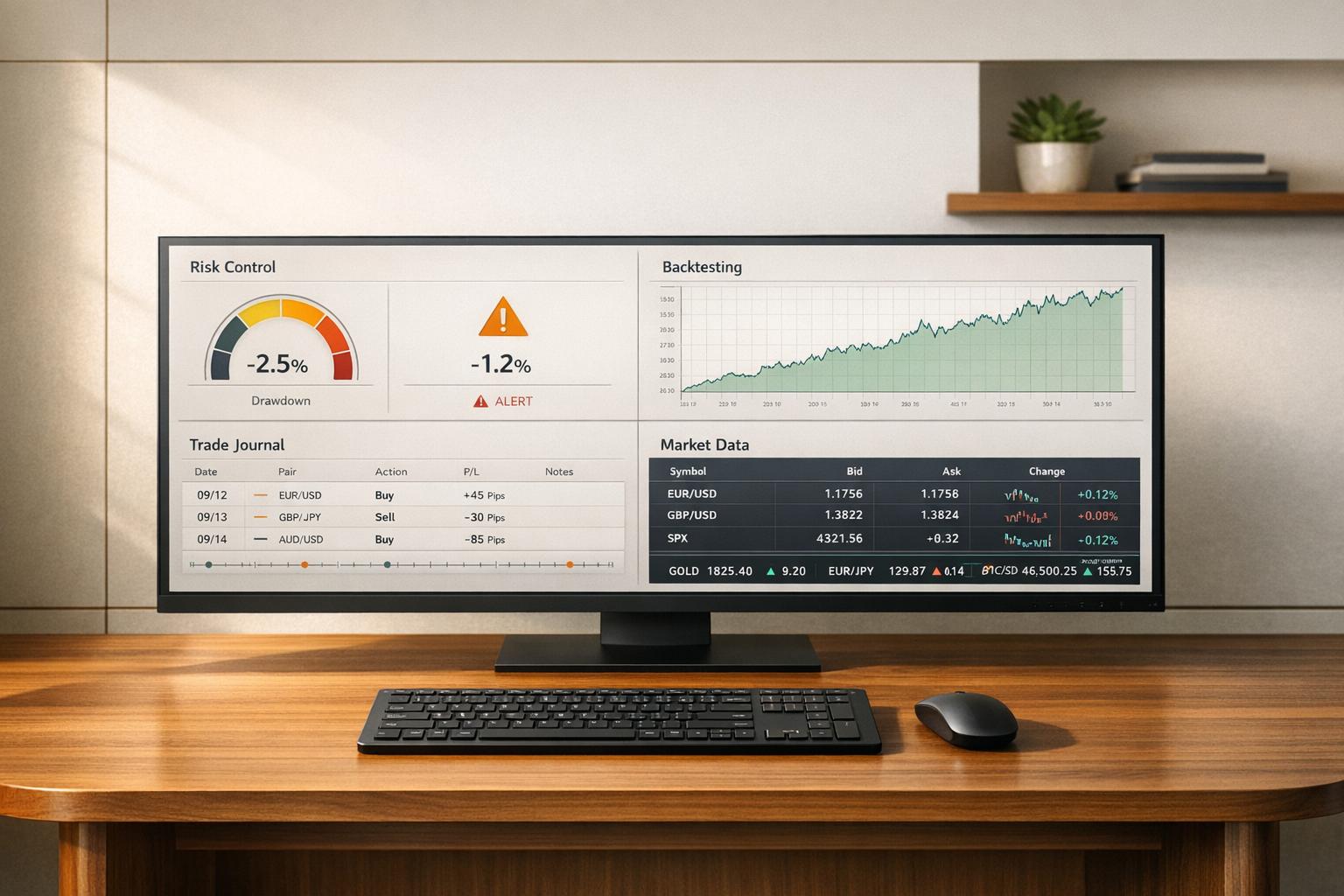
Funded trading is all about discipline, precision, and the right tools. If you're trading with a firm's capital, you need to meet strict profit and risk guidelines. Tools like trading platforms, risk management software, and journaling systems can help you avoid costly mistakes and improve performance. Here's a quick breakdown of the must-have tools for funded traders:
- Trading Platforms: DXTrade, TradeLocker, and cTrader offer fast execution, risk controls, and integration with major prop firms.
- Risk management tools: AI-driven systems like QuantGuard enforce loss limits and prevent emotional trading.
- Trade Journals: Tools like TradesViz and Edgewonk track performance, highlight mistakes, and ensure compliance with prop firm rules.
- Backtesting Software: Simulate and refine strategies using realistic market conditions.
- Real-Time Data Feeds: Low-latency feeds and economic calendars ensure you're trading with the latest market insights.
Key takeaway: Success as a funded trader depends on using tools that ensure discipline, track performance, and align with firm requirements. Start with a trading platform, risk management software, and a trade journal to build a reliable workflow.
Day Trading for Beginners: Funded Account, Trading Tools & How to Find Stocks to Trade
1. DXTrade
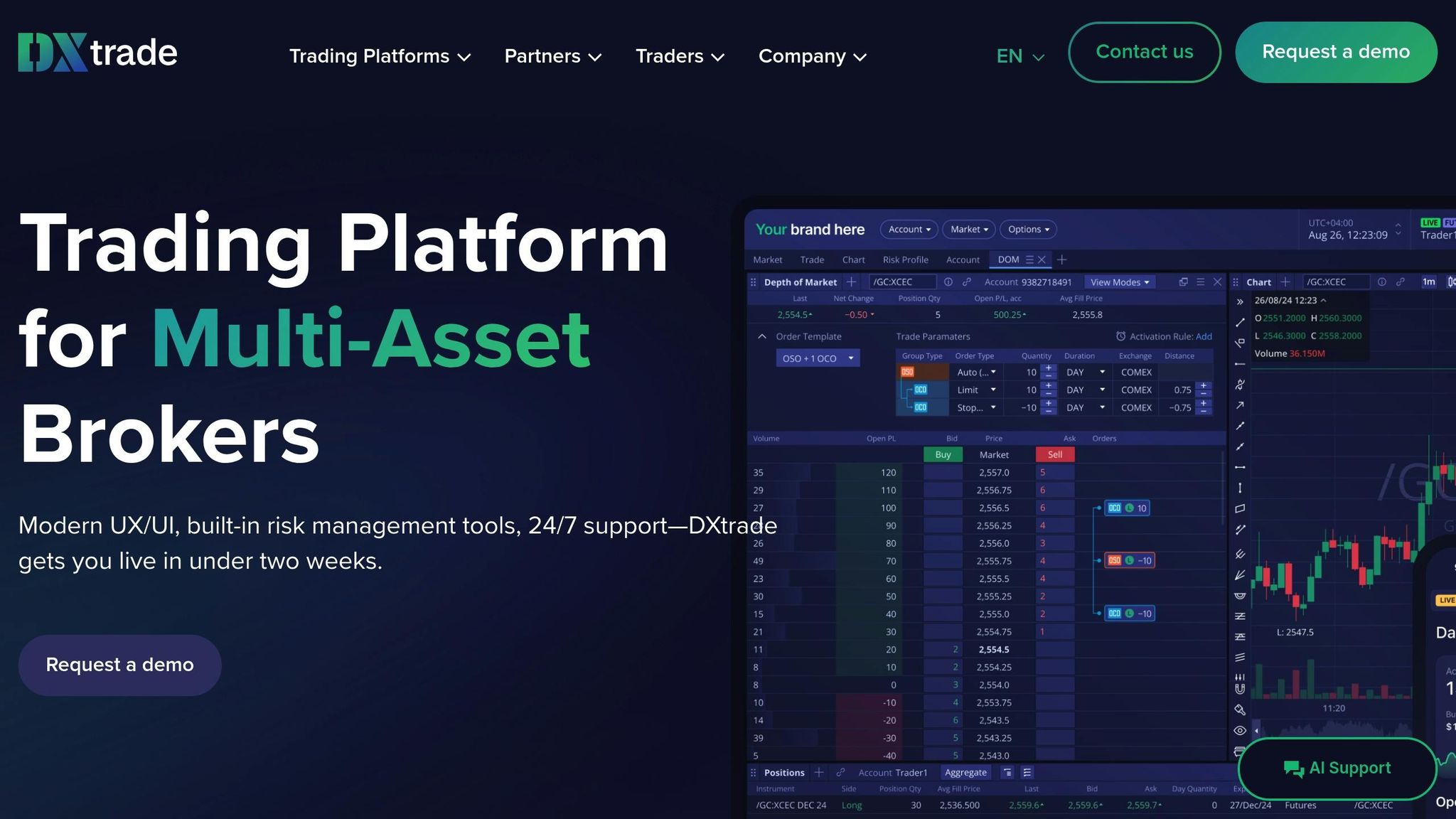
In the fast-paced world of proprietary trading, where precision and discipline are non-negotiable, DXTrade stands out as a powerful tool. Developed by Devexperts, it delivers the speed and reliability that funded traders need to navigate high-pressure market conditions.
Execution Speed and Reliability
DXTrade is designed to handle thousands of traders operating simultaneously, scaling effortlessly as firms grow by deploying additional instances. For traders on the go, its binary protocol ensures stable market data delivery, even in areas with low bandwidth. In simulated environments, it uses Level 2 quotes and liquidity volumes to fill orders, creating execution conditions that closely mimic real markets. This robust infrastructure ensures smooth integration with proprietary trading systems.
Compatibility with Prop Trading Platforms
DXTrade has been adopted by major proprietary trading firms such as FTMO, Funded Trading Plus, and FXIFY. Tailored specifically for prop trading, it includes automated features like immediate liquidation and drawdown validation when risk thresholds are exceeded. Its integration with dxFeed delivers low-latency market data while maintaining a streamlined infrastructure.
Risk Management and Analytics Tools
Beyond speed and reliability, DXTrade offers a suite of tools to support risk management and performance analysis. The built-in Performance Dashboard provides real-time insights into metrics like win rates, risk-reward ratios, and trade holding times. The Trading Journal allows traders to tag their trades with entry and exit logic, offering clarity on what strategies work and what don’t. For traders in options or futures, DXTrade includes CME SPAN margin calculations, adding a professional-grade layer of functionality. Additionally, the platform automates position closures when drawdown limits are reached, ensuring risks are addressed immediately.
As Devexperts explains:
"DXtrade XT can serve thousands of concurrent traders who are out of the box... we can spin up multiple instances and divide your client base between them without them ever noticing a dip in performance".
2. TradeLocker

TradeLocker is a game-changing tool for funded traders who value speed, simplicity, and clear visuals. Designed as a lightweight web app, it removes the clutter of older platforms by embedding execution tools directly onto the chart. With just a click or a drag, you can trade seamlessly, making it easier to manage both execution and risk.
Execution Speed and Reliability
TradeLocker’s one-click trading ensures orders are placed instantly, even during volatile market conditions. The platform also simplifies order management with automatic toggling between "limit" and "stop" orders based on price position, reducing the chance of manual errors in fast-paced environments. You can fine-tune your trades by dragging stop-loss and take-profit lines directly on the chart, blending analysis with execution in real time.
Compatibility with Prop Trading Platforms
TradeLocker doesn’t just excel in execution - it integrates effortlessly with major proprietary trading platforms. It supports challenges for firms like TopTier (5,416+ users), FunderPro (5,316+ users), and Rocket21. Through the TradeLocker Hub ecosystem, it connects with over 25 brokers and more than 20 white-label prop firms, reaching 150,000+ traders every month. For firms launching new challenges, TradeLocker can be set up in as little as 10 days using its API-first integration and sandbox testing environment.
Support for Risk Management and Analytics
Risk management is made simple with TradeLocker’s built-in Risk Calculator. Enter your desired dollar risk (e.g., $100) and stop-loss distance in pips, and the tool calculates the appropriate lot size automatically. A margin level bar provides a clear visual of your exposure as a percentage, helping you stay out of stop-out danger. For strategy development, TradeLocker Studio allows you to create trading bots without coding. Using plain English prompts, it generates scripts and backtests them across 200+ asset pairs, ensuring your strategies are sound before you commit real capital.
3. cTrader
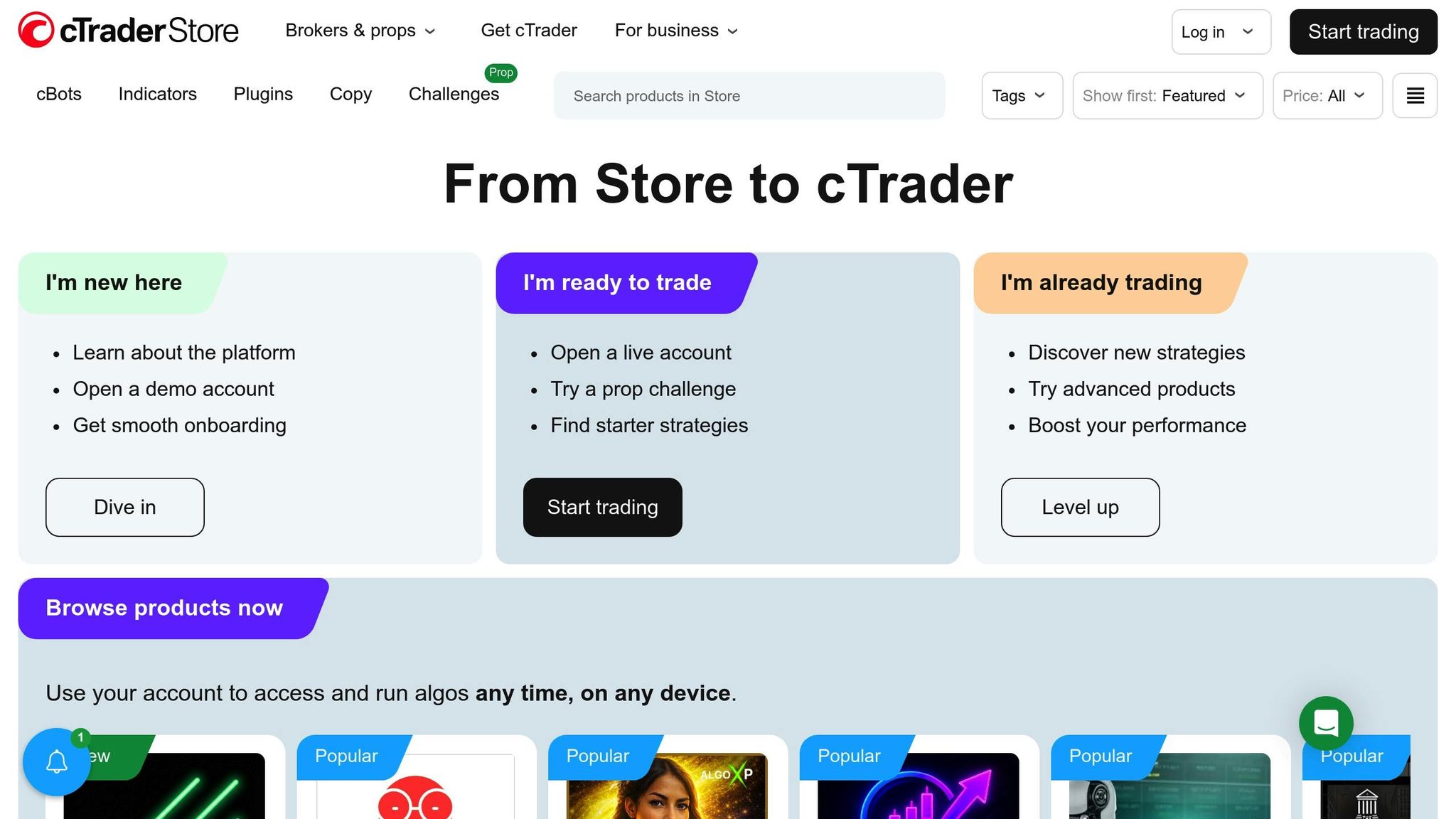
cTrader is designed as a platform that prioritizes transparency, making it ideal for no-dealing-desk (NDD) trading. Unlike broker-dependent systems, it uses Direct Market Access (DMA) to provide real market prices without interference. This transparency ensures you're seeing actual liquidity rather than manipulated or filtered quotes.
"cTrader was built from the ground up for transparent, no-dealing-desk trading. That means you're seeing real market prices without broker manipulation." – Noam Korbl, Prop Firm Expert
Execution Speed and Reliability
When trading with firm capital, speed is non-negotiable. cTrader offers execution times ranging from 50ms to 65ms with top brokers. The platform eliminates freeze levels and does not impose minimum distances for stop-loss or take-profit orders, giving traders precise control during high-speed scenarios like scalping or trading news events. For those using automated strategies, cTrader Cloud keeps trading bots running 24/7 on its infrastructure. This eliminates the need for a VPS, ensuring your algorithms remain operational even if your computer is turned off.
Compatibility with Prop Trading Platforms
cTrader works seamlessly with major prop trading firms such as FTMO, Funding Pips, E8 Funding, FundedNext, and FunderPro. It even includes a "Prop Challenges" directory where traders can compare account sizes, profit targets, and loss limits side by side. However, some firms may charge an additional fee for cTrader access. For instance, Funded Trading Plus adds a $25 fee for using cTrader instead of other platforms. This integration, combined with its flexibility, makes cTrader a strong choice for traders with varied styles and needs.
Customizability for Trading Styles
cTrader caters to diverse trading approaches with features like 28 timeframes, including tick, Renko, and pip charts. It also supports detached charts for multi-monitor setups. Traders can save their preferred layouts as "My Workspace" for easy access. For algo traders, cTrader Automate supports programming in C# and Python, which are robust languages for developing advanced strategies. Additionally, all custom settings, indicators, and trading bots sync effortlessly across desktop, web, and mobile platforms through your cTrader ID.
Support for Risk Management and Analytics
cTrader goes beyond customization by offering powerful risk management tools. It calculates risk/reward ratios directly on the order screen, saving traders from manual calculations. The platform’s Level II pricing feature displays full market depth, including Standard, Price, and VWAP, so traders can see the available volume at each price level. Its Smart Stop Out mechanism protects your account by closing only the necessary portion of your largest position to restore margin, rather than liquidating everything. With over 70 built-in technical indicators, cTrader provides all the tools needed to analyze and execute trades without relying on third-party plugins. From transparent execution to advanced analytics, cTrader equips funded traders with the tools they need to thrive in competitive markets.
4. AI-Driven Risk Management Tools
In the past, risk monitoring relied heavily on manual processes. Today, AI-driven solutions take things up a notch by automating risk enforcement and customizing strategies. Emotional trading can derail even the best-laid plans, but these tools step in to minimize that risk. For example, they automatically enforce Daily Loss Limits (DLL) and drawdown thresholds, even during technical glitches, providing a reliable safety net.
Compatibility with Prop Trading Platforms
AI tools integrate smoothly with popular platforms like Rithmic, Tradovate, DXtrade, and TradeLocker, enabling traders to manage multiple accounts from a single dashboard. Take QuantGuard, for instance - it offers tiered pricing: $75/month for two connections or $150/month for unlimited accounts. The tool directly communicates with trading servers to lock accounts the moment thresholds are breached. This eliminates the risk of missing visual alerts during sudden market volatility.
"QuantGuard saved me from blowing my funded account during a volatile news event. The auto-lock feature is a lifesaver!" – John D., Futures Trader
Customizability for Trading Styles
These tools aren't just about convenience - they're adaptable to different trading styles. You can set parameters like maximum position sizes, profit targets, and even cooldown timers to pause trading after a stop-loss event, helping to prevent revenge trading. Advanced systems go further by using models like the Kelly Criterion or ATR-based volatility targeting to adjust exposure based on market conditions and past performance. For algo traders using strategies like DCA or Grid bots, applying ATR-based filters to reduce position sizes during high-volatility periods adds another layer of risk control.
Support for Risk Management and Analytics
AI tools like TradesViz take risk management to the next level by offering over 600 metrics, including MFE (Maximum Favorable Excursion) and MAE (Maximum Adverse Excursion) analysis. Some systems now include tilt tracking, which monitors emotional trading behaviors and alerts you when you stray from your plan. On top of that, AI dashboards can cut through market noise by identifying institutional sentiment shifts and pinpointing high-probability breakout patterns, giving traders a strategic edge. These features work together to create a robust safety net, freeing you to focus on executing your strategy effectively.
5. Real-Time Data Feeds and Economic Calendars
In fast-paced markets, every millisecond counts. It’s the difference between accessing liquidity first or being left behind. For funded traders working under strict drawdown limits, having low-latency data feeds and detailed economic calendars is crucial to staying within rules and maintaining a competitive edge.
Execution Speed and Reliability
When it comes to profit and loss, data speed can make or break a trade. Tools like Level 2 market depth and WebSocket feeds, which refresh hundreds of times per second, give traders a clear view of liquidity levels before orders are placed. This precision helps scalpers and day traders minimize slippage, while swing traders pair Level 1 data with economic calendars to time their trades effectively.
"In today's markets, milliseconds determine who sees liquidity first, who reacts to order flow, and who gets left behind." – Bookmap
Fast, reliable data delivery ensures that traders across all strategies can execute trades with accuracy.
Compatibility with Prop Trading Platforms
Some platforms are built with data speed and integration in mind. DXTrade, for instance, uses dxFeed to deliver tick-level, low-latency data for stocks, futures, options, and crypto. On the other hand, cTrader integrates tools like Acuity, Autochartist, Trading Central, and FXStreet directly into its interface. This setup eliminates the need to switch between tabs, making it easier to go from idea to execution. Notable features include Acuity's NewsIQ, which provides AI-driven sentiment analysis for specific assets, and FXStreet's 24/7 live newswire and economic calendar, complete with countdown timers displayed in cTrader's Active Symbol Panel.
Customizability for Trading Styles
Modern data feeds are designed to adapt to individual trading styles. For example, Acuity's AssetIQ evaluates opportunities based on news sentiment, while Autochartist overlays technical patterns like Fibonacci levels directly onto charts. Traders can fine-tune news dashboards to focus on sectors or economic indicators that align with their positions. Additionally, custom alerts - whether on your phone or platform - can notify you of high-impact events, such as FOMC announcements or Non-Farm Payrolls, allowing you to prepare if you are trading with prop firms with low drawdown rules that restrict trading during these times. These customizable features enhance both risk management and decision-making.
Support for Risk Management and Analytics
Economic calendars aren’t just about listing events - they need to provide details like event impact, consensus data, and restricted trading hours to help traders avoid violations. Tools like Autochartist even offer risk-sized trade setups within cTrader. For crypto traders, on-chain metrics, such as whale movements, can signal potential spikes in volatility. Integrating these tools into your platform allows you to monitor sentiment, maintain compliance, and execute trades confidently. By combining high-quality data feeds with robust economic calendars, traders can build disciplined, tool-driven strategies essential for long-term success.
6. Trade Journaling Software
Compatibility with Prop Trading Platforms
Keeping an accurate trading journal often depends on seamless data imports. Many journaling tools now support direct integration with platforms like Tradovate, Rithmic, NinjaTrader, MetaTrader 4/5, and cTrader. This eliminates manual entry errors and ensures precise analytics. For traders managing multiple funded accounts, platforms like Trademetria and TradesViz consolidate data from different prop firms into a single dashboard. This provides a clear picture of your overall portfolio risk. Impressively, TradesViz has already analyzed over 50 million trades and supports more than 15,000 tickers, making it a solid option for traders handling diverse asset classes.
Another critical feature for funded traders is IP-friendly synchronization. Some prop firms monitor login patterns and flag accounts for unusual IP activity. PlanningTrade offers automatic syncing that avoids triggering these alerts, allowing your journal to update without risking account violations. This is particularly useful for traders logging entries from multiple devices or locations throughout the day. Such seamless integration ensures that your journal reflects your trading habits without compromising security.
Customizability for Trading Styles
Once your data is reliably imported, customizing the journal to align with your trading style becomes essential. Tools like TradesViz offer over 600 statistics and 70+ interactive charts, enabling you to create personalized dashboards that focus on your strategy-specific metrics. For futures traders, features like tick normalization and contract-level analytics are crucial, and platforms such as TradeTrakR and Edgewonk cater to these needs. Forex traders, meanwhile, benefit from tools that handle automated rollover calculations and customizable lot sizes.
Custom tagging is another powerful feature, allowing you to label trades based on setup types, emotional triggers (e.g., "revenge trading" or "euphoric"), and adherence to trading rules. PlanningTrade even includes a "Mentor Mode", which lets up to nine mentors review your progress at no additional cost - perfect for traders working with coaches or accountability partners. Additionally, some journals now incorporate natural language queries, enabling you to type commands like "Show me my worst performing days" and instantly receive visual insights.
Support for Risk Management and Analytics
Advanced analytics tools in trade journals play a key role in maintaining disciplined risk management. Staying within drawdown limits is non-negotiable for funded traders. Modern journals provide real-time dashboards that monitor daily loss thresholds and trailing drawdown limits, offering early warnings before you hit critical stop-out levels. Some tools even recommend setting alerts at 70% of your daily loss limit to prevent emotional decisions, such as "revenge trading", which often follows consecutive losses. For example, TradeTrakR includes a "tilt meter" that links emotional states to P&L performance. One trader credited this feature with helping them avoid losing a $150,000 evaluation account on day four:
"Finally passed my 150k Apex account. The tilt meter saved me from blowing it on day 4. Withdrew my first payout last week." – Alex R., Funded Trader
Journals also monitor consistency scoring, which ensures no single trading day contributes more than the allowed percentage of total profits - a common requirement from prop firms. Tools like TradeZella automatically flag rule violations and recommend cooldown periods. They can also analyze 30 days of P&L data to identify patterns behind losing streaks. Logging trades promptly - ideally within 24 hours - helps maintain accuracy in mindset and execution notes, which tend to degrade if delayed. These time-stamped records are invaluable for appealing technical stop-outs or requesting account scale-ups.
7. Backtesting and Strategy Testing Software
Execution Speed and Reliability
Modern backtesting tools can process a decade’s worth of data in just minutes, making it easier to refine strategies quickly. However, speed alone doesn’t guarantee success - accurate market simulation is just as important. The type of backtesting engine you use matters. Vectorized engines apply rules across entire datasets, while event-driven engines replay tick-by-tick data, capturing the order-book dynamics that are critical for intraday strategies.
Overlooking factors like slippage, spreads, or partial fills is one of the most common backtesting mistakes that can lead to overly optimistic results. Including realistic slippage in your simulations can improve strategy dependability by around 30%. A solid, realistic simulation lays the groundwork for integrating your strategy with a trading platform.
Compatibility with Prop Trading Platforms
Your backtesting software should work smoothly with the funded trading platform you’re using. Tools like MetaTrader 5 and NinjaTrader provide built-in backtesting environments that replicate live trading conditions. For platforms like DXtrade or TradeLocker, look for software that allows you to export strategies in a format ready for deployment.
Data granularity is another key factor. Tick-by-tick data captures every price movement and market depth change, which is crucial for short-term strategies. On the other hand, relying on simplified OHLC (Open, High, Low, Close) data might miss critical execution details.
Proper integration ensures the strategies you test align with the real-world conditions and risk parameters you’ll encounter in live trading, which is especially important for funded traders.
Support for Risk Management and Analytics
Beyond platform compatibility, backtesting helps assess profitability while adhering to constraints set by prop firms. You can configure tests to simulate realistic limits, such as a maximum daily drawdown (usually 4–5%) or trailing drawdowns (around 10–12%). Advanced backtesting tools often include features like Monte Carlo simulations and walk-forward analysis, which test strategies under a variety of market scenarios to reduce the risk of overfitting.
"Backtests are proof that your idea survived contact with the past under defined conditions, not a guarantee of the future." – Benjamin Sultan, Obside
To ensure your strategy works in real-world conditions, reserve one-third of your historical data for out-of-sample testing. This helps verify that your strategy isn’t just tailored to past market data. It also highlights parameter plateaus - if a strategy only performs well with very specific settings, it’s likely too fragile for live trading.
8. Performance Analytics Dashboards
Performance analytics dashboards are an essential tool for funded traders, blending execution data with risk management insights in a single, streamlined interface.
Compatibility with Prop Trading Platforms
These dashboards integrate seamlessly with widely-used prop trading platforms like Apex, Topstep, and FTMO through API auto-sync or secure CSV imports. For example, TradesViz supports connections to over 200 brokers and platforms, including specialized prop firm connectors. PlanningTrade takes it further by offering IP-friendly auto-sync for platforms like MT4, MT5, and cTrader, which helps avoid security issues caused by logging in from multiple locations.
They also work with execution platforms such as Tradovate, Rithmic, and NinjaTrader, providing real-time alerts. This connectivity ensures traders can monitor risks and analyze performance without disruption.
Support for Risk Management and Analytics
Dashboards provide real-time tracking of critical metrics, including daily loss buffers, trailing drawdown limits, and leverage utilization. Advanced platforms go beyond basic profit and loss (P&L) metrics, offering tools like expectancy, profit factor, R-multiples, and MFE/MAE to evaluate trade exits. Some even feature over 600 unique metrics and charts for an in-depth performance review. AI-powered journals, having analyzed over 50 million trades, help traders spot patterns - like a 40% drop in win rate on Fridays. Tools like TradeTrakR include features such as a "tilt meter", which links emotional states to P&L performance to quantify psychological factors in trading.
Customizability for Trading Styles
These dashboards don’t just track data - they let traders customize their experience. Drag-and-drop systems enable users to design layouts with elements like PnL calendars, equity curves, and symbol breakdowns tailored to their needs. Traders can create separate dashboards for different strategies, such as ICT models, scalping, or swing trading, to focus on specific performance metrics. Scalpers benefit from features like second-by-second replay and tick-level playback to fine-tune execution timing, while swing traders can use tools designed for multi-year data and long-term positions. Some platforms even use natural language processing, allowing users to generate charts with simple queries like, "Show performance by duration and win rate".
Platform Comparison Table

DXTrade vs TradeLocker vs cTrader Platform Comparison for Funded Traders
Here’s a quick overview of how DXTrade, TradeLocker, and cTrader stack up in terms of execution speed, charting tools, customization, and more. Use this table to match each platform to your trading style and needs.
| Feature | DXTrade | TradeLocker | cTrader |
|---|---|---|---|
| Execution Speed | Low-latency execution that reduces slippage | Extremely fast, with a lightweight PWA enabling rapid manual trades | High-performance speed with institutional-grade execution |
| Charting Capabilities | Custom dashboards with advanced tools like Fibonacci retracement and Bollinger Bands | Built-in TradingView integration, offering drag-and-drop SL/TP on charts | Smooth native charting with detachable charts and advanced rendering |
| Prop Firm Compatibility | Designed specifically for prop firms and evaluation challenges | Increasingly used by firms like Eightcap and FXIFY | Widely adopted by major firms such as FTMO and BrightFunded |
| Customization Options | Flexible dashboards tailored to forex, futures, and crypto trading | Simplified, mobile-friendly interface with essential features | Highly customizable, with detachable charts and support for custom bots via C# (cAlgo) |
| Best For | Traders tackling prop challenges who need integrated risk management tools | Mobile-first traders who prefer TradingView's interface and quick execution | Scalpers and technical analysts needing full Depth of Market (DOM) visibility |
DXTrade excels in risk management, TradeLocker combines TradingView's intuitive analysis with fast execution, and cTrader stands out for its transparency and customization. Check the detailed reviews above for a deeper dive into each platform's features.
Conclusion
The right tools can elevate trading performance. As Tradovate aptly states:
"Technology can be more than a convenience - it can be a performance multiplier".
For funded traders navigating strict daily loss limits and drawdown rules, specialized software serves as crucial safeguards, helping to prevent costly errors before they occur.
The data backs this up: a study of prop traders revealed that those who maintained detailed journals achieved 23% higher profit factors compared to those who didn't track their trades systematically. In the world of funded trading, where evaluation constraints are far stricter than what retail traders face, every advantage counts.
Start with the three essential tools: a dependable trading platform (like DXTrade, TradeLocker, or cTrader), a journaling tool that monitors rule compliance in real time, and risk management software that warns you before you reach your limits. These tools create a strong foundation for consistent trading success. As Viktor Tachev from Earn2Trade puts it:
"The tools are there to assist you, but the discipline and decision-making still rest in your hands".
Before going live, test each tool in a demo environment for 2–3 months. Build a workflow that withstands pressure and remember: a single, high-quality setup can cover 90% of your needs, eliminating the need for multiple subscriptions.
Ultimately, the difference between blowing an account and achieving steady payouts often lies in the systems you establish before placing a trade - systems designed to keep you disciplined, informed, and aligned with the rules that drive long-term success.
FAQs
What tools are essential for funded traders to succeed?
Funded traders rely on several important tools to boost their performance and hit their trading goals. At the top of the list is a reliable trading platform, which serves as the backbone for all trading activities. It provides real-time data, enables smooth order execution, and offers essential analysis features.
Equally important is risk management software. This helps traders keep track of daily loss limits, manage position sizes, and stick to the rules set by their proprietary trading firm. For long-term improvement, trade journaling tools are a must. These tools allow traders to log their performance, uncover patterns, and refine their decision-making process.
Lastly, advanced charting tools give traders the edge they need to analyze trends and fine-tune their strategies. With features like customizable indicators and detailed technical analysis, these tools are key for spotting opportunities. When used together, these resources allow traders to work efficiently, minimize risk, and maintain consistency in both practice and live trading scenarios.
How can AI-powered risk management tools improve trading performance?
AI-driven risk management tools can transform trading by providing real-time insights that help traders manage risk more effectively. These tools continuously track market conditions and trading behaviors, automatically generating alerts or recommendations to avoid errors like over-leveraging or surpassing risk limits.
A standout feature is their ability to adjust risk settings dynamically. For instance, they can adapt to market volatility or a trader's performance, maintaining consistent control while eliminating emotional decision-making. Many of these tools also come with advanced features such as automated stop-loss adjustments, adaptive strategies, and detailed trade analytics. These capabilities promote disciplined and informed decision-making.
By automating essential risk management tasks and minimizing emotional biases, these tools enable traders to maintain consistency and improve profitability over time.
Why is real-time market data important for funded traders?
For funded traders, having access to real-time market data isn't just a luxury - it's a necessity. This up-to-the-second information allows traders to respond quickly and make well-informed decisions in markets that can shift in an instant. Timing is everything, and real-time data ensures traders can execute their strategies without unnecessary hesitation.
This immediacy helps traders fine-tune their entry and exit points, minimizing the chance of missing opportunities or executing trades at less-than-ideal moments. For those in funded trading programs, where performance is under constant scrutiny, accurate and instant data becomes a cornerstone for hitting targets and maintaining a consistent track record.
Related Blog Posts
Start Trading with For Traders
Join our platform to test your trading skills, trade virtual capital, and earn real profits. Access educational resources, advanced tools, and a supportive community to enhance your trading journey.
Start your Trading Challenge