

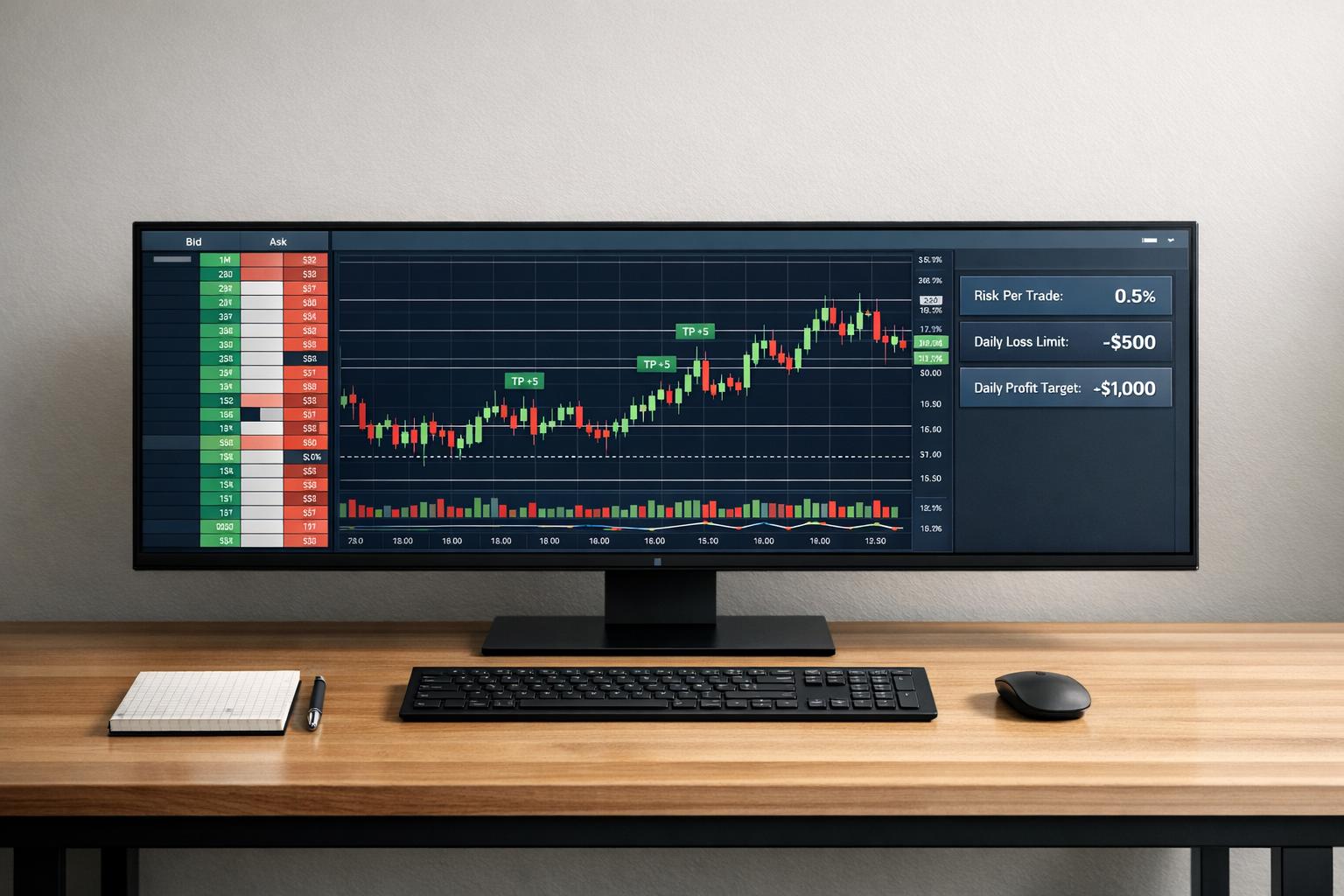
Scalping is a fast-paced trading approach where trades last seconds to minutes, aiming for small price movements, often 5–20 ticks or pips. Scalpers execute 20–100+ trades daily, focusing on high win rates (60–80%) and tight risk-reward ratios (1:1 to 1:1.5). This strategy suits prop trading challenges due to its ability to hit profit targets quickly while minimizing market exposure and overnight risks.
Key scalping methods include:
- Tape Scalping: Analyzing order flow and bid/ask imbalances.
- Chart-Based Scalping: Using candlestick patterns and technical indicators.
Why Scalping Works for Prop Trading:
- Quick Profit Targets: Ideal for strict drawdown rules.
- Low Personal Risk: Prop firms provide capital, reducing personal losses.
- High Trade Frequency: Maximizes small market moves using firm-provided buying power.
Core Strategies:
- Momentum Scalping: Uses indicators like EMA, RSI, VWAP, and MACD to spot short-term trends.
- Price Action Scalping: Focuses on liquidity zones, market structure, and Depth of Market (DOM) data.
- Trend Scalping: Aligns trades with broader trends using tools like trendlines, VWAP, and MACD.
Risk Management:
- Stick to daily loss limits (e.g., 5% on a $100,000 account = $5,000 max loss).
- Use a Two-Loss Rule: Stop after two consecutive losses.
- Limit risk per trade to 0.25%–0.5% to survive multiple losses.
- Avoid correlated trades to reduce compounded risks.
- Set stop-losses just outside key levels and factor in volatility using ATR.
Tools & Markets:
- Top Markets: Forex majors (EUR/USD, GBP/USD) and futures (E-mini S&P 500, Nasdaq 100).
- Optimal Trading Times: London-New York overlap (8:00 AM–12:00 PM EST).
- Platforms: MetaTrader 4/5, DXTrade, TradeLocker, and cTrader.
- Use Level 2 data and DOM for precision.
For Traders Support:

- Offers virtual capital plans from $6,000 to $100,000 with a 5% max drawdown and bi-weekly payouts.
- Includes educational resources, risk management tools, and community support.
Scalping demands discipline, speed, and precise execution. Success hinges on managing risk, sticking to proven strategies, and leveraging tools designed for high-frequency trading.
My Exact 1 Minute Scalping Strategy For Prop Firms (Full Walkthrough)
This walkthrough demonstrates how to execute high-probability setups, but you can further refine your approach by mastering additional scalping strategies for different market conditions.
Core Scalping Strategies for Prop Traders
Prop trading scalping demands strategies that balance strict risk management with profit targets. Three primary approaches - momentum scalping, price action scalping, and trend scalping - each provide specific methods to achieve evaluation goals while keeping drawdowns under control.
Momentum Scalping with Technical Indicators
Momentum scalping focuses on capturing short price movements using technical indicators. One popular technique is the Moving Average Ribbon strategy, which uses 5-8-13 simple moving averages (SMA) on a two-minute chart. When these averages align and spread apart, traders enter trades in the direction of the ribbon's movement. This setup helps avoid getting caught in choppy markets, which can lead to losses from excessive commissions.
Another effective strategy is the EMA Crossover with RSI Filter. A long entry occurs when the closing price is above the fast EMA, the fast EMA is above the slow EMA, and the RSI crosses above 50. The RSI filter ensures trades are avoided in sideways markets, reducing the risk of false signals.
The VWAP + MACD combination is another momentum-based method. Here, traders look for the price to close above the Volume Weighted Average Price (VWAP) while the MACD signal line crosses the MACD line. This dual confirmation increases the likelihood of catching genuine momentum-driven moves.
"The key to successful scalping today isn't just speed - it's having a systematic approach that lets you identify high-probability setups quickly." - Investopedia
While technical indicators are valuable, incorporating price action into scalping can uncover additional opportunities.
Price Action Scalping at Key Levels
Scalping based on price action involves analyzing market structure rather than relying solely on indicators. One approach involves identifying Liquidity Zones, which are areas marked by equal highs and lows, large wicks, or session open levels. These zones often indicate where large orders are clustered, creating higher chances for bounces or breakouts.
Skilled scalpers may also use the Depth of Market (DOM) to spot areas where large orders - typically over 500 contracts - are sitting at key price levels. These orders can act as temporary support or resistance, leading to quick reversals.
A common pitfall for traders is falling into the Break of Structure (BoS) trap. On 1-minute charts, an initial break of structure may simply be a liquidity sweep rather than a true trend shift. Waiting for a retest of the broken level instead of entering immediately can help avoid unnecessary stop-loss hits from false breakouts. Understanding why most traders fail funded challenges can help you avoid these common technical and psychological traps.
Trend Scalping with MACD and Trendlines
Trend scalping focuses on aligning trades with the broader market direction. The MACD Momentum Surge strategy uses MACD signals on 1- or 5-minute charts to pinpoint entries during strong market moves. This method works best during high-volatility periods, such as the London or New York market openings.
Another trend-following method is the VWAP Bounce technique, where VWAP acts as dynamic support or resistance. When the price pulls back to VWAP and forms a rejection candle, traders can enter in the direction of the prevailing trend. This approach provides clear entry points while keeping risks well-defined.
The 1MS Method framework combines three key elements: Market Structure (higher highs and higher lows), Momentum (EMA alignment), and Sentiment (RSI extremes). This framework is particularly effective for achieving the 60–80% win rates often necessary to compensate for the tight 1:1 risk-reward ratios common in scalping. The EMA 50 serves as a "bias anchor", guiding traders to take positions only in its direction.
For prop trading challenges, risk management is critical. Limiting risk per trade to 0.25%–0.5% allows traders to endure multiple consecutive losses without exceeding typical daily loss limits of 4–5%. This disciplined approach ensures traders stay within the boundaries required by prop firms.
Risk Management for Scalping in Prop Firms

Scalping Risk Management Framework for Prop Traders
In prop trading, the biggest reason traders fail challenges isn’t their strategy - it’s poor risk management. Over 80% of challenge failures stem from this issue. On a prop account, even exceeding the daily loss limit by just $1 can result in immediate termination.
Managing Daily Loss Limits and Drawdowns
Prop firms impose strict rules like the Daily Loss Limit (DLL) and Maximum Drawdown (MDD). The DLL resets every calendar day and caps how much you can lose in a single session. Meanwhile, the MDD tracks your total losses, either from your starting balance or the highest equity point, and doesn’t reset. This level of discipline is especially critical in scalping, where quick decisions and precise execution are key.
Here’s an example: on a $100,000 account with a 5% daily limit, you can lose up to $5,000 before your account is closed, even if your equity has grown. A single 1-lot Gold (XAU/USD) trade moving 50 pips against you could wipe out this entire allowance.
Trailing drawdowns add another layer of risk. As your gains increase, so does the risk of hitting your loss threshold during a bad session. Static drawdowns, which stay fixed relative to your initial balance, often provide more flexibility, and some prop firms with low drawdown rules prioritize this structure.
"Getting funded is 20% strategy, 80% risk management." - Gary M., Founder, Traders Second Brain
To manage risk effectively, many traders risk only 0.5% per trade and stick to a Two-Loss Rule. This means stopping after two consecutive losses, even if you’re still under the daily limit. For example, with a 5% daily limit, risking 0.5% per trade allows you to endure roughly 10 consecutive losses. In contrast, risking 1% per trade would limit you to just five losses.
Another tip: set a personal stop at 60–70% of the official limit. For instance, on a $5,000 daily limit, stop yourself at $3,000. This buffer helps protect against slippage and sudden market spikes.
When calculating position sizes, start with your personal daily stop. Divide it by the maximum number of losing trades you’re willing to take. For example, if your stop is $3,000 and you can handle 10 losses, risk $300 per trade. Use this formula to determine position size:
Position Size = Risk Amount / (Stop Loss Distance × Value Per Point)
Round down to the nearest fractional lot to avoid over-leveraging. Also, add a slippage buffer - about 5 pips - to your stop-loss distance to account for potential execution delays. Limit your exposure by avoiding more than two correlated positions at once. For instance, holding long positions in both EUR/USD and GBP/USD during a USD rally could double your risk and breach your limits quickly.
Once your daily limits are under control, define clear stop-loss and take-profit levels to secure your trades further.
Setting Stop-Loss and Take-Profit Levels
Place your stop-losses just outside key support or resistance levels, adjusting them using 1.5 times the Average True Range (ATR) to account for volatility. For long trades, stops should go just below recent swing lows; for short trades, just above recent swing highs. This keeps your stops outside normal market fluctuations.
"A stop loss is not an admission of failure; it is an act of disciplined risk management." - Colibri Trader
Once you’ve set your stop-loss and take-profit levels, resist the urge to widen your stop-loss after entering a trade. Stick to your plan, place your orders, and step away to avoid emotional decisions.
Professional scalpers often rely on limit orders for over 80% of their entries. This helps reduce slippage, which can range from 1 to 3 ticks during fast-moving sessions. In trending markets, trailing stops can help lock in profits without constant manual adjustments. For example, a 20% trailing stop threshold has been shown to outperform static stops by about 27.5% in certain conditions.
When setting take-profit levels, factor in both the spread and commission. If you’re scalping EUR/USD with a 1-pip spread and a $4 round-trip commission, your target must cover these costs. For high-frequency strategies with 100 round trips per day, these fees can add up to around $8,000 monthly.
Finally, many prop firms have consistency rules that disqualify traders if a single session contributes too much to their total profit. To avoid this, spread your gains across multiple trades and days. This approach ensures profits accumulate steadily through small, consistent wins rather than relying on one big trade. Mastering these parameters is key for scalpers aiming to succeed in prop trading environments.
Best Markets and Tools for Scalping
Top Markets for Scalping
When it comes to scalping, forex majors are the go-to choice. Their high liquidity and tight spreads make pairs like EUR/USD, GBP/USD, USD/JPY, and USD/CAD popular among traders. Interestingly, USD/CAD often mirrors oil price movements, adding another layer of strategy for scalpers. Futures markets also attract attention, with E-mini S&P 500 (ES), Nasdaq 100 (NQ), and Crude Oil (CL) futures being top picks. These contracts are valued for their small price movements and advanced market data access, making them ideal for quick trades.
The key to effective scalping lies in choosing markets with steady volatility - enough movement to create opportunities without chaotic price swings.
"For a scalper who may execute dozens of trades in a single session, [low transaction costs are] the difference between profitability and failure." - BrightFunded
Timing matters just as much as the market. Scalpers often trade during the overlap of the London and New York sessions (8:00 AM – 12:00 PM EST), when trading volumes are at their highest and spreads are at their lowest. On the flip side, it’s wise to steer clear of entering trades 15 minutes before and after major economic announcements, like Non-Farm Payroll (NFP) or Consumer Price Index (CPI) releases. Pairing these optimal trading windows with advanced tools can make all the difference.
Scalping Tools and Platforms
Professional scalpers typically rely on a combination of tools and platforms to stay ahead. Many use TradingView for its sophisticated charting features, while executing trades on platforms like MetaTrader 4/5, DXTrade, or TradeLocker. In the futures market, Rithmic is a favorite thanks to its lightning-fast execution speeds and minimal slippage.
For precision, tools like DOM (Depth of Market) ladders and Level 2 market data are indispensable. Scalpers aiming to minimize slippage often stick to limit orders for the majority of their trades - about 80%. Market orders, while faster, can lead to slippage of 1–3 ticks in fast-moving markets, which can erode a scalper’s edge.
Platforms such as DXTrade, TradeLocker, and cTrader, supported by For Traders, are designed with scalpers in mind. They offer the speed and order flow tools necessary to execute trades efficiently, giving prop traders the edge they need to thrive.
How For Traders Supports Scalping Success
For Traders builds on strict risk management principles by offering tailored capital plans and educational resources to help scalpers thrive.
For Traders Plans for Scalpers
For Traders provides five virtual capital plans, ranging from $6,000 to $100,000, designed to suit different trading profiles. New customers can get a 20% discount using the code NEW2. These plans come with a 9% profit target, 5% maximum drawdown, and bi-weekly payouts - all crucial for the disciplined approach scalping requires. These features are especially suited for the rapid pace and high trading frequency that scalping demands.
The 5% max drawdown is particularly important for scalpers, who aim for win rates between 60% and 80% while targeting small 5- to 20-tick price movements. This limit provides enough flexibility for multiple quick trades without risking account failure. Additionally, the 15% profit share rewards consistent performance, while the unlimited time limit removes the pressure of making rushed decisions during long, intense trading sessions, which often last 6 to 8 hours.
Traders can start small with the $6,000 plan for $46 to test their strategies and gradually move up to the $100,000 plan at $413 as they demonstrate consistent success. To meet the speed and precision scalping requires, For Traders integrates advanced tools like DXTrade, TradeLocker, and cTrader.
Educational and Risk Management Resources
For Traders doesn’t just stop at flexible capital plans - it also provides scalpers with valuable educational and risk management tools. The For Traders Academy offers resources specifically designed for scalpers, including video courses, livestreams, and interviews. Additionally, the High Performance Coaching program focuses on trading psychology, a critical area for managing the stress of high-frequency trades.
An AI-driven risk management system adds another layer of protection by analyzing market sentiment and macroeconomic events. It can automatically reduce positions to prevent losses during potential market crashes. Scalpers can also set up automated circuit breakers to halt trading if a preset daily loss limit is reached, helping to avoid the emotional "revenge trading" that accounts for 60% of breached accounts.
"Position sizing is THE #1 skill. Not technical analysis. Not economic news reading. The sizing." – Van Tharp
The Discord community allows scalpers to share real-time insights and stay disciplined during challenging periods. Meanwhile, the educational blog keeps traders informed about market-moving events, helping them avoid situations that could widen spreads and disrupt tight stop-loss orders. For Traders also organizes in-person events, providing opportunities for networking and strategy sharing.
Conclusion
Scalping is all about precision, discipline, and having the right tools. It’s not just about executing 20 to 100+ trades a day - it’s about sticking to strict drawdown limits, following consistency rules, and keeping an eye on commission costs. Even the smallest slippage, like a single tick, can eat up 10% to 20% of your expected profit when aiming for just 5 to 10 ticks per trade.
"Passing a prop firm challenge doesn't require 10 complex strategies... It requires one clear, repeatable edge that you can apply under strict conditions without breaking risk rules." – Stephen Madu, Financial Markets Strategist
The strategies in this guide - whether it’s momentum scalping with technical indicators or price action setups at key levels - only work if you stick to solid risk management. That means sizing your positions based on daily drawdown limits and using safeguards like personal soft caps and circuit breakers to avoid emotional decisions like revenge trading.
Having the right trading environment makes all the difference. For Traders offers scalpers low-latency platforms and strong risk controls, including a 5% maximum drawdown, bi-weekly payouts, and access to educational resources. Platforms like DXTrade, TradeLocker, and cTrader are designed to handle high-frequency trading, while the unlimited time limit takes the pressure off rushing your trades. Plus, the For Traders Academy and Discord community provide ongoing support to help you stay consistent.
Think of what to expect from your funded account as an ongoing evaluation, not a green light to take bigger risks. Prioritize efficiency, stick to your process, and take advantage of the tools and community designed to help you succeed. Scalping success isn’t about quick wins - it’s about building a repeatable, rule-driven system that turns tiny market movements into steady profits over 6 to 8 hours of focused trading.
FAQs
How do I choose the best scalping strategy for my prop challenge rules?
To succeed in a prop trading challenge, start by thoroughly reviewing the rules. Pay close attention to details like holding periods, risk limits, and trading frequency restrictions. These guidelines will shape how you approach the challenge.
Next, pick a trading strategy that aligns with both your personal style and the challenge's requirements. For many, short-term, high-frequency approaches work well. Focus on highly liquid currency pairs, such as EUR/USD, as they allow for tighter spreads and quicker execution. Use tight stop-loss orders and aim for strong risk-reward ratios to manage potential losses effectively.
Key priorities should include maintaining discipline, executing trades swiftly, and keeping risks under control. Timing also matters - capitalize on high-liquidity periods, like the overlap between the London and New York trading sessions, to maximize opportunities.
What position size should I use to avoid hitting the daily loss limit?
To keep from exceeding your daily loss limit, it's crucial to manage your position size carefully. Aim to keep your maximum loss per trade small enough to endure several losses in a row without significant damage. A widely used guideline is to risk no more than 1% of your account per trade.
Here's a simple formula to help you calculate your position size:
Position Size = Risk Amount / (Stop Loss Distance × Value Per Point)
For instance, if you're risking $1,000 on a $100,000 account, using a 25-pip stop loss and a $10 pip value, your position size would be 4 lots. This approach ensures you stay within your risk tolerance while trading.
How can I reduce slippage and fees when scalping a lot of trades?
To keep slippage and fees in check while scalping, make sure you're using a fast and reliable trading platform that supports quick order execution. Opt for brokers or prop firms offering tight spreads and low commissions to reduce costs. Timing is also key - trade during high-liquidity periods to ensure smoother order fills. Lastly, stick to disciplined risk management and steer clear of overtrading. This helps control unnecessary expenses and keeps your scalping strategy running efficiently.
Related Blog Posts
Start Trading with For Traders
Join our platform to test your trading skills, trade virtual capital, and earn real profits. Access educational resources, advanced tools, and a supportive community to enhance your trading journey.
Start your Trading Challenge