


Most prop accounts fail for one reason: traders hit drawdown limits before their edge has time to work. If I want to keep a prop account alive, I need to think about survival first and profit second.
Here’s the short version:
- Risk small on each trade, often around 0.25% to 1.00%
- Size trades from drawdown room, not from total account size
- Set my own daily drawdown rules before the firm's limit, such as 60% soft stop and 80% hard stop
- Cut size after losses instead of trying to win it back
- Lock in gains with trailing stops, partial exits, and profit caps
- Follow written rules so emotion does not take over
A prop account can be lost even when a setup is good. Why? Because equity-based rules, daily loss caps, and total drawdown limits can end the account fast. In many cases, traders fail from rule breaks, not from a bad system. Some industry estimates say 85% of funded traders lose their accounts within the first 60 days because of weak risk control.
What matters most is simple: the buffer you have left. On a $100,000 account with a 5% max drawdown, I am not working with $100,000 in practical risk. I am working with $5,000 of room. If I risk $1,000 on one trade, I just used 20% of my full loss allowance.
A few ideas shape the whole article:
- Balance and equity are not the same
- Open losses can break rules before trades close
- Static and trailing drawdown need different trade handling
- A green day is only useful if I keep it
- A written plan beats in-the-moment decisions
Why Traders Blow Accounts: Risk Management Explained
Quick comparison
| Area | What I focus on | Why it matters |
|---|---|---|
| Risk per trade | Keep it small and fixed by planning risk-reward ratios | One trade should not put the account in danger |
| Daily loss control | Stop before the firm's hard cap | Gives room for slippage and mistakes |
| Drawdown model | Know if it is static or trailing | Each model changes how I hold winners and size trades |
| Profit protection | Lock gains at milestones | Stops green days and green weeks from turning red |
| Discipline | Use rules, journaling, and routines | Helps me stay inside limits under pressure |
If I had to sum it up in one line, it would be this: in prop trading, staying in the game is the first win.
What capital preservation means in simulated prop accounts
In simulated prop accounts, capital preservation means managing your balance, equity, and drawdown room so a rule breach doesn't end the evaluation early. At any point, four numbers shape your risk: account balance, equity, max daily loss, and overall drawdown.
Balance is your closed P&L. Equity is the live figure: balance plus open P&L. That gap matters a lot. Many platforms track drawdown based on equity, not balance, so an open loss can breach the account before the trade even closes.
Max daily loss is the amount of equity you can lose in a single day - often 4% to 5% - and it usually resets each day. Overall drawdown is your total allowed loss from peak equity. Once you hit that limit, the account is closed.
| Metric | What It Measures | Why It Matters |
|---|---|---|
| Account Balance | Realized closed P&L | Baseline for daily resets on many platforms |
| Equity | Balance + open P&L | Main metric for live drawdown breaches |
| Max Daily Loss | Single-day equity drop limit | Locks or closes the account when hit |
| Overall Drawdown | Peak-to-trough cumulative loss limit | Hard ceiling for account survival |
| Drawdown Room | Distance remaining to the loss limit | Shows how much you can risk on the next trade |
Here's the key point: in prop trading, remaining drawdown matters more than account size.
Capital preservation vs. profit maximization
A strategy can make money and still fail the evaluation if it hits the drawdown limit before it hits the profit target. The same goes for a good edge during a rough stretch. If a losing streak burns through the buffer first, the account is done.
That's why aggressive position sizing is so dangerous here. It doesn't just put one trade at risk. It puts the account's whole future at risk.
Survival-first trading takes the opposite path. You move more slowly, but you protect the drawdown buffer. And that buffer is what keeps you in the game long enough to reach a payout.
How prop-style rules shape trading decisions
These limits don't just protect the account. They change how every trade needs to be sized and timed.
Prop-style rules are there to screen for traders who can manage risk when the pressure is on. Consistency rules push traders away from oversized "hero" trades and toward repeatable, lower-variance setups. Position-size discipline means you can't just double down after a loss and try to win it back fast. News restrictions are there because sharp volatility often leads straight to rule breaches.
In practice, this shifts your focus. You start thinking less about trading more often and more about taking better setups. You also stop sizing trades off total account balance and start sizing them off remaining drawdown room. On a $100,000 account with a $5,000 max loss, 1% risk uses 20% of your buffer. That's a very different way to look at position sizing.
Why this matters on For Traders

For Traders shows what these rules look like in practice. Traders use virtual capital, with account sizes from $6,000 to $100,000, under a 5% maximum drawdown and a 9% profit target.
That 5% drawdown cap is the main limit. The 9% target only matters if you keep enough room to reach it. Protecting that room is what keeps the account alive during the evaluation.
With the rules clear, the next step is turning them into fixed risk limits on every trade.
Core risk management rules that protect trading capital
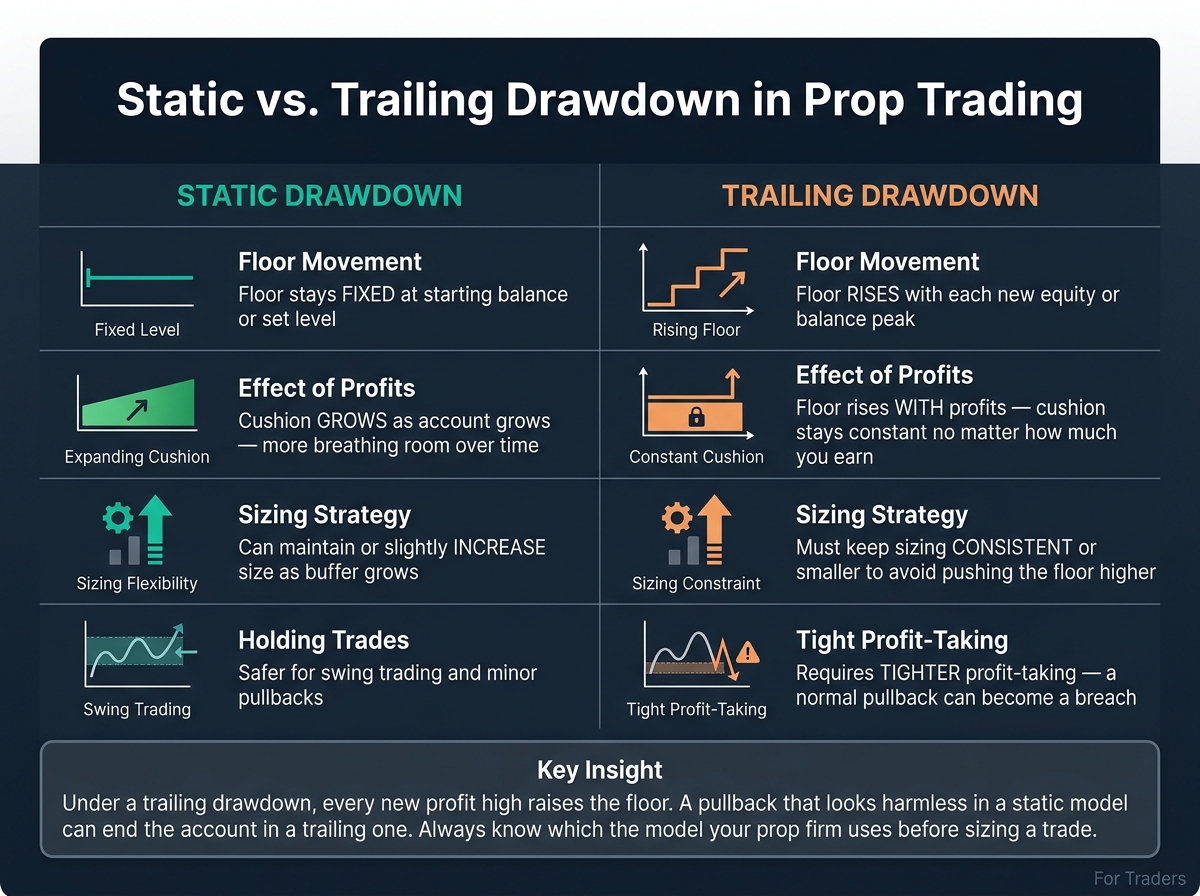
Static vs. Trailing Drawdown: How Each Model Affects Prop Trading Strategy
Good risk management in prop trading isn't about avoiding losses altogether. It's about making sure one bad trade, or even a bad run, doesn't kill the account.
That's the whole game: turn your drawdown room into hard rules you can use every day. Not vague ideas. Actual limits for each trade, each session, and each losing streak.
Set risk per trade and size positions correctly
Size trades from remaining drawdown room, not from account balance.
The formula is simple: Position Size = Risk Amount ÷ (Stop Loss Distance × Value Per Point). Always round down to avoid stacking extra risk by accident.
Your stop also needs to reflect trading friction. Spread and possible slippage count. So if your planned stop is 20 pips and the spread is 1 pip, size the trade as if the stop were 21 pips.
| Risk Level | Account Protection | Best For |
|---|---|---|
| 0.25% | Ultra-high - survives 40+ losses | Funded accounts, tight drawdowns, or trailing drawdowns |
| 0.50% | High - survives 20+ losses | Standard funded accounts; closing phase of evaluations |
| 1.00% | Moderate - survives 10 losses | Evaluation phase; building an initial profit cushion |
Correlation can trip traders up fast. If you're trading pairs like EUR/USD and GBP/USD, cut the per-trade risk in half for each extra position. One market move can hit both trades at the same time and push you into the daily limit much faster.
Set personal loss limits tighter than the platform allows
The firm's daily loss limit is the line you cannot cross. Your own limit should come before that line.
A practical setup is a soft stop at 60% of the firm's daily limit and a hard stop at 80%. That last 20% acts as a buffer for slippage or unrealized losses while trades are closing.
Daily loss limit breaches are the #1 reason prop traders fail. They happen more often than max drawdown breaches or consistency rule violations. One rough session can wipe out weeks of steady work.
A few rules help keep that from happening:
- Use a 3-strike rule: stop trading for the day after three losing trades, no matter how much room is left.
- After two losses in a row, cut the next position size by 50%.
- Only scale back up after the drawdown floor has locked and you've built at least a 2% profit cushion.
These rules matter most when losses start piling up fast. That's usually when discipline slips.
Manage drawdown buffers and trade quality
Your buffer doesn't behave the same way under every drawdown model. And that changes how you should size trades and manage open positions.
With static drawdown, the floor stays fixed at the starting balance or another set level. As the account grows, the space above that floor grows too. With trailing drawdown, the floor moves up with new equity highs. So every new high-water mark pulls the floor higher with it. A pullback that looks harmless in a static model can breach the account in a trailing one.
| Feature | Static Drawdown | Trailing Drawdown |
|---|---|---|
| Floor Movement | Fixed at the starting balance or set level | Moves up with equity or balance peaks |
| Effect of Profits | Cushion grows as the account grows | Floor rises with profits; cushion stays constant |
| Sizing Strategy | Can maintain or slightly increase size as the buffer grows | Must keep sizing consistent or smaller to avoid rising to new highs |
| Holding Trades | Safer for swing trading and minor pullbacks | Requires tighter profit-taking to avoid the floor rising |
Under a trailing structure, don't let a winning trade turn into a drawdown problem. If profits push the floor up too far, a normal pullback can suddenly become a breach. That's why tighter profit-taking matters.
With a static structure, you get more room to work with - but only after you've locked in a real cushion above the floor. Think of that equity cushion as risk capital, not spendable profit.
Once risk is capped, the next step is locking in gains before drawdown gives them back.
Capital lock-in strategies for evaluations and funded payouts
Once drawdown is under control, the focus changes. Now the job is to stop earned profit from sliding back into risk. Limiting losses matters, but that only gets you halfway there. You also need a way to keep gains from leaking away.
Reduce risk at equity milestones
When the floor is locked, cut exposure at each profit milestone instead of pushing size. That way, each step forward adds to your cushion instead of putting old progress back on the table.
When what to expect after getting funded becomes your reality, cut risk per trade by 30% to 50% so the goal shifts from fast growth to payout consistency.
And once size is lower, your exits matter even more. That’s where trade management comes in.
Lock in open and closed profits with trade management
Use ATR-based trailing stops instead of fixed pip stops so normal market noise doesn’t knock you out too early. Partial exits help too. You bank part of the move while still leaving room for the trade to run.
After that, put limits on how much upside you’re willing to risk giving back during a session or over a full week. A strong run should build the account, not turn into a round trip.
Use daily and weekly profit locks
Set a daily profit cap, then stop trading or cut size once you hit it. That helps preserve the account state you need for the next evaluation phase or payout.
Also, cut Friday size by 50% to lower weekend gap risk. A Friday afternoon move against an open position can wipe out a careful week in a matter of minutes.
| Strategy | Main Benefit | Trade-off | Best Use Case |
|---|---|---|---|
| Equity Milestones | Locks in progress toward targets; keeps decisions objective | Slower compounding if risk is cut too early | Evaluation phases near profit targets |
| Daily Profit Locks | Prevents giving back a green day; protects psychology | May miss extended trend moves after hitting the cap | Funded accounts focused on daily consistency |
| Trailing Stops | Converts unrealized gains into protected equity automatically | Can result in premature exits during normal market noise | Volatile markets or intraday trailing drawdown accounts |
| Partial Exits | Secures some profit while keeping skin in the game | Reduces the total R-multiple of a winning trade | Scaling out of winners to build a drawdown buffer |
Across all four methods, the rule is simple: set it before the trade starts. Don’t make it up on the fly while P&L is moving.
How to write and follow a capital preservation plan
Once your risk rules and lock-in rules are set, put them on paper. That sounds simple, but it matters more than most traders think. A capital preservation plan works best when you write it before the session starts and review it before each trading day. Pressure changes behavior fast. If your rules aren’t clear ahead of time, it’s easy to wing it.
Define account rules, risk limits, and non-negotiables
Your written plan should spell out the basics: starting virtual capital, max drawdown, max daily loss, and risk per trade. Then add the rules you refuse to break.
That means a short list of non-negotiables, such as:
- No averaging down
- No moving stop losses farther away
- No revenge trading after a loss
The table below shows practical starting ranges for three common simulated account sizes.
| Account Size (Simulated) | Risk Per Trade | Daily Stop Level (Personal) |
|---|---|---|
| $15,000 | $10–$15 | $250–$300 |
| $50,000 | $25–$50 | $625–$750 |
| $100,000 | $50–$100 | $1,250–$1,500 |
Those daily stop levels sit well below the hard ceiling, which gives you room for slippage, gap moves, and the kind of mistakes that can happen when stress kicks in.
Use routines, journaling, and platform tools to stay disciplined
When it’s time to trade, the plan should turn into a fixed pre-trade routine. Before you enter anything, check your remaining drawdown buffer. Know how much drawdown room you have left. Then calculate position size before you even open a chart or place an order. That order matters. It keeps emotion from sneaking in first.
After the session, review compliance - not just P&L. Ask the hard questions. Did you follow your rules? Did you close positions before major news? Did you stop after three consecutive losses?
Journal rule adherence, not just results. Tagging trades as "rule-based" versus "discretionary" makes behavior leaks easier to spot.
For Traders supports this with AI risk alerts, educational resources, and Discord accountability. That kind of routine helps keep decisions steady when the pressure is on.
Conclusion: Preserve first, grow second
Traders who preserve capital tend to stay in the evaluation longer, finish challenges with more consistency, and build a track record that supports steady payouts.
FAQs
How do I calculate drawdown room before a trade?
Calculate your remaining drawdown room by comparing your current equity to your peak equity, then subtracting that drawdown from your maximum allowed drawdown.
The formula is simple: Remaining Drawdown Room = Maximum Drawdown Limit – Current Drawdown.
Here’s what that looks like in practice:
- Peak equity: $110,000
- Current equity: $105,000
- Current drawdown: about 4.55%
- Maximum drawdown limit: 10%
- Remaining drawdown room: about 5.45%
Put another way, if you’re down 4.55% from your peak and your account allows a 10% max drawdown, you still have 5.45% of room left before you hit the limit.
What risk per trade makes sense for a funded prop account?
A risk per trade of 0.25% to 1% of your account balance usually makes sense for a funded prop account.
For most traders, the sweet spot is 0.5% to 1%. That range helps protect capital without making growth painfully slow.
How should I trade differently under trailing drawdown?
Trade with more care while the drawdown is still trailing. The goal is simple: build a 2%–3% profit buffer, keep a close eye on your current floor, and cut risk until that floor locks at your starting balance.
If your drawdown updates at the end of the day, it may make sense to take profits before the market close. That way, you’re not leaving yourself exposed to a tighter limit after the session ends.
Set alerts, watch the numbers closely, and stop trading if you get too close to the limit.
Related Blog Posts
Start Trading with For Traders
Join our platform to test your trading skills, trade virtual capital, and earn real profits. Access educational resources, advanced tools, and a supportive community to enhance your trading journey.
Start your Trading Challenge