

Most prop traders do not fail because their strategy is bad. They fail because they break one rule.
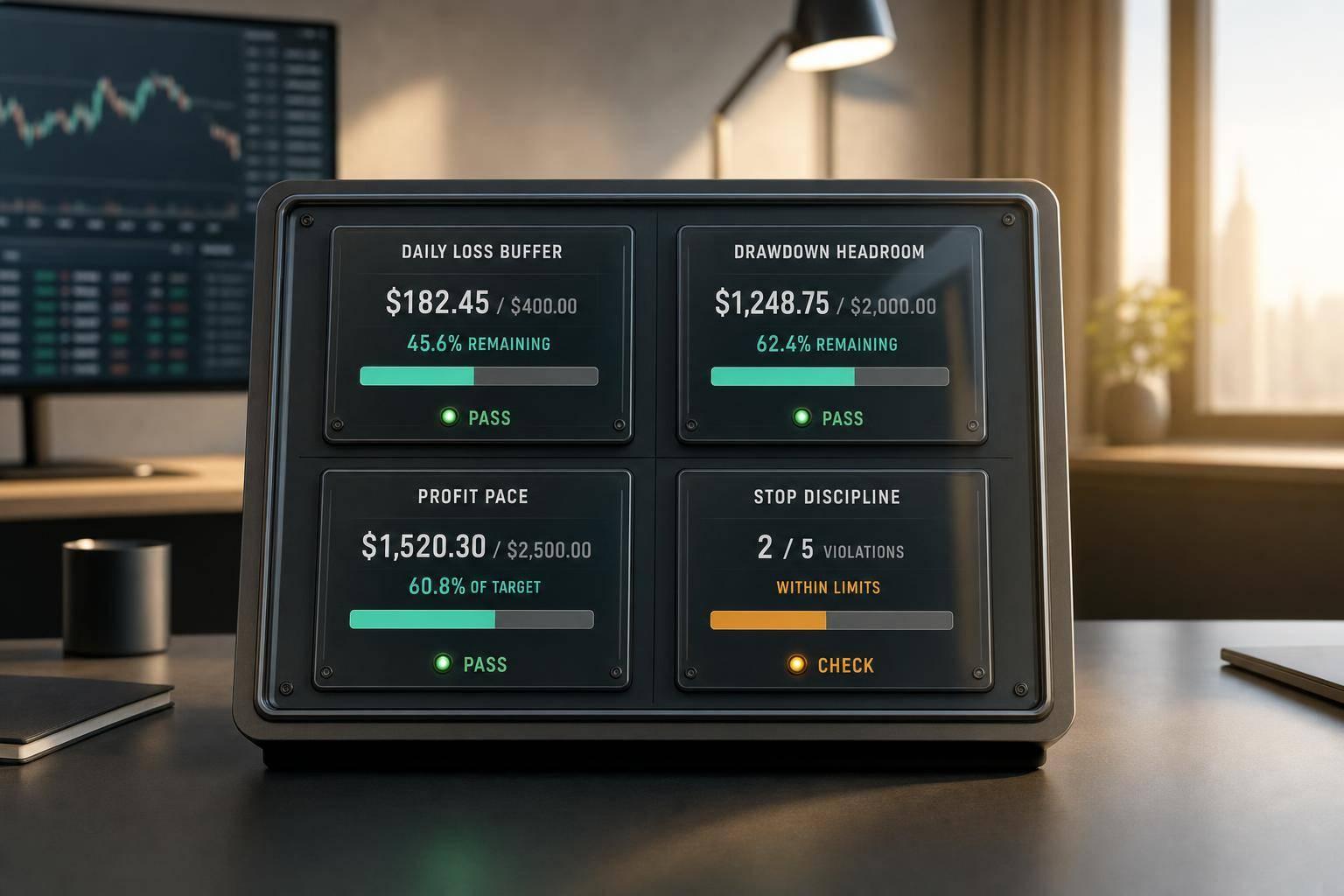
If I were tracking a prop challenge, I would focus on just four things first: daily loss buffer, drawdown room, profit target progress, and stop discipline. That is the fastest way to see whether I should keep trading, cut size, or stop for the day.
Here’s the short version:
- I track rule limits in dollars, not just percentages
- I separate realized P&L from unrealized P&L
- I check static vs. trailing drawdown as two different risk rules
- I label the account green, yellow, or red before the session starts
- I review trades each day for rule breaks, not just profit
- I use a journal to spot repeat mistakes before they end the challenge
One stat stands out: more than 90% of traders fail Phase 1 of prop evaluations. That makes one point clear: gross profit alone is not the score that matters. Rule control is.
A simple tracker should answer these questions at a glance:
- How much of the daily loss limit have I used?
- How much drawdown headroom is left?
- How close am I to the profit target?
- Am I trading inside the firm’s consistency and minimum day rules?
- Did I follow my stop and session limits today?
A small comparison helps:
| What I watch | Why I watch it |
|---|---|
| Profit target progress | Shows how close I am to passing |
| Daily loss used | Shows same-day breach risk |
| Drawdown room | Shows how much space is left before failure |
| Realized vs. unrealized P&L | Shows live exposure, not just closed results |
| Rule breaches | Shows whether discipline is slipping |
So if I wanted one takeaway from the whole guide, it would be this: I should treat progress tracking like a pass/fail control panel, not a profit scoreboard.
Most Traders Track The WRONG Metrics In 2026
How to Set Up Your Progress Tracker
Set up your tracker before the session starts. The goal is simple: keep every rule, limit, and target in one spot so you can see them fast.
Once the layout is ready, enter the fixed rules first. Then, after each session, log the day’s changes. That way, you’re not guessing where you stand when pressure kicks in.
Choose a Format: Spreadsheet, Journal, or Dashboard
A spreadsheet works well if you want hands-on control. A journaling app can help if you want trade imports and automatic rule checks.
Spreadsheets give you control. Apps give you speed and automation.
Core Fields Your Tracker Must Include
These fields should show, at a glance, whether you’re still inside the challenge rules.
| Field | What to Enter |
|---|---|
| Starting Balance | Account size at challenge start |
| Current Balance | Closed-trade balance |
| Current Equity | Balance including open trades |
| Profit Target ($) | Dollar amount required to pass |
| Daily Loss Limit ($) | Max dollar loss allowed per session |
| Max Drawdown ($) | Lowest allowed account value |
| Drawdown Type | Static or trailing |
| Minimum Trading Days | Days required by the firm |
| Completed Trading Days | Count of qualifying trading days |
Convert percentages into dollar amounts before you trade. It cuts out a common mistake. For example, a 5% daily loss limit on a $100,000 account equals $5,000.
Once the core fields are in place, add threshold markers so you can spot when risk starts getting tight, similar to how firms with low drawdown rules require strict monitoring.
Record All Challenge Rules in One Place
Add a rule-reference table at the top of your tracker. Check it at the start and end of every session.
If your challenge has a consistency rule, log that too. Some firms require that no single day make up more than 30% to 50% of total profit.
If you’re using For Traders, log the profit target and max drawdown once, then check them each day.
Set Warning Levels for At-Risk Conditions
Use 50%, 75%, and 80% of your limit as trigger points. Those markers should tell you when to cut size, stop adding new trades, and stop trading.
In a spreadsheet, you can do this with conditional formatting. Say your daily loss limit is $4,000. You might flag:
- Yellow at $2,000 used
- Orange at $3,000 used
- Red at $3,200 used
Set your own hard stop below the firm limit so you have a buffer. At 80%, stop trading to protect the account.
With the tracker ready, the next move is watching profit target progress and drawdown in real time.
How to Monitor Profit Target and Drawdown in Real Time
Once your tracker is in place and your warning levels are set, focus on two numbers first: how close you are to the profit target and how much drawdown room is left. Those numbers tell you a lot, fast. They show whether you can keep trading as usual, need to ease up, or should stop for the day.
Use them before, during, and after every trade. You can also use TradingView scripts to automate these checks.
Track Target Progress, Loss Limits, and Buffer Remaining
Track each limit in dollars and percentages. The dollar view shows the exact room left. The percentage view shows your pace.
| Metric | Dollar ($) View | Percentage (%) View |
|---|---|---|
| Profit Target | $ remaining to hit target (e.g., $4,800 left) | % of target achieved (e.g., 40% complete) |
| Daily Loss | $ remaining before you hit the daily loss limit (e.g., $1,200 left) | % of daily limit consumed (e.g., 36% used) |
| Max Drawdown | $ room to the drawdown floor | % of total allowed drawdown used |
These numbers should shape every intraday decision about size and hold time. Before you place a trade, check the buffer first. It sounds simple, but this is where many traders get sloppy.
Track Realized and Unrealized P&L Separately
Don’t combine closed results with open-trade equity.
An open position showing +$800 may look like solid progress. But if it turns, that same trade can push you into your daily loss limit before you exit. That’s why the split matters.
Log:
- Realized P&L for closed trades only
- Unrealized P&L for the floating value of open trades
Your actual intraday exposure is the total of both.
This matters even more on accounts with intraday trailing drawdown rules. In that setup, intraday trailing drawdown can move the floor up while open profits are on the screen. If those gains fade, you can still break the rule.
How to Handle Static vs. Trailing Drawdown
Use separate fields for static drawdown and trailing drawdown. They do not behave the same way, and treating them like one number can get you in trouble.
| Feature | Static Drawdown | Trailing Drawdown |
|---|---|---|
| Floor Movement | Fixed at account start; never moves up | Moves up as equity hits new highs (intraday or end-of-day) |
| Impact of Profit | Buffer grows as your balance increases | Buffer stays the same or shrinks as gains are made |
| Risk Profile | Lower; early profitability creates more room | Higher; winning streaks can tighten the floor |
| Journaling Focus | Distance from the original starting floor | Distance from the highest equity high-water mark |
With trailing drawdown, log each session’s high-water mark. That mark becomes the reference point for the floor. So even after a winning move, the account can feel tighter, not looser.
Define Ahead, On-Pace, and At-Risk Account States
Give your account a daily label with a simple three-state model. This helps take emotion out of trade decisions. Instead of guessing how aggressive to be, you follow the state.
| Status | Condition | Action |
|---|---|---|
| Ahead / Green | Target more than 50% complete; buffer largely intact | Use normal size. |
| On-Pace / Yellow | Steady progress; buffer partially consumed | Cut size and trade only A+ setups. |
| At-Risk / Red | Buffer nearly exhausted | Stop trading or cut size sharply. |
Update this status at the start of each session, not only at the end. If you begin the day already in Yellow, your sizing should reflect that before the first order goes out.
Use this live state in your daily risk checks.
Daily Risk Checks Before, During, and After Trading
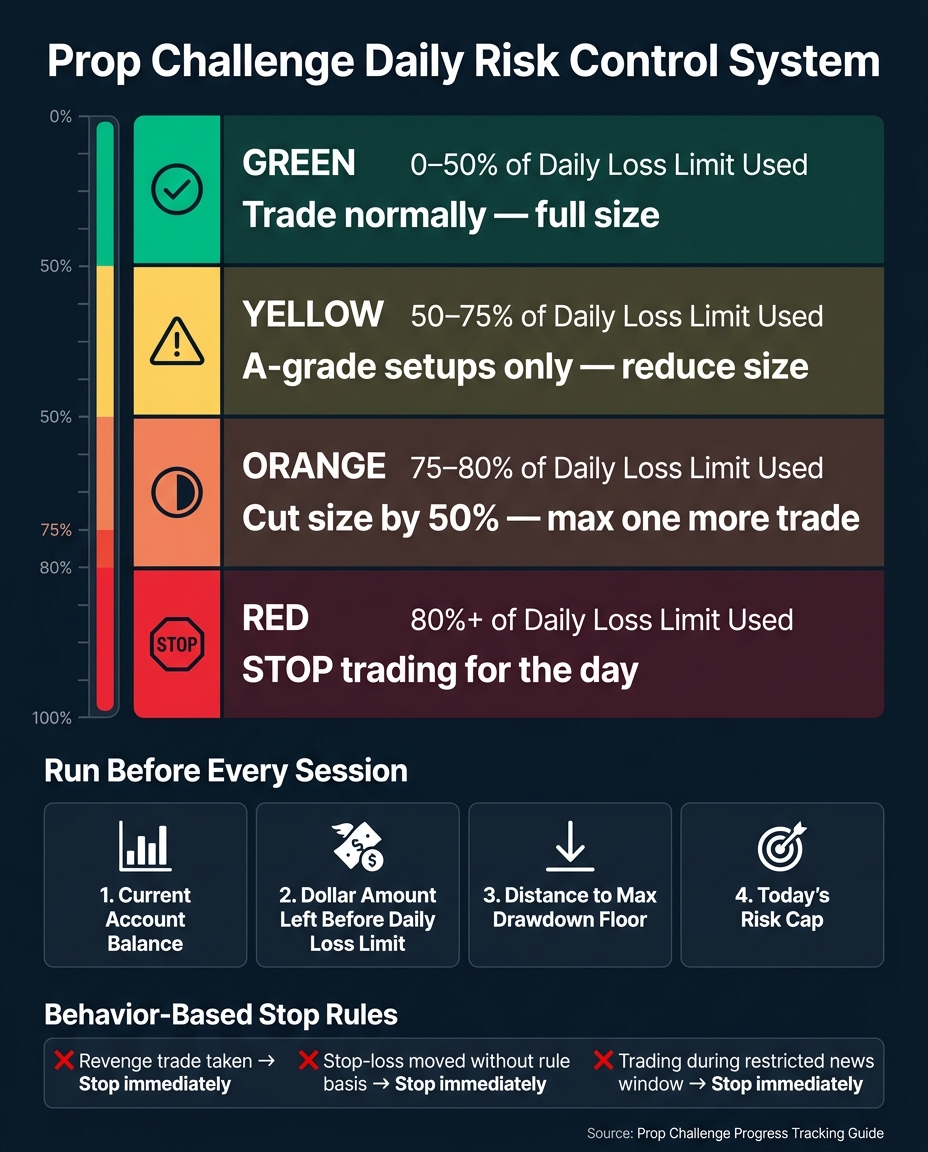
Prop Challenge Tracker: 4-Zone Daily Risk Control System
A tracker only helps if you use it before every decision. That’s the whole point of a daily risk check: take memory and emotion out of the process. You follow rules, not mood.
Run a Pre-Session Rule Check
Before you place even one trade, confirm four numbers:
- your current account balance
- the dollar amount left before you hit your daily loss limit
- the distance to your max drawdown floor
- today’s risk cap
If you’re trading a trailing drawdown account, recalculate the floor from the previous session’s equity peak, not from your starting balance. Then check the day’s high-impact macro events, like FOMC announcements, CPI releases, and NFP reports, and decide your trade-window policy before the session starts.
Write down tomorrow’s trading window, instrument, max position size, and stop trigger.
Use the account state from the previous section to set today’s size and stop levels.
Check Open Risk Before Adding New Positions
Once the session begins, every new entry should go through the same rule check. No exceptions.
Before adding any new position, calculate your combined daily P&L: realized P&L from closed trades plus unrealized P&L from open trades. Open losses still count toward the same daily limit.
Before each entry, run a three-point check:
- current combined P&L
- remaining daily and drawdown buffer in dollars
- the max potential loss on the trade you’re about to take (size × stop distance)
If that potential loss puts you too close to your remaining daily budget, cut size or pass on the trade.
Set Hard Stop Conditions for Each Session
Hard stops should be written down before the session opens, not invented in the heat of the moment. As your loss level shifts, your permission to trade should shift too. A simple four-zone stop model tied to the warning thresholds in your tracker does that job well.
| Zone | % of Daily Loss Limit Used | Required Response |
|---|---|---|
| 🟢 Green | 0–50% | Trade normally; full size. |
| 🟡 Yellow | 50–75% | A-grade setups only; reduce size. |
| 🟠 Orange | 75–80% | Cut size by 50%; max one more trade. |
| 🔴 Red | 80%+ | Stop trading for the day. |
Add behavior-based stop rules next to the money rules. Stop trading if you take a revenge trade, move a stop-loss without a rule-based reason, or trade during a restricted news window. After a stop-out, wait 5 minutes before any new entry.
Log the reason for the stop so tomorrow’s plan starts from the right risk state.
How to Review Trades Daily and Weekly
A daily risk check keeps you safe during the session. A review cycle helps you stop repeating the same mistake next week. Those are two separate habits, and both matter.
Run a Short Daily Rule-Compliance Review
Your daily review should stay tight. This is about rule compliance, not edge analysis.
Go through five steps in order:
- Log your trade data: entry, exit, R-multiple, and setup tag
- Calculate your rule meters: daily loss % used, drawdown buffer remaining, and consistency ratio
- Tag any mistakes
- Identify your main risk for tomorrow
- Write your next-day plan
Use those numbers to check compliance and set up the next session. End each review with one rule-based instruction for tomorrow.
When you tag mistakes, sort them into three buckets:
- Plan deviations: you broke a written rule
- Execution errors: the setup was valid, but the entry or exit was poor
- Unsupported trades: you took a trade with no clear basis
That split matters. It shows whether the fix is behavioral or technical.
Daily logs show compliance. Weekly logs show repeat behavior.
Use Weekly Reviews to Find Repeat Problems
Once the daily log is done, group the week by setup, time, and mistake type.
Use a 30-minute weekly review to find repeat errors. Group trades by setup type, time of day, and emotional tag. Then ask a blunt question: where is the drawdown actually coming from?
Pay close attention to how often you got near your daily loss limit. If that happened more than once in a week, you’re not looking at bad luck. You’re looking at a sizing or discipline problem.
Also flag any week where one day accounts for more than 30–50% of total profit. That can create consistency-rule problems.
Turn Review Notes Into Next-Week Rules
Turn each pattern into one rule for the next week.
Review notes mean nothing if they don’t lead to change. Every weekly review should produce at least one concrete rule for the following week.
If your losses bunch up after a second straight losing trade, make the rule: no trading after two losses in a session. If your drawdown buffer keeps getting smaller, make the rule: reduce size until the buffer recovers.
Close each week with one rule that cuts out a recurring mistake.
Build a Rule-Based Trading Journal and Track the Right Metrics
Structure Each Journal Entry Around Execution and Rules
Use your journal to turn each session’s rule checks into better decisions for the next one.
Each entry should track execution, rule status, and how much risk room is left. Include:
- Date and time
- Instrument
- Direction (long/short)
- Entry and exit prices
- Stop-loss
- Take-profit
- Position size
- Result in dollars and R-multiples
- Emotional state
- Entry chart screenshot
- Entry rule-check time
- At-entry daily buffer
- At-entry drawdown buffer
- Stop Honored?
That last field matters a lot. If Stop Honored? says “No,” treat it as a critical incident even if the trade ended in profit. A timestamped rule check shows you verified buffer before entry and keeps the journal centered on compliance first.
Focus on the Metrics That Affect Passing
Track the numbers that show whether the account can still pass.
| Metric | What to Track | Why It Matters |
|---|---|---|
| Profit vs. Target | % of evaluation target reached | Shows whether you are on pace to pass |
| Drawdown Room | Distance to the drawdown floor ($) | Tells you how much room you have left |
| Daily Loss Consumed | % of the daily loss limit used | Shows how close you are to a same-day breach |
| Rule Breaches | Number of trades with a rule violation | Highlights where discipline is breaking down |
Keep win rate, average R, and setup frequency in the second tier. Early failures usually come from a few oversized trades, not slow drift.
Use Metrics to Adjust Risk and Pace
Your journal data should lead to action, not sit there like a post-game note nobody uses. If buffer loss starts speeding up, cut position size or stop for the day.
If drawdown climbs faster than target progress, slow the pace.
When these journal trends get worse, the next move is to find the mistake that keeps showing up underneath them. This process is easier when you follow established risk management rules designed for prop challenges.
Common Tracking Mistakes That Lead to Challenge Failures
Most challenge failures start with bad tracking habits, not bad trade ideas. A lot of traders watch the right account but the wrong signal. That’s where things start to go sideways.
Tracking Profit While Ignoring Rule Pressure
A green P&L can make you feel safe while your buffer is getting smaller. That’s the trap. Traders who focus on gross profit often miss the number that decides whether they pass: how much room is left before a rule limit gets hit.
You can be up on the day and still lose a challenge. One intraday swing that breaks the drawdown floor ends the account, no matter what the closed P&L says. With trailing drawdown, this gets even trickier because profit can tighten your buffer as the floor moves up with equity.
Track your live distance to the floor right next to your P&L. If that buffer starts to shrink, cut size before the next entry.
This gets worse when you only look at end-of-day numbers.
Using End-of-Day Numbers Instead of Intraday Risk
End-of-day reports miss intraday breaches because daily loss rules usually include unrealized P&L. So a day can finish green even if open losses crossed the limit earlier in the session. Once the rule is broken, the challenge is over at that moment, not at the close, and an EOD summary won’t show it.
Near-misses get hidden too. Maybe open positions pushed you close to the daily limit in the morning, then bounced back by the close. On paper, the day looks normal. In practice, the same bad habit is still sitting there.
Log session high equity so you know where the trailing floor now sits.
Too many metrics can cause the same problem in a different way.
Tracking Too Many Metrics and Missing the Important Ones
Overloaded journals bury the numbers that matter. If your dashboard tracks everything under the sun, the figures that decide whether you pass can get lost in the noise: profit progress, remaining buffer, daily loss used, and rule compliance.
Mixing personal, sim, and evaluation trades in one journal also muddies the picture. It becomes much harder to spot rule-compliance trends that belong only to the evaluation account. Keep evaluation accounts in a separate tracker.
A simple rule helps here: if a metric does not affect today’s pass/fail risk, move it to a secondary review. Your main dashboard should show only what you need to decide whether to trade, cut size, or stop.
Conclusion: Use Tracking to Pass Challenge Stages With Fewer Mistakes
Once setup, monitoring, and review are in place, the goal is simple: keep the account inside the essential trading rules. Passing a prop challenge comes down to rule control, not perfect trades. Tracking works best when it helps with live decisions, not when it only records what already happened.
Keep your tracker open before every session, watch your remaining buffer at all times, and review results each day and each week. Focus on four metrics:
- Daily loss buffer
- Drawdown headroom
- Profit target progress
- Stop discipline
These numbers show when to trade, when to cut size, and when to stop.
Systematic journaling is a common trait among traders who pass. Logging brings repeating mistakes into plain view and ties straight into the execution and rule-compliance framework built throughout this guide.
Use For Traders to put these tracking habits to work in a simulated evaluation environment.
FAQs
How often should I update my prop challenge tracker?
Update your prop challenge tracker after every trade so you always have a clear view of your risk and how much drawdown room you have left. That way, you can catch rule slips or see when you're getting too close to loss limits before you open the next position.
It also helps to do a short pre-session review. Check your starting headroom so you know exactly where you stand before the day begins. Then set aside time each week for a broader review. Look at your win rate, your progress, and how close you are to hitting your challenge goals.
What is the biggest difference between static and trailing drawdown?
The main difference comes down to how the drawdown floor moves as the account changes.
With static drawdown, the floor stays fixed at the starting balance minus the drawdown limit. So if you make money, your risk buffer gets bigger over time.
With trailing drawdown, the floor moves up with your peak equity. That means your buffer doesn’t grow in the same way, and giving back unrealized profit can put you at higher risk of breaking the account rules.
What should I do if I hit 80% of my daily loss limit?
If you hit 80% of your daily loss limit, treat that as a hard warning.
Don’t keep trading like nothing changed. Tighten your stops or cut your position size right away so you don’t slip into a full account breach.
At that stage, the safer move is to stop trading, reset your daily risk budget, or switch to lower-volatility products like micro futures to protect the capital you still have.
Related Blog Posts
Start Trading with For Traders
Join our platform to test your trading skills, trade virtual capital, and earn real profits. Access educational resources, advanced tools, and a supportive community to enhance your trading journey.
Start your Trading Challenge