The Ultimate Funded Trader Toolkit for 2026
Essential platforms, charting, risk controls, journaling, and community tools every funded trader needs to pass challenges and manage funded accounts in 2026.
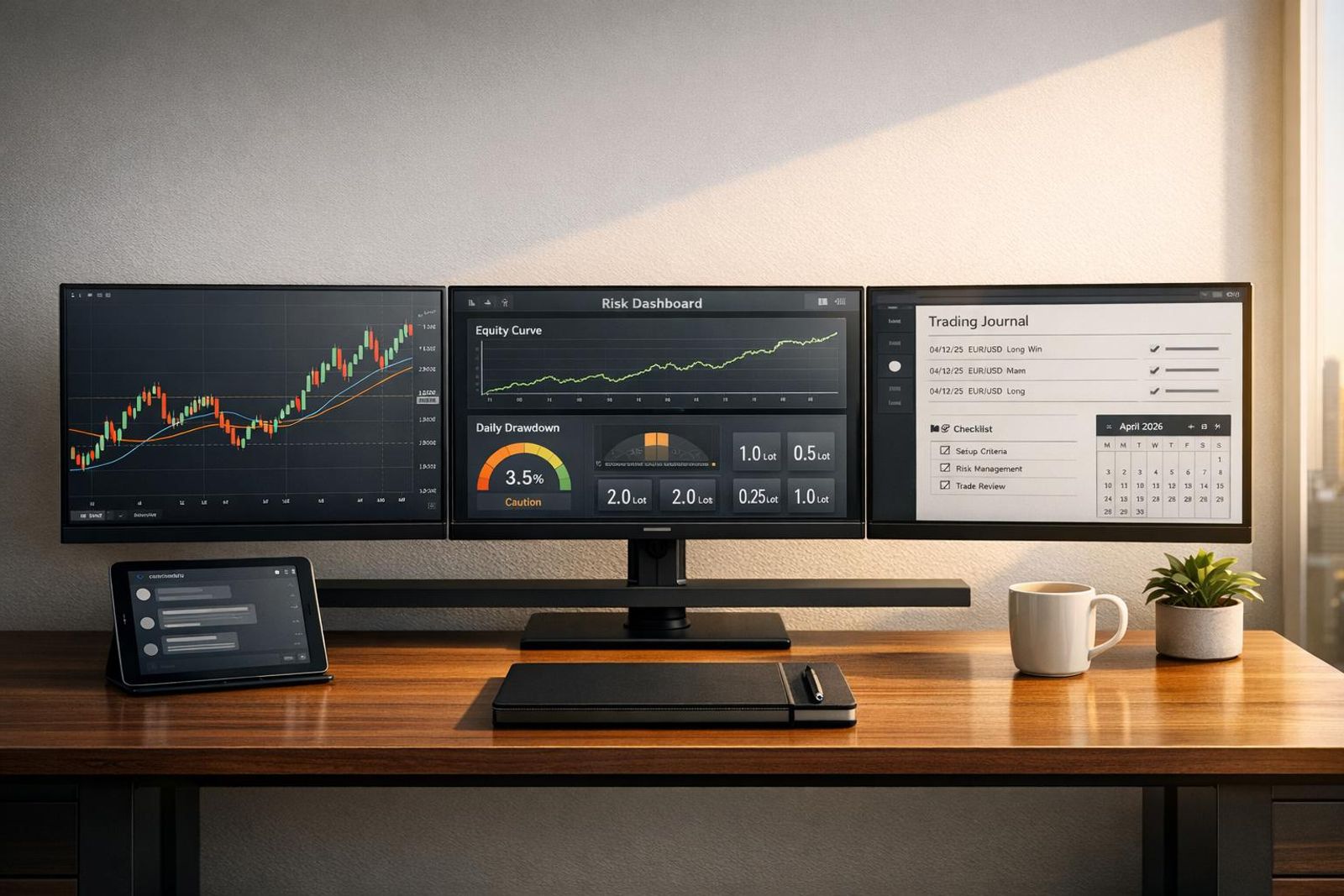
The funded trading world is more competitive than ever, with over 90% of traders failing challenges due to poor tools and risk management. Success hinges on using the right platforms and systems to meet strict prop firm rules. Here’s a quick breakdown of the key tools every funded trader needs:
- Execution Platforms: Low-latency platforms like MetaTrader 5, cTrader, and NinjaTrader ensure fast order fills and automated risk management.
- Charting Tools: TradingView dominates with advanced technical analysis, custom scripting, and real-time alerts.
- Risk Management Systems: Automated tools for stop-losses, drawdown tracking, and daily loss limits protect your account.
- Journaling Software: TradesViz and TradeTrakR turn trading data into actionable insights, highlighting strengths and weaknesses.
- Educational Resources: Communities, webinars, and tailored courses build trading skills and discipline.
The best traders combine these tools into a structured system, focusing on risk control and consistent performance. Whether you’re starting a challenge or managing multiple accounts, these tools can help you trade smarter.
Top 5 Must-Have Forex Trading Tools for 2025 | Beginner Trader Essentials
New to the industry? See how funded trading accounts work before choosing your toolkit. ###### sbb-itb-9de3b6e
1. Trading Platforms and Execution Tools
In funded trading, the tools you use for execution are more than just a convenience - they're a critical part of your strategy and a safeguard for your capital. With strict drawdown rules in place, even a millisecond delay in execution can lead to costly mistakes, especially in fast-moving markets. That's why your chosen platform must excel in speed, reliability, and functionality. It should handle quick order fills, support automation, and provide a clear view of market depth.
The most reliable platforms for funded traders share some essential features: low-latency execution to reduce slippage, support for algorithmic trading to run Expert Advisors or custom scripts, and advanced risk management tools like automated bracket orders. These features ensure stop-losses and take-profits are automatically set as soon as you enter a trade. Understanding and tracking drawdown in real-time is also indispensable, giving you visibility into how close you are to breaching the firm's limits.
"The trading platform is the base of every trader's work. It is where market analysis, order execution and risk management come together." - Anna H., Prop Insider
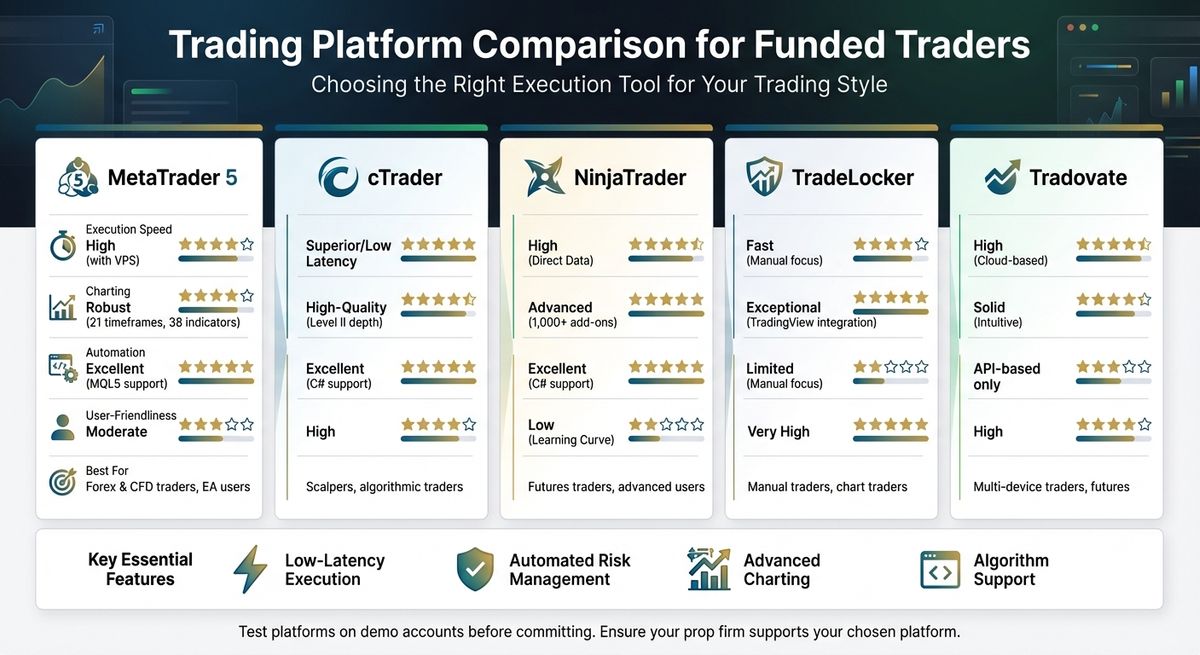
For Forex and CFD traders, MetaTrader 5 stands out with its 21 timeframes, 38 built-in indicators, and robust support for MQL5-based Expert Advisors. Another strong contender is cTrader, known for its superior execution speeds and Level II market depth, which reveals resting liquidity and large orders. Futures traders, on the other hand, often prefer NinjaTrader, which offers advanced order flow tools like Depth of Market (DOM) heatmaps and compatibility with over 1,000 third-party add-ons. Cloud-based platforms like Tradovate and TradeLocker are becoming increasingly popular for their ability to sync seamlessly across desktop, web, and mobile devices, making it easier to manage trades on the go.
Below, we’ll look at the most important platform features and compare some of the top tools for funded traders.
1.1 Key Platform Features
Execution quality is a non-negotiable aspect of any trading platform. Both cTrader and MetaTrader 5 offer direct market access and transparent pricing, which help reduce slippage during high-volume trading sessions. For scalpers, features like one-click trading or "QuickTrade" buttons allow for instant trade entries and exits without navigating through multiple menus.
If you rely on algorithmic trading, the platform's coding environment matters. MetaTrader 4 and 5 use MQL for creating Expert Advisors, while cTrader and NinjaTrader support automation through C#. To ensure uninterrupted performance for automated strategies, consider using a VPS (Virtual Private Server) for low-latency, continuous operation. For manual traders, platforms like TradeLocker integrate with TradingView, combining top-tier charting with fast execution.
Another crucial feature is order flow visualization, which helps refine decision-making. Tools like Bookmap provide microsecond-level data and liquidity heatmaps to track large orders and institutional activity. NinjaTrader’s Market Replay feature, which allows you to practice strategies on historical data with full order book depth, is invaluable for testing and refining your approach before risking real capital.
Risk management automation is just as important. Platforms should support bracket orders, where stop-loss and take-profit levels are set automatically when a trade is opened. Some platforms even offer daily loss alerts and real-time drawdown trackers, which act as a buffer to prevent accidental breaches of the firm's limits. A good practice is to set your personal stop-loss slightly tighter than the firm's rules to avoid unexpected violations during volatile market conditions.
1.2 Platform Comparison Table
Before committing to a platform, test it using a demo account to ensure it aligns with your trading style and speed requirements. Additionally, make sure your chosen prop firm supports the platform. For example, firms like Eightcap offer MT4, MT5, and TradeLocker, while others specialize in environments like Tradovate for futures. Scalpers will benefit from features like DOM and one-click execution, while swing traders will appreciate robust charting and alert systems.
2. Charting and Technical Analysis Tools
Your charting software is where planning meets action. In funded trading, you need more than just basic candlestick charts. Advanced tools that display volume distributions, synchronize multiple timeframes, and send real-time alerts off-platform are essential. The quality of your tools and their integration directly impacts the reliability of your trading signals.
Modern charting platforms now offer features that were once reserved for institutional traders. For example, Volume Footprint charts let you see exactly where buyers and sellers are positioned at different price levels. Meanwhile, Time Price Opportunity (TPO) charts help pinpoint value areas and market imbalances throughout a session. If you’re juggling multiple instruments or timeframes, syncing up to 16 charts per screen with matching symbols and drawings is a game-changer for spotting opportunities across markets.
Custom scripting, like Pine Script, allows traders to combine price, volume, and volatility into powerful indicators. For instance, you can create an alert that triggers when price breaks a key level, RSI crosses above 30, and volume spikes - all at once. These alerts can notify you via webhooks, email, or mobile, working around the clock so you’re not glued to your screen.
"Pine Script is elegantly minimalist, pre-integrated with data, and breaking your analysis limits." – TradingView
Before putting money on the line, Market Replay lets you practice your strategy using historical data. This feature allows you to step back in time and execute trades as if they were happening live. It’s a critical step for building confidence and consistency before tackling a funded challenge.
2.1 TradingView: The Industry Standard
TradingView is a favorite among traders, boasting a community of over 100 million users. It offers access to more than 400 built-in indicators, over 100,000 scripts contributed by the community, and coverage of 3.5 million financial instruments worldwide.
The platform’s multi-timeframe analysis and cloud-based alerts let you monitor the daily trend on one chart while pinpointing precise entry points on another - all in a synchronized layout. While the free version includes one chart per layout and three indicators, many serious traders upgrade for additional features like unlimited indicators, more charts per layout, and advanced alert capabilities.
Pine Script, TradingView’s custom scripting language, makes creating personalized indicators straightforward. You don’t need to be a coding expert to set up alerts, like one that triggers when the MACD crosses above its signal line and RSI is below 30. These alerts run on TradingView’s cloud servers, ensuring they work 24/7, even when your computer is off.
Another standout feature is Bar Replay, which allows you to move through historical data one candle at a time. Many traders use this tool to simulate at least 50–100 trades and refine their strategies before committing to a funded challenge.
TradingView’s pricing is flexible. The Essential plan starts at $14.95/month with two charts per layout, five indicators, and five alerts. The Plus plan at $29.95/month increases this to four charts, ten indicators, and ten alerts. For advanced traders, the Premium plan at $59.95/month offers eight charts per layout, unlimited indicators and alerts, and even second-based charts for scalping.
While TradingView stands out as a top-tier charting tool, its real power shines when integrated directly with trading platforms.
2.2 Integration with Trading Platforms
Smooth integration between your charting and trading platforms is crucial for executing trades effectively. Direct integration reduces the risk of manual entry errors, especially during volatile market moves. Platforms like TradingView now connect seamlessly with execution tools such as Tradovate, TradeLocker, and DXtrade. This integration allows you to place orders, manage brackets, and adjust stop-loss levels directly from the chart interface.
This "chart trading" functionality means you can drag and drop stop-loss or take-profit levels directly on the chart, and the platform applies them to your live position automatically. For funded traders working under low drawdown rules, this kind of automation ensures risk controls are in place the moment you trade.
Another key advantage is cross-device synchronization. Whether you’re on a desktop, mobile, or tablet, your chart layouts, indicators, and watchlists stay updated. This flexibility allows you to analyze setups at your desk and monitor positions on the go. For traders managing multiple prop firm accounts, tools like Tradovate Prop enable you to oversee accounts from different firms in one streamlined environment, keeping your workflow consistent.
The quality of your data feed is just as important as integration. Always ensure your charting tool uses real-time data from reliable sources like CME for futures. Delayed or aggregated data can lead to poor trades and even unintentional rule violations under tight daily loss limits. Some firms, like Eightcap, use regulated broker infrastructure to provide raw pricing and execution that closely mirrors live market conditions.
"Delayed/wrong data = bad trades." – PropFirmApp
Finally, verify that your prop firm’s execution platform integrates directly with your chosen charting tool. For example, if your firm uses MT5, ensure TradingView supports direct order placement through MT5. The goal is to create a seamless workflow where analysis, execution, and risk management all happen in one place.
Ready to trade funded capital?
Choose your path — Instant Accounts, One-Step or Two-Step Challenges — from just $23, with up to $300,000 in funded capital.
Choose your challenge3. Risk Management and Performance Monitoring
While advanced charting tools can refine your market entries, it's solid risk management that ultimately protects your capital. In funded trading, managing risk effectively is crucial for long-term success. Poor risk management is one of the biggest reasons traders fail, but using a structured approach can cut losses by as much as 50%. In a fast-paced environment where decisions can lead to either big wins or significant losses, maintaining discipline in risk management is non-negotiable.
Today's trading platforms come equipped with automated tools designed to act like financial safety nets. For instance, automated bracket orders allow you to set stop-loss and take-profit levels the moment you enter a trade. Position sizing calculators are another game-changer, converting your chosen risk percentage (like 1% of your account) into precise position sizes based on your stop-loss distance. These tools help prevent over-leveraging, and data shows that about 65% of traders now use them to manage their exposure.
On top of that, many platforms offer features like daily loss caps, which automatically stop trading once you've hit a predetermined limit. You can even set alerts to warn you when you're nearing these thresholds. Top-tier prop traders often limit their risk per trade to just 0.25% to 0.5%, giving themselves more room to bounce back from losing streaks.
"Risk management is the foundation of success in prop trading. Whether you're trading with a funded account or completing a challenge, your ability to manage risk can make or break your career." – OANDATeam
3.1 Automated Risk Management Features
Automated tools make it easier to follow prop firm risk management rules without constant manual oversight. Platforms like Tradovate offer real-time risk dashboards that monitor your equity curve, margin usage, and daily or overall drawdown as you trade. This level of transparency is essential, especially when juggling multiple positions across various markets.
A smart risk strategy is to size your trades in a way that allows for at least 10 to 20 consecutive losses before hitting your maximum drawdown limit. Another helpful tactic is setting profit giveback thresholds - automated trailing stops can lock in gains by adjusting as your trade moves in your favor.
For those managing multiple funded accounts, tools like Tradovate Prop include trade copiers, ensuring consistent risk parameters across all accounts at the same time. These automated options not only simplify risk management but also pave the way for seamless performance tracking.
3.2 Performance Dashboards and Analytics
Beyond risk management, performance analytics play a huge role in refining your trading strategy. Performance dashboards take raw data and turn it into meaningful insights. You can track equity curves, drawdowns, and payout statuses in real time, giving you a clear view of your progress and compliance with firm rules. Platforms like Propfolio even combine data from multiple prop firms into one interface, making it easier to compare results and identify what’s working.
Metrics like the Sharpe ratio go beyond just profits, offering a deeper understanding of how your returns stack up against the volatility of your trades. Behavioral analysis tools can highlight your most successful setups and pinpoint recurring mistakes.
These dashboards also help you stay compliant with trading rules. For example, they’ll notify you if you’re nearing your daily loss limit or if your trading activity risks breaking consistency rules (like ensuring no single day accounts for more than 15–30% of total profits). Interestingly, traders who keep their daily losses below 50% of the Daily Loss Limit tend to achieve funded status 2.3 times faster than those who frequently push the limit.
"Over 90% of traders fail due to poor risk management." – TradersDNA
Platforms like Propfolio offer a Pro version for $29.99 per month, which includes unlimited account tracking and AI-driven insights. On the other hand, TradersX provides free basic features, such as document storage for payout receipts and funded account certificates. These tools encourage disciplined, data-focused trading by emphasizing metrics like expectancy and drawdown.
4. Trade Journaling and Analytics Tools
Having a solid risk management plan is essential, but it’s not complete without detailed trade records. Trade journaling takes things to the next level, transforming raw data into insights that can sharpen your trading skills. By keeping a journal, you can track outcomes and uncover patterns you might not notice otherwise. It’s not just about recording trades - it’s about deepening your understanding of how markets work.
Today’s journaling platforms go far beyond basic spreadsheets. Take TradesViz, for example. It offers over 600 statistics and performance visualizations, making it a powerhouse for traders looking to analyze their performance in detail. Even better, its AI-powered Trade Chat feature lets you ask questions like, “Why do I lose money on Fridays?” and get instant, data-driven answers.
Tracking your mental state is just as important as monitoring profits and losses. Tools like TradeTrakR include features like tilt meters, which measure emotional states and link them to trading outcomes. One trader, Marcus K., shared how this helped him: “The AI caught a pattern I didn’t even know I had. Stopped revenge trading on Fridays and passed my FTMO eval in 8 days”. For traders managing funded accounts, such insights can mean the difference between success and failure.
"TradesViz is the most useful trading journal on the market for finding and quantifying your edge." – Steve Burns, Founder of NewTraderU.com
4.1 Features of Effective Journaling Platforms
The best journaling tools combine psychological insights with hard data. For instance, metrics like Maximum Favorable Excursion (MFE) and Maximum Adverse Excursion (MAE) are key. MFE shows the highest unrealized profit during a trade, while MAE tracks the largest unrealized loss. Comparing these figures to your actual exit points can reveal if you’re cutting profits short or allowing losses to grow too large.
For prop traders, staying within firm rules is critical. Platforms like TradeTrakR and PlanningTrade include breach guards to monitor daily loss limits, trailing drawdowns, and maximum contract sizes in real time. These alerts can prevent costly rule violations that might jeopardize your funded account. Pricing varies: TradeTrakR costs $14.99 per month (or $7.99 when billed annually), while PlanningTrade offers its full feature set for free, including tools for mentorship and backtesting.
Another standout feature is strategy tagging. By labeling trades with specific setups - like ICT concepts, scalping, or breakout strategies - you can quickly identify which approaches yield consistent profits. This kind of clarity helps refine your trading edge.
4.2 Integration with Trading Accounts
Manual data entry can be tedious and error-prone, which is why automation is now the standard. Many platforms offer auto-sync capabilities to streamline the process. For example, TradesViz supports syncing with over 200 brokers, including MetaTrader 4 or 5, NinjaTrader, and Tradovate. Similarly, TradeFuse has already logged over a million trades from 50+ brokers, pairing automated importing with AI-driven insights. By automating data entry, traders can save over 40% of their time and focus more on actual trading.
For funded traders, syncing methods need to be secure and compliant. Some prop firms flag accounts when they detect logins from multiple IP addresses, which can lead to issues. PlanningTrade tackles this by offering IP-friendly syncing options, ensuring your account stays in good standing.
Managing multiple accounts across different prop firms is another challenge. Tools like TradesViz and PlanningTrade consolidate data from several accounts into one dashboard, giving you a clear, portfolio-level view of your performance. This makes it easier to see which accounts are doing well and helps you allocate your time wisely.
5. Community and Educational Resources
Success in trading isn't just about mastering technology or analytics; it's also about building a strong network and continually improving your skills. Trading in isolation can hold you back, while tapping into communities and educational resources can make all the difference in achieving your goals.
5.1 Community Platforms and Peer Collaboration
As trading evolves, so does the need for active and supportive networks. These communities go beyond being social spaces - they’re hubs for real-time insights, shared strategies, and mutual support. Platforms like Discord and Telegram have become go-to spaces where traders exchange live setups, discuss technical indicators, and help each other navigate volatile markets.
Take All In Traders, for instance. Their Discord community boasts over 10,839 active members and offers up to 40 hours of live trading sessions each week. These sessions give traders firsthand exposure to professional strategies in action. Beyond the virtual space, they also hosted ALLinCAMP 2025 in Turkey from September 20–27, 2025. This event brought together over 10,000 traders for an immersive experience, including live trading, Smart Money Concepts training, and one-on-one mentoring sessions.
Trading can feel isolating, especially during tough times like drawdowns. Communities provide a support system that helps traders stay disciplined and avoid emotional pitfalls like revenge trading. This is particularly crucial for those managing funded accounts with strict drawdown limits. Some trading platforms even integrate AI tools, such as ScanAI, to assist members in analyzing macroeconomic data, enabling collaborative, data-driven decision-making.
5.2 Educational Content and Resources
Alongside community support, structured education plays a key role in refining trading skills. This becomes even more important when considering that over 80% of traders failed Phase 1 of their challenges at FundedNext in 2023. To address this, many educational platforms now offer tailored learning paths. For example, some academies split their content into tracks like "Challenge Preparation", which focuses on rules and risk management, and "Funded Trader Mastery", which emphasizes scaling and long-term consistency.
Video courses have also shifted to a more flexible streaming model, with some platforms offering 100+ lessons covering topics from technical strategies to trading psychology. This structured approach helps traders systematically tackle common mistakes, especially when operating under the strict rules of proprietary trading firms.
"The risk management course was a game-changer. I passed my challenge on the first attempt and now manage multiple funded accounts", said Michael Chen, a funded trader handling a $200,000 account.
Live webinars and Q&A sessions further bridge the gap between theory and practice. Weekly sessions led by experienced traders allow participants to compare their market analysis with expert insights, helping them identify and correct blind spots. Some platforms also include digital performance coaching tools, like TopStep's "Coach T", which provides real-time feedback based on trading data. These tools encourage accountability and help traders build better habits. For those aiming to scale their trading careers, these resources are essential for transitioning from passing challenges to managing significant capital.
Conclusion
Building a successful funded trading career in 2025 hinges on how well you integrate the tools at your disposal. Your execution platform, charting software, risk management dashboards, and journaling tools shouldn't function as standalone apps. Instead, they need to operate as a seamless system, supporting your long-term trading goals.
Recent data from 2023 revealed that over 80% of traders failed phase one of their challenges at FundedNext. The common culprit? A lack of disciplined, long-term risk management. These numbers emphasize that success in trading isn’t just about talent - it’s about shifting your mindset. Moving from a "challenge mentality" to a "funded mentality" means focusing on preserving capital rather than chasing quick profits. Top traders use structured approaches like the 3-Level Protection System (alerts at -2%, stops at -4%, emergency pauses at -6%) and frameworks such as the 3-2-1 Strategy (trading a maximum of 3 days per week, 2 trades per day, with a 1% weekly profit target).
"In trading, luck doesn't last. Structure does." - ATFunded
Start with the basics: a stable execution platform, dependable charting tools, and automated risk controls. As your skills and experience grow, expand your toolkit with specialized features. While advanced tools can enhance decision-making and help you avoid expensive errors during volatile sessions, they are only as effective as the trader using them.
Take a moment to evaluate your current setup. Look for gaps in risk management, automate your journaling process, and test new platforms on demo accounts vs funded accounts before putting real money on the line. Whether you’re tackling your first challenge or managing multiple funded accounts, having a disciplined and adaptable toolkit can transform trading from a high-stakes gamble into a sustainable career path.
FAQs
What should I look for in a trading platform to succeed as a funded trader?
When picking a trading platform for funded trading, it's important to focus on features that help you manage risk, ensure ease of use, and deliver consistent performance. Look for platforms that simplify setting stop-loss and take-profit orders - these are essential for keeping your trades within the rules of funded accounts and minimizing risk. Access to real-time market data, advanced charting tools, and technical analysis features is a must for making well-informed trading decisions.
Speed and reliability are especially crucial during volatile market conditions, where even small delays can affect your trades. Opt for platforms that allow customization, support trading across multiple asset classes (like forex, stocks, and futures), and have transparent fee structures. Choose one that matches your trading style and offers tools that boost efficiency while meeting the requirements of funded trading programs.
How can tools like TradingView improve my trading strategy?
Advanced charting tools like TradingView can take your trading game to the next level. They offer a wide range of customizable features, including multiple chart types, various timeframes, and an array of technical indicators. These features help you spot trends, pinpoint entry and exit opportunities, and even anticipate potential market reversals. In short, they provide a clearer window into market behavior, enabling more informed decision-making.
One standout aspect of TradingView is its support for real-time analysis and strategy testing. This means you can fine-tune your trading approach before committing to a trade. Plus, its collaborative features connect you with a vibrant community of traders. You can share ideas, discuss strategies, and gain insights from seasoned professionals.
Another bonus? TradingView integrates smoothly with other trading platforms. This ensures quick execution and helps you respond faster to market shifts - an essential edge in today’s fast-moving markets.
Why is risk management essential for success as a funded trader?
Risk management is the backbone of success for funded traders. It’s what keeps your trading capital safe and ensures your account stays stable over the long haul. By applying strategies like setting daily loss limits, carefully managing position sizes, and sticking to strict risk-per-trade rules, you can reduce losses - even when markets get unpredictable.
It’s not just about protecting your account, though. Good risk management helps you stay consistent and avoid emotional decisions like overtrading or taking on too much risk. These are the kinds of mistakes that can drain your account faster than you might expect. Tools like stop-loss orders and daily loss buffers act as safety nets, helping you stay disciplined and weather tough market conditions.
At the end of the day, risk management isn’t just a box to check - it’s the key to building steady growth and maintaining your funded status over time.
Ready to trade funded capital?
Choose your path — Instant Accounts, One-Step or Two-Step Challenges — from just $23, with up to $300,000 in funded capital.
Choose your challengeTrade up to $300,000
Choose challenge