How Demo Accounts Help Build Trading Skills
How demo accounts help build trading skills: what they teach, what they can't, and how to bridge to funded capital via prop firm evaluations.
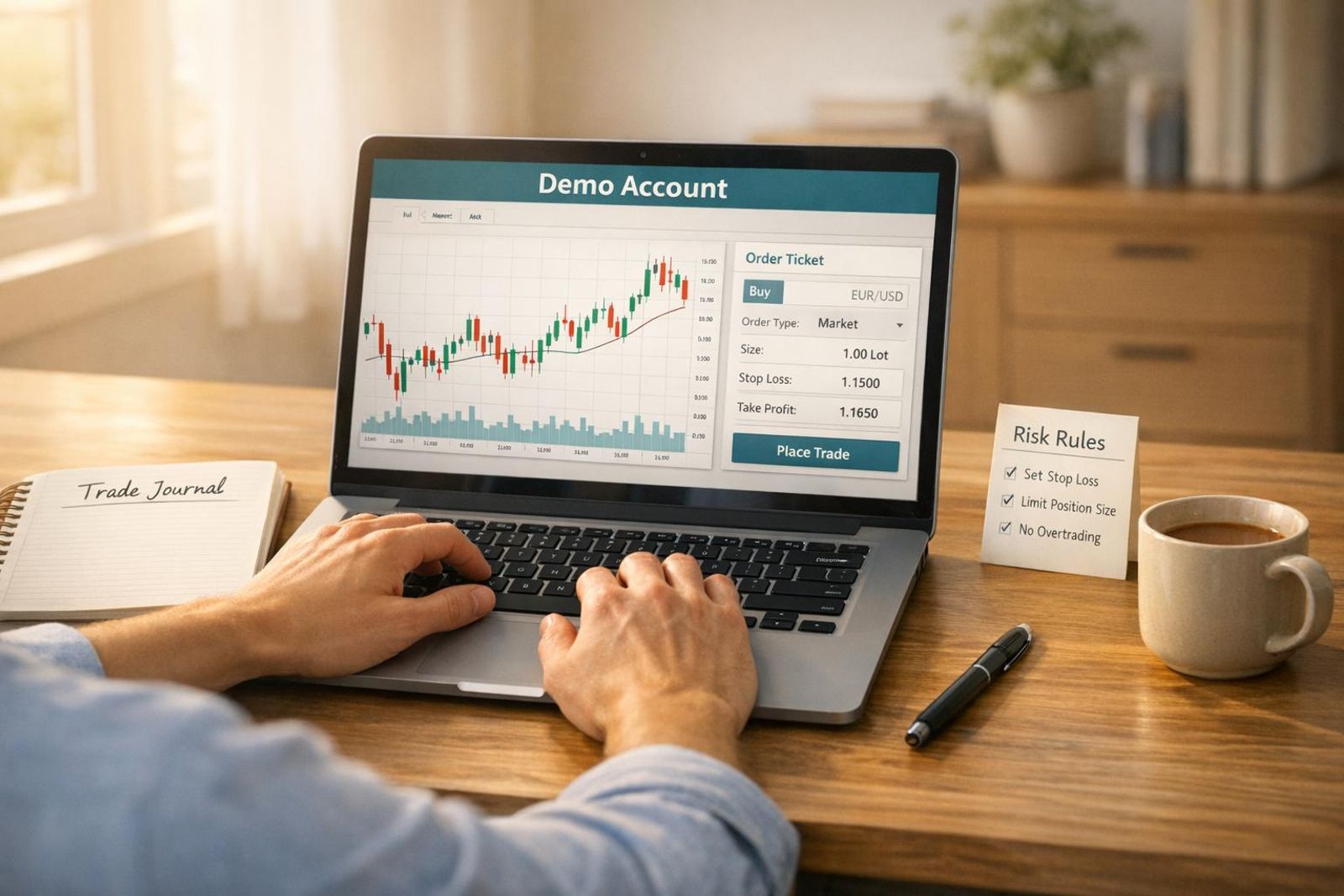
By Lenka Rož Schánová · Operations & Risk, For Traders
A demo trading account is a simulated environment that mirrors live market prices and order flow using virtual capital — it builds skills by letting you practise execution, risk management, and strategy without financial loss, but only bridges to live results when paired with structured progression and real emotional stakes (like a prop firm evaluation).
Key takeaways
- Demo accounts use real-time market data but simulated fills — most of the mechanics translate, but emotional pressure and slippage often do not.
- The reason most demo winners lose live is psychological capital, not skill — the fix is progressive stake escalation.
- Risk management drills (position sizing, stop placement, max daily loss) are the highest-ROI use of a demo account.
- A structured 30/60/90-day demo plan beats open-ended practice by a wide margin.
- A prop firm challenge is essentially a demo account with real performance rewards — the natural bridge between free demo and live capital.
- The best demo accounts replicate real spreads, realistic order execution, and enforce risk limits similar to a funded account.
Demo Account Meaning: What It Actually Is
A demo account is a simulated trading environment that streams real-time market data and processes orders against virtual capital — you see the same prices as live traders, but no real money ever changes hands.
The Technical Definition
At its core, a demo account is a software environment — provided by a broker, trading platform, or prop firm challenge provider — that connects to the same live price feeds as a real account. When you place a buy order on EURUSD at 1.0842, that price is genuine. The bid-ask spread you're crossing is real. The slippage you experience during an NFP spike reflects actual market conditions. The only thing that isn't real is the capital behind the trade.
Most platforms fund demo accounts with a preset virtual balance — commonly $10,000 to $200,000 depending on the provider — and track your equity, margin, drawdown, and P&L exactly as a live account would. The execution engine runs the same logic; the settlement just never hits a real bank account.
Simulated Capital vs Real Market Data
This distinction matters more than most new traders realise. The data is real — price, volume, spread, liquidity conditions. The money is not. That split is what makes demo accounts genuinely useful for practising execution mechanics, and simultaneously what limits them as a complete preparation tool.
When gold (XAUUSD) spikes 40 points in two seconds on a Fed statement, your demo account shows that move in real time. You'll feel the chart move. What you won't feel is your pulse. The simulated capital means there's no financial consequence if your stop doesn't fill where you expected, and that absence of consequence changes how you make decisions — sometimes in ways you don't notice until you're trading real stakes. That's the gap demo accounts help you approach, but can't fully close on their own.
What a Demo Account Is NOT
Three things traders regularly confuse with demo accounts — and why the distinction matters:
- Paper trading: Manually logging hypothetical trades in a spreadsheet or notebook. No live price feed, no real order simulation, no spread or slippage. Paper trading is slower and cruder — useful for early concept testing, not for execution practice.
- Backtesting: Running a strategy against historical price data, either manually or with automated scripts. Backtesting tells you how a system would have performed. A demo account tests how you perform in real-time conditions. These answer different questions.
- A prop firm evaluation: A structured challenge where you trade on simulated capital under defined rules — max drawdown limits, daily loss limits, minimum trading days — with a real financial stake (the challenge fee) and a real reward (a funded account and performance rewards) if you pass. A demo account has none of those constraints. The evaluation borrows the demo account's simulated capital but adds accountability, rules, and consequence — which is exactly what makes it a more powerful skill-building environment than a free demo alone.
Understanding what a demo account actually is — and where it ends — is the starting point for using it deliberately rather than just using it to feel busy.
Why New Traders Use Demo Trading Accounts
Most new traders open a demo account for one reason: they don't want to lose real money before they know what they're doing. That instinct is correct. Traders who skip the demo stage and go straight to live capital have a measurably shorter runway — industry data consistently shows that a significant portion of retail traders blow their first live account within 90 days, often because they never stress-tested their execution in a consequence-free environment first.
But "not losing money" is only the surface-level benefit. A demo account is doing six distinct jobs simultaneously, and understanding all six is what separates traders who use it deliberately from those who just click around until they feel ready.
Learning the Platform Without Risking Capital
Every platform has its own logic — where the order ticket lives, how to set a stop-loss at entry versus at a price level, what "close at market" actually does in fast conditions. These are not things you want to discover mid-trade when XAUUSD is moving 15 dollars in 90 seconds. Demo time is where you build platform muscle memory: pulling up charts, switching timeframes, placing and modifying orders, reading the depth of market. The goal is that by the time you trade live or enter a funded challenge, the interface is invisible and your attention is entirely on price action.
Testing Strategies Before Committing Money
A strategy that looks clean on a backtested chart often behaves differently in real-time execution. Entries that seemed obvious in hindsight arrive with noise, conflicting signals, and ambiguous candle closes. Demo trading forces you to make those calls in real time — to decide whether that pullback to the 50 EMA is a valid entry or a trap — without the distortion of knowing how it resolves. Run at least 50 to 100 trade samples on demo before drawing any conclusions about a strategy's edge. Anything less is anecdote, not data.
Building Baseline Confidence and Screen Time
Screen time compounds. The trader who has watched 500 hours of live price action across different sessions — London open, New York overlap, post-FOMC volatility — reads a chart differently than someone who has only studied static examples. Demo accounts provide that repetition without tuition fees. Confidence built this way is earned confidence: you've seen price behave a certain way dozens of times, so when it sets up again, you act rather than hesitate.
The Mistakes Demo Accounts Help You Avoid
This is where demo trading accounts reduce beginner mistakes most visibly. The errors that kill early live accounts are almost always mechanical, not analytical:
- Fat-finger lot sizes — entering 1.0 lots when you meant 0.1, instantly over-exposed on a volatile instrument
- Wrong order types — placing a limit order when you needed a stop-entry, or a market order when slippage was about to be brutal
- Forgetting stops — leaving a position unprotected because you planned to "watch it closely" and then got distracted
- Over-leveraging — risking 10% of the account on a single trade because the setup "looked certain"
- Misreading session times — trading illiquid hours and wondering why spreads are three times wider than expected
Every one of these mistakes is cheap on demo and potentially account-ending on live capital. The demo trading accounts benefits for beginners aren't just educational — they're protective. You're screening out the errors that have nothing to do with strategy and everything to do with not yet knowing how markets and platforms actually operate under real conditions.
How Demo Accounts Simulate Real Market Conditions (and Where They Don't)
Most demo trading accounts stream a genuine live price feed — the bid, ask, and spread you see are real. But the moment you click buy or sell, the simulation diverges from live trading in ways that can quietly wreck a strategy that looked perfect on demo.
Understanding exactly where the mirror holds and where it cracks is the difference between demo practice that transfers to live performance and demo practice that builds false confidence.
What Is Realistic: Spreads, Price Feed, Volatility
The honest answer is that modern demo platforms get a lot right. Most retail demos pull from the same aggregated price feed as live accounts, which means:
- Spreads reflect actual market conditions — XAUUSD widening from 0.3 pips to 3+ pips around the London open is replicated accurately.
- Price feed ticks in real time, so you're reading the same volatility clusters, the same ATR expansions, the same candle formations a live trader sees.
- Volatility events like NFP or FOMC show up as genuine spikes — the price action is real, even if the fill mechanics aren't.
For learning to read charts, practise entries on structure, and build intuition around how gold or US100 moves through a session, demo is a legitimate training ground. Nobody disputes that.
Where Simulation Breaks: Slippage, Requotes, Partial Fills
Here's where the gap opens. In a live market, your order joins a queue. Liquidity at any given price level is finite — if you're buying 5 lots of XAUUSD at a fast-moving price, you might get filled across three different levels, averaging worse than the displayed ask. On demo, you get filled instantly at the price you clicked. Every time. No queue, no rejection, no partial fill.
Slippage on a live account during an NFP release can be 10–30 pips on major forex pairs and significantly more on gold. On demo, that same spike fills you cleanly at your limit. If your strategy relies on precise entry within a 3-pip window during high-impact news, demo results are structurally misleading — the strategy may never be executable in live conditions at the size you tested.
Requotes — where a broker rejects your market order and offers a new price — don't exist on demo. In fast markets on live accounts, they absolutely do.
Weekend Gaps and News Events on Demo vs Live
Weekend gaps are one of the most underappreciated risks in live trading. Price can open Monday 50–200 pips away from Friday's close, triggered by geopolitical events or central bank announcements over the weekend. Demo accounts typically show the gap in the chart, but they fill your open positions at the gap-open price — which is actually realistic. What isn't realistic is that most demo traders don't feel the emotional weight of waking up to a 150-pip gap against a position they forgot to hedge. The data is there; the gut punch isn't.
News spikes during FOMC or NFP are a sharper problem. Demo fills your stop-loss at the exact stop price. Live markets gap through stops, especially in the first 200 milliseconds of a major release. Your 20-pip stop on demo becomes a 40-pip loss on live because the market never traded at your stop level — it jumped straight through it.
The Order Execution Gap You Need to Know About
This is the single most important technical limitation of demo trading accounts when it comes to realistic order execution. Scalping strategies are especially vulnerable. A system that captures 5-pip moves with a 3-pip stop looks profitable in demo backtests and live demo trading — but the moment latency, spread widening, and real slippage enter the equation, the edge evaporates.
| Execution Factor | Demo Account | Live Account |
|---|---|---|
| Fill speed | Instant at displayed price | Variable; subject to latency and liquidity |
| Slippage on market orders | None | 0–30+ pips depending on conditions |
| Stop-loss execution on spikes | Filled at exact stop price | Often gapped through; worse fill guaranteed |
| Partial fills on large size | Never — full fill always | Common above certain lot thresholds |
| Requotes | None | Possible in fast or illiquid markets |
| Weekend gap impact on open positions | Gap shown; fill at open price | Same fill, but real P&L and margin consequences |
The most realistic demo trading account environment available still can't replicate what happens when real capital, real liquidity constraints, and real counterparties interact at speed. Use demo to build the right habits — entry discipline, position sizing, risk management — and treat the P&L figures on scalping or news-trading strategies with serious scepticism until you've stress-tested them in conditions where execution friction is real.
Why New Traders Struggle on Demo Accounts
Demo accounts don't fail traders — traders fail demo accounts, and they do it in two completely opposite ways. Some take demo so casually that they build habits that will destroy them live. Others take it so seriously that when a losing streak hits, they freeze up exactly as they would on a live account — except now they're paralysed on a platform where the stakes are zero. Both failure modes are real, and understanding them is what separates traders who genuinely use demo as a development tool from those who just spin their wheels.
The Emotional-Capital Gap
Here's the core problem with demo trading that almost no one talks about honestly: a $10,000 drawdown on a demo account does not feel like a $10,000 drawdown on a live account. It doesn't even come close. Trading psychology research consistently shows that losses feel roughly twice as painful as equivalent gains feel good — but that asymmetry only fires when the loss is real. On demo, the pain circuit simply doesn't activate the same way.
This is the emotional-capital gap. You can intellectually understand that you just lost 8% of your simulated account, but your hands won't sweat, your breathing won't change, and you won't lie awake at 2am running the trade through your head. That absence of discomfort isn't a feature — it's a bug. The discomfort is precisely what trains you to respect your risk parameters. Without it, you're practising the mechanics of trading without practising the hardest part: staying rational when money is leaving your account.
Overtrading Because Losses Don't Hurt
The most common way new traders struggle on a demo trading account is by treating it like a video game. When a trade goes wrong, the natural response is to immediately open another one — bigger, to make it back faster. Revenge trading on demo costs you nothing, so the feedback loop that should punish that behaviour never triggers. You can blow a $100,000 demo account in a morning, reset it by afternoon, and never learn a thing.
The traders who do this the most aggressively are often the ones who look most active and "experienced" on a demo platform. High trade frequency, large position sizes, dramatic equity swings — none of it translates. When they move to a funded environment where a daily loss limit actually ends your session, that muscle memory for overtrading becomes catastrophic.
Ignoring Risk Management on 'Free' Money
A related trap: because the capital isn't real, many traders skip the risk management steps they know they should be taking. Stops get skipped "just this once." Position sizes balloon because there's no consequence. R:R ratios get ignored because a bad trade can simply be waited out — you have infinite patience when nothing real is on the line.
The problem is that these aren't just bad habits — they're deeply grooved ones. Neuroscience on habit formation is clear: repetition builds automaticity regardless of whether the repetition is good or bad. Every time you skip your stop on demo, you're training yourself to skip your stop. How demo trading helps improve trading performance only works if you impose real constraints on yourself deliberately.
Why Demo Winners Often Lose Live
The "demo hero, live zero" phenomenon is so common it's become a cliché in prop trading communities — and clichés get that way because they're true. A trader runs six months of profitable demo results, moves to a live or funded account, and collapses within weeks. The mechanics were sound. The strategy had edge. But the emotional environment was completely different, and they'd never trained in it.
This is exactly where a structured prop firm evaluation functions as a psychological bridge rather than just a skills test. When there's something real at stake — your evaluation fee, your shot at a funded account, a hard daily loss limit that ends your day — the emotional stakes suddenly exist. You're not live trading, but you're also not playing. That middle ground is where the genuine skill transfer happens, and it's the gap that demo alone, however well-intentioned, cannot close on its own.
How Demo Accounts Build Risk Management Skills
Risk management is the one skill that transfers almost perfectly from demo to live — the math doesn't care whether your capital is real or simulated. Position sizing formulas, stop placement logic, daily loss limits: these are mechanical disciplines you can drill into muscle memory before a single real dollar is on the line.
The catch is that most traders waste their demo time on strategy-hunting instead of risk drilling. They run 20 trades with random lot sizes, declare the strategy "doesn't work," and move on. That's not practice — that's tourism. Structured risk management drills are what separate the traders who actually carry something useful into a funded account from those who just got comfortable with the interface.
Position Sizing Drills You Can Only Practise on Demo
Run 100 consecutive trades at exactly 1% account risk each. Not approximately 1% — exactly. Calculate the lot size for every single trade before entry, log it, then check your work after the fill. Do this until the calculation is automatic. This drill exposes sloppy habits fast: rounding up "just slightly," eyeballing lot sizes on volatile instruments like XAUUSD, or forgetting to adjust for pip value on different pairs. Demo is the only place you can run this volume of deliberate repetitions without paying tuition in real losses.
Once that's clean, practise pyramiding a winner: add a second position at half the original risk after price moves 1R in your favour, move the initial stop to breakeven. It sounds simple on paper. Executing it calmly, without second-guessing, takes repetition — exactly the kind demo provides.
Stop Loss Placement Without the Ego Attached
On a live account, stops get moved. Not because the analysis changed — because losing feels bad. On demo, you can practise the discipline of placing a stop at the technically correct location and leaving it there, even when price taps within a few ticks before reversing. Log every stop that gets hit. Review whether the placement was correct given the structure at entry, not whether the trade eventually would have worked. That distinction is everything.
Place stops based on structure — below the last significant low, beyond a key level — not at a round-number distance that "feels" safe. The round number gets hunted first.
Simulating Maximum Daily Loss Limits
Deliberately hit your self-imposed daily loss limit — say, 5% of the demo account — and then stop trading for the rest of the day. Close the platform. This sounds trivial until you're sitting there at 11 a.m. watching a setup you'd normally take. The discipline of honouring a hard stop on a bad day is exactly what prop firm evaluations test. Practise the behaviour now, so it's not a new sensation when it counts.
Practising a Fixed Risk-Per-Trade Percentage
Consistency compounds. Varying your risk size based on "conviction" is how traders blow up — high conviction is often just high recency bias. Set a fixed percentage — 0.5%, 1%, whatever suits the account size and challenge rules you're targeting — and apply it without exception across 50 trades. Review the equity curve. Variance in position sizing creates variance in outcomes that has nothing to do with your edge.
Building a Trading Journal Habit from Day One
A trading journal is not optional if demo practice is going to mean anything. Log entry price, stop level, target, lot size, risk percentage, the setup rationale, and — critically — how you felt before and after. Screenshot the chart at entry and exit. Do this from trade one, not after you "get serious."
The journal is where demo trading accounts for risk management shift from simulation to genuine skill development. Patterns you'd never notice trade-by-trade become obvious across 50 logged entries: you size up on revenge trades, you cut winners early on Fridays, your stop placement widens on news days. That feedback loop is the whole point — and it only exists if you've been writing it down.
Testing Leverage Strategies Safely on Demo
Demo accounts are the only rational place to test leverage, because the lesson leverage teaches most often is a violent one — and you want to learn it with virtual capital, not real money on the line.
Leverage doesn't give you edge. It amplifies whatever edge you already have — or don't have. A strategy with a 52% win rate and a 1:1.5 R:R doesn't become more profitable at 1:500; it just becomes more likely to wipe your account before the statistical edge has time to play out. That's the core lesson, and demo is where you need to absorb it.
Why Demo Is the Only Sane Place to Test High Leverage
Take a $10,000 demo account and put on a full-margin trade at 1:500 leverage on XAUUSD. You're now controlling roughly $5,000,000 in notional gold exposure. A 0.2% move against you — about $10 per ounce on a $2,000 gold price — wipes the account. That move can happen in under a minute during a London open or an FOMC release. The account either doubles or it's gone, and it usually happens before you can react.
Running that experiment on a live account is financially catastrophic. Running it on demo costs you nothing except the illusion that high leverage is a shortcut. Most traders need to see the blown demo account to genuinely believe the math. See it once on demo, and you never need to see it again.
The 1:30, 1:100, 1:500 Comparison
The table below shows what a single standard lot (100,000 units) costs in margin at each leverage tier on a $10,000 account, and how many pips of adverse movement it takes to trigger a margin call at 50% margin level:
| Leverage | Margin Required (1 lot, EUR/USD) | % of $10k Account | Pips to Margin Call (50% level) |
|---|---|---|---|
| 1:30 | $3,333 | 33.3% | ~167 pips |
| 1:100 | $1,000 | 10% | ~450 pips |
| 1:500 | $200 | 2% | ~490 pips (but free margin gone in <10 pips on a full position) |
At 1:30 — the retail cap in many regulated jurisdictions — you feel the constraint immediately. That constraint is protective. At 1:500, the low margin requirement creates a dangerous illusion of capacity, because free margin disappears almost instantly if you size up.
Position Sizing Math at Different Leverage Tiers
The correct question isn't "what leverage do I have access to?" — it's "what lot size keeps my risk per trade at 1-2% of account equity?" Those are different questions entirely. On a $10,000 account risking 1% ($100) with a 20-pip stop on EUR/USD, your position size is 0.5 lots — regardless of whether your broker offers 1:30 or 1:500. Leverage determines your margin requirement, not your risk. Position sizing math is what determines your risk.
Use demo to practise this calculation until it's automatic: Risk Amount ÷ (Stop in Pips × Pip Value) = Lot Size. Run it before every trade. At 1:500 leverage, most traders skip this step because the margin looks so small — and that's exactly when accounts blow up.
The Leverage Lesson Most Demos Will Teach You Within a Week
Within five to seven trading days of running demo trading accounts with leverage strategies at the higher tiers, the same pattern emerges: a few outsized wins reinforce reckless sizing, then one bad trade — usually on a news spike or a gap — erases the gains and more. The demo account that felt like it was working suddenly looks like a margin call waiting to happen.
That feedback loop is the most valuable thing demo offers on leverage. The market doesn't care that you were up 40% before the blow-up. It only cares about what your account looks like when the dust settles. Learn that on simulated capital, apply the discipline on real capital — or on a prop firm evaluation where the drawdown rules are explicit and enforced.
The Best Demo Trading Accounts and Their Features
Not all demo environments are built equal. The platform you practise on shapes the habits you build — so choosing one that mirrors the conditions you'll eventually trade live is the first real decision you make as a developing trader.
MetaTrader 4 and MetaTrader 5 Demos
MetaTrader 4 remains the most widely used retail forex platform on the planet, and its demo environment is a solid starting point for anyone learning currency pairs and CFDs. You get full access to the order types, indicators, and Expert Advisor scripting that define the MT4 ecosystem. The catch: the demo feed is broker-dependent, meaning spreads and execution quality vary significantly between providers. Some brokers serve demo accounts with artificially tight spreads that disappear the moment you go live.
MetaTrader 5 extends this with a proper market depth panel, more order types (including the buy-stop-limit and sell-stop-limit orders that MT4 lacks), and multi-asset capability covering stocks, futures, and forex under one roof. If you're planning to trade anything beyond spot forex, MT5's demo is the more honest training ground. Both platforms allow you to run strategy testers against historical data — a powerful way to stress-test an edge before you risk a single tick of simulated capital in live market hours.
cTrader Demo Environment
cTrader is the platform serious about order execution transparency. Its demo environment shows you Level II pricing — the actual bid/ask depth — which trains a completely different set of instincts compared to MT4's single-price view. For traders who want to understand how liquidity works around major levels, or who plan to scale into ECN-style execution, cTrader's demo is genuinely more instructive. The interface is also cleaner for discretionary traders who think visually about price action.
TradingView Paper Trading
TradingView paper trading sits in a different category. It's charts-first, which makes it ideal if your edge is built around technical analysis, multi-timeframe confluence, or pattern recognition. The paper trading module integrates directly into the charting workspace — you can annotate a setup, mark your levels, and execute a simulated trade without switching windows. The weakness is execution realism: fills are idealised, and there's no meaningful slippage modelling. Use TradingView paper trading to validate your read on price structure, not to benchmark your order management.
Prop Firm Evaluation Platforms as Advanced Demos
This is where demo trading grows up. A prop firm evaluation runs on simulated capital, but it enforces hard rules — maximum daily drawdown, overall drawdown limits, minimum trading days, and profit targets — that standard demo accounts completely ignore. That structure changes the psychological environment entirely. You can't just reset and start over when a week goes badly. The rules are the same rules you'd face managing real capital, which means the feedback is real even if the money isn't. This is the closest a demo environment gets to replicating live performance pressure.
What to Look for: Realistic Spreads, Order Execution, and Historical Data Depth
Whichever platform you choose, three factors determine whether your demo experience transfers to live conditions:
- Realistic spreads: If your demo shows 0.0 pip spreads on EURUSD during the London open, your P&L numbers are fiction. Verify that the demo feed matches the broker's or platform's live conditions as closely as possible.
- Order execution quality: Look for platforms that model slippage and partial fills, especially around news events. Best demo trading account realistic order execution means your market orders don't always get the price you clicked — because in live markets, they often don't.
- Historical data depth: Strategy testing on six months of data is a different exercise from testing on six years. Deeper history exposes your system to multiple volatility regimes, rate cycles, and liquidity conditions that a shallow dataset hides.
| Platform | Best For | Execution Realism | Risk Rule Enforcement | Asset Coverage |
|---|---|---|---|---|
| MetaTrader 4 | Forex, CFD beginners | Moderate (broker-dependent) | None | Forex, CFDs |
| MetaTrader 5 | Multi-asset, algo traders | Moderate–Good | None | Forex, Futures, Stocks, CFDs |
| cTrader | ECN-style, depth-of-market learners | Good (Level II visible) | None | Forex, CFDs |
| TradingView Paper Trading | Chart-first, technical analysts | Low (idealised fills) | None | Forex, Stocks, Crypto, Futures |
| Prop Firm Evaluation (e.g. For Traders) | Traders ready for performance pressure | High (live-equivalent feeds) | Hard rules enforced | Forex, Gold, Indices, Futures, Crypto |
The progression here is deliberate. You start on MT4 or TradingView to learn the mechanics. You move to cTrader when execution nuance starts to matter. And when your strategy is consistent enough that you want to prove it under real constraints — with drawdown rules that don't forgive a bad week — a prop firm evaluation is the logical next step. It's still simulated capital, but the discipline is anything but simulated.
Ready to trade funded capital?
Choose your path — Instant Accounts, One-Step or Two-Step Challenges — from just $23, with up to $300,000 in funded capital.
Choose your challengeThe 30/60/90-Day Demo Progression Framework
Most traders spend too long on demo doing the wrong things, or not long enough doing the right ones. A structured 90-day block — three distinct phases with measurable exit criteria — is the most reliable way to use demo accounts to build trading skills that actually transfer. Here's how to run it.
Days 1–30: Platform Mastery and Rule-Based Execution
The first month is not about finding an edge. It's about eliminating friction. If you're fumbling with bracket orders or accidentally clicking market instead of limit, you're not trading — you're fighting the interface. Every mental resource spent on mechanics is a resource taken away from reading price.
- Learn every order type your platform offers — market, limit, stop, stop-limit, OCO. Place each one intentionally, not just the ones you think you'll use.
- Build your chart layout and save it — indicators, timeframes, drawing tools. You should be able to set up your workspace from scratch in under three minutes.
- Take a minimum of 50 trades — instrument, direction, and strategy don't matter yet. What matters is that you log every single one: entry time, exit time, size, reason, result.
- Record every fill and note slippage — even on demo, understanding how your platform handles fills around news events matters when you eventually move to a prop firm evaluation.
Exit criteria: 50+ logged trades, a complete journal with no gaps, and the ability to execute any order type without hesitation.
Days 31–60: Strategy Testing and Journal Discipline
Month two is where most traders either find their process or drift into randomness. Pick one strategy — one — and commit to it for the full 30 days. Trend-following on the 4H, mean reversion on the 15-minute, structure-based entries on XAUUSD. It doesn't matter which; what matters is that you can define it in writing before you take a single trade.
- Document your strategy rules explicitly — entry trigger, invalidation, stop placement, target. If you can't write it down in five sentences, you don't have a strategy yet.
- Execute 100 trades on that single strategy — 100 is the minimum sample size where expectancy starts to mean something. Fewer than that and you're reading noise.
- Calculate expectancy after every 25 trades — expectancy = (win rate × average win) − (loss rate × average loss). A positive number doesn't guarantee future results, but a negative one tells you to stop now.
- Grade every trade in your journal — A, B, or C quality based on how well it matched your rules, regardless of outcome. A losing A-grade trade beats a winning C-grade trade every time.
Exit criteria: 100 trades logged with full detail, a calculated expectancy that is positive, and an honest grade distribution showing at least 70% A/B-grade setups.
Days 61–90: Risk Parameters and Pre-Live Simulation
The final phase answers the question every trader eventually has to face: how long should I demo trade before going live? The honest answer is — until you can operate inside real constraints without flinching. Month three replicates the exact conditions of a prop firm evaluation, because that's the most structured and honest proxy for live trading discipline available without risking your own capital.
- Set a 5% daily drawdown limit and a 10% maximum drawdown limit — hard stops, not guidelines. If you breach either, you restart the month. No exceptions.
- Enforce a minimum trading day count — most evaluation programs require 10 to 15 active trading days. Build the habit of consistent engagement, not sporadic bursts.
- Stop adjusting your strategy — month three is about proving the process you built in month two, not refining it. Changes mid-evaluation are a red flag in live conditions and here too.
- Review your journal weekly for rule violations — not losses, violations. A loss inside your rules is fine. A trade taken outside your rules — even a winning one — is a failure.
Exit criteria: Zero daily or max drawdown breaches, positive expectancy sustained over the full 30 days, journal complete with no missing entries, and no rule violations logged. Hit all four and the demo-to-live transition isn't a leap — it's a logical next step you've already rehearsed.
Challenges of Testing Trading Strategies Without a Demo Account
Without a demo account, your only options for testing a strategy are backtesting historical data, trading live with real money, or keeping a paper journal — and each one has a critical flaw that forward testing on demo directly solves.
This isn't a minor gap. The method you use to validate a strategy shapes the assumptions you carry into live markets. Get it wrong here and you're not just wasting time — you're building false confidence on a foundation that cracks the moment price moves against you in real time.
Backtesting Alone: The Survivorship and Hindsight Trap
Backtesting has genuine value — running a strategy across five years of EURUSD or XAUUSD data tells you whether the edge existed historically. The problem is the word "historically." You already know how those candles closed. Your brain, even when you're trying to be objective, anchors to outcomes it can already see.
This is the hindsight trap: you draw the support level after price bounced from it, not before. Studies on discretionary backtesting consistently show that traders overfit entries to past price action without realising it, producing backtests that look like equity curves from a hedge fund and live results that look like everyone else's.
Survivorship bias compounds this. You're testing on instruments that still exist, in market regimes that resolved cleanly. The messy, choppy, news-spike sessions that blow up real accounts are underrepresented in the clean historical data most retail platforms serve you.
Backtesting tells you what worked. It doesn't tell you how you'll behave when the setup is 80% there, the candle is closing in 20 seconds, and you haven't slept well.
Learning on Live: The Expensive Way
Some traders skip testing entirely and go straight to a live account, treating early losses as "tuition." The logic sounds reasonable until you price it out. At standard retail lot sizes, a 50-pip stop on EURUSD costs roughly $50 per mini-lot per trade. Run a 30-trade learning curve — conservative for a new strategy — and you're looking at $1,500 in losses before you've even confirmed the edge exists.
Worse, emotional interference distorts the data. You widen stops to avoid booking a loss. You cut winners early because the P&L is finally green. The strategy you're "testing" is no longer the strategy — it's a corrupted version shaped by fear and greed in real time. You can't learn what the system does when you keep overriding it.
Paper Journals Without Live Feeds
Writing down hypothetical trades from end-of-day charts sidesteps both cost and emotion, which sounds ideal. But paper journaling without a live feed has its own blind spot: you never meet the spread, slippage, or partial fills that live execution produces. A breakout entry that looks clean on a daily close might have triggered 8 pips wide on the actual 1-minute candle. Your paper trade shows a winner; the live version would have been stopped out before price moved in your direction.
Paper journals build pattern recognition. They don't build execution skill, and they don't test whether your rules hold when the market is moving.
Why Forward Testing on Demo Is the Middle Path
Forward testing on a demo account closes the gap that backtesting and paper trading both leave open. You're operating in real time — live spreads, live order flow, live volatility — but with no financial cost attached to the mistakes you're supposed to be making right now.
The distinction between backtesting and forward testing matters precisely here. Backtesting is retrospective: you know the outcome. Forward testing is prospective: you don't. That uncertainty is the point. It forces you to make decisions under the same informational conditions as live trading, which means the data you collect — win rate, average R, drawdown profile — actually reflects how you trade, not how you would have traded with hindsight.
A 30-session forward test on demo, with a structured journal and fixed rules, gives you a statistically meaningful sample without the financial exposure of live learning or the distortion of hindsight-driven backtesting. It's not a shortcut. It's the only clean way to validate that an edge is real before you risk capital — or a prop firm evaluation — on it.
Demo Account vs Prop Challenge vs Live Account
A demo account, a prop firm evaluation, and a live account all involve chart-reading and order execution — but they are three fundamentally different environments with different stakes, different feedback loops, and different failure modes. Knowing which one you should be in right now is as important as knowing how to trade.
Capital: Virtual, Simulated-with-Rewards, or Your Own
The capital source defines everything downstream. On a demo account, you're trading virtual money with zero consequence — no upside, no downside. On a live account, you're trading your own savings, which creates real financial exposure from day one. A prop firm evaluation like a For Traders challenge sits in a third category: the challenge itself runs on simulated capital, so you cannot lose real savings during the evaluation, but passing unlocks a funded account with genuine performance rewards tied to simulated profits. The capital isn't yours, but what you earn from it is real.
Execution and Market Conditions
Demo execution is clean — almost suspiciously so. Fills are instant, spreads are often tighter than live, and there's no partial fill on a 10-lot XAUUSD order at a key level. Prop firm evaluations typically run on conditions that more closely mirror live trading: real spreads, realistic latency, and the same instruments at the same prices you'd see in a live environment. A live account adds one more layer — your own broker's liquidity, possible requotes, and slippage that scales with position size. If your strategy depends on precise entry at a spread of 0.3 pips on gold, test it in an environment that actually replicates that cost.
Risk Rules and Psychological Pressure
This is where the three environments diverge most sharply. Demo has no enforced risk rules — you can ignore a 10% drawdown and keep going, which is exactly the habit that kills live accounts. A prop firm evaluation enforces hard limits: maximum drawdown, daily loss limits, and sometimes minimum trading days. Break any of them and the challenge ends. That structure isn't punitive — it's the closest thing to live-account discipline you can get without putting your own money on the line. On a live account, the rules are self-imposed, which means most traders quietly bend them under pressure.
The psychological pressure gradient runs: demo (none) → prop challenge (moderate, something real is on the line) → live account (high, personal savings at risk). That middle rung — the prop challenge — is the bridge that fixes the demo-hero problem: traders who look brilliant in simulation but freeze or revenge-trade the moment stakes appear.
What Each Is Best for at Your Stage
Use the table below as a decision framework, not a rigid rulebook. Most traders benefit from cycling through all three at different points in their development.
| Factor | Demo Account | Prop Challenge (e.g. For Traders) | Live Account |
|---|---|---|---|
| Capital source | Virtual, no value | Simulated capital, real rewards on passing | Your own savings |
| Execution realism | Low (idealised fills) | Medium-high (live market conditions) | High (real liquidity, slippage) |
| Risk rules enforced | None | Yes — max DD, daily loss limit, drawdown trailing | Self-imposed only |
| Psychological pressure | None | Moderate — evaluation fee and opportunity on the line | High — personal capital at risk |
| Cost | Free | Challenge fee (refundable on first payout with For Traders) | Full capital at risk |
| Best for | Learning mechanics, strategy building, forward testing | Validating discipline under pressure, scaling without personal capital risk | Trading a proven, rule-based system with capital you can afford to lose |
The sequence that works: build the skill on demo, prove the discipline in a prop firm evaluation, and use a live account only when your process is documented and repeatable. Skipping the middle step is how traders end up funding their education with money they couldn't afford to lose.
From Demo Mastery to Funded Capital: The Prop Firm Path
A prop firm challenge is, at its core, a demo account — you're trading simulated capital against real market data — but with two additions that change everything: enforced risk rules that mirror professional trading desks, and genuine performance rewards tied to your results when you pass.
That distinction matters. A standard demo account lets you do whatever you want. Blow the account, reset it, trade 50 lots on a whim — no consequences. A structured evaluation removes that escape hatch. The rules are fixed, the clock runs, and your discipline is on record. That's exactly what the 30/60/90-day demo progression is preparing you for.
Why a prop challenge is the natural next step
After 30 days you have baseline data. After 60 you have a process. After 90 you have documented consistency. At that point, continuing on a free demo with no stakes attached stops producing growth — you need the pressure of real consequences to keep sharpening the edge. A prop firm evaluation provides that pressure without requiring you to risk personal capital. It's the logical bridge between "I can trade this" and "I can prove I can trade this."
How For Traders evaluations work on simulated capital
The For Traders challenge operates entirely on simulated capital with live market data feeds. You're not trading real money during the evaluation — but the fills, spreads, and price action are drawn from live markets, so execution behaviour is authentic. Pass the evaluation, and you receive a funded account where your simulated profits convert into real performance rewards. The Two-Step Challenge runs you through two phases of defined targets before that funded account is issued; Instant Funding skips the phase structure entirely for traders who want to start earning performance rewards immediately.
Bringing demo discipline into an evaluation
Every habit you built during structured demo practice maps directly onto the evaluation environment. Position sizing relative to account balance? Same calculation. Pre-session bias work and trade journaling? Same process, now with a real record being evaluated. The emotional difference — knowing there's something at stake — is real, but traders who've already stress-tested their rules across volatile sessions like NFP or FOMC aren't starting from zero when that pressure arrives.
Rules to prepare for: daily loss, max drawdown, minimum days
Three rules define most prop firm evaluations, and all three should already be part of your demo routine before you register:
- Daily loss limit: A hard cap on how much you can lose in a single session. Breach it and the evaluation ends. If you've been enforcing a personal daily stop-loss on demo, this rule feels familiar rather than threatening.
- Maximum drawdown: The total peak-to-trough loss your account can absorb across the entire evaluation. This is where overleveraged revenge trading gets traders eliminated — the same behaviour that wrecks undisciplined demo accounts.
- Minimum trading days: You can't scalp a lucky streak in two sessions and claim a funded account. Minimum day requirements confirm that your edge is repeatable, not a fluke — exactly what 90 days of structured demo trading is designed to prove.
If those three rules already govern your demo sessions, you're not adapting to the evaluation — you're already living it.
Ready to trade funded capital?
Choose your path — Instant Accounts, One-Step or Two-Step Challenges — from just $23, with up to $300,000 in funded capital.
Choose your challengeDemo Trading Accounts: Pros and Cons
Pros
- Zero financial risk while learning platform mechanics and order types
- Real-time market data lets you forward-test strategies under live conditions
- Perfect environment to drill position sizing and stop loss discipline
- Cheap way to discover which asset class and timeframe suit you
- Builds a trading journal habit before real money is on the line
- Lets you break your account safely and learn from it
Cons / risks
- No emotional capital at stake — demo success rarely translates 1:1 to live
- Order execution is idealised: no slippage, no requotes, no partial fills
- Unlimited resets encourage overtrading and reckless leverage tests
- Weekend gaps and news event fills often unrealistically favourable
- Can create false confidence that gets punished on day one live
- Open-ended demo use with no structure becomes a comfort zone, not a training ground
Frequently Asked Questions
How do demo accounts help build trading skills effectively?+
Demo accounts build trading skills by letting you execute real strategies on live market data without risking capital. You learn to read price action, manage entries and exits, and handle the emotional pressure of watching positions move — all before real money is on the line. The critical caveat: the skill transfer only happens if you treat every demo trade with the same discipline you'd apply to a funded account. Sloppy demo habits become sloppy live habits.
Why do new traders still struggle on demo trading accounts?+
Demo accounts remove financial risk but not psychological risk — and that gap is where most new traders fall apart. Without real capital at stake, it's easy to overtrade, ignore stop-losses, or revenge-trade after a loss because there's no consequence. The market data is real; the discipline has to come from you. Traders who treat demo as a game rather than a structured evaluation rarely transfer skills successfully when real capital enters the picture.
Do demo trading accounts use real market conditions?+
Most quality demo accounts stream live market data — real bid/ask spreads, real price movement, real volatility events like NFP or FOMC. Where simulation breaks down is execution: demo fills are typically instant and at the quoted price, while live or prop-challenge environments introduce slippage, partial fills, and requotes during fast markets. This means your demo results on a thin-spread XAUUSD spike may look cleaner than they would in a real evaluation environment.
How do demo accounts improve risk management and position sizing?+
Demo accounts give you a controlled environment to stress-test your risk framework before it costs you anything. You can practice calculating lot sizes relative to account balance, set stop-losses at technically valid levels rather than arbitrary ones, and observe how drawdown compounds across a losing streak. Running a demo with a defined max daily loss limit — mirroring what prop challenges enforce — is one of the fastest ways to internalize disciplined position sizing.
How long should you demo trade before taking a prop challenge?+
There's no universal number, but a meaningful benchmark is 50-100 trades executed under consistent rules with documented results — not calendar time. Two weeks of random demo trades teaches less than 30 disciplined trades with a written plan and post-trade review. When your win rate, average R:R, and max drawdown are stable across a sample size you trust, that's the signal to consider a prop firm evaluation, not the moment you string together a few good days.
What features should the best demo trading account have?+
The best demo accounts offer live market data feeds, realistic spreads that match what you'd see in a live or prop-challenge environment, and access to the same instruments you plan to trade — whether that's XAUUSD, US100, or CME futures. Configurable account balance and leverage settings matter too, so you can mirror the exact parameters of a prop challenge before you pay for one. Instant-fill execution is the one area where most demos still diverge from reality.
What common beginner mistakes can demo trading help prevent?+
Demo trading exposes the most expensive beginner errors before they cost real capital: oversizing positions relative to account balance, ignoring stop-losses when a trade moves against you, trading without a defined plan, and chasing entries after missing the initial move. Seeing these mistakes play out on a demo — and tracking them in a trade journal — builds the pattern recognition that stops you repeating them when the stakes are real.
How do you transition from demo trading to a funded prop account?+
The transition runs through a prop firm evaluation, where you trade on simulated capital under defined rules — profit targets, max drawdown limits, daily loss caps — and earn a funded account by demonstrating consistent performance. For Traders offers Two-Step and Three-Step Challenges designed exactly for this bridge. The key is entering the evaluation with a strategy already validated on demo, not using the paid challenge as an extension of your learning phase.
Why does using real market data in a demo account matter for learning?+
Real market data means your demo experience includes actual volatility, genuine spread widening during news events, and authentic price gaps — not a sanitized simulation. Learning to trade on synthetic or delayed data builds habits that break down the moment you hit a live spread spike on XAUUSD during a CPI print. Practicing on live data ensures the patterns you learn, the timing you develop, and the risk reactions you build are calibrated to the market you'll actually trade.
How should new traders use leverage safely on a demo account?+
Set your demo leverage to match what you'll actually use in a prop challenge or live account — not the maximum available. High leverage on a demo with no consequences teaches you nothing about managing margin and amplified drawdown; it just reinforces reckless sizing. Practice treating each 1% account risk as if it were real money. Traders who demo-trade at 1:10 leverage but then trade at 1:100 live are essentially starting from scratch on risk management.
Written by
Lenka Rož Schánová
Operations & Risk, For Traders
Lenka focuses on the operational and risk side of running a prop trading firm — the rules behind evaluations, why drawdown limits exist, and the patterns that distinguish traders who pass from those who don't. She writes for traders who want to understand the framework they're trading inside, not just the markets they're trading.
Follow on LinkedInReady to trade funded capital?
Choose your path — Instant Accounts, One-Step or Two-Step Challenges — from just $49, with up to $300,000 in funded capital.
Choose your challengeTrade up to $300,000
Choose challenge