Overtrading vs. Discipline: Key to Evaluation Success
Discipline beats overtrading: limit trades, grade setups, and use systems to protect capital and pass prop firm evaluations.

Discipline is the backbone of trading success, especially in prop firm evaluations. Overtrading, driven by emotions like FOMO or revenge, is one of the main reasons traders fail. Here’s what you need to know:
- Overtrading happens when traders take impulsive, low-quality trades, often exceeding daily trade limits or deviating from their strategy. This leads to higher transaction costs, emotional spirals, and poor results.
- Discipline means sticking to predefined rules, risk limits, and high-probability setups. It ensures consistent progress, protects capital, and reduces stress.
- Key Stats: 80–90% of trading failures are due to psychological factors. Trades beyond the third of the day often have a negative expected value. Overtrading increases monthly losses by 23%.
The Fix:
- Cap daily trades (3–5 max).
- Use a setup grading system and risk management strategies to focus on “A” quality trades.
- Take breaks after losses to avoid revenge trading.
- Leverage tools like risk limits, trade caps, and accountability systems.
Discipline isn’t about willpower - it’s about creating systems to guide your decisions. By prioritizing process over impulsive actions, you can significantly improve your trading outcomes and pass evaluations with confidence.
How do you avoid overtrading and revenge trading?
What is Overtrading in Trading Evaluations?
Overtrading isn’t about the sheer number of trades you make - it’s about taking positions without a clear, statistical edge. In simpler terms, it happens when you stray from your strategy and make emotional, impulsive decisions instead of sticking to rule-based setups. In the context of prop firm challenges, overtrading is often called a "silent killer" because it can quickly deplete your drawdown buffer and lead to account violations.
For instance, a scalper might execute 30 well-planned trades in a session, while a swing trader could overtrade with just five impulsive, unplanned trades. The key difference lies in the quality of decisions. Professional traders know the importance of patience, waiting for high-probability setups. However, many fall into the "action trap", mistaking constant activity for productivity.
In trading evaluations, overtrading poses unique risks. It exposes you to more market noise and increases transaction costs, including spreads and commissions. These added costs can push you closer to daily loss limits - even if some of your trades are profitable. For example, making just three unnecessary trades per day at 1 lot can cost a forex trader around $5,460 annually in spread-related expenses.
Here’s a snapshot of how trade sequence impacts performance:
Source: Aggregated data from 1,200+ trading accounts
These figures clearly show how performance declines as traders move beyond their optimal number of trades.
Common Signs of Overtrading
One of the biggest red flags is straying from your strategy - trading more frequently than market conditions justify or settling for "good enough" setups instead of waiting for top-tier opportunities. You might also notice yourself shortening planned hold times, exiting trades prematurely, and impulsively re-entering the market.
Another clear indicator is revenge trading - placing trades solely to recover losses. Data reveals that about 73% of impulsive trades occur right after a loss in the same session. Other signs include trading during low-liquidity periods, ignoring your predefined rules, or increasing lot sizes after a loss in an attempt to quickly recover capital.
Why Traders Overtrade
The structure of trading evaluations often pushes traders into a recovery mindset. Many rush to regain losses before the day ends to avoid exceeding daily drawdown limits. This desperation shifts the focus from executing quality trades to simply trying to get back to even - a recipe for disaster.
FOMO (fear of missing out) can also lead traders to force entries in fast-moving markets, while boredom during slow periods can tempt them into impulsive trades. There’s even a psychological element: placing a trade releases dopamine, creating a rush that can make trading addictive - even when it’s not profitable.
"Overtrading is not about how many trades you take. It is about whether each trade has a clear purpose." - FTM Team
Exceeding your optimal number of trades can increase monthly losses by 23%. Moreover, 80–90% of evaluation failures stem from psychological triggers rather than a lack of technical skills. Recognizing these patterns is the first step toward avoiding the overtrading trap and maintaining discipline during evaluations.
What is Disciplined Trading in Evaluations?
After examining how overtrading can sabotage performance, disciplined trading stands out as the antidote for achieving success in trading evaluations. At its core, disciplined trading means sticking to predefined rules, routines, and risk parameters - no matter how you're feeling or what the market throws at you. This isn’t about relying on sheer willpower. Instead, it's about building systems that enforce consistent, rule-based behavior. In evaluation programs, discipline becomes a key advantage, as rules like daily drawdowns and maximum loss limits are designed to test your ability to stay consistent under pressure.
Discipline works like a circuit breaker for emotions. While overtrading often stems from boredom, revenge, or FOMO, discipline steps in with structural safeguards - like daily trade caps and loss limits - to stop emotional spirals before they even begin.
"Discipline Is Not Willpower - It's Systems." - Gary M., Founder, Trader's Second Brain
Willpower tends to fade when you're trading live. That’s why effective discipline relies on systems like pre-session checklists, setup grading frameworks, and strict daily limits. These systems take care of 60–70% of the decisions you’d otherwise make during a session, leaving your mental energy available for critical tasks like managing risk.
Core Principles of Trading Discipline
Disciplined trading is built on three essential pillars: risk management, patience, and structured planning.
- Risk Management: Stick to strict position sizing, typically risking only 1–2% of your account equity per trade. This approach ensures you stay in the game, even during losing streaks.
- Patience: Focus on high-probability setups that meet your criteria. Instead of chasing mediocre trades, aim for A-grade opportunities with strong confluence and a risk-to-reward ratio of at least 2:1. Interestingly, traders who grade their setups see a 12% higher win rate on A-rated trades compared to when they trade without grading.
- Structured Planning: Create and follow specific, measurable rules for entries, exits, and daily stops. Research shows that 80% of rule violations happen during the first and last 30 minutes of a trading session - often when traders skip preparation.
Here’s an example of a framework for grading setups:
Source:
Skipping a pre-session checklist increases the likelihood of overtrading by 3x. This is why successful traders dedicate just 2–3 minutes before each session to verify daily loss limits, review the economic calendar, and assess their mental state.
These principles not only shape better trading decisions but also highlight the benefits of maintaining discipline.
Benefits of Discipline in Evaluations
While overtrading leads to unnecessary risks and losses, disciplined trading ensures steadier outcomes. In trading evaluations, discipline delivers three key benefits: consistency, reduced stress, and capital protection.
- Consistency: Following your plan helps you maintain a stable performance baseline, even under the pressure of prop firm rules. When your strategy dictates your actions, your results become more predictable and repeatable.
- Reduced Stress: Limiting your choices to high-quality, preselected actions reduces decision fatigue. This breaks the cycle of guilt and frustration that impulsive trading often creates. Moreover, traders who work with accountability partners report 40% fewer rule violations.
- Capital Protection: Hard stops, like daily loss limits, prevent a single bad session from erasing weeks of progress. A single impulsive trade can undo consistent performance, breach risk limits, or even force you to restart an evaluation. Discipline ensures that one bad day doesn’t spiral into a failed evaluation.
The numbers speak for themselves: overtrading costs the average retail trader around 23% of annual profits. Meanwhile, traders with documented plans are 3x more likely to pass evaluations compared to those with flexible approaches. Discipline isn’t just a helpful trait - it’s what separates those who succeed from those who don’t.
Ready to trade funded capital?
Choose your path — Instant Accounts, One-Step or Two-Step Challenges — from just $23, with up to $300,000 in funded capital.
Choose your challengeOvertrading vs. Discipline: Direct Comparison
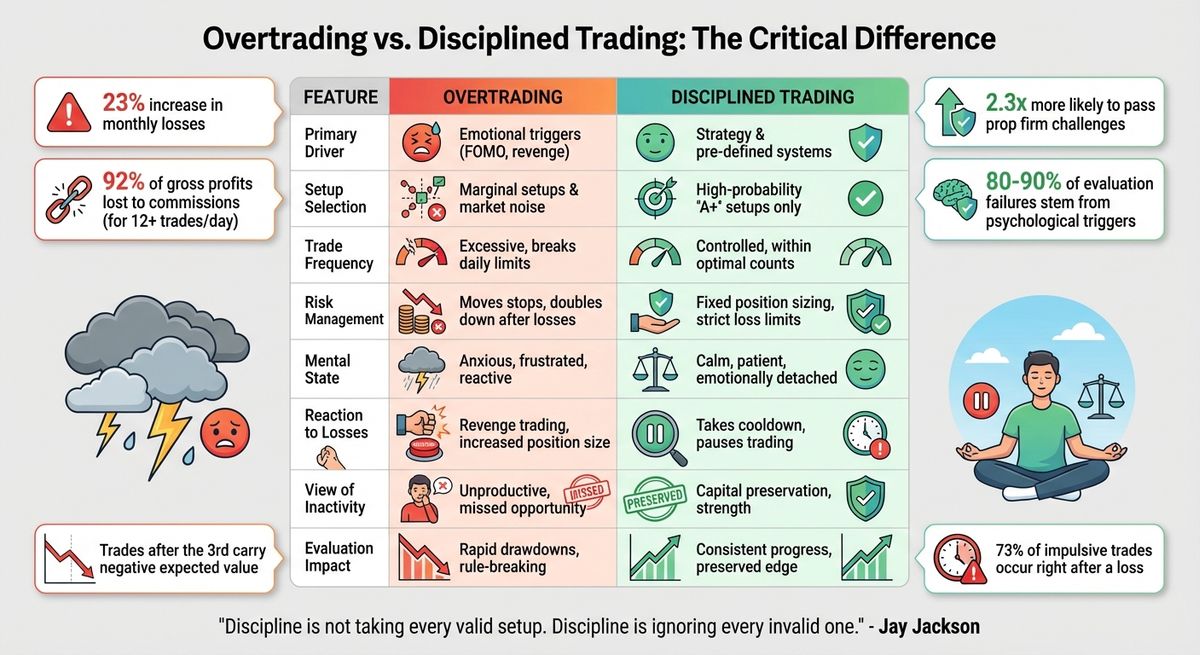
When you put overtrading side by side with disciplined trading, the differences couldn’t be clearer. Overtrading thrives on impulsiveness - driven by emotions like FOMO (fear of missing out), boredom, or the need to recover losses. Disciplined trading, on the other hand, operates on a foundation of structure, guided by pre-set rules and strategies. Overtraders often chase low-quality opportunities just to stay in the game, while disciplined traders focus solely on high-quality, high-probability setups that align with their criteria.
The numbers tell a powerful story. Traders who exceed their optimal number of trades see monthly losses increase by 23%. Meanwhile, those who stick to daily trade limits are 2.3 times more likely to pass prop firm challenges. Even more striking, trades taken after the third one of the day typically carry a negative expected value. These figures highlight just how much risk and performance differ between these two approaches.
Here’s a breakdown of how overtrading and disciplined trading compare across key areas:
Comparison Table
The mindset difference between these approaches is just as striking. Overtrading stems from emotional reactions - trying to "fix" losses or avoid missing out. Disciplined trading, however, is deliberate and calculated, with every action serving a specific purpose within a broader plan. Overtraders often view inactivity as wasted time, but disciplined traders recognize that sitting out can protect their capital and maintain their edge.
"Discipline is not taking every valid setup. Discipline is ignoring every invalid one." - Jay Jackson
The financial toll of overtrading can’t be ignored. For example, a trader executing 12 trades in a single day might lose up to 92% of their gross profits to commissions and spreads. Additionally, 73% of impulsive trades happen right after a loss in the same session, feeding into a destructive revenge cycle. Disciplined trading is designed to avoid this spiral, helping traders maintain emotional control and stick to their strategies. By prioritizing discipline, traders not only improve their performance but also significantly boost their chances of staying consistent during a trading challenge.
How For Traders Supports Disciplined Trading
For Traders weaves discipline directly into its platform by combining education, community support, and automated safeguards. Instead of leaving traders to rely solely on willpower, the platform enforces structured decision-making and addresses the mental challenges of trading alongside the technical aspects.
Educational Resources and Community Support
For Traders offers an Academy packed with video courses, livestreams, and interviews that focus on more than just technical analysis. These resources dive into the psychological side of trading - teaching traders to wait for high-probability setups and avoid impulsive decisions driven by boredom or frustration. To further enhance this, the platform provides High Performance Coaching, which helps traders identify emotional triggers before they lead to overtrading.
A dedicated Discord community adds another layer of support. This network of peers and mentors reinforces disciplined habits and provides crucial guidance when traders feel tempted to take unnecessary risks or chase losses. Additionally, the platform’s blog and video library offer practical advice on reframing inactivity. For example, zero-trade days are presented as a form of capital preservation, not missed opportunities, helping traders stay patient and focused.
These educational tools and community features set the stage for the platform’s technical safeguards, which ensure discipline is maintained during live trading.
AI-Driven Risk Management and Customizable Rules
To complement its focus on disciplined habits, For Traders incorporates automated safeguards that enforce strict risk management. Features like Daily Pause and Daily Profit Cap in the Two-Step Challenge PRO automatically stop trading once preset thresholds are reached, preventing emotional decisions from spiraling out of control. On accounts like Instant Master and Crypto One-Step PRO, the platform uses a Consistency Score to monitor trading patterns, encouraging steady, calculated behavior over erratic, high-volume sessions.
Every account is equipped with hard risk limits, mandatory stop-losses, and real-time tracking of Daily and Trailing Max Drawdowns. These measures ensure traders stay within their predefined risk parameters. For Traders also prohibits risky strategies such as high-frequency trading (HFT), tick scalping, and martingale. Additional rules, like the 40% Margin Rule and inactivity requirements, help keep traders engaged while reducing the likelihood of overtrading.
How to Move from Overtrading to Disciplined Trading
Breaking free from overtrading requires more than just willpower - it demands a structured approach that makes discipline second nature. By implementing a system that prioritizes thoughtful decision-making over impulsive actions, you can shift from chaotic trading to a more measured and strategic approach.
Identify Your Overtrading Triggers
Start by analyzing your trading history from the past 60 days. Export your data and calculate your win rate and profit/loss for each trade in sequence. Most traders notice their performance peaks on the first or second trade of the day, with a steady decline afterward. If your win rate or profit consistently drops after the third trade, that’s your signal to cap your daily trades there.
Next, pinpoint the emotional patterns that lead to overtrading. Many impulsive trades happen right after a loss, as traders chase their losses in frustration. Other triggers include boredom, creating a false sense of urgency, or FOMO (fear of missing out) when watching price movements without taking action. Additionally, the rush of placing trades can become addictive. Pay attention to when these urges are strongest - studies show that 80% of rule violations occur in the first and last 30 minutes of a trading session.
Create and Follow a Trading Plan
A well-thought-out trading plan eliminates emotional decision-making by requiring every trade to meet specific criteria. Use a setup grading system to evaluate potential trades:
- Grade A setups: Perfect alignment with all criteria and a risk-to-reward ratio of at least 2:1.
- Grade B setups: Mostly aligned with criteria but missing minor elements.
- Skip everything else - avoid Grade C setups and impulsive Grade F trades driven by revenge or boredom.
Incorporate mechanical safeguards into your plan. Set a hard daily trade limit (usually 3-5 trades based on your data). After any losing trade, take a mandatory 15-30 minute break to reset and avoid revenge trading. Before each session, complete a quick two-minute checklist: confirm your daily loss limit, review the economic calendar, and assess your mental state on a scale of 1-10. If you score below 6, reduce your position size or consider pausing trading for the day.
"Overtrading is rarely a volume problem in isolation. It is a decision-quality problem. The fix is structural." - Gary M., Founder, TSB
Track your discipline with a Trade Quality Score each week. Divide the number of planned trades by your total trades, then multiply by 100. Aim for a score of 80% or higher - traders who achieve this level of discipline show far better consistency. In fact, traders with daily trade limits are 2.3x more likely to pass prop firm challenges compared to those without limits. Tools like those offered by For Traders can help reinforce these strategies.
Use For Traders Tools and Resources
For Traders provides tools to help you stick to these systems. Their customizable rules allow you to set daily trade limits and loss caps that trigger alerts or even halt trading entirely once reached. The $6K Virtual Capital plan, available for $46, offers a simulated environment where you can practice discipline under real-world pressures. With a 5% max drawdown and 9% profit target, it mirrors the challenges of live trading.
The platform’s Academy includes video courses that focus on the psychological side of trading, complementing technical training. Meanwhile, the Discord community offers real-time accountability when you’re tempted to break your rules. For an extra layer of discipline, place a sticky note on your monitor with your max trade count and daily loss limit. When you hit your limit, physically close your trading platform to avoid the temptation of taking "just one more trade".
Shift your focus from profits to process. At the end of each session, evaluate your performance by asking: Did you stay within your trade limit? Did you follow your setup criteria? Did you take a break after a loss? By prioritizing the quality of your decisions over short-term outcomes, you’ll build the resilience needed to handle inevitable losing streaks with confidence.
Conclusion
The analysis above highlights the critical differences between overtrading and disciplined trading, emphasizing that success hinges on the quality of decisions rather than the sheer number of trades. Overtrading often stems from emotions like FOMO, boredom, or revenge, while disciplined trading is grounded in structured systems designed to safeguard both your capital and mental focus. Research shows that traders who exceed their optimal daily trade count lose an average of 23% more per month, while those who set daily trade limits are 2.3 times more likely to pass proprietary firm challenges.
The key to evaluation success lies in protecting your edge by avoiding low-probability trades and focusing on high-quality setups. As Warren Buffett wisely noted:
"The stock market is designed to transfer money from the impatient to the patient".
Data reveals that trades beyond the third often carry a negative edge, making it clear that sometimes the most profitable move is simply waiting for the right opportunity.
For Traders provides tools like customizable rules, AI-driven risk management tools, and access to an Academy and Discord community to help traders cultivate the discipline needed for success. Their $6K Virtual Capital plan, starting at just $46, offers a low-risk way to practice disciplined trading in real evaluation scenarios. These resources are designed to reinforce habits that help traders navigate challenging evaluations with confidence.
To succeed, focus on refining your process and executing trades with intention and consistency. Track your Trade Quality Score, take mandatory breaks after losses, and close your platform once you hit your daily limit. Remember, the market doesn’t reward activity - it rewards precision and patience.
FAQs
How do I know my daily trade limit?
To manage your trading effectively, establish a clear daily trade limit. This could mean setting a cap on the number of trades you make or defining a total risk amount you’re willing to take on each day. Tools like discipline systems, daily limits, or violation trackers can help you stick to these boundaries and prevent overtrading. Make sure these limits align with your overall trading plan to stay in control and enhance your decision-making.
What’s the fastest way to stop revenge trading?
The fastest way to put an end to revenge trading is by sticking to a clear plan that disrupts impulsive actions. Start by implementing mandatory cooldown periods: after a single loss, take at least a 10-minute pause before making another trade. If you experience two losses in a row, step away for 30 minutes - or even call it a day. Another helpful tactic is tracking your trades and emotional triggers. This practice makes it easier to stick to your rules and avoid trading based on emotions instead of strategy.
How can For Traders enforce discipline automatically?
For Traders uses tools like hard daily trade limits and kill switches to automatically enforce discipline. These features act as safeguards, preventing impulsive or excessive trading by setting strict boundaries. By incorporating these mechanisms, traders can develop healthier trading habits and improve their chances of long-term success.
Ready to trade funded capital?
Choose your path — Instant Accounts, One-Step or Two-Step Challenges — from just $23, with up to $300,000 in funded capital.
Choose your challengeTrade up to $300,000
Choose challenge