5 Steps to Optimize Sortino Ratio
Boost your Sortino Ratio by setting a clear MAR, measuring downside deviation, optimizing allocation, and managing drawdown.

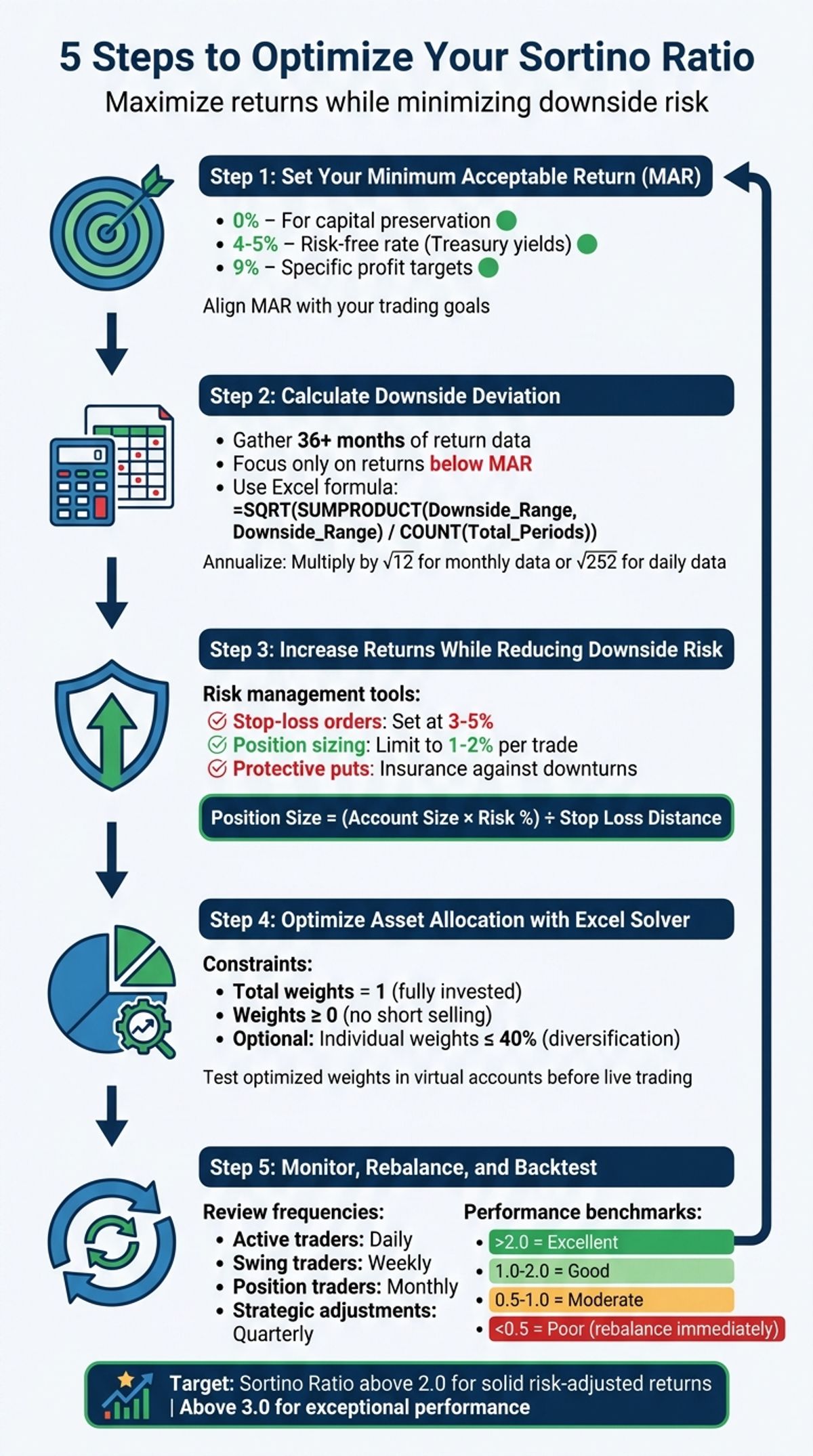
The Sortino Ratio focuses on downside risk, helping you measure how well your portfolio generates returns relative to harmful volatility. Unlike the Sharpe Ratio, it ignores upside fluctuations, making it a better tool for assessing risk-adjusted performance. Here's how you can improve your Sortino Ratio:
- Set Your Minimum Acceptable Return (MAR): Define a benchmark for acceptable performance. Common options include 0%, the risk-free rate (4–5%), or a specific target like 9%.
- Calculate Downside Deviation: Focus only on returns below your MAR. Use Excel formulas to compute this metric based on historical data.
- Increase Returns While Reducing Risk: Use tools like stop-loss orders, position sizing, and protective puts to limit losses without sacrificing gains.
- Optimize Asset Allocation: Use Excel Solver to adjust portfolio weights, maximizing risk-adjusted returns based on downside deviation.
- Monitor, Rebalance, and Backtest: Regularly review your portfolio, rebalance quarterly, and test strategies in simulated environments to maintain strong performance.
Key Tip: A Sortino Ratio above 2.0 indicates solid risk-adjusted returns, while anything above 3.0 shows exceptional performance. Use platforms like For Traders for tools and analytics to track and refine your strategy.
Sortino Ratio: How to Calculate the Sortino Ratio
Step 1: Set Your Minimum Acceptable Return (MAR)
Your Minimum Acceptable Return (MAR) is the benchmark that separates satisfactory performance from falling short.
Why MAR Is Key in Sortino Ratio Calculations
MAR is a crucial component of the Sortino Ratio formula. First, it’s subtracted from your portfolio’s average return to determine the excess return. Second, it sets the threshold for downside deviation - only returns below the MAR are factored into the downside deviation, while returns above it are ignored .
"The choice of the minimum acceptable return (MAR) can significantly influence the Sortino Ratio. Investors must carefully select a MAR that aligns with their risk tolerance and goals." – IBKR Quant
This makes the Sortino Ratio more practical than the Sharpe Ratio, which treats all volatility as negative, regardless of whether it’s upward or downward .
The next step is to align your MAR with the specific goals or requirements of your trading challenge.
Setting MAR for For Traders Challenge Requirements
If you’re participating in a trading challenge, your MAR should reflect the specific goals of that challenge. For example, on For Traders, all virtual capital accounts - from $6,000 to $100,000 - must achieve a 9% profit target to qualify for a 15% profit share. By setting your MAR at 9% (annualized or adjusted for your data frequency), you can measure how often your strategy falls short of this target.
Additionally, the challenge’s 5% maximum drawdown rule influences your approach. While the MAR highlights underperforming returns, the drawdown limit defines the threshold for acceptable losses. If your primary goal is to preserve capital, you might set your MAR at 0%. Alternatively, if you aim to outperform low-risk investments, you could use the risk-free rate (approximately 4–5%, based on Treasury yields) as your MAR.
Here are some strategies for aligning your MAR with the challenge requirements:
For accurate and comparable Sortino Ratios, ensure consistency in your MAR and the return frequency (daily, weekly, or monthly). For daily returns, divide your annual MAR by 252 (the standard number of trading days in a year); for monthly returns, divide by 12 .
Step 2: Calculate Downside Deviation
Downside deviation zeroes in on the volatility of returns that fall below your Minimum Acceptable Return (MAR). While standard deviation accounts for all fluctuations - both above and below your target - downside deviation focuses only on the underperformance. This specificity makes it the key denominator in the Sortino Ratio, offering a clearer view of how often your strategy falls short of its goals. You can test your strategy's resilience through trading challenges before committing real capital. Below, we'll walk through the data you need and the Excel steps to compute this metric.
Data Needed for Downside Deviation
To start, gather at least 36 months (or 3 years) of return data. Set up your Excel sheet with these columns:
- Dates
- Adjusted Closing Prices
- Monthly Returns
Calculate monthly returns using this formula:
Next, identify the shortfalls with:
This formula ensures only the returns below your MAR are captured, while returns meeting or exceeding the MAR are set to zero.
Using Excel for Downside Deviation Calculations
Once your data is ready, follow these steps in Excel to compute downside deviation:
- Square the downside returns: Use the formula to square each shortfall value.
- Aggregate the squared values: Apply the SUMPRODUCT function: =SUMPRODUCT(Downside_Range, Downside_Range)
- Calculate downside deviation: Divide the sum of squared shortfalls by the total number of periods (including both positive and negative returns), then take the square root: =SQRT(SUMPRODUCT(Downside_Range, Downside_Range) / COUNT(Total_Periods))
To standardize the result for annualized comparison, adjust for the timeframe:
- Multiply by √12 (approximately 3.46) for monthly data.
- Multiply by √252 (approximately 15.87) for daily data, reflecting the average number of trading days in a year.
This annualization ensures you can compare downside deviation across different assets and timeframes. By focusing on downside risk, this calculation provides a critical insight into areas where your strategy may underperform, helping you refine your approach and optimize the Sortino Ratio.
Ready to trade funded capital?
Choose your path — Instant Accounts, One-Step or Two-Step Challenges — from just $23, with up to $300,000 in funded capital.
Choose your challengeStep 3: Increase Returns While Reducing Downside Risk
Boosting your Sortino Ratio means finding that sweet spot where returns climb without introducing unnecessary volatility. The goal here? Maximize gains while keeping losses in check. This involves using smart risk management techniques to tackle harmful volatility while leaving room for profits to grow. Let’s explore how to make this happen.
Risk Management Techniques to Limit Downside
Stop-loss orders are a straightforward way to limit losses. By automatically exiting positions at predetermined prices, they help control downside deviation. A good rule of thumb is to set stop-loss limits between 3–5% and tighten them during periods of market uncertainty. This approach balances limiting losses while staying open to significant gains .
Position sizing is another critical tool. To manage risk effectively, limit exposure to 1–2% of your total equity per trade. The formula for calculating position size is simple: (Account Size × Risk %) ÷ Stop Loss Distance. This ensures that no single trade jeopardizes your portfolio.
For added protection, consider protective puts. These options act like insurance for your portfolio, setting a floor for potential losses during market downturns while keeping upside potential intact. This strategy is particularly helpful given that research shows losses feel about 2.5 times more painful than equivalent gains. Plus, recovering from a big loss requires an equally large rebound - a scenario every investor wants to avoid .
Leveraging For Traders' Risk Management Tools
For Traders offers a suite of tools designed to integrate these risk management strategies seamlessly. Their AI-driven solutions distinguish between harmful downside volatility and beneficial upside movements, allowing you to penalize only the returns that fall below your target . Platforms like DXTrade, TradeLocker, and cTrader support automated stop-losses, helping you protect against downside risks without capping your profit potential.
Additionally, For Traders enforces a strict 5% maximum drawdown limit on all virtual capital accounts. This automated safeguard helps prevent emotional decision-making and ensures tighter control over capital erosion. When paired with the platform's volatility monitoring and drawdown management features, it allows you to align your position sizing more closely with downside deviation rather than overall volatility .
To stay on top of your performance, regularly monitor your Sortino Ratio using the platform's analytics. A ratio between 2.0 and 3.0 is generally considered solid, while anything above 3.0 is excellent. In particularly volatile markets, maintaining a Sortino Ratio above 2.0 shows that your strategy is striking the right balance - capturing gains while keeping losses under control. For a broader perspective on risk, consider pairing the Sortino Ratio with metrics like the Calmar Ratio and Value at Risk (VaR) .
Step 4: Optimize Asset Allocation with Excel Solver
After defining your risk management approach, the next step is figuring out the best portfolio weights to maximize your Sortino Ratio. Excel Solver is a handy tool for this - it tweaks asset weights to maximize risk-adjusted returns. Unlike traditional methods that penalize all volatility, Solver lets you target downside deviation, focusing solely on negative performance.
Setting Up Excel Solver for Portfolio Optimization
Start by organizing your spreadsheet into clear sections for asset weights, returns, and Sortino Ratio calculations. Use a solid dataset of around 36 months of historical data to ensure your optimization captures enough downside events for accurate results. Make sure your Sortino Ratio is annualized to align with standard financial reporting before running Solver. This setup ensures your asset allocation strategy emphasizes downside risk management as intended.
To use Solver, go to the Data tab in Excel and select Solver. Set your objective to the cell containing the annualized Sortino Ratio and choose "Max." For the variable cells, select the range containing your asset weights - Solver will adjust these percentages. Then, configure Solver with the following parameters:
- Objective: Maximize the Sortino Ratio.
- Variable Cells: The range of asset weights.
- Constraints: Total weights must equal 1 (fully invested portfolio). Weights must be non-negative (no short selling). Optionally, cap individual weights at 40% to ensure diversification.
Choose either the GRG Nonlinear or Evolutionary solving method since the calculations involve nonlinearity (like square roots and conditional logic). Once Solver completes its run, it will generate weights that theoretically maximize your Sortino Ratio. Keep in mind, though, these weights are based on historical data and may not perfectly predict future performance.
After determining your optimized weights, the next step is to test them in a simulated environment.
Testing Allocation Strategies on For Traders Virtual Accounts
Once you've optimized your portfolio with Solver, it's time to test those weights in a virtual trading environment. Platforms like For Traders' demo accounts (supporting DXTrade, TradeLocker, and cTrader) allow you to simulate live market conditions without risking real money. This testing phase ensures your strategy holds up in current market dynamics.
Monitor your portfolio's performance over at least one quarter, tracking metrics like the Sortino Ratio, maximum drawdown, and overall behavior during volatile periods. For Traders' 5% maximum drawdown limit provides an automatic safeguard, helping you assess whether your allocation remains within acceptable risk levels. If your virtual account achieves a Sortino Ratio above 2.0 while staying under the drawdown cap, you may have a solid strategy in place.
To keep up with changing market conditions, re-run Solver quarterly or semi-annually, and always validate new allocations in a virtual account before implementing them at scale.
Step 5: Monitor, Rebalance, and Backtest Your Portfolio
Once you've set up your optimized asset allocation, the next step is to keep a close eye on it. Regular reviews are essential to ensure your portfolio stays aligned with your risk-return goals. How often you monitor depends on your trading style: active traders might check daily, swing traders weekly, and position traders monthly. For strategic adjustments, aim for quarterly reviews to maintain your portfolio's balance and risk-return performance.
Quarterly Rebalancing and Performance Tracking
Quarterly reviews are a great time to reassess your portfolio's performance. Update your Excel Solver outputs and evaluate your Sortino Ratio using a 90–180 day lookback period. If you're aiming for a quicker response to market changes, a 30–60 day lookback might work better. During these reviews, compare your current Sortino Ratio to benchmarks: anything above 2.0 is excellent, while 1.0 to 2.0 is considered good. A ratio below 0.5 signals that your portfolio isn't compensating well for downside risk.
Set performance thresholds to guide your rebalancing decisions. For instance, you might define "Strong" as 1.0 or 2.0 and "Weak" as 0.5. If your Sortino Ratio dips below the weak threshold or shows a significant drop in ranking, it's time to rebalance. This could mean adjusting asset weights or reducing exposure to positions that are underperforming. To get a fuller picture of risk and performance, combine the Sortino Ratio with other metrics like Maximum Drawdown, Win Rate, and the Omega Ratio.
Tools and Community Support for Better Insights
Platforms like For Traders offer tools to help you track performance metrics like the Sortino Ratio in real time. One standout feature is a 5% maximum drawdown limit that acts as a safeguard, keeping your portfolio within manageable risk levels. When backtesting strategies, make sure to include data from at least one major market downturn. This helps you get a realistic sense of how your strategy handles downside risk. After backtesting, validate your strategy with out-of-sample data and follow up with 3–6 months of paper trading or at least 50 trades before putting real money on the line.
The For Traders Discord community, which connects over 80,000 traders from 130+ countries, is another valuable resource. You can share strategies, discuss rebalancing decisions, and get feedback on your Sortino Ratio goals. The platform also features an AI Coach that analyzes your trading performance and provides actionable suggestions for improvement. This mix of advanced analytics and community support is especially helpful, considering that losses tend to feel about 2.5 times more painful than equivalent gains.
Conclusion
Improving your Sortino Ratio is a continuous journey that involves setting clear goals, accurately measuring risks, making strategic adjustments, and routinely reviewing your approach. Establishing a realistic Minimum Acceptable Return (MAR) helps define what constitutes undesirable risk, aligning your portfolio with your financial objectives. By calculating downside deviation, you focus on the type of volatility that can harm your portfolio, while ignoring positive fluctuations. From there, strategies like diversification and hedging can either enhance returns or minimize downside risk, ultimately improving the ratio.
Tools like Excel Solver can play a key role in optimizing your asset allocation, helping you find the ideal balance of weights to maximize your Sortino Ratio. Regular monitoring and rebalancing ensure your portfolio stays aligned with market changes, maintaining its risk-adjusted performance over time. Incorporating more downside events into your analysis sharpens the accuracy of your Sortino Ratio, enabling smarter, data-driven decisions.
Platforms like For Traders offer valuable support, including automated performance tracking, an AI Coach, and a dynamic Discord community to help you refine and execute your strategy effectively.
Achieving a Sortino Ratio above 2.0 is a strong indicator of well-managed downside risk and excellent performance. Reaching this level demands a disciplined approach, combining mathematical precision with practical tools for risk management. By following these steps, you can create a portfolio that turns downside risks into opportunities for excess returns, no matter the market environment.
FAQs
How do I pick the right MAR for my goals?
To determine the right Minimum Acceptable Return (MAR) for your investments, it's important to align it with both your financial objectives and your tolerance for risk. The MAR represents the minimum return you aim for to avoid losses, and it plays a critical role in calculating the Sortino Ratio.
- Match it to your financial goals: Your MAR should reflect what you need to achieve to meet your investment targets.
- Consider your risk tolerance: A higher MAR might mean taking on more risk, so ensure it aligns with your comfort level.
- Use benchmarks for guidance: Look at relevant market or portfolio benchmarks to set a realistic MAR.
- Refine over time: Regularly test and adjust your MAR to ensure it supports your portfolio's performance in changing market conditions.
How much return history do I need for a reliable Sortino Ratio?
To get a dependable Sortino Ratio, it's best to use at least five years of historical return data. This timeframe helps ensure that the measurement of downside risk is based on a broad and representative sample of the investment's performance. By doing so, you reduce the influence of short-term fluctuations and achieve a more accurate assessment of downside risk. Longer periods generally lead to more reliable insights.
What should I do if my Sortino Ratio drops below 1.0?
If your Sortino Ratio dips below 1.0, it suggests your portfolio isn't delivering enough return to justify the downside risk. To address this, you can take a few practical steps:
- Shift your asset allocation toward investments with lower risk profiles.
- Incorporate risk management strategies, such as stop-loss orders or hedging techniques, to limit potential losses.
- Rebalance your portfolio or choose assets that historically perform better during market downturns.
By implementing these strategies, you can work toward improving your Sortino Ratio.
Ready to trade funded capital?
Choose your path — Instant Accounts, One-Step or Two-Step Challenges — from just $23, with up to $300,000 in funded capital.
Choose your challengeTrade up to $300,000
Choose challenge