

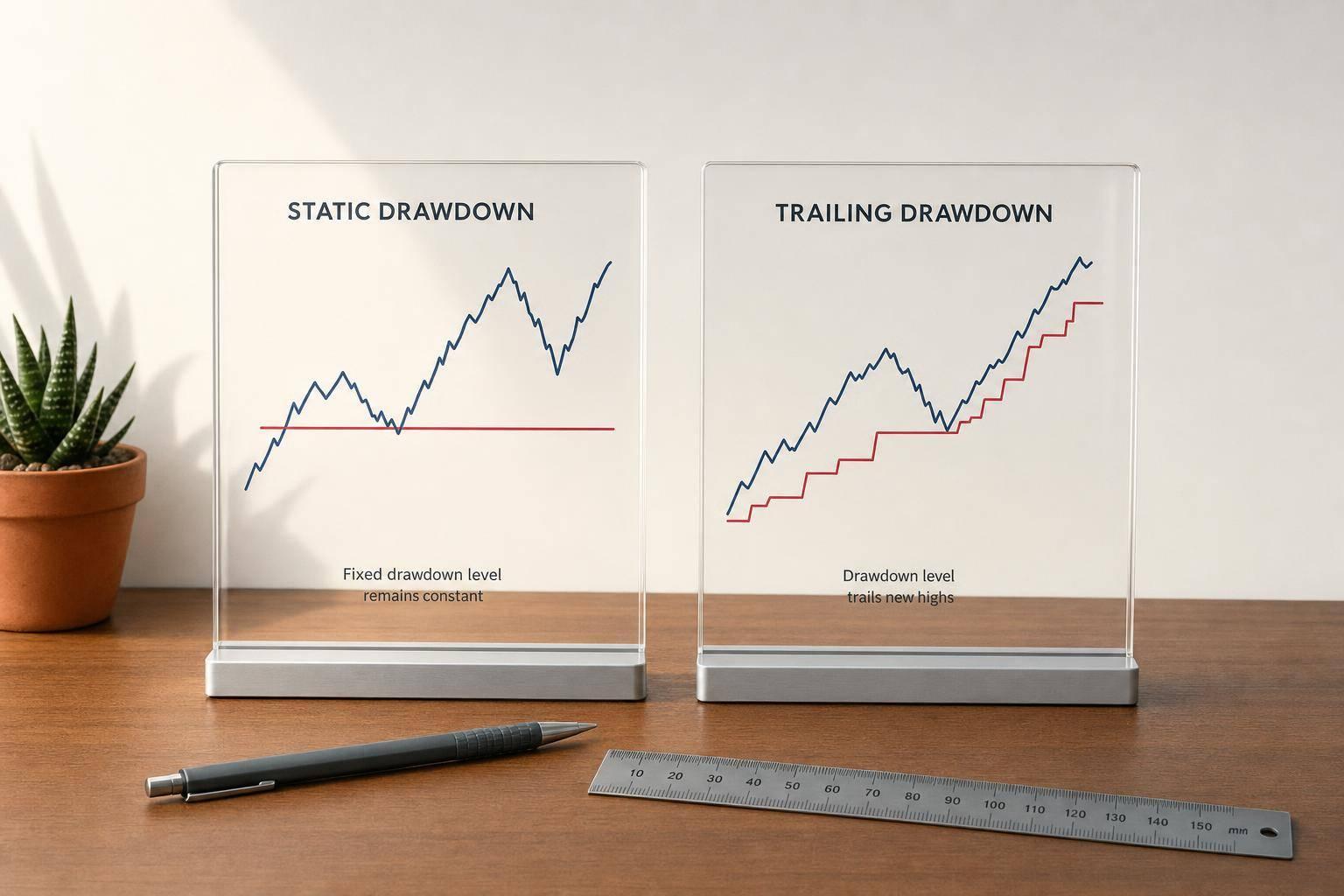
If I had to pick the tougher rule fast, I’d say this: trailing drawdown is usually harder to trade than static drawdown.
Here’s the short version:
- With static drawdown, the loss floor stays fixed from day one.
- With trailing drawdown, the loss floor moves up when the account hits a new high.
- On a $100,000 account with a 5% drawdown limit, static starts with a floor at $95,000 and keeps it there.
- Under trailing rules, that same floor can move up after gains, which can leave you with much less room after a pullback.
- That changes how I would handle position size, stop-loss distance, open profits, and daily loss limits.
In other words: the profit target matters, but the drawdown rule often decides whether a trader passes or fails.
Trailing Drawdown vs. Static Drawdown: How to Boost Your Chances of Passing Prop Firm Evaluations
Quick Comparison
| Rule | How the floor works | What happens after gains | What happens after losses | What it means for sizing |
|---|---|---|---|---|
| Static drawdown | Fixed at the starting level minus the max loss | Buffer grows as profits build | Floor stays the same | I can keep size more steady |
| Trailing drawdown | Moves up with new account highs | Room may stay tight or get tighter | Floor stays at the high-water mark | I often need to cut size as room shrinks |
A simple example shows the gap. If a $100,000 account goes to $105,000, a static floor still sits at $95,000. But with trailing drawdown, the floor can move near $99,750, which leaves far less space if the account dips.
My takeaway: if a strategy has swings, longer holds, or pullbacks inside winning trades, static drawdown is often easier to work with. If the rule is trailing, I’d track headroom every day and base risk on the remaining buffer, not the account balance.
Static drawdown
With a static drawdown, the loss floor is locked in on day one and doesn't move. It's figured by subtracting the max allowed loss from your starting balance, and that number stays the same for the whole challenge, no matter how much profit you make.
How the fixed loss floor works
Take a $100,000 account with a 5% static drawdown. Your floor starts at $95,000 and stays there from the moment you begin. If the account grows to $105,000 by the end of week one, the floor is still $95,000. The upside doesn't change that number.
That setup gives you more room as profits build. At $105,000, you've got $10,000 of space before a breach instead of $5,000. That's the main trait of the static model, which is a key part of understanding drawdown in professional trading.
How green and red days affect position sizing
Since the floor is fixed, your sizing can stay more steady, and your buffer grows after winning days.
After a run of green days, you're trading with more room above a fixed floor. In plain English, that means you may be able to use wider stops or bump size a bit without adding as much breach risk. If a red day hits after a good stretch, it doesn't put you on the edge right away because your earlier gains take the first hit.
A smart rule of thumb is to leave 40%–50% of the drawdown unused to deal with slippage and losing streaks. On a $100,000 account with a $5,000 limit, that means treating $97,500 as your working floor instead of $95,000. That extra cushion gives you room for normal market noise without drifting too close to the actual breach level. Trailing drawdown works differently because the loss floor moves up when you hit new highs.
Trailing drawdown
A trailing drawdown lifts the loss floor each time your account prints a new high. It never moves back down. In a challenge, that means every new peak changes how much room you have left. Your buffer doesn’t get bigger. It either stays the same or gets smaller. And that puts more pressure on position sizing and risk management.
How the moving loss floor follows new highs
Take a $100,000 account with a 5% trailing drawdown. The floor starts at $95,000. If the account moves up to $105,000, the floor moves to $99,750. Your buffer is still $5,250.
But here’s where it gets tricky. If the account then drops to $101,000, the floor stays at $99,750. That leaves just $1,250 of breathing room, even though the account is still up $1,000 overall.
How shrinking headroom affects position sizing
Because the floor follows new highs, you have to size trades off the remaining buffer, not the full account balance. That changes how you manage risk day to day.
For example, letting winners run can get more dangerous under intraday trailing rules. Unrealized gains can push the floor higher before the trade is even closed. So a trade can still breach the account after a new high if it pulls back far enough, even when the trade is still in profit.
That gap shows up most clearly when you look at how each rule changes sizing after green days and red days. The next comparison breaks down how risk shifts after both.
Static vs. trailing drawdown: side-by-side rule comparison
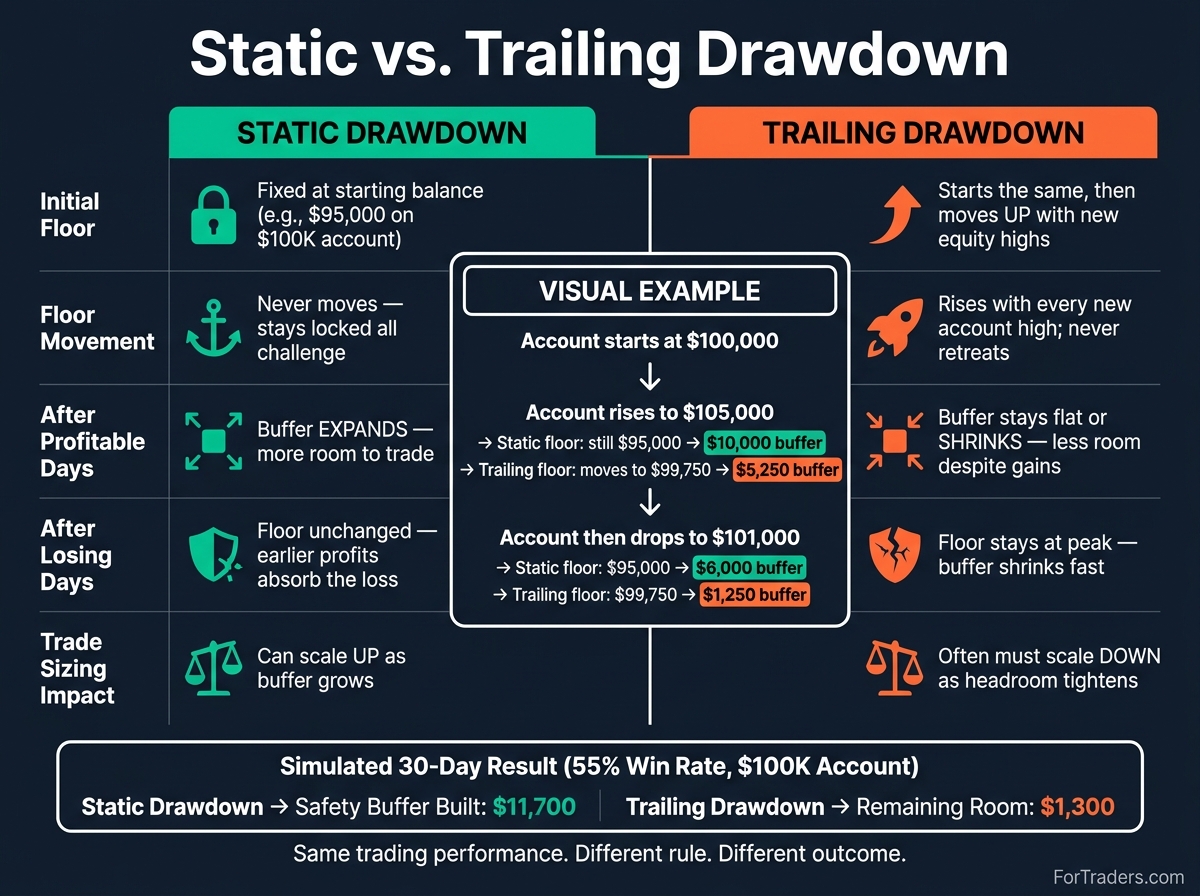
Static vs Trailing Drawdown: Side-by-Side Rule Comparison
Put next to each other, the difference is pretty clear:
| Feature | Static Drawdown | Trailing Drawdown |
|---|---|---|
| Initial floor | Fixed at the starting balance | Starts at the same level, then moves up when equity makes a new high |
| Floor movement | Never moves | Moves up with new highs; never retreats |
| After profitable days | Buffer expands | Buffer does not grow and can shrink |
| After losing days | Floor unchanged; buffer absorbs the loss | Floor stays at its peak; buffer shrinks |
| Impact on trade sizing | Can scale up as buffer grows | Often requires scaling down as headroom tightens |
The biggest gap shows up after winning days. With trailing drawdown, a good day can quietly leave you with less room than you expected.
How each rule changes risk on winning and losing days
Under static drawdown, profits make your cushion larger. On a $100,000 account with a $5,000 floor, each dollar you gain increases the distance between your balance and that fixed floor. That gives you more room on the trades that come next.
Under trailing drawdown, profits push the floor higher and can cut into your future room. Then, if you have a losing day, the floor stays locked at its highest prior level. Your balance is lower, but the floor doesn’t come down with it. That leaves less space to recover, even if the account is still net positive overall.
Which rule is stricter in live execution
Trailing drawdown is stricter in live execution. A trade can move in your favor, lift your unrealized equity, and push the floor up before you ever close the position. Then if the market pulls back, you're dealing with a tighter margin. Static drawdown doesn’t create that same problem.
Static drawdown is also easier to map out day to day. You know where the floor sits each morning, and you don’t need to keep recalculating it.
Pros and cons by trading style
Whether you prefer scalping vs swing trading, this rule can change which setups still make sense. It doesn’t hit every style the same way.
| Trading Style | Static Drawdown | Trailing Drawdown |
|---|---|---|
| Swing traders | Pro: Can hold through volatility without the floor moving | Con: Intraday peaks can make pullbacks more dangerous |
| Intraday scalpers | Pro: Predictable floor; no surprises | Pro: Short hold times reduce unrealized peak exposure |
| Trend followers | Pro: Rewards letting winners run to full targets | Con: Letting winners run can raise breach risk; often requires earlier banking |
| Beginners | Pro: Lower psychological pressure; clear boundaries | Con: Constant headroom tracking can be stressful |
In plain English, static drawdown gives you a steadier line in the sand. Trailing drawdown asks you to watch that line as it moves, sometimes at the exact moment a trade seems to be going your way.
Conclusion: Matching the drawdown rule to your trading plan
Static drawdown stays fixed. Trailing drawdown moves up when you hit new highs.
That one difference has a big effect on how you trade day to day, especially with position sizing, open trade handling, and how much room you have left after a losing session.
Before you enter a challenge, line up the rule with your strategy’s volatility, stop size, and your comfort level with tighter headroom after a win. When low drawdown rules are tight, that fit matters more than the profit target.
In a simulated 30-day comparison with a 55% win rate, a static drawdown account can build an $11,700 safety buffer, while the same performance under trailing rules may leave just $1,300 in remaining room. That gap comes from the rule itself, not from better or worse trading.
If you trade on For Traders, check whether the 5% floor is static or trailing before you place a trade.
FAQs
How do I calculate my remaining drawdown buffer?
First, identify your current account status and which drawdown rule applies.
With static drawdown, subtract the fixed floor from your current balance.
With trailing drawdown, find the high-water mark, subtract the drawdown amount, then compare that threshold with your current equity.
Intraday trailing can include open equity. EOD trailing updates from your closing balance only.
Does trailing drawdown use balance or equity highs?
It depends on the firm's model: trailing drawdown may track either your account balance or live equity highs.
With intraday models, the drawdown follows real-time equity, including unrealized profit. That means the floor can move up right away, even before you close the trade.
With end-of-day trailing drawdown, the update usually happens at the close and uses your closing balance. So if your equity spikes during the day, that higher level won't change the threshold until the trading day ends.
Which drawdown rule fits my trading style?
It depends on your strategy, risk tolerance, and psychological comfort.
- Static drawdown is often the easiest to manage. It tends to work well for beginners, swing traders, and trend followers.
- EOD trailing drawdown sits in the middle. It often fits momentum traders and day traders.
- Intraday trailing drawdown is the most restrictive. It’s usually a better match for experienced scalpers with tight risk control.
Related Blog Posts
Start Trading with For Traders
Join our platform to test your trading skills, trade virtual capital, and earn real profits. Access educational resources, advanced tools, and a supportive community to enhance your trading journey.
Start your Trading Challenge