

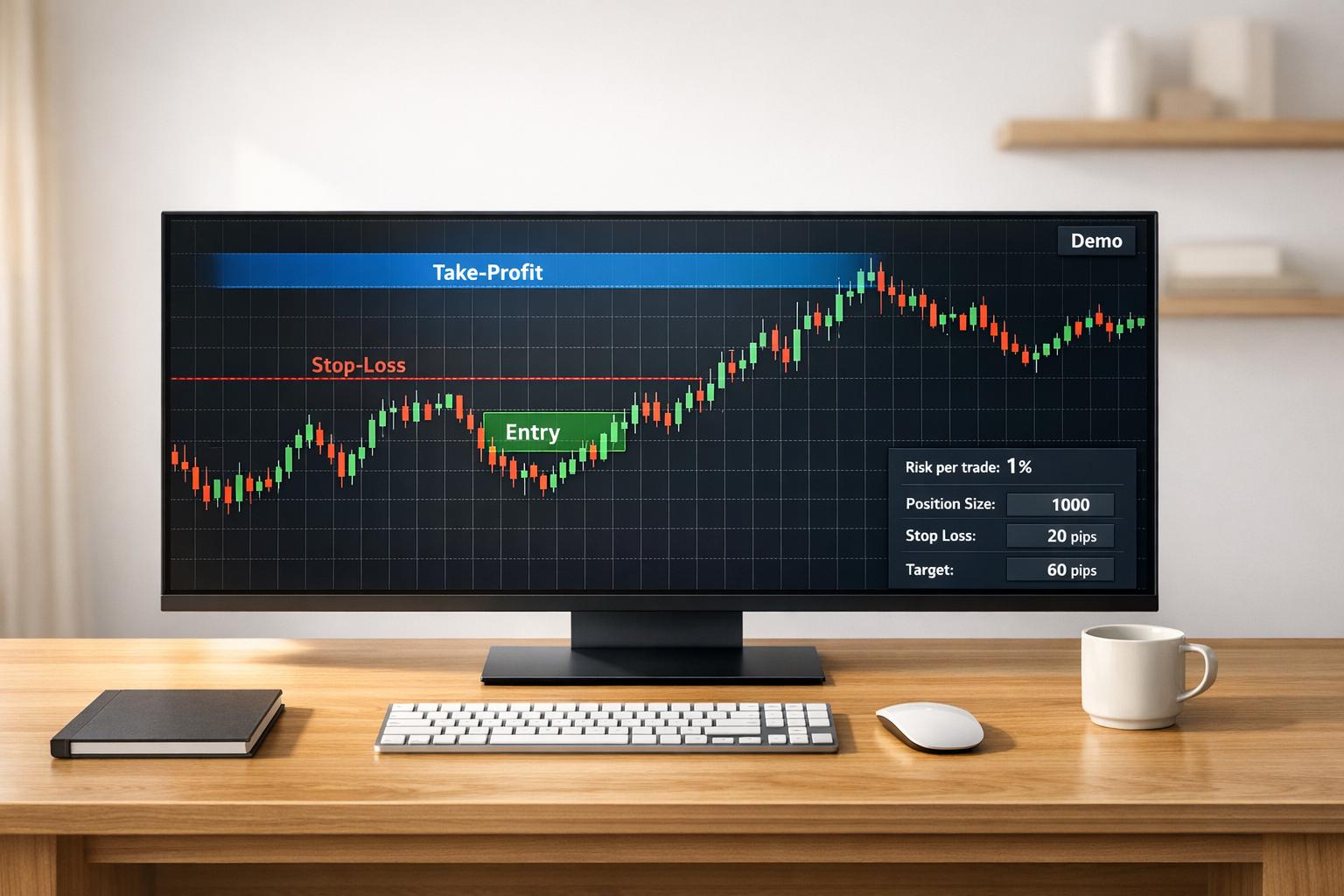
Swing trading is perfect for those who want to trade without constantly monitoring markets. It's about holding positions for a few days to weeks, using technical and fundamental analysis to spot trends. Beginners should start with demo accounts to practice strategies without risking real money. Here's a quick overview of what you need to know:
- Demo Accounts: Use platforms like MetaTrader 4/5 or TradingView. Practice with virtual funds, test strategies, and focus on consistency.
- Entry Rules: Use chart patterns, support/resistance levels, and moving averages to time trades effectively.
- Exit Rules: Set stop-losses to manage risk and plan profit targets with a 2:1 or 3:1 risk-reward ratio.
- Risk Management: Learn to manage risk like a professional by limiting risk to 1-2% per trade. For demo challenges, follow rules like daily drawdown limits and profit targets.
- Platforms: Choose ones with realistic market simulations, essential tools, and features like trailing stops or AI coaching.
How to Start Swing Trading for Beginners 2026
What You Need Before Starting Swing Trading
Before diving into swing trading, it’s crucial to understand market behavior, pick a reliable demo platform, and set realistic expectations. These steps lay the groundwork for mastering strategies like when to enter and exit trades.
Understanding Market Trends and Volatility
Markets generally move in three directions: uptrends (prices make higher highs and higher lows), downtrends (lower highs and lower lows), and sideways ranges (prices fluctuate within a horizontal band). Knowing which phase the market is in helps you decide whether to buy, sell, or sit out.
Volatility plays a key role in swing trading since profits rely on price movements. Without enough volatility, there’s little room for gains. Stocks with beta values between 0.8 and 1.5 and daily price swings of 2% to 4% are often ideal. Too little volatility means small profits, while too much can lead to unpredictable risks.
For better results, focus on large-cap stocks with high liquidity to reduce slippage. Align your trades with the broader market trend and strong-performing industries.
"The industry group in which you trade is more important to your success or failure than which company you pick in that industry group." - Omar Bassal, CFA, Founder, Shukr Investments
Unlike day trading, swing trading involves holding positions overnight, which exposes you to gaps - unexpected price changes caused by news or events when markets are closed. Understanding this risk is vital before you start using real money.
| Market Condition | Strategy Adjustment | Risk Level |
|---|---|---|
| Bull Market | Focus on long positions; expect higher entry points | Moderate (due to potential bad habits) |
| Bear Market | Shorten trade durations; hold more cash; consider put options | High (natural buying/selling risks) |
| Sideways Market | Trade between support and resistance levels; ideal for rebounds | Lower (losses are often smaller) |
Being familiar with these dynamics will help you choose a demo platform that mirrors real-world trading conditions.
Choosing the Right Demo Platform
Look for platforms like MetaTrader 4/5, TradingView, or cTrader that offer top technical analysis tools such as Moving Averages, RSI, MACD, and Bollinger Bands. These indicators are key for analyzing swing trades.
The platform should provide realistic market simulations with raw spreads and low commissions. If the demo environment doesn’t reflect actual trading costs, your strategies might fail when applied to live trading. Make sure it supports daily and weekly charts for spotting trends and hourly or 4-hour charts for timing your entries.
Key features to look for include automated stop-loss/limit orders and drawdown tracking. Since swing trades often last several days, the platform must allow you to hold positions overnight and through weekends without forced liquidation. Some platforms now also offer AI Coaches to review your performance and integrated learning resources like webinars and eBooks.
For Traders offers demo challenges with varying virtual capital levels, starting at $39 for $6,000 and going up to $375–$455 for $100,000. These challenges include customizable rules and educational tools to help you refine your strategy in a structured environment.
Once you’ve chosen a demo platform, the next step is setting achievable goals for your trading journey.
Setting Realistic Goals and Expectations
Demo trading removes the emotional pressure of risking real money, making it the perfect environment to set realistic expectations. Instead of chasing massive returns, focus on sticking to a systematic trading plan and spotting high-quality setups.
Follow professional risk management guidelines by limiting your risk to 1% to 2% per trade and aiming for similar profit levels. While these numbers may seem small, consistency is what leads to long-term success.
Practice until you can reliably execute one strategy - usually over 50 trades or about a month. Also, match your demo account balance to the amount you plan to use in live trading. Practicing with $100,000 when you’ll start with $5,000 creates unrealistic expectations.
Treat your demo account as seriously as a live one. Record not just your entry and exit points but also your emotional state during trades. This will help you identify psychological triggers and improve your decision-making when real money is on the line.
Swing Trading Entry Rules
Knowing when to enter a trade is what sets successful swing traders apart. Entry rules help you stay disciplined, avoid impulsive decisions, and focus on setups with the best potential for success - especially when testing strategies on a demo account.
Using Chart Patterns and Technical Indicators
Chart patterns such as Head and Shoulders (~83% success with 12–15% moves), Double Tops/Bottoms (~78%), and Triangle Patterns (~72%) can provide valuable insights into potential price movements. However, it's not enough to rely on patterns alone. Wait for volume to confirm the pattern with at least a 50% increase, and use momentum indicators like the Relative Strength Index (RSI) or MACD (Moving Average Convergence Divergence) to strengthen your analysis. For instance, spotting a bullish engulfing candle at a support level becomes a more reliable entry signal if the RSI is below 30, indicating the market is oversold.
Other tools, such as the Stochastic Oscillator and Average Directional Index (ADX), can add further confirmation. An ADX reading above 40 signals a strong trend, which is ideal for identifying "volatility squeeze" setups - where you aim to enter at the lowest price range of the last six days. This method allows you to position yourself just before a significant price move.
"You want to exploit the long-term rising trend of the stock market by buying when there is short-term weakness or panic. You buy the weakness and you sell when the market shows strength." - Oddmund Groette, Founder and Analyst, Quantified Strategies
In addition to patterns, timing your entry by analyzing support, resistance, and moving averages can be just as effective.
Using Support and Resistance Levels
Support and resistance levels are like invisible boundaries in the market. Support acts as a "floor" where buying pressure prevents further declines, while resistance serves as a "ceiling" where selling pressure limits upward movement. These levels are essential for timing entries, as they often represent zones where traders place a large number of orders.
The Alternation Principle is a helpful concept: when a support level is broken, it often turns into resistance, and vice versa. This flip happens around 85% of the time. It's important to treat these levels as zones rather than fixed lines to account for market volatility. Pay extra attention to round numbers like $50, $100, or $150, as they tend to attract more orders.
Two effective strategies for these levels include:
- Bounce Trade: Wait for the price to approach a support zone and look for rejection signals, such as a hammer or bullish engulfing candle, before entering in the direction of the bounce.
- Breakout-Retest Strategy: Instead of entering immediately after a breakout, wait for the price to retest the broken level from the opposite side. Enter once the level is confirmed to have flipped.
"Indicators confirm, but structure and location pay." - TradeStockAlerts
Using higher timeframes, such as daily or weekly charts, helps identify key levels that attract more traders and larger order flows compared to lower timeframes like 5-minute charts. To protect against minor price fluctuations, set stop-loss orders just below support zones.
Dynamic indicators like moving averages can further refine your entry strategy.
Using Moving Averages in Entry Strategies
Moving averages help smooth out price fluctuations and highlight the medium-term trend, acting as dynamic support and resistance levels. This makes them especially useful for swing trades held over two to ten days, particularly when practicing with simulated capital.
Exponential Moving Averages (EMAs) are more responsive than Simple Moving Averages (SMAs), reacting 1–3 bars faster, which makes them ideal for short-term signals. Common EMA periods include 9, 21, and 55 days for detecting quick trend changes. For longer-term trends, the 200-day SMA is a popular benchmark - only taking long trades when the price is above this moving average can reduce false signals by 30% to 40%.
There are two main ways to use moving averages for entry signals:
- Crossovers: A shorter-term moving average crossing above a longer-term one, like the 20 EMA crossing the 50 EMA, indicates a momentum shift. This 20/50 EMA crossover strategy has a success rate of 55% to 60% when volume exceeds the 20-day average by at least 120%.
- Pullbacks: In established trends, wait for the price to retrace to a rising moving average, such as the 20-period EMA, before resuming its direction. Pullback entries have win rates of 60% to 65%. However, avoid entering if the RSI is above 70 (overbought), as the trend may be weakening.
| Moving Average Type | Common Periods | Best Used For |
|---|---|---|
| Simple (SMA) | 10, 20, 50 days | Identifying overall trend direction and major support/resistance |
| Exponential (EMA) | 9, 21, 55 days | Reacting to quick trend changes and short-term momentum |
Swing Trading Exit Rules
An exit strategy is your safety net - it protects your virtual capital, locks in profits, and helps you build discipline while trading on demo accounts.
Setting Stop-Loss Levels to Limit Risk
The 1% Risk Rule is a cornerstone of effective risk management. It means you should never risk more than 1% - or at most 2% - of your total account equity on a single trade. For instance, with $50,000 in virtual capital, your maximum loss per trade should be capped at $500.
To figure out your position size, start by calculating your dollar risk: multiply your account balance by 0.01. Then, use the formula:
Account Risk ($) / (Entry Price - Stop Loss Price).
For example, if you enter a stock at $100 with a stop-loss at $98, you can buy up to 250 shares ($500 ÷ $2 = 250 shares).
Volatility-Based Placement uses the Average True Range (ATR) indicator to adjust stop-loss distances based on market conditions. A common approach is to multiply the ATR value by 0.5, 1, 2, or 3. For example, if the ATR is $2, setting the stop-loss 2×ATR ($4) away accounts for volatility.
You can also place stop-loss orders just below support levels for long positions and above resistance for shorts. To avoid being stopped out by minor price fluctuations, consider adding a 1–2% buffer below support. Steer clear of round numbers like $20.00 or $50.00; instead, use levels like $19.73 or $49.82 to avoid "stop clusters", where many traders place their orders.
"The occasional trade that gets stopped out and then runs in your expected direction is a small price to pay for controlling risk on ALL trades."
- Cory Mitchell, CMT, TradeThatSwing
| Stop-Loss Method | Description | Best Use Case |
|---|---|---|
| Fixed Percentage | Set at a specific % (e.g., 2%) below entry | Simple, but doesn't account for volatility |
| Technical/Chart | Placed below support or above resistance | Trending markets with clear levels |
| Volatility (ATR) | Based on the asset's average price range | Highly volatile or "noisy" markets |
| Trailing Stop | Moves as price moves in your favor | Capturing extended trends |
| Time-Based | Exit if the trade stagnates over time | Avoiding idle capital |
Defining Profit Targets for Consistent Gains
Planning profit targets is just as important as managing losses. Aim for a risk-reward ratio of at least 2:1 to ensure profitability. A 3:1 ratio is even better - it allows you to stay in the green even if only 3 out of 10 trades succeed. For example, three trades with a 15% gain (45% total) can offset seven losses of 5% each (35% total), leaving you with a 10% net gain.
Profit targets should align with technical resistance levels, where prices often struggle to climb higher. Fibonacci retracement levels, like the 61.8% mark, can guide your decisions. Additionally, look at an asset's historical momentum. If a stock typically rises 15–20% after breaking out, set a profit target within that range to stay conservative.
In April 2020, trader Cory Mitchell applied a cup and handle strategy on Amazon (AMZN). Using past breakouts of 19% and 24% as a guide, he set a modest target of 17% above the entry point. With a stop-loss below the consolidation zone, the trade achieved an impressive 5.3:1 reward-to-risk ratio.
"If I don't think the trade can produce 3:1 or greater, I don't take the trade."
- Cory Mitchell, CMT, Trade That Swing
Set sell limit orders at your target prices as soon as you enter a trade to avoid making emotional decisions. Place targets just below psychological round numbers (e.g., $49.50 instead of $50.00) to improve the chances of your order being filled. If your target isn’t hit within a set timeframe - like two weeks - consider closing the trade to free up capital for better opportunities.
When trading in For Traders demo challenges, ensure your strategy aligns with the required profit targets: 9% for Fast (1-Step) challenges or 8% in Phase 1 and 5% in Phase 2 for Classic (2-Step) challenges.
Using Trailing Stops for Dynamic Position Management
Trailing stops adjust dynamically as the price moves in your favor. To calculate them, use the asset’s Average True Range (ATR) or its average daily price range. For example, if an ETF has a 1% daily range, you might set your trailing stop 2% below the current price. As the price rises, the stop-loss follows at the same interval. If volatility increases - say, the daily range jumps from $1 to $3 - recalculate the stop-loss and adjust your position size to maintain the 1% risk rule.
Trailing stops are particularly useful on For Traders demo platforms, where Daily Drawdown limits are capped at 3% to 4% of your starting balance. Since drawdown is calculated on both open and closed positions, trailing stops can protect your equity and help you stay within these limits. Also, consider weekend gaps when setting trailing stops. Swing trading often involves holding positions over weekends, so ensure your stops are wide enough to absorb potential Monday morning price jumps. Once a trade gains significantly, tighten your trailing stop to lock in profits while allowing for further upside.
Risk Management Rules for For Traders Demo Challenges

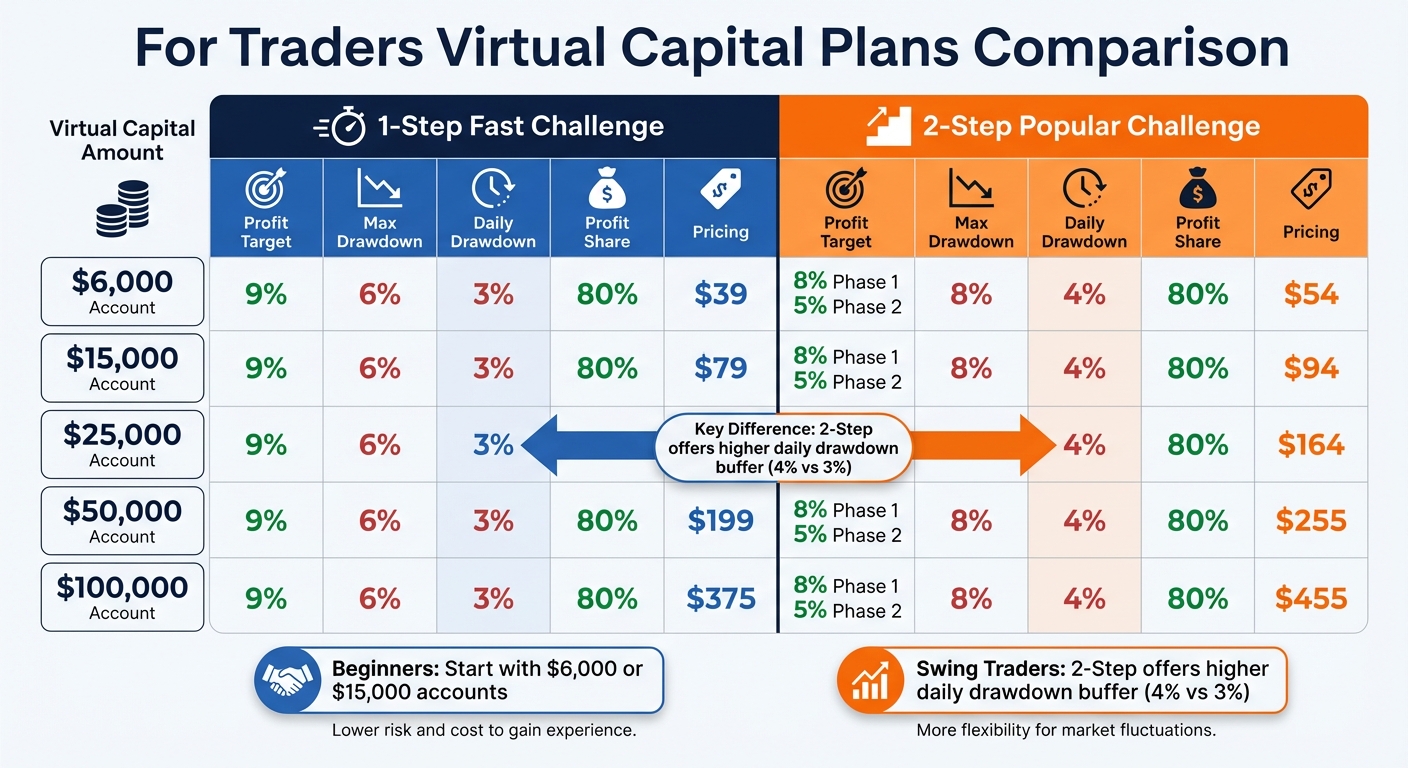
For Traders Demo Challenge Plans Comparison: Virtual Capital, Profit Targets, and Pricing
Managing risk is a cornerstone of success in For Traders demo challenges. These rules emphasize controlling drawdowns and calculating position sizes effectively.
Following Drawdown and Profit Target Rules
For Traders demo challenges set specific profit targets and drawdown limits to encourage disciplined trading. In the 1-Step (Fast) challenge, traders aim for a 9% profit target while adhering to a 6% maximum drawdown and a 3% daily limit. Meanwhile, the 2-Step (Popular) challenge requires an 8% profit target for Phase 1 and 5% for Phase 2, with an 8% maximum drawdown and a 4% daily limit.
Daily drawdowns reset at 00:00 CE(S)T and are calculated based on the higher of your balance or equity at that time. For swing traders holding overnight positions, unrealized profits increase the equity baseline. For example, if you have $2,000 in open profit at midnight, the next day’s drawdown limit will reflect this higher equity level, reducing your loss buffer.
Profit targets are based solely on closed trades. Even if you have a 10% unrealized gain, it won’t count toward your target until the trade is closed. Additionally, the 70% Consistency Rule ensures no single trade - or series of closely related trades - exceeds 70% of your total profit target.
These rules make careful position sizing a critical skill for success in demo challenges.
Calculating Position Sizing with Virtual Capital
Position sizing should be tied to your daily drawdown limit, not your total virtual capital. For instance, in a $100,000 2-Step challenge with a 4% daily drawdown limit, risking 10% of this cap means limiting a trade’s risk to $400.
To calculate position size using a lot size calculator, divide your maximum risk per trade by the per-share risk (entry price minus stop-loss). For example, if you enter a stock at $50 with a stop-loss at $48, the $2 per-share risk allows you to purchase up to 200 shares ($400 ÷ $2 = 200 shares). This approach keeps losses within your daily drawdown limit.
Swing traders should also account for leverage, which varies by asset class - for example, 1:125 for Forex, 1:20 for Indices, and 1:40 for Commodities. Incorporating leverage into position sizing helps manage equity fluctuations more effectively.
For Traders Virtual Capital Plans Comparison
Here’s a breakdown of key parameters for different virtual capital levels in For Traders challenges:
| Virtual Capital | Challenge Type | Profit Target | Max Drawdown | Daily Drawdown | Profit Share | Price (1-Step) | Price (2-Step) |
|---|---|---|---|---|---|---|---|
| $6,000 | 1-Step (Fast) | 9% | 6% | 3% | 80% | $39 | $54 |
| $15,000 | 1-Step (Fast) | 9% | 6% | 3% | 80% | $79 | $94 |
| $25,000 | 1-Step (Fast) | 9% | 6% | 3% | 80% | $143 | $164 |
| $50,000 | 1-Step (Fast) | 9% | 6% | 3% | 80% | $199 | $255 |
| $100,000 | 1-Step (Fast) | 9% | 6% | 3% | 80% | $375 | $455 |
| $6,000 | 2-Step (Popular) | 8% (Phase 1) / 5% (Phase 2) | 8% | 4% | 80% | - | $54 |
| $15,000 | 2-Step (Popular) | 8% (Phase 1) / 5% (Phase 2) | 8% | 4% | 80% | - | $94 |
| $25,000 | 2-Step (Popular) | 8% (Phase 1) / 5% (Phase 2) | 8% | 4% | 80% | - | $164 |
| $50,000 | 2-Step (Popular) | 8% (Phase 1) / 5% (Phase 2) | 8% | 4% | 80% | - | $255 |
| $100,000 | 2-Step (Popular) | 8% (Phase 1) / 5% (Phase 2) | 8% | 4% | 80% | - | $455 |
For beginners, starting with smaller accounts like $6,000 or $15,000 can simplify the learning process while providing a manageable level of risk. Swing traders, in particular, may find the 2-Step challenge appealing due to its slightly higher daily drawdown buffer (4% compared to 3%).
Practicing Swing Trading on For Traders Demo Platforms
Recording and Analyzing Trades
Keeping track of every trade is essential for turning practice into meaningful progress. Make sure to log details like entry and exit points, prices, reasons for entering the trade, profit or loss, percentage changes, and even your emotional state during the process. Note which technical indicators or chart patterns prompted your decision, assess whether you stuck to your trading plan, and reflect on what you could improve for next time.
For Traders makes this easier with its AI Coach, which reviews your trading activity and provides tailored tips for improvement. By analyzing metrics, you can spot trends like exiting trades too early or holding onto losses for too long, helping you fine-tune your strategy. This kind of disciplined recordkeeping is a cornerstone for building a better approach to swing trading.
Customizing Trading Rules for Your Strategy
To get the most out of your practice, adapt the demo platform's settings to align with your swing trading strategy. For Traders allows you to adjust demo parameters, offering challenge structures like 1-Step, 2-Step, or 3-Step, and virtual capital ranging from $6,000 to $100,000. For instance, the 2-Step challenge provides a 4% daily drawdown buffer, compared to the 1-Step's 3%, which is particularly helpful for swing traders managing overnight positions.
You can also choose between platforms like DXTrade, TradeLocker, or cTrader, depending on whether you need advanced charting tools, a user-friendly interface, or support for algorithmic trading. Set price or indicator alerts to avoid constant screen time while still staying on top of market movements. If your strategy involves holding positions for several days, confirm that your selected challenge includes the "Hold Over Weekend" feature, crucial for swing trading.
Using Community Support and Educational Resources
Practicing alone is important, but tapping into a community can take your skills to the next level. For Traders provides a range of learning tools to help you grow faster. The For Traders Academy offers resources like video courses, live streams, and interviews that cover key topics such as recognizing chart patterns and mastering risk management.
Their Discord community connects you with other traders working on similar strategies, giving you a space to ask questions, share ideas, and learn from others’ experiences. Additionally, the High Performance Coaching program focuses on trading psychology, helping you develop the mental discipline needed for consistent success.
Since 2023, For Traders has paid out over $9,000,000 to traders in more than 130 countries, proving that structured practice on demo accounts can translate into real-world results. By regularly engaging with these tools and resources, you can deepen your understanding of swing trading and better prepare for real-market challenges.
Conclusion
Using demo accounts for swing trading practice is a key step toward long-term success. Swing trading opportunities in live markets are relatively rare - sometimes just a few setups per month. This makes it challenging to gain enough experience quickly through live trading alone. Demo platforms, however, allow you to simulate various market conditions in a much shorter time frame, helping you build your skills faster and refine your trading strategy.
Executing at least 50 trades in a demo environment helps validate your strategy while sharpening essential skills like position sizing, stop-loss placement, and order execution. As Cory Mitchell, CMT from TradeThatSwing, explains:
"If you start using real capital out of the gate... chances are you will have lost your account by the time you are just starting to get the hang of it".
For Traders offers tools that make this practice both effective and realistic. With virtual capital options ranging from $6,000 to $100,000, customizable challenges, and features like the AI Coach for performance analysis, you can fine-tune your trading approach in a risk-free setting. The platform’s impact is clear - it has paid out over $9,000,000 to traders from more than 130 countries, showing that disciplined practice on demo accounts can lead to real-world success.
FAQs
When should I switch from demo to live swing trading?
When you're consistently hitting realistic profit targets in your demo account, have minimized mistakes, and feel mentally prepared to handle real money and risks, it might be time to transition to live swing trading. The key is to ensure you've fully mastered your trading strategy, developed solid risk management skills, and built the confidence and discipline needed to navigate the markets. Make sure your demo trading closely mimics the conditions of live trading to ease the shift and set yourself up for success.
What’s the best timeframe for swing trading charts?
The best charts for swing trading are often the 4-hour, daily, and weekly timeframes. These options are great for spotting trends, cutting through market noise, and fine-tuning your trade entries and exits. The right choice depends on your personal trading style and how much risk you're comfortable taking.
How do I avoid breaking daily drawdown rules with overnight trades?
To stay within daily drawdown limits, keep a close eye on your account's equity and balance at the start of each trading day. The daily drawdown is typically a set percentage of your starting balance (like 4%). If you hold trades overnight, make sure your equity doesn’t dip below this limit by adjusting your position sizes or closing trades when necessary. Consistent monitoring can help you avoid violations and maintain control over your account.
Related Blog Posts
Start Trading with For Traders
Join our platform to test your trading skills, trade virtual capital, and earn real profits. Access educational resources, advanced tools, and a supportive community to enhance your trading journey.
Start your Trading Challenge