

Most reset policies are simple at the top level: evaluation accounts may get a paid do-over, funded accounts usually do not, and the fine print decides whether a reset is even worth buying.
If I boil this down, here’s what matters most:
- What caused the failure: daily loss, max drawdown, inactivity, banned conduct, news-rule issues, or contract-limit breaches
- What the reset costs: often about $50 to $150 on a $100,000 evaluation, though some plans run much higher
- How many resets you get: many firms now cap resets at 2 to 3 per account
- When you must act: some firms give only a short request window, such as 48 hours
- What gets wiped: most resets restore the starting balance and loss limits, but erase profit progress and trading days
If you’re comparing firms, that last point is the one I’d watch most. A low fee can still be a bad deal if the reset clears all progress, has a tight deadline, or doesn’t apply to the rule you broke.
For Traders is a good example of why this topic gets messy. Its public rules show breach triggers like 3%–4% daily loss, 6% trailing drawdown or 10% static drawdown, plus inactivity rules of 30 days on Standard accounts and 7 days on Master accounts. But its public pages do not clearly show a separate reset fee or spell out what a reset restores.
What are Resets in Prop Trading? Challenge & Funded Example
Quick Comparison
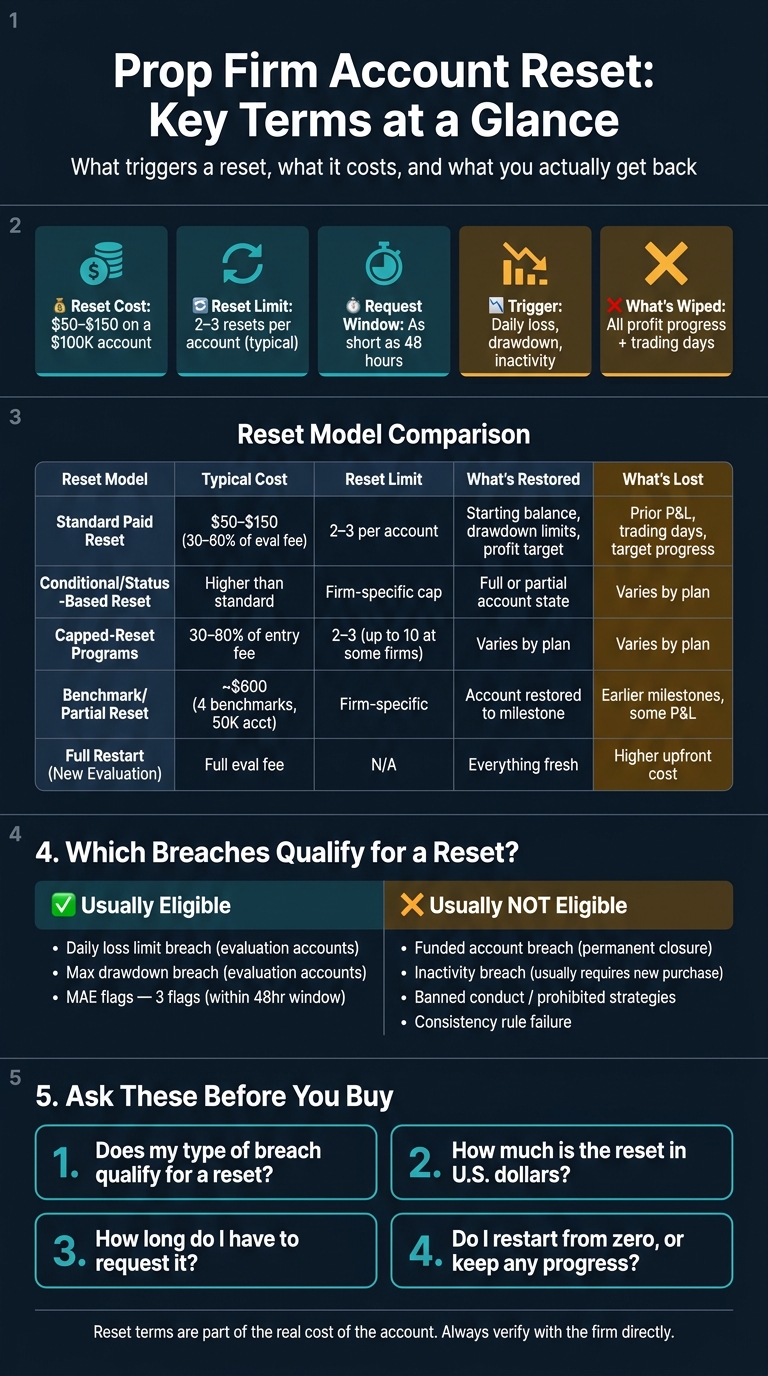
Prop Firm Reset Fees, Limits & Rules Compared
| Program/Model | Main Trigger Types | Typical Reset Cost | Reset Limit | What Usually Comes Back |
|---|---|---|---|---|
| For Traders | Daily loss, drawdown, inactivity | Not clearly listed in public pricing | Not clearly stated | Not clearly stated |
| Standard paid reset | Daily loss, trailing/max drawdown, some rule failures | $50–$150 on a $100,000 account | Often 2–3 per account | Starting balance, drawdown rules, original target |
| Conditional reset | Depends on account stage and status | Often higher than a standard reset | Firm-specific cap | Full or partial account state |
| Capped-reset programs | Drawdown, daily loss, news rules, consistency, some technical flags | About 30%–80% of entry fee | Often 2–3, sometimes more | Varies by plan |
| Short-window reset programs | Hard breach that disables the account | Varies by account | Limited by account rules | Usually a clean restart |
So if I were checking prop firm terms before buying, I’d ask four plain questions:
- Does my type of breach qualify?
- How much is the reset in U.S. dollars?
- How long do I have to request it?
- Do I restart from zero, or keep any progress?
That gives you the true cost of the account much more than the headline fee alone.
1. For Traders
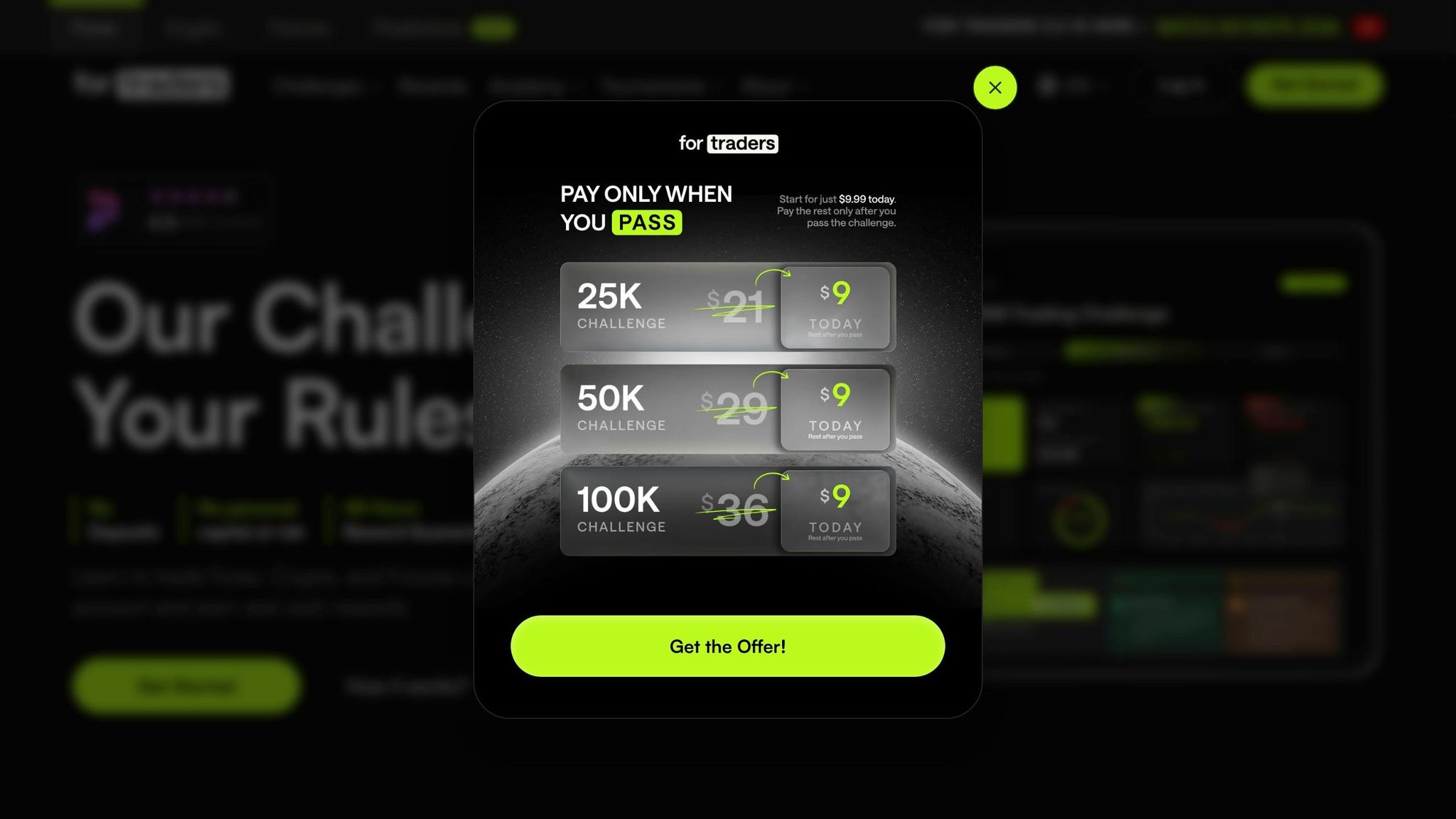
For Traders stands out here for one simple reason: its breach rules are clear, but its reset pricing isn't. The firm offers simulated evaluation accounts ranging from $6,000 to $100,000 in virtual capital.
Breach Triggers
The main breach triggers are pretty specific. They include a daily loss limit of 3%–4%, a trailing or static drawdown breach (6% trailing or 10% static, depending on the plan), and an inactivity breach.
The inactivity window also changes by account type:
- Standard accounts: 30 days
- Master accounts: 7 days
For U.S.-based traders, the daily cutoff needs extra attention because it follows a set time zone. Miss that cutoff, and you could run into problems even if your trade idea made sense on paper. These trigger rules matter more than the fee details at this stage because they decide when an account can even qualify for a reset.
Reset Fee
Public pricing does not show a separate reset fee. The $100,000 plan is listed at $413.
That leaves a key gap: it's still unclear how much of the account status a reset brings back.
Restore Scope
Public materials do not say what a reset restores.
2. One-Time Paid Reset After Evaluation Breach
In most programs, the standard fallback after a rule breach is a paid reset. That means you can restart the evaluation without paying the full challenge fee again.
Reset Fee
Reset fees usually land in the 30%–60% range of the original evaluation fee. On a $100,000 account, that often works out to about $50–$150.
Breach Trigger
A paid reset usually applies when you breach rules tied to:
- daily loss rules
- trailing drawdown
- max drawdown
- consistency rules
- time limits
That said, resets often don't apply to violations tied to banned conduct. This can include restricted strategies, misuse of account access, or news-loss breaches on accounts where news trading isn't allowed.
Reset Limit
Most firms put a cap on paid resets, usually 2–3 per account. A few go much further. For example, some select accounts allow up to 10 lifetime resets.
Restore Scope
A reset usually brings the account back to its starting point. In plain English, it restores the starting balance, resets drawdown limits, and brings back the original profit target.
It also clears out prior progress. That means completed trading days, failed-attempt P&L, and any progress made during the first run are wiped, and the evaluation starts over.
Some programs also layer on extra status rules, shorter request windows, or tighter caps on how many resets you can use.
3. Conditional Reset Tied to Account Status
Standard paid resets are only part of the picture. Some firms connect reset access to account status and evaluation stage.
That means not every breach gets treated the same way. In some programs, reset access depends on the account type you hold and where you are in the process.
Breach Trigger
Conditional resets kick in only after certain breaches, and only for accounts that qualify. Resets for funded accounts are rare. In many cases, the trader has to buy a new account instead.
A standard drawdown failure may still qualify for a reset. But if the issue involves prohibited conduct, the result can be permanent disqualification with no reset option at all. Some firms also give traders a free retry when they fail only because of a time limit and did not break a risk rule.
Reset Fee
Some conditional resets come with a higher fee. Why? Because they may keep part of the trader's progress in place or include added drawdown protection.
That difference also changes what the reset actually gives back.
Reset Limit
Conditional resets still come with limits. Once you hit the cap tied to that account, you usually need to purchase a new one.
Restore Scope
A standard reset usually brings the account back to the starting balance and the default drawdown settings. A partial-reset setup works differently. It restores only the progress tiers the firm allows.
That gap between full and partial resets is exactly why request windows and reset timing matter.
4. Programs That Cap the Number of Resets Per Account
Many firms now cap resets at 2–3 per account. In plain English, you don't get endless do-overs. For those new to these terms, our prop trading glossary covers the basics. Some firms add another check by limiting how many times the same account can be reset, not just how much the reset costs.
Reset Limit
These caps are usually tied to the account ID, not the trader. So if one account hits its limit, that's what matters. In some programs, the limit lands around 3–5 resets per account per quarter. PropShopTrader puts a hard ceiling on each Gladiator account at 10 lifetime resets.
Once a cap is in place, the next thing to check is what kind of breach actually counts toward it.
Breach Trigger
Capped resets are often triggered by violations tied to:
- daily loss
- low drawdown rules
- consistency
- news trading
These are the usual ones. Some firms also count technical failures. For example, three MAE flags can trigger a reset event at PropShopTrader.
Reset Fee
Reset fees often land between 30% and 80% of the original evaluation fee. Tradeify charges about $25 to $75, while PropShopTrader runs from $65 to $350, depending on the account.
That price gap matters. After enough resets, paying for another one can cost more than just starting over with a new evaluation.
Restore Scope
What the reset gives back can differ a lot by plan. PropShopTrader's Preserve Drawdown Balance Add-On can restart the account at a higher balance. On a $50,000 account, for example, the reset can begin at $52,500, which helps offset trailing drawdown.
5. Short-Window Reset Policies
Some programs put a time limit on reset requests. If you miss that window, the reset option disappears. So timing matters just as much as the breach itself.
Breach Trigger
These policies usually kick in after a rule breach that disables the account. Softer rule reviews usually don't start a timed reset window.
Reset Fee
At PropShopTrader, reset fees range from $65 for a Sprint Evaluation to $350 for a 50K Forge account.
Reset Limit
PropShopTrader sends failure emails at 6:00 p.m. EST, and the reset button becomes available only after that report goes out. From there, traders have 48 hours to submit the request. Miss the cutoff, and that reset chance is gone.
Restore Scope
These resets usually return the account to a clean starting point, with no past progress carried over. The next difference is whether a reset brings back the full account state or only part of it, which is a key factor when choosing the right prop firm.
6. Full Account Restart vs. Partial State Reset
Not every reset wipes the slate clean. Programs handle resets in different ways, and that changes the actual cost of starting over.
Restore Scope
A full restart takes the account back to day one. A partial reset brings it back only to an approved milestone.
A full account restart restores the starting balance, gives you fresh drawdown limits, and resets the profit target to its original level. Earlier P&L is wiped out, and completed trading days go back to zero.
A partial state reset, sometimes called a Benchmark Reset, restores the account to an earlier milestone - up to four benchmarks in some programs.
The fee usually matches how much of the account gets restored.
| Feature | Standard Reset | Partial/Benchmark Reset |
|---|---|---|
| Starting Balance | Restored to initial | Initial, or higher with add-on |
| Profit Target | Reset to original level | Preserved at milestone |
| Previous P&L | Wiped | Partly preserved |
| Trading Days | Reset to 0 | Usually reset to 0 |
| Typical Cost | ~$200 (50K account) | ~$600 (4 benchmarks, 50K account) |
In plain English, benchmark-style resets usually make more sense for a one-time technical issue or a bad trade around a news event, not for repeat discipline problems.
Next, compare which breach events trigger resets, how many each account allows, and how long traders have to request one.
Trigger Events, Reset Limits, and Request Windows Compared
This section breaks down which breaches can lead to a reset, when you can ask for one, and how many resets you get based on the account type. So the main point here isn't price. It's what triggered the issue and when the reset window starts.
Hard breaches, like a daily loss limit hit or max drawdown breach, usually end the account. On evaluation accounts, those failures may still qualify for a paid reset. Funded accounts, though, are usually shut down for good.
Timing matters too. A trader might qualify for a reset but still miss the window if the firm doesn't open requests right away.
Take PropShopTrader. It stops trading as soon as the breach happens, but the reset option doesn't show up until after the 6:00 p.m. EST end-of-day (EOD) report. After that, traders get 48 hours to send in the reset request. Other firms handle it differently and let traders request a reset as soon as the failure happens.
Some rule violations don't usually affect reset status at all. Consistency rules or risk-policy violations more often change whether an account passes or whether a payout counts, instead of deciding reset access.
As of mid-2026, reset caps have gotten tighter across the industry. Programs that used to allow unlimited resets now often limit traders to 2–3 resets per account, while PropShopTrader allows up to 10 resets over the life of a Gladiator account. In some cases, firms no longer offer paid resets at all and instead require traders to buy a new evaluation.
The same breach can lead to very different outcomes. It depends on the account stage, the request window, and the reset cap.
| Trigger Event | Immediate Result | Reset Eligible? | Typical Cap |
|---|---|---|---|
| Daily Loss Limit | Trading halt, account failure | Yes (evaluation only) | Often 2–3 per account |
| Max Drawdown | Trading halt, account failure | Yes (evaluation only) | Often 2–3 per account |
| Consistency Rule Failure | Profit exclusion, account stays open | No | N/A |
| Inactivity (30 days) | Account closure | Rarely; usually requires new purchase | N/A |
| Funded Account Breach | Permanent closure | No | N/A |
| MAE Flags (3 flags) | Account failure | Yes; within 48 hours of EOD report | 10 lifetime |
What a Reset Actually Restores: Trade-offs by Model
The fee matters, sure. But the bigger issue is what the reset gives back - and what it doesn’t.
A standard reset usually restores the starting balance and the drawdown rules. But it also wipes out your progress. That means prior profit, target progress, and completed trading days all go back to zero. That’s the part that separates one reset model from another.
This is also why a reset usually costs less than a new evaluation, while still sending you back to the beginning of the process. So yes, it can make sense after a one-off mistake or a news-driven loss. But let’s call it what it is: not a repair.
Some firms offer partial or conditional resets while the account is in drawdown. Those cases are uncommon, and the rules are usually tight. On the other hand, a full restart means you buy a brand-new evaluation.
What should guide the choice? The cause of the failure.
If the problem was technical, or tied to a single market event, a standard reset may fit. If the issue was behavioral or happened more than once, a full restart can make more sense because it doesn’t let the same pattern roll into the next attempt. This approach helps address the emotional pressures and harsh realities that often lead to repeated failures.
| Reset Model | What It Restores | What It Leaves Behind | When It Applies |
|---|---|---|---|
| Standard Paid Reset | Starting balance and drawdown buffer | Prior profit, target progress, completed trading days | Accounts that hit a limit due to a one-time mistake or news-driven loss |
| Full Restart (New Evaluation) | Full fresh start on all account parameters | Higher upfront cost | Accounts with repeated rule violations |
| Conditional/Free Retry | Available only under strict conditions | Only available when the account stays within rules | Traders who stayed within rules but missed the target or time limit |
In some cases, a discounted new evaluation can cost less than a reset. At that point, the key issue isn’t just price. It’s whether the reset terms make sense for the account type they apply to.
Conclusion
Across programs, the main difference isn’t just the fee. It’s the set of rules behind that fee.
Reset fees are simple to line up side by side. But the bigger factors are what kinds of breaches count, how many resets you’re allowed, how fast you need to ask for one, and what the reset actually puts back in place. A lot of programs now limit resets to 2–3 per account, which means repeat mistakes can push you into buying a new evaluation instead of getting another shot.
Before you buy, check the reset terms closely. Make sure you know which breaches qualify, whether the rule clock starts over, and whether trading-day or consistency rules restart too.
Reset terms are part of the real cost of the account.
FAQs
Which breaches usually qualify for a reset?
Common reset-eligible breaches include:
- Daily loss limit violations
- Exceeding maximum drawdown
- Hitting consistency caps
- Prohibited event exposure
- Execution errors, such as misconfigured trade copiers
A reset usually comes into play when a trader breaks standard risk rules and wants another shot under the same program terms. The catch is that eligibility depends on the firm. In many cases, resets don't apply to prohibited conduct or abusive account use.
What does a reset actually restore?
A reset puts your account back at its original starting point. It resets your balance and drawdown limits and sends the account back to the start of the evaluation, including the initial profit target and the same rule set.
It does not keep any previous progress. Completed trading days, generated P&L, and progress toward profit targets are removed, so you start from scratch.
When is a reset not worth paying for?
A reset often isn’t worth it if a new evaluation costs less during a sale. It can also be a bad move if you’ve hit the limit more than once.
If the breach came from a basic flaw in your trading plan, a reset may just set you up for another failure. And if your next billing cycle is close, waiting for the free scheduled reset may cost less.
Related Blog Posts
Start Trading with For Traders
Join our platform to test your trading skills, trade virtual capital, and earn real profits. Access educational resources, advanced tools, and a supportive community to enhance your trading journey.
Start your Trading Challenge