

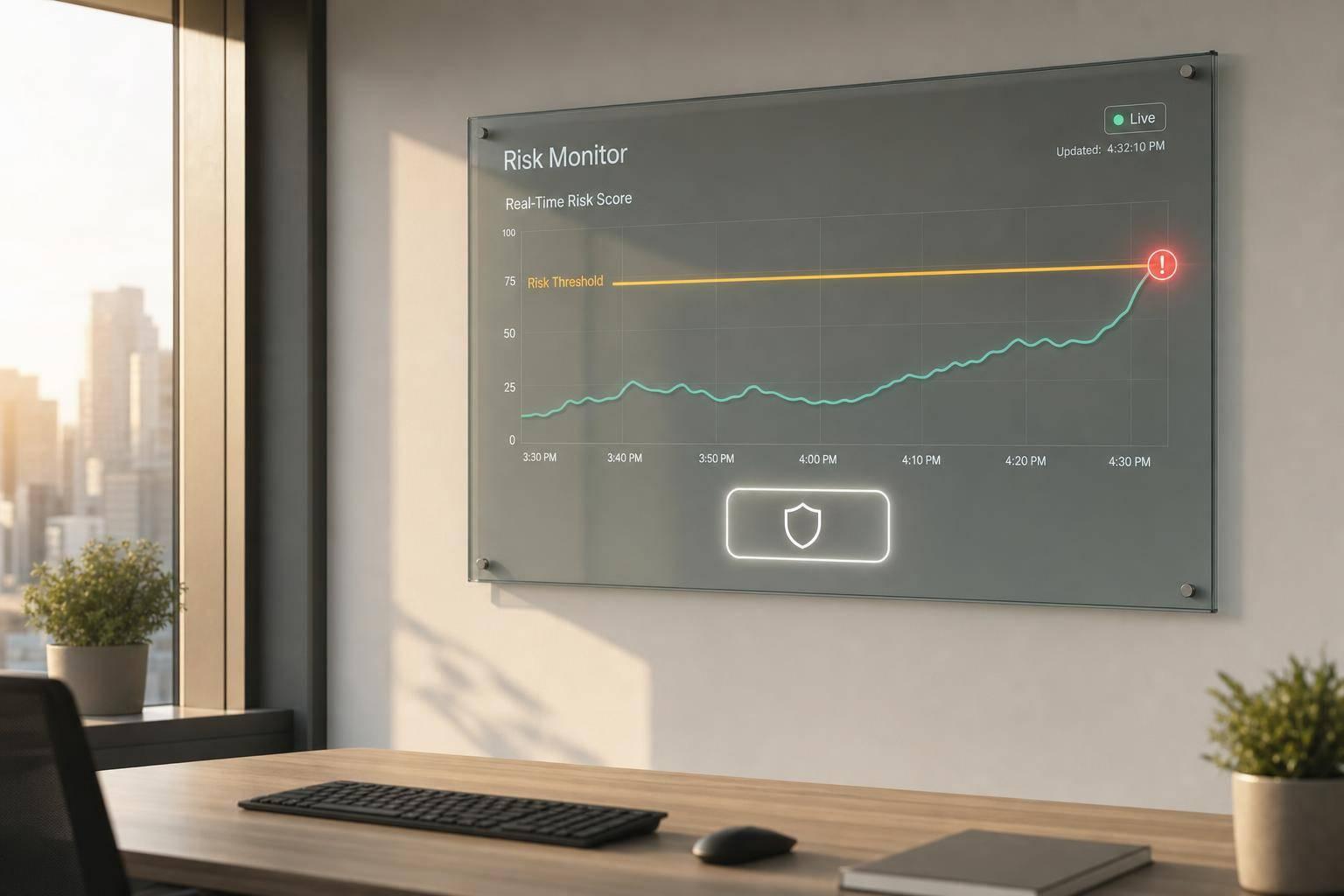
A risk alert system works only if it does three things at once: watches live data, checks fixed rules, and triggers a preset response in seconds.
If I had to boil this article down, I’d say this:
- Real-time alerts beat end-of-day reviews because they watch unrealized P&L, margin, orders, and exposure while trades are still open.
- Most systems follow the same flow: ingest live data, recalculate risk on each update, test thresholds, score the event, then notify or auto-act.
- Common alerts watch daily drawdown, max drawdown, margin use, concentration, VaR, system health, and behavior around news or rule breaks.
- Thresholds matter. A margin warning may hit near 70%, while hard action may start near 85%. Some funded-account tools also close trades at about -2% floating loss.
- Good alerts need a matching action. A warning without a plan is just noise: cut size, pause entries, trim exposure, or flatten positions.
- Static rules are simpler. AI-based alerts can spot patterns across markets, but they need more data and more setup.
- Tight limits fit rule-based evaluation accounts better. For example, if an account has a 5% max drawdown, strict alerts help stop rule breaks before they happen.
Here’s the core idea: I don’t need more alerts. I need the right alerts, tied to clear limits and one fixed response for each one.
| Area | What matters most |
|---|---|
| Data | Live prices, fills, equity, margin, order flow |
| Rules | Fixed limits or volatility-based triggers like ATR/Z-scores |
| Alert states | WARN, PAUSE, KILL, SAFE MODE |
| Delivery | Pop-up, audio, push, webhook; email is too slow for urgent use |
| Action | Reduce size, block entries, cancel orders, flatten positions |
| Review | Check alert logs weekly for repeat mistakes |
If you trade fast markets, that setup is the difference between a small loss and a rule breach that hits after the fact.
The Core Parts of a Real-Time Risk Alert System
A real-time alert system usually works in three steps: ingest data, test rules, trigger action. Each step has a clear job, and the order matters. First, the system takes in live data. Then it checks that data against risk rules. If something crosses a limit, it fires off an alert or takes action.
Live Data Inputs: Prices, Orders, Equity, and Margin
The system pulls in a nonstop stream of price ticks, open position data, order activity, unrealized P&L, account equity, and available margin.
Unrealized P&L matters most because losses can pile up before a trade is closed. Margin use also needs close tracking. Many systems send a warning when margin use gets near 70% and hit a hard stop near 85% before forced liquidation.
The system also watches order rate to catch runaway loops. And it checks positions against broker records to catch mismatches and orphaned orders.
Once those inputs are live, the system compares each update against its risk rules.
Risk Rules, Thresholds, and Severity Levels
Some rules stay fixed. Others shift with market volatility by using ATR or Z-scores. That helps cut false positives when the market gets extra choppy.
Many solid systems group these rules into a risk state machine. Each watched condition maps to a response state:
| State | Trigger Example | Action Taken |
|---|---|---|
| WARN | P&L down 40% of the daily loss limit | Alert trader, log event, optional 50% size reduction |
| PAUSE | Order rate 3x normal | Cancel open orders, block new entries, keep stops |
| KILL | Daily loss limit reached or heartbeat lost | Flatten all positions, cancel all orders, disable trading |
| SAFE MODE | Manual restart after review | Manual restart required after root-cause review |
That setup turns raw thresholds into clear actions. Instead of just saying something is wrong, the system knows what to do next.
Alert Delivery, Logging, and Automated Actions
Alerts can show up as pop-ups, audio signals, push alerts, or webhooks within seconds. Email is slower. Because of that, email works better for review and compliance than for immediate action.
Every alert should also be written to a log so there’s a permanent audit trail. Systems with automated enforcement can go a step further. They may block new orders at a hard threshold, cut position size at a warning level, or flatten all positions at a kill trigger.
The next step is the real-time sequence that turns a breach into an alert.
How Real-Time Risk Alerts Are Generated, Step by Step
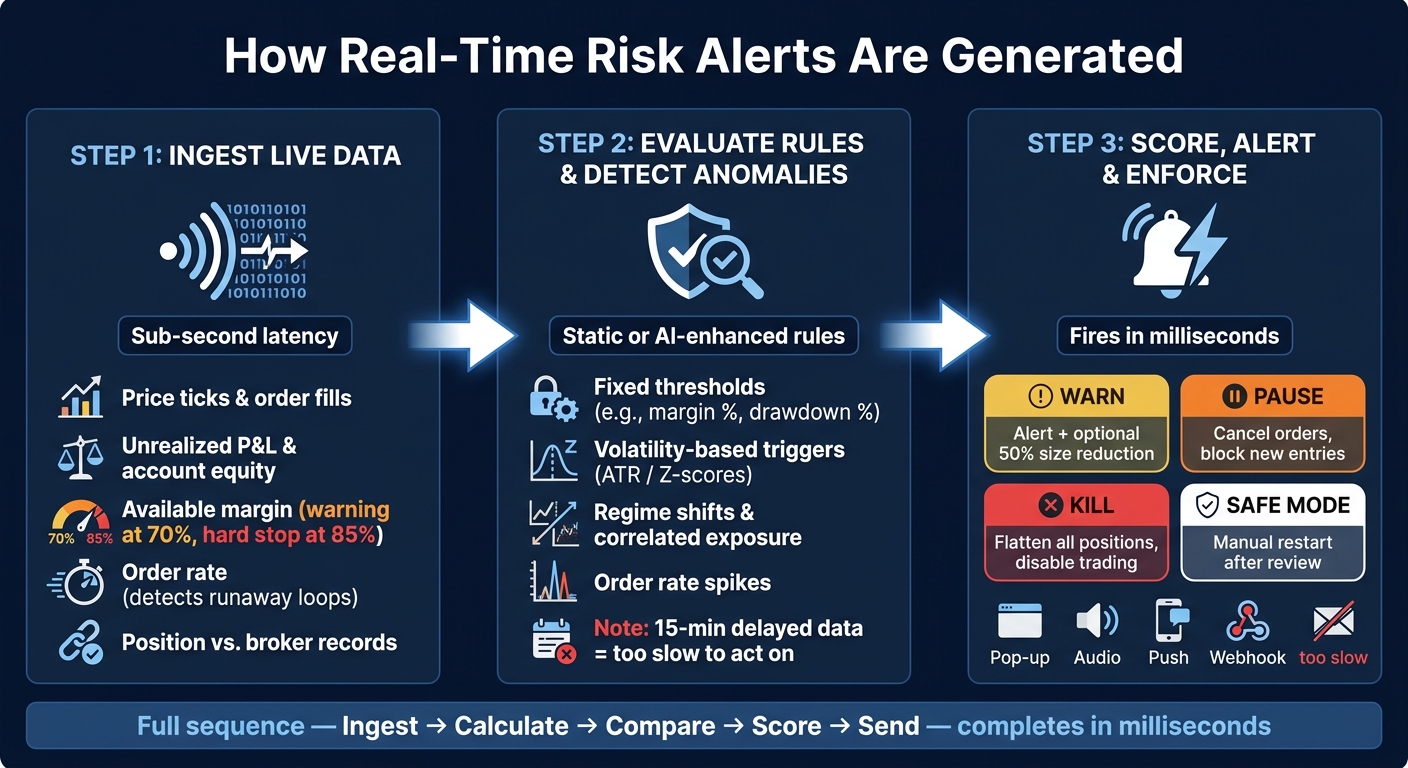
How Real-Time Risk Alerts Work: 3-Step Workflow
Here’s the alert workflow from data update to notification. It’s simple: update, evaluate, alert.
Step 1: The Risk Engine Recalculates Metrics on Every Update
Every price tick, order fill, or account change starts a new round of calculations. In plain English, the system keeps rechecking risk as new data comes in. Modern streaming risk engines can process these updates with sub-second latency.
On each update, the engine recalculates key risk metrics tied to prices, fills, equity, and margin. Risk is assessed as fills and account updates arrive.
That new set of metrics then moves straight into the next check.
Step 2: The System Checks Thresholds and Detects Unusual Patterns
The system compares updated metrics against preset thresholds and anomaly rules. For example, it may check whether margin use is creeping past a 70% warning threshold. Data only turns into a risk signal after it clears these threshold and anomaly checks.
More advanced systems don’t stop at fixed limits. They also watch for things like:
- regime shifts
- correlated exposure across symbols or accounts
- sudden spikes in order rate
These signals can flag higher risk before any hard limit is crossed. That matters in fast markets, where a delayed feed can be almost useless. Stale data, such as a 15-minute delayed feed, is too old to act on during a fast-moving market event.
If the breach checks out, the system moves to scoring and enforcement.
Step 3: The Alert Is Scored, Sent, and Possibly Enforced
The system assigns severity, sends the alert, and can trigger a preset action. Using the same states introduced earlier, a WARN triggers a notification and optional size reduction, a PAUSE cancels open orders and blocks new entries, and a KILL flattens all positions and disables trading.
For example, For Traders' automated Drawdown Protection feature closes all open trades the moment a trader's floating loss hits -2% of their starting balance. A second breach of that same threshold triggers automatic account closure.
In practice, the full sequence - ingest, calculate, compare, score, send - happens in milliseconds. Once an alert fires, traders need a preset response for each alert type.
How Traders Can Use Risk Alerts in Practice
Once an alert fires, what matters is the response.
Set Alert Rules That Match Your Trading Plan
After the system spots a breach, the next move is to line that alert up with your prop-firm-approved trading plan. Alerts only help when the thresholds fit how you trade. If they’re too tight, you get noise. If they’re too loose, losses have room to run.
Stick with the alerts that fit your setup: drawdown, concentration, VaR, and price triggers. In simulated evaluation accounts, set those thresholds to match the account rules.
It also helps to use more than one input. Combine price, volume, momentum, and news filters to cut down on false alarms. During volatile sessions, ATR or percentile-based triggers can do a better job than fixed levels.
Respond to Each Alert Type With a Predefined Action
An alert without a planned response is just a notification. The move needs to be decided before the alert fires, not in the heat of the moment.
Map each alert to one fixed action.
| Alert Type | Trigger Example | Predefined Response |
|---|---|---|
| Drawdown Warning | Floating loss approaches your limit | Reduce size or pause trading |
| Concentration Alert | A position grows beyond your target weight | Trim to target weighting |
| Volatility / VaR Spike | Correlated positions move sharply together | De-risk, hedge, or raise cash |
| News Window Alert | Before a high-impact release | No new entries until the window closes |
If a drawdown warning fires, cut size. If a concentration alert fires, rebalance. Simple rules help remove hesitation.
Use Alert History to Build Consistency Over Time
A weekly review can show repeat problems: drawdown breaches, overtrading after losses, and concentration drift. For Traders uses AI-driven risk monitoring to scan trading data 24/7 for repeating behavior patterns.
That review makes one thing clear: are your alerts too strict, too loose, or set at the right level?
Conclusion: Key Rules for Making Real-Time Risk Alerts Work
Once an alert fires, one last design choice matters: how tight the rule should be.
Real-time risk alerts only help when three parts work together: live streaming data, predefined thresholds, and a clear response plan.
From there, the big choice is simple: should the rule stay fixed, or should it react to patterns?
Static Alerts vs. AI-Enhanced Alerts
| Feature | Static Rule-Based Alerts | AI-Enhanced Alerts |
|---|---|---|
| What they monitor | Binary price levels or simple indicator crosses | Complex patterns, sentiment, and cross-asset correlations |
| How they trigger | When Price A crosses Level B | When a pattern matches a learned model or probability score |
| Best use cases | Entry/exit timing and hard stop-loss enforcement | Detecting regime shifts, unusual options flow, and hidden risks |
| Main limitations | Lack of context; high false-positive rates in volatile markets | Requires high-quality data; can be too heavy for solo traders |
Static alerts are straightforward. They watch for a price level, an indicator cross, or another hard condition. That makes them useful for entries, exits, and stop-loss rules.
AI-enhanced alerts do more. They look for patterns across sentiment, options activity, and linked markets. That can help spot regime shifts or risk that doesn't show up in a single chart. The trade-off is simple: they need strong data and can be too heavy for solo traders.
Strict vs. Moderate vs. Loose Thresholds
The right threshold has to match the account's risk limits. If it doesn't, the alert may fire too often, or worse, too late.
| Setting | Loss Control | Discipline | Stress | Suitability |
|---|---|---|---|---|
| Strict (e.g., 2–3% drawdown) | High - acts as a hard stop | Forces immediate discipline and rule compliance | High - little room for market noise | Beginners and evaluation challenge participants |
| Moderate (e.g., 5–10% drawdown) | Medium - allows for normal market fluctuations | Encourages balanced risk-taking within a mandate | Moderate - manageable for disciplined traders | Experienced discretionary traders |
| Loose (e.g., 15–20% drawdown) | Low - higher risk of significant capital erosion | May allow bad habits like averaging down to persist | Low at first, then high once losses compound | Long-term investors or high-volatility systematic strategies |
A strict setting, like a 2% to 3% drawdown alert, works like a hard line in the sand. It pushes immediate rule compliance, but it also leaves very little room for normal market noise. That's why it fits beginners and evaluation challenge participants so well.
A moderate setting, such as 5% to 10%, gives traders more breathing room. It supports balanced risk-taking while still keeping losses in check. For disciplined discretionary traders, this is often the middle ground that makes the most sense.
Loose thresholds, around 15% to 20%, can feel easier at first. But that comfort can be misleading. They allow more downside, increase the chance of capital erosion, and can let weak habits, like averaging down, stick around longer than they should.
For traders in a simulated evaluation account with a 5% max drawdown rule, strict thresholds match the mandate and help cut rule-breaking losses.
FAQs
How fast should risk alerts fire?
Risk alerts should fire right away when a breach or market-moving event is detected. In fast markets, even a 30-second delay can lead to big losses. That’s why professional systems aim for sub-10-second detection from source to dashboard.
For critical news, top systems can notify users within 1 second. But speed alone isn’t enough. Alerts also need to be tuned so they fire only when the information is actionable enough to change a trading decision.
Should I use fixed or volatility-based thresholds?
Prioritize volatility-based thresholds. Fixed cutoffs tend to fall apart when market conditions shift.
Metrics like volume z-scores, ATR-multiplied thresholds, and percentile-based triggers adjust to how an asset usually moves. That helps keep alerts relevant and useful, instead of tying them to arbitrary dollar amounts.
What should happen after a risk alert triggers?
What happens next depends on how serious the alert is and what caused it. A critical alert might call for immediate action while the market is still open, like cutting position sizes, hedging exposure, or moving part of the portfolio into cash.
In automated trading, the system may step in at once by closing positions, freezing the account, or blocking new orders. The point is simple: trigger a review or corrective move so you stay within your risk limits.
Related Blog Posts
Start Trading with For Traders
Join our platform to test your trading skills, trade virtual capital, and earn real profits. Access educational resources, advanced tools, and a supportive community to enhance your trading journey.
Start your Trading Challenge