


Scaling plans in simulated trading are structured frameworks designed to grow virtual trading capital as you demonstrate consistent profitability and manage risk effectively. These plans help traders progress by increasing account balances, position sizes, or total capital exposure based on performance milestones. Here's a quick breakdown:
- What is Scaling? It’s a system that rewards consistent performance with increased virtual capital and trading limits.
- Why it Matters: Without scaling, accounts remain static. Scaling fosters disciplined growth, focusing on steady returns rather than risky trades.
- How it Works: Platforms implement rules like realistic profit targets (e.g., 10% over 4 months) and risk compliance to trigger scaling events. Adjustments include higher account balances, increased loss limits, and improved profit-sharing terms.
- Key Features on For Traders:
- Standard accounts cap at $200,000, while Premium members can manage up to $300,000.
- Profit milestones and consistent payouts are required to scale up.
- Tools like AI coaching and calculators support traders in managing risk and optimizing performance.
Scaling plans are essential for traders aiming to grow their virtual accounts systematically while maintaining disciplined trading practices.
How Scaling Virtual Capital Works
What Gets Scaled in a Simulation?
When a scaling event occurs, it doesn’t just boost your account balance - it adjusts several related parameters. The most noticeable change is the increase in your virtual starting balance, typically by 25% of the original amount. Alongside this, the maximum daily loss and maximum total loss limits rise proportionally. For example, a $400,000 account with a $20,000 daily loss limit (5%) scales up to $500,000, raising the daily loss limit to $25,000. The percentage remains the same, but the dollar value increases.
Another perk of scaling is the potential improvement in your profit split. Some platforms reward traders by increasing their profit share from 80% to 90% once they meet specific scaling criteria. In essence, scaling offers more capital, higher loss limits, and better profit-sharing terms. But what exactly triggers these changes?
What Triggers a Scaling Event?
Scaling isn’t automatic, even if your account is profitable. Platforms usually have specific requirements involving time-based cycles and performance milestones that must be met before scaling is approved.
Here’s a typical scenario: traders must achieve a set net profit percentage within a defined period, maintain a positive account balance, and adhere to all risk rules. For example, some plans require 10% total net profit over a 4-month window and at least two successful payouts. Others may ask for 8% total profit across two consecutive profitable months.
Risk compliance is critical. Any violation of daily loss or total drawdown limits will likely disqualify an account from scaling, regardless of profits. Platforms also enforce consistency rules to ensure growth reflects skill rather than a single high-risk trade.
How Scaling Adjustments Are Calculated
The math behind scaling is fairly simple. Platforms usually add a fixed percentage of the original starting balance, not the current balance. For instance, if your starting balance is $400,000, each scaling event adds 25% of that original amount - $100,000 - regardless of your accumulated profits.
Here’s how this works over time, assuming a 4-month review cycle and a $400,000 starting balance:
| Elapsed Time | Simulated Balance | Max Daily Loss (5%) | Max Total Loss (10%) |
|---|---|---|---|
| 0 months | $400,000 | $20,000 | $40,000 |
| 4 months | $500,000 | $25,000 | $50,000 |
| 8 months | $600,000 | $30,000 | $60,000 |
| 12 months | $700,000 | $35,000 | $70,000 |
| 16 months | $800,000 | $40,000 | $80,000 |
This table assumes a 25% increase of the original $400,000 balance every 4 months.
Most platforms set a maximum scaled balance, often $2,000,000, although some may allow for higher limits. If your balance dips below the original starting amount due to losses, you’ll need to recover to the initial level before scaling can resume.
4 Step Plan To Scale Your Prop Trading (Safely)
Risk Management in Scaling Plans
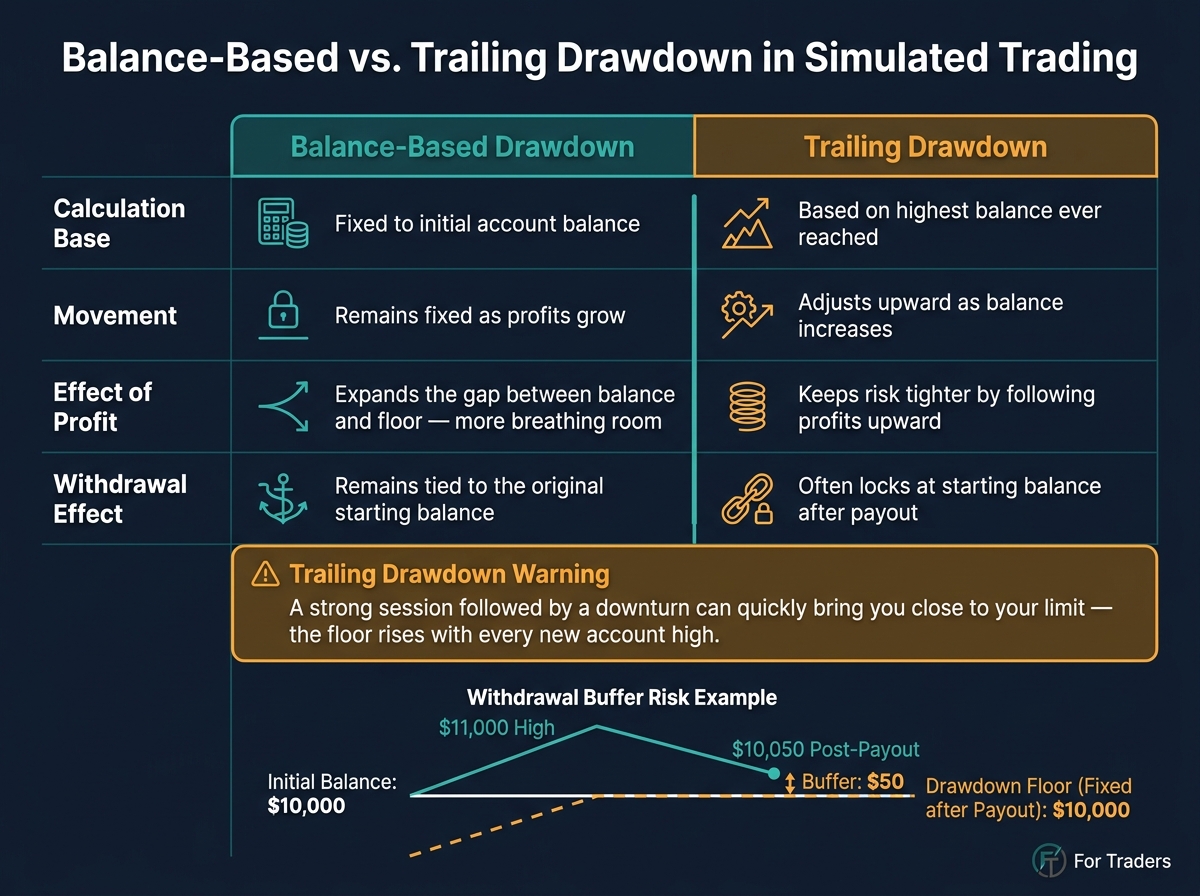
Balance-Based vs. Trailing Drawdown: Key Differences Explained
Risk Limits Tied to Scaling
As your virtual capital increases, risk management becomes even more critical. Adjusted risk limits ensure that as your account grows, your approach to managing risk evolves alongside it. On For Traders, the daily drawdown limit is set at 3–4% of the initial account balance. This limit is recalculated daily at 10:00 PM UTC, based on the higher value between the current balance or equity. During evaluation phases or once you reach a funded Master stage, leverage is reduced, and a 40% Margin Rule is applied. This rule restricts the use of available margin on any single trade, helping to prevent over-concentration.
Scaling Ladders and Tiered Risk Controls
Scaling is like climbing a ladder - each step introduces new risk controls. As your virtual capital increases, the platform adjusts risk measures to ensure larger positions are managed responsibly. Many platforms use tiered scaling, which gradually increases trading capacity only after consistent profitability is demonstrated. For instance, an account might start with limited trading parameters, unlocking more capacity once specific profit milestones are reached.
Here’s a comparison of two popular drawdown structures:
| Feature | Balance-Based Drawdown | Trailing Drawdown |
|---|---|---|
| Calculation Base | Initial account balance | Highest balance ever reached |
| Movement | Fixed as profits grow | Adjusts upward with balance increases |
| Effect of Profit | Expands the gap between balance and floor | Keeps risk tighter by following profits |
| Withdrawal Effect | Remains tied to the original balance | Often locks at the starting balance after payout |
Trailing drawdowns are generally stricter. As your account hits new highs, the floor rises, meaning a strong session followed by a downturn can quickly bring you closer to your limit.
How Withdrawals and Resets Affect Scaling
Withdrawals require strategic planning. On For Traders Instant Accounts, requesting a payout can lock the maximum trailing drawdown to the initial starting balance. For example, if you grow a $10,000 account to $11,000 and withdraw $950, your balance drops to $10,050, but the drawdown floor remains at $10,000. This leaves you with a very thin buffer.
To mitigate this, For Traders enforces a 3% payout buffer from the starting balance before withdrawals can be made. Only profits beyond this buffer are eligible for withdrawal, ensuring the account retains enough cushion to manage risk effectively.
Strict adherence to withdrawal and reset protocols is crucial for maintaining scaling progress. Breaching account rules, such as hitting a hard stop or exceeding the daily drawdown limit, results in disqualification and forces you to restart from the initial tier. Additionally, scaling eligibility requires ending each review period with a positive balance. Accounts in drawdown cannot advance to the next scaling tier.
Building a Personal Scaling Plan
To make the most of a platform's scaling framework, you need to tailor it to your specific financial goals and trading style.
Matching Personal Goals to Platform Rules
It's crucial to align your trading approach with the platform's rules, including limits like the 3–4% daily drawdown and the 40% Margin Rule. A good starting point is risking only 1–2% of your account equity per trade. This approach allows for compounding growth while minimizing the chance of breaching the daily drawdown limit due to a single bad trade. From there, calculate your maximum lot sizes to ensure you stay within the platform's risk parameters throughout your trading session.
Your choice of account type is equally important. For example, Classic accounts use a fixed drawdown based on your balance, while Instant accounts feature a trailing drawdown that adjusts as your balance grows. Deciding which account type best suits your risk tolerance is a key step before you can create a solid scaling plan.
Writing Your Scaling Plan
A well-structured scaling plan should include clear profit targets, risk limits, and time requirements. Three essential components to include are:
- Profit milestone: For instance, achieving a 10% net profit over four months.
- Drawdown gate: Staying below 50–60% of your available drawdown limit.
- Tenure requirement: Maintaining consistent profitability for 30–60 days before requesting a scale-up.
These guidelines prove to the platform that your performance is steady and reliable - qualities they look for before granting additional capital.
"A trader who makes 2–3% every month is a better scaling candidate than one who makes 10% one month and loses 5% the next." - PropJournal
Don’t forget to outline your exit strategy. A three-tier exit model can help smooth your equity curve and reduce emotional decision-making. For example:
- Take one-third of the position off at the first target.
- Close another third at a major resistance level.
- Leave the final third as a runner with a trailing stop.
This method helps you lock in profits along the way while still giving your trade room to grow.
Testing and Refining Your Scaling Rules
Before implementing your scaling plan, test it thoroughly. Compare fixed exit trades with scaled entries using the 50/50 method. Evaluate metrics like your equity curve, drawdown depth, and profit factor. If the results don’t show clear improvements in at least one area, tweak your rules before trading live.
When testing scaled entries, be careful not to exceed the 1–2% risk threshold for your account. Simulating these scenarios helps you build the discipline needed for consistent performance under real market conditions.
"The expected value of preserving the account far exceeds the potential gain from one aggressive trade." - PropJournal
Lastly, ensure your gains are spread out rather than concentrated in a few standout trades. Many platforms, such as For Traders, have rules that prevent progression if a single day accounts for too large a percentage of your total profit. A plan that produces balanced results is far more likely to pass compliance checks, even if the overall profit numbers look good. Once refined, these rules can seamlessly integrate into your broader trading strategy.
Using Scaling Plans on For Traders Simulated Accounts

For Traders' Virtual Capital Plans
For Traders offers a structured approach to scaling virtual capital through its tiered capital plans. Traders can choose from five starting capital levels: $6,000, $15,000, $25,000, $50,000, and $100,000, with one-time fees ranging from $42 to $469. Each account includes specific parameters: a profit target of 8–10% in Phase 1 and 5% in Phase 2, a daily drawdown limit of 3–4%, and a maximum drawdown of 6–10%.
Scaling happens through the Max Allocation system, which allows standard traders to manage up to $200,000 in total virtual capital across active Master Accounts. This allocation is divided into $100,000 in Instant accounts and $100,000 in Challenge-based accounts. Traders in the Premium Program can expand their total capital allocation to $300,000.
The Premium Program also introduces a tiered growth system based on trading performance:
| Premium Tier | Profitable Period | Payouts Required | Total Profit Target | Balance Increase |
|---|---|---|---|---|
| Bronze | 4 months | 4 payouts | 13% | +25% |
| Silver | 8 months | 6 payouts | 20% | +50% |
| Gold | 12 months | 8 payouts | 30% | +75% |
To progress through these tiers, traders must maintain consistent profitability, as no failed funded accounts are allowed at any level.
Setting Up Scaling Rules on For Traders
For Traders uses a step-by-step system for scaling. Success begins with passing a challenge to earn a Master Account. If a trader reaches their allocation limit and passes another challenge, the new Master Account is placed in reserve. It will activate automatically when space becomes available. This system ensures disciplined growth and helps traders manage their accounts effectively.
The platform includes a dashboard to track key metrics like profit progress, daily loss limits, and maximum drawdown in real time. One critical rule: every Master Account must execute at least one trade every 30 days (or every 7 days for Instant Master Accounts) to remain active. Failing to meet this requirement can result in account closure and forfeited allocation.
Tools and Resources on For Traders That Support Scaling
To support traders in scaling their accounts, For Traders provides a suite of tools and resources. The AI Coach reviews trading journals to identify patterns that could impact performance, offering insights that are especially helpful when aiming for higher Premium tiers. Other tools, like the Lot Size Calculator and Earnings Calculator, help traders adjust their position sizing to match changing risk parameters. These tools work alongside the For Traders Academy, which focuses on both trading psychology and technical strategies - key elements for managing multiple Master Accounts.
The platform also emphasizes community and mentorship. The Discord community and High Performance Coaching sessions allow traders to test their strategies with peers and coaches before making significant decisions. By combining technical tools with community support, For Traders helps traders maintain the consistency needed for long-term success.
As of May 2026, For Traders has paid out over $9,000,000 to more than 80,000 customers in 130+ countries. On average, traders earn approximately $4,043 in performance rewards on a $100,000 account.
Conclusion
Scaling plans are all about building trading discipline. The concept is simple: consistent, rule-based performance leads to growth in virtual capital. Whether it’s achieving profit targets, staying within drawdown limits, or maintaining profitability over several months, each milestone strengthens disciplined trading habits.
For example, consider a $100,000 account growing by 25% every four months - it could surpass $305,000 in just two years. This kind of growth doesn’t come from a single big win but from steady, disciplined execution, as highlighted earlier.
For Traders structures this journey through its Premium Program. Traders who reach the Gold Tier after 12 months gain access to a 75% balance boost, a $1,500 monthly salary, and up to $300,000 in virtual capital allocation. As the platform explains:
"At For Traders, we believe in rewarding consistency and professionalism. Our Premium program is designed specifically for traders who demonstrate unwavering commitment, strategic prowess, and consistent profitability."
This system emphasizes the long-term mindset needed for sustained success in simulated trading.
Think in terms of years, not weeks. Use payouts strategically - reinvest in new evaluations, stick to consistency rules, and treat every funded account as a valuable, protected asset. This disciplined approach aligns perfectly with the framework discussed throughout this article.
FAQs
Does scaling add to my original balance or my current balance?
When scaling, your current balance grows by 25% each time you qualify. This increase is always calculated using your original starting balance as the reference point.
What can stop me from getting a scale-up even if I’m profitable?
If your account doesn't meet the necessary performance criteria, you might not qualify for a scale-up. These criteria could involve reaching specific cumulative growth targets, completing mandatory payouts, or keeping a positive balance as outlined in the scaling plan guidelines.
How do payouts affect my drawdown and scaling progress?
When it comes to scaling your trading account, payouts can directly influence your progress. To remain compliant, you need to ensure your account balance stays above the Max Drawdown threshold.
Another factor to consider is that requesting a payout can lock your trailing drawdown at your initial account balance. While this secures your position, it can also limit the drawdown room available for future trades, potentially affecting your trading flexibility.
Related Blog Posts
Start Trading with For Traders
Join our platform to test your trading skills, trade virtual capital, and earn real profits. Access educational resources, advanced tools, and a supportive community to enhance your trading journey.
Start your Trading Challenge