

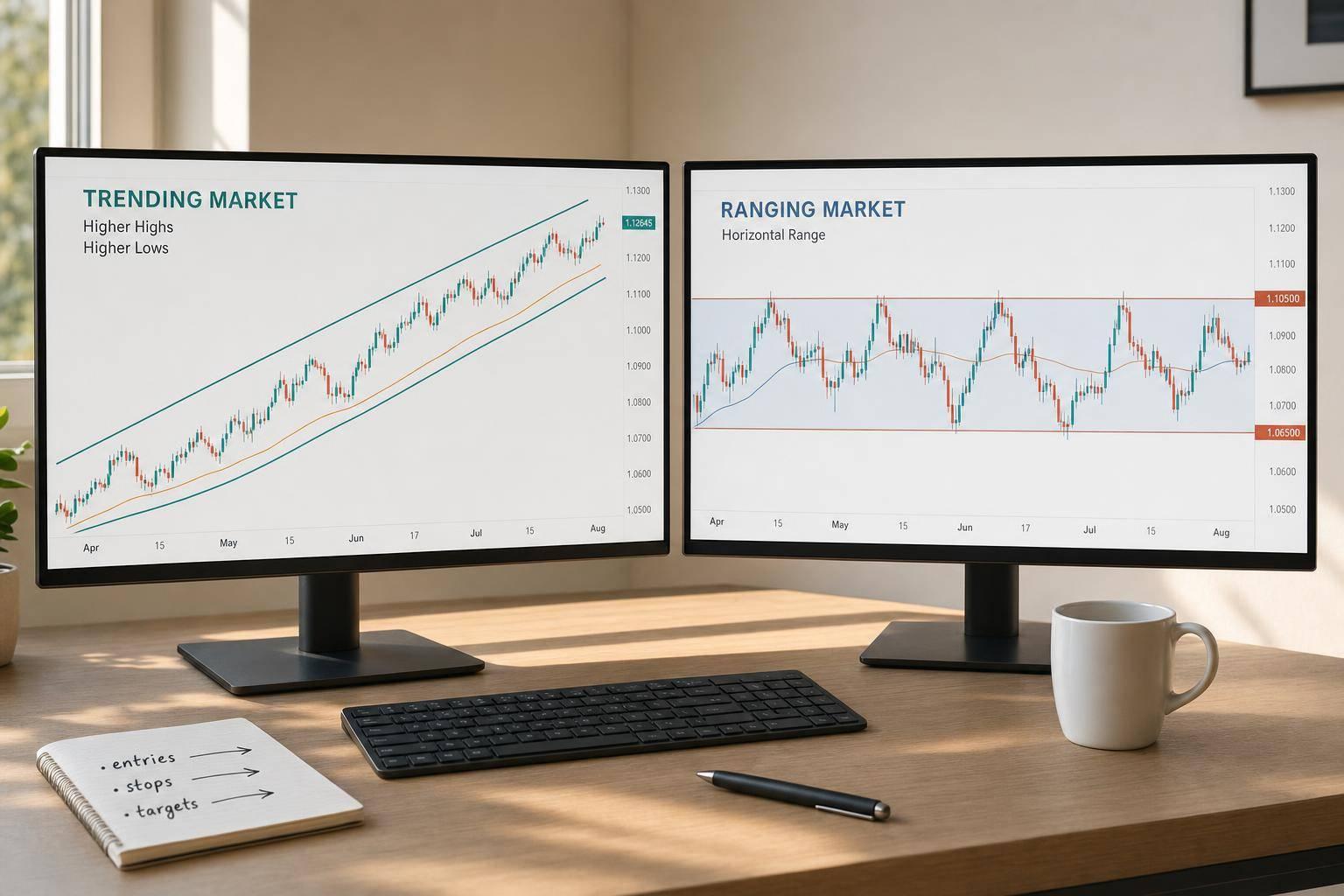
Most trading errors start with one mistake: using a trend setup in a range, or a range setup in a trend.
If I had to boil this down fast, it would be this:
- In a trend, I look for continuation
- In a range, I look for reversals
- In a trend, levels often break or flip
- In a range, levels often hold
- In a trend, I rely more on moving averages, ATR, and ADX
- In a range, I rely more on horizontal zones, RSI, and Stochastics
- In a trend, I often use trailing stops
- In a range, I usually use fixed targets
That one read changes almost everything: entry, stop, target, and position size.
A simple way I think about it:
- Higher highs and higher lows or lower highs and lower lows = trend
- Flat support and resistance with back-and-forth price action = range
- ADX above 25 can hint at trend strength
- ADX below 20 often points to a weak, sideways market
- Markets often spend more time ranging than trending, so knowing when a breakout is likely to fail matters just as much as knowing when one may run
Trend Trading vs Range Trading Explained for Beginners (The Skill New Traders Ignore)
Quick Comparison
| Criteria | Trending Market | Ranging Market |
|---|---|---|
| Price behavior | Moves in one direction | Moves sideways between boundaries |
| Market structure | HH/HL in uptrends, LH/LL in downtrends | Repeated swings between support and resistance |
| Key levels | Moving levels like trendlines and EMAs | Flat horizontal zones |
| Level behavior | Levels often break, retest, then flip | Levels often reject price and hold |
| Best entries | Pullbacks and breakout retests | Buys near support, sells near resistance |
| Indicators | ADX, moving averages, ATR | RSI, Stochastics, low ADX |
| Stop style | Beyond recent swing points | Just outside range edges |
| Target style | Let the move run with a trailing stop | Aim for the other side of the range |
Bottom line: I treat market regime as the first filter. If I get that part wrong, even a good setup can fail for the simple reason that it does not fit the market in front of me.
Market Types Overview
What a Trending Market Looks Like
A trending market moves in one clear direction. In an uptrend, price forms higher highs (HH) and higher lows (HL). Each rally breaks above the last peak, and each pullback stays above the last trough. A downtrend does the opposite: lower highs (LH) and lower lows (LL). Price bounces, but sellers step in before the prior peak, and each drop pushes lower.
That doesn’t mean price moves in a straight line. It rarely does. More often, price pulls back into an area - often near an earlier breakout level - and then resumes the move. In an uptrend, those pullback areas act as the support that matters.
Momentum often grows during a trend. A rising ATR, along with an ADX reading above 25, is a common sign that directional force is in play.
When that force starts to weaken, price will often tighten up and move into a range.
What a Ranging Market Looks Like
A ranging market moves sideways. Swing highs tend to form near the same resistance area, while swing lows keep showing up near the same support area. Price bounces between support and resistance without making clear progress up or down.
Here, the main pattern is momentum vs mean reversion. Price reaches one edge, stalls, and turns back toward the other side. Then it does it again. And again. That repeated back-and-forth is why the same horizontal levels keep getting touched.
Ranges often show up after a trend starts losing steam. A flat or choppy EMA, a low ADX below 20, and a contracting ATR all suggest range conditions.
That shift matters because it changes how support and resistance work in practice.
Why Identifying the Market Type Changes the Trade
In a range, resistance tends to reject price. In a trend, resistance will often break and then turn into support. That one difference changes the whole trade plan: entries, stops, and targets.
In a trend, stops usually go beyond the latest swing low or swing high, and the goal is continuation. In a range, stops usually sit just outside the boundary, and the target is the other side of the range.
Get that wrong and the damage adds up fast. It may look like a string of bad entries, but the real issue is a regime mismatch.
Support and Resistance in Trends vs Ranges
How to Draw Levels in Each Market Type
Once you know the regime, the next job is simple: mark the levels price is most likely to respect.
That process looks different in each market type. In trends, levels move with market structure. Think trendlines, moving averages like the 20 EMA, and channels that slope along with price. In ranges, support and resistance are more static. They show up as horizontal zones where price keeps stalling, reversing, or chopping around.
In a trend, keep updating levels as structure shifts. In a range, define the boundaries and focus on the revisits.
Breakouts, Pullbacks, Retests, and False Breaks
The same level can lead to a continuation trade in one regime and a trap in another. That's where traders often get caught, which is why it's vital to prepare for your first trading challenge by mastering these market dynamics.
In a strong trend, a breakout above a prior high often leads to continuation. The part that matters most is the retest. Price breaks the level, pulls back, holds that area, and then moves higher again. That's the classic flip: old resistance becomes new support.
Ranges behave differently. Breakouts often fail. Price may poke above resistance or dip below support, only to snap right back inside the range. Those fakeouts can trap breakout traders, which is why breakout setups tend to be less dependable in a range. It helps to confirm breakouts with:
- A strong close
- Higher volume
- Rising ADX
Use pullbacks when trading trend continuation. In ranges, focus on swings from one boundary to the other.
Indicator Use and Trade Management by Market Type
RSI and Stochastics tend to work better in ranges. In trends, they can stay overbought or oversold for longer than many traders expect without reversing.
Trade management follows the same idea. In a trend, the goal is to stay with the move. That usually means using a trailing stop and adding on pullbacks into key levels. In a range, the play is tighter and more direct. Take profits faster, often at the opposite side of the range.
| Management Rule | Trending Market | Ranging Market |
|---|---|---|
| Levels | Dynamic: trendlines, channels, moving averages | Horizontal support/resistance zones |
| Entries | Buy pullbacks and breakouts with a clean retest | Buy support and sell resistance; avoid breakout chasing |
| Indicator Use | ADX, moving averages, ATR | RSI, Stochastics at range extremes |
| Targets | Trailing stop; let it run | Fixed target at the opposite boundary |
Those differences shape whether a level holds, breaks, or flips.
Key Differences to Know
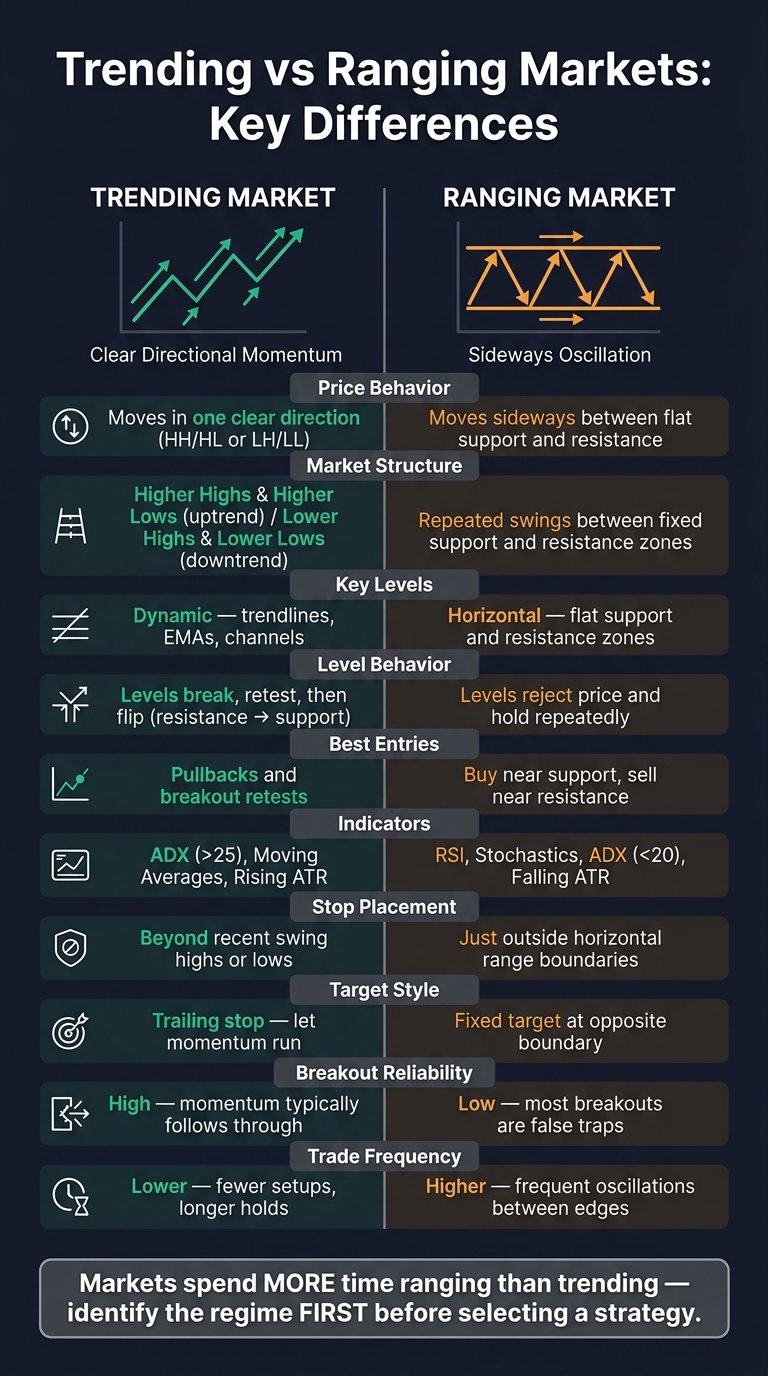
Trending vs Ranging Markets: Side-by-Side Comparison
Trending vs Ranging Markets: Comparison Table
The big issue isn't only what price is doing. It's how that changes the next level you trade.
A support level in a trend doesn't behave the same way it does inside a range. Same label, different job. This quick table shows how support and resistance tend to work in each regime.
| Feature | Trending Market | Ranging Market |
|---|---|---|
| Support/Resistance Structure | Dynamic - trendlines, moving averages, stepped HH/HL or LH/LL | Horizontal - fixed upper and lower boundaries |
| Breakout Reliability | High; momentum typically follows through | Low; most breakouts are traps that snap back |
| Preferred Indicators | ADX (>25), moving averages, rising ATR | RSI, Stochastics, ADX (<20), falling ATR |
| Stop Placement | Beyond recent swing highs or lows | Just outside the horizontal range boundaries |
| Target Style | Open-ended; trailing stop to ride momentum | Fixed; target the opposite boundary |
| Trade Frequency | Lower - fewer setups, longer holding time | Higher - frequent oscillations between edges |
| Risk Profile | Momentum-driven; buying strength and riding continuation | Mean-reverting; buying low and selling high |
Ranges take up more of the market's time. Clean trends show up less often.
How Markets Shift Between Trends and Ranges
Once you've identified the active regime, the next job is spotting when it's starting to break down.
The most common shift is a range turning into a trend. Volatility tightens, then price closes beyond a boundary with volume and momentum. That's your cue to redraw the map. You can practice these transitions using the best trading challenges to refine your execution without risking capital. Former resistance becomes the new support zone to watch on a retest.
The move in the other direction usually takes longer. A trend that starts slipping into a range often shows deteriorating swing structure - maybe a new high barely gets above the last one, or a higher low gets undercut. That kind of action tells you the trend is losing shape. At that point, diagonal trendlines stop being as useful. Mark horizontal clusters where price keeps stalling instead.
When the regime changes, update your levels to match the new structure instead of trying to force the old framework to still work.
Use this rule: treat the current regime as active until price structure clearly confirms a shift.
Applying This in a Structured Trading Plan
Top-Down Level Mapping for Better Trade Selection
Once you know the regime, you can decide which levels are worth your time. Start with the higher timeframe, figure out the active market state, and then mark the levels that matter on your execution chart.
Open the Daily or 4-hour chart first and ask a simple question: is price making higher highs and higher lows, lower highs and lower lows, or just moving back and forth between flat levels? That answer sets the tone for the whole trade.
Then drop to your execution chart. In a trend, focus on pullbacks into dynamic support, like a rising EMA or a higher low forming in the right area. In a range, trade the edges. Buy near support, aim for resistance, and stay away from midpoint trades. The edge usually gives you a better risk/reward setup.
This top-down process also helps you avoid a classic trap: treating a short-term move like a true market shift. A neat uptrend on a 15-minute chart might be nothing more than a bounce inside a bigger daily range. Checking the higher timeframe first keeps your trade plan in sync with the broader market state. It should also shape how much risk you put on.
Risk Rules for Simulated Evaluation Accounts
Market type should directly affect position size and trade expectations. A regime mismatch is a structural problem. A mean-reversion system will often break down in a trend. When the regime is off, the level is off, and the risk is off too. In a clear trend, setups that line up with that direction may deserve size near your normal max. In choppy or unclear conditions, cut size or skip the trade. Regime mismatch can burn through drawdown fast.
In simulated evaluation, that point matters even more. The same setup should not carry the same risk in every market condition. For Traders gives you room to practice separate rule sets for trending and ranging markets with virtual capital accounts and a 5% max drawdown rule. That repetition helps build the habit of reading the regime before picking a strategy. The aim is simple: match the risk, the setup, and the regime before you enter.
Conclusion: Core Takeaways
Trends are about continuation and dynamic levels. Your job is to find pullbacks and stay with momentum. Ranges are about mean reversion and flat boundaries. Your job is to buy low, sell high, and take profit before price leaves the edge.
Support and resistance only help when they match the market regime. You can draw a level the right way and still lose if the context is wrong. Identify the market type first, map levels that fit it, and let that structure guide each trading decision.
FAQs
How can I confirm a real breakout?
Look for:
- a strong close that pushes well past support or resistance
- higher volume
- a rising ADX, which shows the trend has strength
- a clean retest of the broken level, where it holds as new support or resistance
What if the market shifts mid-trade?
If the market shifts in the middle of a trade, stop for a moment and reassess the setup. When the market changes its character, your strategy often needs to change too. That pause can help you avoid heavy losses.
This matters most when a trend starts moving sideways, or when a quiet range breaks and turns into a trend.
Which timeframe should define the market type?
Define the market type with the timeframe that shows the clearest big-picture structure, such as the daily or 4-hour chart.
Then confirm that read with indicators like the ADX or Hurst exponent, and check that it lines up across more than one timeframe.
Related Blog Posts
Start Trading with For Traders
Join our platform to test your trading skills, trade virtual capital, and earn real profits. Access educational resources, advanced tools, and a supportive community to enhance your trading journey.
Start your Trading Challenge