Best Trade Journals and Analytics Tools in 2026
Compare top trade journals and analytics tools for 2026 — AI insights, broker auto-sync, backtesting, risk metrics, and integrations to sharpen trading performance.
Trading success in 2025 depends on using the right tools to track performance and refine strategies. Trade journals and analytics platforms help traders document decisions, analyze data, and stick to their plans. The top tools offer features like AI-driven insights, real-time monitoring, and advanced backtesting. Here's a quick overview of the best options:
- For Traders: Tools funded traders use like AI-powered journaling, broker syncing, and risk management tools.
- Edgewonk: Deep data analysis with AI tools like Edge Finder and mistake tracking.
- Tradervue: Automatic trade imports, performance analysis, and tagging for setups.
- NinjaTrader: Built-in performance tracking, advanced charting, and free core features.
- TradeLocker: Integration-focused platform with AI tools and automated journaling.
- TradingView: Powerful charting, strategy testing, and a global trading community.
- Tradovate: Auto-sync with analytics tools, real-time data, and futures-focused features.
Each tool caters to specific needs, such as advanced analytics, risk management, or integration with brokers. Whether you're a beginner or an experienced trader, these platforms can streamline your trading process and improve decision-making. Below, we dive deeper into what makes each tool stand out.
Edgewonk vs Tradervue vs Notion | Which Trading Journal is Best in 2025?
Why Traders Need Trade Journals and Analytics Tools
Trading without a journal is like trying to navigate uncharted waters without a compass. Analytics tools take the guesswork out of trading by providing data-driven insights into what's working in your portfolio and what isn’t. Instead of relying on hope, these tools let you see the hard numbers behind every decision, giving you the confidence to know whether your strategies are effective.
One of the standout features of these tools is their ability to reveal patterns you might otherwise miss. For example, calendar views highlight performance streaks or tough trading days, while "Seasonals" features can uncover recurring trends that happen annually. You can even break down your profit and loss by strategy, asset type, or specific days of the week to figure out which approaches are actually delivering results. Some platforms go even further, ranking thousands of symbols in real time using over 180 indicators, giving you a clear view of potential opportunities.
But it’s not just about spotting trends - it’s also about staying disciplined. Analytics tools make it easier to quantify the cost of straying from your trading plan. For example, journals can calculate exactly how much money you’ve lost on trades where you broke your own rules, putting emotional decisions into stark focus on your dashboard. Features like custom checklists and "Strategy Checkers" help ensure you’re sticking to your rules before executing trades. Tools like TraderSync’s AI analyst can even pinpoint losses caused by undisciplined trades, such as identifying $12,340 in losses from plan deviations.
"Journaling allows you to take ownership of your progress as a trader. It promotes consistency and stability which develops the confidence you need to trade the market without fear." Ed Martin, Founder, averagejoetrader.com
Risk management also becomes sharper with these tools. They allow traders to dive deep into metrics like risk-adjusted returns, win/loss ratios, and even "what-if" scenarios for options spreads. Advanced analytics, such as Maximum Favorable Excursion (MFE) and Maximum Adverse Excursion (MAE), can help you determine whether you’re cutting your winners too soon or holding onto losing trades for too long. Automated trackers for metrics like profit and loss, win rates, and risk limits can send real-time alerts, helping you avoid costly mistakes like overtrading.
What to Look for in Trade Journals and Analytics Tools
The best trade journals sync automatically with brokers, reducing manual entry errors and saving you time. They can handle complex data like multi-leg options, commissions, and precise execution times, ensuring complete accuracy. This automation also opens the door for broader integration with other platforms.
When choosing a journal, make sure it integrates smoothly with your broker. For example, TraderSync supports over 700 brokers, while Tradervue connects with more than 80.
Look for tools that provide advanced metrics such as Profit Factor, Win Rate, Expectancy, Sharpe Ratio, Maximum Favorable Excursion (MFE), and Maximum Adverse Excursion (MAE). For instance, TradesViz offers over 600 detailed statistics, while TradeZella delivers 50+ comprehensive reports. These metrics are essential for spotting data-driven trends and maintaining discipline throughout your trading journey.
Customizable dashboards are another feature to prioritize. Tools with drag-and-drop widgets let you focus on the performance indicators that matter most. Integrated psychological tracking - like trade notes, checklists, and mistake tagging - helps you understand the reasoning behind your decisions. This level of customization often pairs well with advanced risk management tools.
Speaking of risk management, look for features like Monte Carlo simulations, position sizing tools, drawdown analysis, AI-powered daily summaries, and backtesting with historical data.
"TradesViz is the most useful trading journal on the market for finding and quantifying your edge." Steve Burns, Founder, NewTraderU.com
Finally, ensure the journal supports your broker’s API or CSV format. For frequent traders, API-based auto-sync is the ideal choice for seamless data management.
1. For Traders
For Traders combines simulated trading challenges with detailed journaling and analytics to help users track their performance in both demo and live markets.
Trade Journaling and Performance Analytics
The platform simplifies trade logging by syncing directly with brokers or importing data via CSV files, making manual entry a thing of the past [21, 16, 18, 22]. Its intuitive dashboards provide a clear view of key metrics like daily profit and loss, winning and losing streaks, turning points, and other essential stats - all updated in real-time [21, 16, 22]. This comprehensive analytics system lays the groundwork for effective risk management.
Risk Management and Behavioral Tracking
For Traders takes its analytics a step further with a powerful risk management suite. Tools like the Risk Simulator, which uses Monte Carlo simulations and drawdown analysis, help traders assess portfolio risks. The AI Trade Chat feature identifies risky patterns, such as over-leveraged positions or trades influenced by emotions [16, 12]. Additionally, a second-level simulator offers over 15 customizable parameters, allowing traders to test strategies thoroughly before committing real funds. To support skill-building, the platform provides access to 12+ video courses, e-books, and an active Discord community, creating an all-in-one solution for fostering disciplined trading habits and managing risk effectively.
2. Edgewonk
Edgewonk stands out as an analytics-focused journaling platform, designed to uncover trading performance patterns through deep data analysis. Since its launch in 2015, it has processed over 5,000,000 trades, offering traders powerful insights with its AI-driven tools, like the Edge Finder, which significantly reduces the need for manual analysis.
Trade Journaling and Performance Analytics
At the heart of Edgewonk is the Edge Finder, an AI-powered tool that uses proprietary algorithms to identify high-impact trading behaviors. The platform simplifies the process by automating trade imports from over 200 brokers, analyzing up to 1,000 trades in just 12 seconds. Traders can monitor key metrics such as equity growth, performance by trade setup, holding times, and advanced statistics like the Sharpe and Sortino ratios. Additional features like the Profit Calendar and hourly performance charts help pinpoint underperforming times of day, offering actionable insights.
Integration with Trading Platforms and Workflows
Edgewonk integrates seamlessly with major trading platforms, including MetaTrader 4/5, NinjaTrader, TradeStation, and Interactive Brokers. For MetaTrader users, the platform offers continuous automatic synchronization, further simplifying the journaling process. It also supports proprietary trading firm workflows, allowing users to import evaluation results from proprietary trading firms like FTMO and Topstep X. With cloud-based access, traders can review their journals from anywhere, ensuring flexibility and convenience. These integrations provide a solid base for improving risk management and gaining deeper behavioral insights.
Risk Management and Behavioral Tracking
Edgewonk takes risk management and behavioral tracking to the next level with tools like the Tiltmeter, which monitors emotional patterns and alerts traders to moments of lost discipline. The Mistake Tracking feature flags specific errors - such as "revenge trading" or "exiting too early" - and calculates the exact dollar cost of these mistakes, turning abstract concepts into measurable data. The Exit Analysis tool uses MAE (Maximum Adverse Excursion) and MFE (Maximum Favorable Excursion) reports to show how close trades came to stop losses or targets, enabling traders to refine their risk-reward strategies. Additionally, the Alternative Strategy feature allows users to test different stop-loss or take-profit scenarios, helping them determine whether a "set-and-forget" approach might outperform active management.
"Edgewonk puts a number on it. It shows you exactly how much your rule breaking costs compared to how you perform when you stick to your plan. By making the difference crystal clear, Edgewonk turns discipline from an abstract idea into a measurable edge."
For $169 per year, Edgewonk offers access to all its features, along with a 14-day money-back guarantee.
3. Tradervue
Tradervue has become a go-to platform for professional traders looking to simplify their trade journaling process. Used by over 207,623 traders worldwide, it eliminates the need for manual data entry by automatically importing trades from more than 80 brokers. Once imported, the platform generates price charts that clearly mark entry and exit points, saving traders valuable time. Tradervue supports a range of markets, including stocks, options, futures, and forex, making it a versatile choice for traders across different specialties. Its advanced analytics tools then transform this data into actionable insights.
Trade Journaling and Performance Analytics
Tradervue doesn’t just store your trade data - it turns it into meaningful insights. Traders can analyze performance across various timeframes, from weekly trends to minute-by-minute breakdowns, helping them fine-tune their execution strategies. One standout feature, the Exit Performance tool, evaluates whether traders are exiting positions too early or holding onto losses longer than they should. By comparing actual exits to the best possible exit points, traders can identify patterns in their decision-making. Additionally, the platform’s tagging system lets users label trades with terms like "breakout" or "support." This makes it easy to run reports and identify which setups are driving the best results.
Integration with Trading Platforms and Workflows
Tradervue’s seamless integration with brokers and trading platforms ensures that traders spend less time on data entry and more time analyzing their performance. Key metrics like Maximum Favorable Excursion (MFE) and Maximum Adverse Excursion (MAE) are automatically calculated for each trade, providing insights into how close positions came to hitting stop losses or profit targets. For intraday equity traders, liquidity reports break down whether trades added or removed liquidity - an essential factor for understanding fee structures and execution quality. If the built-in reports don’t meet all your needs, you can export data to Excel or Google Sheets for further analysis.
Risk Management and Behavioral Tracking
Tradervue also shines in its approach to risk management. By using R-multiples, the platform helps traders evaluate performance based on risk-adjusted returns rather than just dollar gains or losses. This approach provides a clearer picture of how well traders are managing risk across different position sizes. Another helpful feature is the ability to attach notes to trades, allowing traders to document their emotions and thought processes. Over time, this can reveal psychological patterns that might be affecting performance. The platform even offers hourly performance stats, which can help traders identify specific times when behavioral issues, like overtrading during low-volume periods, tend to occur.
"SMB traders rely on Tradervue for journaling and performance analysis" - Mike Bellafiore, SMB Capital
Tradervue offers a range of pricing options to cater to different needs. The free plan allows for basic journaling of up to 100 trades per month. For more advanced features like exit performance analysis and liquidity reports, the Silver plan costs $29 per month, while the Gold plan is available for $49 per month.
4. NinjaTrader
NinjaTrader is a robust trading platform that combines professional-grade charting with built-in performance tracking. Unlike many standalone journaling tools, NinjaTrader integrates features like Trade Performance and Executions tabs, which provide insights into win rates, profit factors, and trade summaries - all within the platform itself. While it specializes in futures trading, including micros and minis, it also supports stocks and forex instruments. The best part? The core platform is entirely free, offering advanced charting, backtesting tools, and an unlimited trade simulator with real-time market data. This makes it an attractive option for traders who want powerful tools without a hefty price tag.
Real-Time Data and Charting Capabilities
NinjaTrader is packed with institutional-grade tools for market analysis, featuring over 100 built-in technical indicators and fully customizable charts. The Market Analyzer acts as a real-time quote board, allowing traders to track multiple instruments and sort by custom technical criteria - like using Stochastics to pinpoint overbought or oversold markets. For futures traders, the SuperDOM (Depth of Market) offers a clear view of order book depth, enabling precise order execution. Additionally, the Market Replay feature allows users to replay historical data tick-by-tick at adjustable speeds, synchronized across the platform. These features not only enhance market analysis but also integrate seamlessly with NinjaTrader’s broader ecosystem, boosting its trade journaling capabilities.
Integration with Trading Platforms and Workflows
The platform supports an ecosystem of over 1,000 third-party apps and add-ons, enabling real-time trade syncing, customization through NinjaScript, and cross-device data synchronization. Traders can connect with tools like TurtleMetrics, TraderSync, and TradesViz to sync trades in real time - often within seconds of closing a position. For example, TradesViz can generate over 600 statistics and charts using NinjaTrader data. Developers can leverage the NinjaScript framework (built on C#) for low-level access to balances, positions, and order flow, allowing for highly tailored workflows. The platform also ensures that layouts and data stay synchronized across desktop, web, and mobile devices, enabling traders to manage their positions and orders from anywhere.
Risk Management and Behavioral Tracking
By integrating with third-party journaling tools, NinjaTrader offers deeper insights into trading behavior. Tools like TradesViz provide advanced metrics, such as Maximum Favorable Excursion (MFE) and Maximum Adverse Excursion (MAE), along with features like setup tagging and mistake tracking. These metrics help traders maintain discipline and refine their strategies. The Advanced Trade Management (ATM) feature further supports disciplined trading by automatically placing stop-loss and profit-target orders upon entry, reducing the influence of emotions. With tick-level accuracy, traders can analyze execution quality against market depth. Additionally, those managing funded accounts can consolidate multiple proprietary firm accounts into one analytics layer for comprehensive tracking.
"NinjaTrader's award-winning trading platform is consistently voted an industry leader by the trading community. Featuring 1000s of Apps & Add-Ons for unlimited customization, NinjaTrader is used by over 500,000 traders for advanced market analysis, professional charting and fast order execution." - NinjaTrader
The platform’s free core features make it accessible to beginners, while optional integrations like TurtleMetrics ($19/month) and TradesViz ($19-$29/month) cater to traders seeking advanced analytics. Futures commissions start as low as $0.09 per Micro contract, with intraday margins beginning at just $50.
Ready to trade funded capital?
Choose your path — Instant Accounts, One-Step or Two-Step Challenges — from just $23, with up to $300,000 in funded capital.
Choose your challenge5. TradeLocker
TradeLocker is a modern trading platform designed to streamline integration with other tools rather than relying on built-in journaling features. By connecting directly with TradingView for advanced charting and offering 100% auto-sync capabilities with platforms like TradesViz and TradeBB, it reduces journaling time by up to 40%. This connectivity creates a foundation for more detailed performance analysis.
Integration with Trading Platforms and Workflows
TradeLocker acts as a central hub for trading across Forex, crypto, stocks, metals, and indices. Its TradeLocker Studio feature includes an AI model that helps traders convert manual strategies into automated bots, even if they lack coding skills. Additionally, the platform fosters collaboration through a Discord community where traders can exchange strategies in real-time, creating a more connected experience. These integrations enhance its ability to provide meaningful analytics.
Trade Journaling and Performance Analytics
TradeLocker offers access to over 600 statistics and AI-driven insights, going far beyond simple profit and loss tracking. Users can perform "what-if" scenario analyses and backtest strategies using real trade data, helping them refine stop-loss and take-profit levels. The platform also tracks key metrics like profit factor, win rate, expectancy, and R-multiples, enabling traders to pinpoint strategies that yield consistent results. Notably, TradesViz, which integrates with TradeLocker, was a finalist in the Benzinga FinTech Awards for "Best Data Analysis Tool".
Risk Management and Behavioral Tracking
Beyond analytics, TradeLocker enhances risk management and helps users monitor their trading behavior. TradeLocker Studio promotes "emotion-free trading" by automating strategies, reducing the impact of impulsive decisions during market fluctuations.
"Automated trading eliminates emotional bias, ensuring a disciplined approach aligned with long-term goals."
The platform allows traders to configure margin sizes during backtesting to evaluate risk exposure across different leverage levels. It also offers manual control, letting users close automated trades when needed. When paired with external tools like TraderSync or TradesViz, traders gain deeper behavioral insights, helping them stay aligned with their trading plans and uncover patterns in their decision-making.
6. TradingView
TradingView is a favorite among traders, boasting a user base of over 100 million worldwide. While its reputation is built on powerful charting tools, it also offers features for journaling and performance tracking. Its Portfolios tool acts as a central hub for analyzing stocks, crypto, forex, and indices, providing advanced metrics like Beta, Sharpe ratio, and Sortino ratio to evaluate strategies against market benchmarks. Let’s dive into the charting, integration, and analytics tools that make TradingView a go-to platform for active traders.
Real-Time Data and Charting Tools
TradingView gives users access to an impressive 3,539,722 instruments through global data feeds, covering markets worldwide. With over 12 chart types - like Renko, Kagi, and Heikin Ashi - it’s designed to cut through market noise and highlight trends. Users can tap into more than 400 built-in indicators or explore 100,000 community scripts for a tailored analysis experience. For those on the Ultimate plan, the platform supports up to 16 synchronized charts per screen, making it easy to perform multi-timeframe analysis across various assets.
Seamless Integration with Brokers and Tools
TradingView connects with over 100 verified brokers, allowing traders to execute orders directly from their charts. The Paper Trading feature simulates broker functionality, letting users test strategies with virtual funds and even set custom account balances. For reviewing past market conditions, the Bar Replay tool offers adjustable playback speeds, enabling traders to revisit and analyze historical data before making real-world decisions. Plus, all workflows are fully synchronized across web, desktop, tablet, and mobile devices, ensuring a consistent experience.
Journaling and Performance Tracking
The platform’s Strategy Tester allows users to backtest trading ideas using historical data and provides detailed performance reports adjusted for risk. For options traders, the Options Strategy Builder models P&L profiles, Greeks, and "what-if" scenarios for more complex positions. Additionally, the "Portfolio tips" section offers suggestions to improve tracking accuracy.
"Tired of hand-writing your trades? To free up your time, we've designed Portfolios - your analytical hub to evaluate your strategy".
TradingView also supports automated alerts through Pine Script, enabling notifications via email, app, or webhook when specific conditions are met. These tools help traders fine-tune their strategies, stay disciplined, and streamline their workflows, aligning with the principles of effective trading.
7. Tradovate
Tradovate is a cloud-based platform designed specifically for active futures traders, offering automated journaling and real-time performance tracking. One of its standout features is the 100% Auto Sync, which eliminates the need for manual data entry by seamlessly connecting with third-party analytics tools like TradesViz. This setup provides a solid framework for advanced analytics and instant data delivery.
Trade Journaling and Performance Analytics
With automated integration, Tradovate tracks over 600 metrics, including MFE/MAE (Maximum Favorable/Adverse Excursion), slippage, and session-based volatility patterns. It allows traders to consolidate data from multiple futures accounts and prop firm evaluations, such as Apex, into one comprehensive analytics layer. This automation replaces the tedious process of maintaining spreadsheets with real-time, structured risk assessments.
One particularly useful feature is the detailed order replay, which lets traders reconstruct the context of order flow to refine their exit strategies with precision. Scalpers, in particular, benefit from second-by-second data that highlights microstructure and rapid volatility shifts. Additionally, the platform benchmarks actual trade exits against theoretical "best exits", helping traders reduce the risk of late reversals. These analytics are complemented by advanced charting tools that support informed decision-making.
Real-Time Data and Charting Capabilities
Tradovate delivers live market data through its Tick Stream module, which displays every trade and its corresponding volume. It also offers a variety of charting options, such as Heiken Ashi, Renko, Point and Figure, and TPO Profile charts. The Performance Center provides real-time account statistics and on-demand strategy testing using the proprietary Market Replay tool, which can operate at speeds of up to 4x. Additionally, traders can execute orders directly from the charts, with support for up to 10 target and stop levels on server-side bracket orders.
For those with smaller accounts, Tradovate offers day trading margins starting as low as $50 for Micro Futures, making it accessible to a wide range of traders.
Integration with Trading Platforms and Workflows
Tradovate’s cloud-based design ensures that custom dashboards, charts, and preferences are synced across all devices. The platform integrates with Jigsaw, enabling traders to manage orders, balances, and positions seamlessly within that interface. Server-side bracket orders (OCO/OSO) remain active even during local device disconnections, safeguarding exit strategies against technical issues. For traders handling multiple accounts, the Group Trade feature allows simultaneous order placement across unlimited defined groups with a single action.
Comparison Table
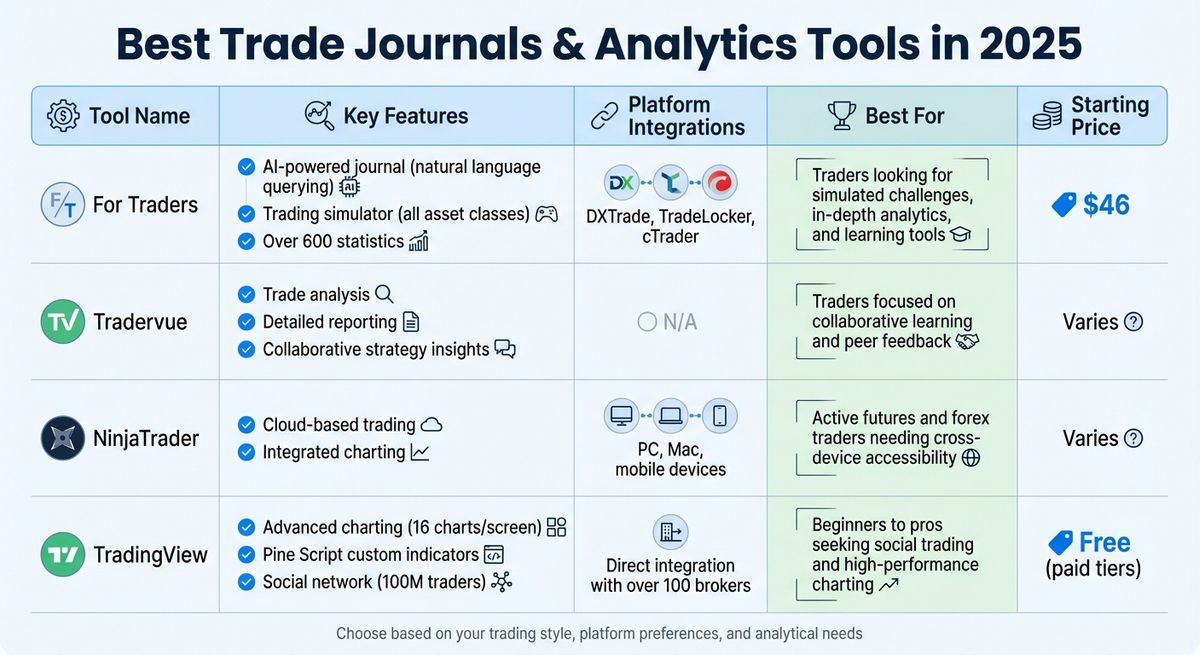
Choose the right trade journal and analytics tool based on your trading style, platform preferences, and analytical needs. Here’s a quick comparison to help you decide which tool suits you best:
Each tool has its strengths: TradingView shines with its social network and broker integrations, NinjaTrader is ideal for futures and forex across devices, Tradervue emphasizes collaboration and analysis, and For Traders stands out with its AI-powered journaling and educational challenges.
Conclusion
Trade journals and analytics tools are reshaping how traders approach the markets by promoting data-driven strategies and minimizing emotional decision-making. With modern platforms automating trade syncing - cutting manual entry time by over 40% - and offering decades of historical data for backtesting, traders now have access to resources that were once unimaginable. Whether it's analyzing multi-timeframe trends to filter out false signals or using Monte Carlo simulations to prepare for worst-case scenarios, these tools provide the competitive edge needed in today’s fast-paced markets.
Each platform we reviewed addresses specific trading needs. TradingView connects you with a massive community of 100 million traders. NinjaTrader excels in offering cross-device access for active futures and forex traders. For Traders, on the other hand, leverages AI-powered analytics and over 600 performance metrics to give you unparalleled insights into your trading.
If you're unsure where to start, consider testing free trials or basic plans to see how each platform fits into your workflow. Simulated environments with free demo accounts are invaluable for practicing strategies without risking real money. Once you're confident, transition to live trading with a well-validated approach. As Max Madaz, Founder of madazmoney.com, aptly puts it:
"Attempting to trade without any form of journaling or data tracking is like trying to navigate the world without a map".
Select a platform suited to your preferred asset class, make it a part of your daily routine, and consistently review your performance. The difference between traders who struggle and those who succeed often boils down to this: tracking, analyzing, and adapting based on real, actionable data.
FAQs
What features should I prioritize when choosing a trade journal and analytics tool?
When selecting a trade journal and analytics tool, focus on features that simplify your tasks and deliver clear, actionable data. Tools with automated trade imports can save you valuable time and minimize the risk of manual errors. Additionally, customizable dashboards allow you to tailor the tool to fit your specific trading strategies and preferences.
Depth in analytics is a must. The best tools dig into metrics like profit and loss, win rate, risk-reward ratios, and trade duration. Features like interactive charts and visualization tools make it easier to identify patterns and fine-tune your strategies. Some tools even offer simulation options, such as trading replays, which let you practice and refine your skills without taking on real-world risks.
In short, the ideal tool brings together automation, flexibility, and in-depth analytics to help you trade more effectively and confidently.
How can AI-driven insights help traders improve their performance?
AI tools are transforming the way traders operate by processing massive amounts of data with speed and precision. These advanced systems can detect patterns and opportunities that might slip through the cracks during manual analysis. They assist traders by offering actionable insights - like pinpointing the best entry and exit points, predicting possible outcomes, and identifying market trends. The result? Faster, smarter decision-making.
On top of that, AI-powered analytics provide in-depth performance reports and tailored recommendations. By evaluating trading strategies, they reveal both strengths and areas for improvement. This helps traders fine-tune their methods, leading to better risk management, smarter strategy adjustments, and, ultimately, improved results in the market.
Why is integrating your broker with a trade journal important?
Broker integration plays a key role in trade journals by simplifying how trades are recorded. Instead of manually entering every detail, the system pulls data directly from your brokerage account. This not only saves time but also minimizes the risk of mistakes.
Having precise, up-to-date trade information allows traders to dive deeper into their performance, assess strategies, and make smarter decisions. It also keeps trading records consistent and complete, offering a clear and trustworthy overview of your activity - an essential foundation for analyzing results and maintaining discipline.
By streamlining data management and improving accuracy, broker integration turns trade journals into an even more effective tool for sharpening strategies and working toward long-term success in trading.
Ready to trade funded capital?
Choose your path — Instant Accounts, One-Step or Two-Step Challenges — from just $23, with up to $300,000 in funded capital.
Choose your challengeTrade up to $300,000
Choose challenge